

Enrolling at the counter
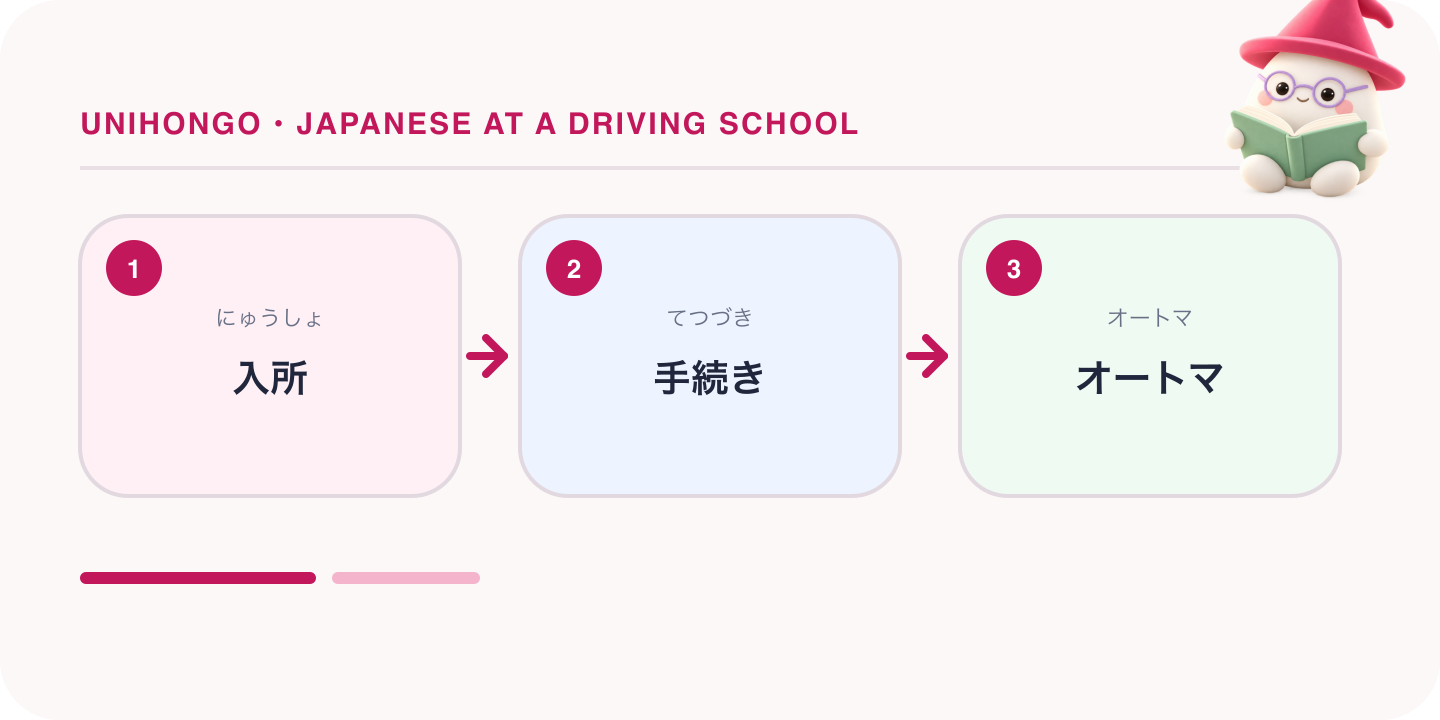
Enrolment is called nyūsho, entering the school, and it happens at the reception counter. You will be asked which licence you want, futsū jidōsha for an ordinary car, and whether you want a manual, manyuaru or MT, or an automatic-only licence, ōtoma gentei or AT. The automatic-only course has fewer practical hours and is the common choice today. You fill in an application, nyūsho mōshikomisho, show proof of your address, usually a residence card, have a photo taken and take a short eyesight test, shiryoku kensa, on the spot.
The staff will explain the plan, puran, you are buying: a standard course, a course with guaranteed lesson slots, or a residential gasshuku. Payment terms, cancellation charges and the deadline for finishing, which is fixed by regulation from your first lesson, all vary, so ask for the written schedule and keep it.
| Japanese | Romaji | Meaning |
|---|---|---|
| 入所の手続きをしたいんですが。 | Nyūsho no tetsuzuki o shitai n desu ga. | I'd like to enrol. |
| オートマ限定でお願いします。 | Ōtoma gentei de onegai shimasu. | The automatic-only licence, please. |
| 英語の教材はありますか。 | Eigo no kyōzai wa arimasu ka. | Do you have English materials? |
| 卒業までどのくらいかかりますか。 | Sotsugyō made dono kurai kakarimasu ka. | How long does it take to graduate? |
| 平日の夜も教習を受けられますか。 | Heijitsu no yoru mo kyōshū o ukeraremasu ka. | Can I take lessons on weekday evenings? |
| 在留カードで登録できますか。 | Zairyū kādo de tōroku dekimasu ka. | Can I register with a residence card? |
The two stages and the tests in outline
Training is divided into two stages, dankai. Dai-ichi dankai, stage one, mixes classroom lessons, gakka kyōshū, with practical lessons, gijutsu kyōshū, on the school's own course, a miniature road network with a slope, an S-bend, a crank and a railway crossing. It ends with a driving check, the shūryō kentei, and a written test for the provisional licence, the karimen gakka shiken. Pass both and you hold a karimen, a provisional licence, which lets you drive on public roads with an instructor.
Dai-ni dankai, stage two, moves the practical lessons onto real roads, rojō kyōshū, and adds first aid, an expressway lesson and often a simulator. It ends with the graduation test, sotsugyō kentei, on public roads. Graduating gives you a certificate, sotsugyō shōmeisho, which exempts you from the practical test at the licence centre; there you sit only the written honmen gakka shiken and receive the licence. The details of the on-road phrases and of exchanging a foreign licence are covered in their own guides, so this post stays with life inside the school.
| Japanese | Romaji | Meaning |
|---|---|---|
| 今、第一段階ですか。 | Ima, dai-ichi dankai desu ka. | Am I in stage one now? |
| 修了検定はいつ受けられますか。 | Shūryō kentei wa itsu ukeraremasu ka. | When can I take the stage-one driving check? |
| 仮免の学科試験は何問ですか。 | Karimen no gakka shiken wa nanmon desu ka. | How many questions are on the provisional written test? |
| 路上教習は何時間ありますか。 | Rojō kyōshū wa nanjikan arimasu ka. | How many hours of on-road lessons are there? |
| 卒業検定に落ちたらどうなりますか。 | Sotsugyō kentei ni ochitara dō narimasu ka. | What happens if I fail the graduation test? |
Classroom lessons and the textbook
Classroom lessons, gakka, are numbered, and you must attend each one once, in any order, until the sheet is complete. You sit in a classroom, kyōshitsu, with the textbook, kyōhon, open, and the instructor lectures for a set time while a video plays clips of hazards. Attendance is stamped or scanned, and arriving after the start usually means you cannot enter. Practice tests, mogi shiken, are true-or-false questions about rules and signs.
The written tests are famous for tricky wording, so learners read the textbook's key phrases slowly: kanarazu, always; shite wa ikenai, must not; shinakereba naranai, must. Sign names, hyōshiki, and road markings, hyōji, are tested with pictures, and the vocabulary for them is worth learning from the textbook before the lesson rather than during it.
| Japanese | Romaji | Meaning |
|---|---|---|
| 学科は何番まで受けましたか。 | Gakka wa nanban made ukemashita ka. | Which classroom lessons have you completed? |
| この標識の意味を教えてください。 | Kono hyōshiki no imi o oshiete kudasai. | Please tell me what this sign means. |
| 模擬試験は受けられますか。 | Mogi shiken wa ukeraremasu ka. | Can I take a practice test? |
| 教本のどのページですか。 | Kyōhon no dono pēji desu ka. | Which page of the textbook is it? |
| 遅刻したら受けられませんか。 | Chikoku shitara ukeraremasen ka. | Can't I attend if I'm late? |
What the instructor says in the car
Practical lessons start in the waiting room, machiaishitsu, where a board or a screen shows your name, the car number and the instructor, shidōin. You walk to the car, bow lightly, say yoroshiku onegai shimasu, and the instructor checks your seat, mirrors and belt before you move. Commands are short and repeated every lesson, so learn them as a set: hassha, move off; migi ni magatte, turn right; ichiji teishi, stop completely; kakunin, check; and yukkuri, slowly.
The instructor evaluates from the passenger seat and can brake for you. Feedback comes at the end of each lesson, and it is written in your record book, kyōshū genbo, with the items you passed and the ones you need to repeat.
| Japanese | Romaji | Meaning |
|---|---|---|
| よろしくお願いします。 | Yoroshiku onegai shimasu. | Thank you in advance (said before the lesson). |
| 発進してください。 | Hasshin shite kudasai. | Please move off. |
| 次の交差点を右に曲がってください。 | Tsugi no kōsaten o migi ni magatte kudasai. | Please turn right at the next intersection. |
| 一時停止、確認して。 | Ichiji teishi, kakunin shite. | Full stop, and check. |
| もう少しゆっくり。 | Mō sukoshi yukkuri. | A little slower. |
| 今日はここまでです。お疲れ様でした。 | Kyō wa koko made desu. Otsukaresama deshita. | That's it for today. Good work. |
| どこを直せばいいですか。 | Doko o naoseba ii desu ka. | What should I fix? |
Booking, cancelling and the school rules
Practical lessons are booked by slot, and demand is high in spring and summer. Most schools use a website or an app, and some still use a terminal in the lobby or a paper request at the counter. The verbs you need are yoyaku suru, to book, and kyanseru suru, to cancel. Cancelling late, usually after a stated deadline the day before, often costs a fee, and missing a lesson without notice, mudan kyanseru, can cost the full lesson.
The rules of the school are posted in the lobby and in your enrolment pack. Typical items are arriving before the lesson, bringing your provisional licence and record book to every stage-two lesson, wearing shoes you can drive in, no sandals or high heels, and no alcohol on the day of a lesson, which is checked with a breath test at many schools. Phones stay off in the car and in class.
- Book practical lessons early; weekends and evenings fill first
- Cancel before the deadline to avoid a charge; check what yours is
- Bring your record book, and in stage two your provisional licence
- Wear flat shoes with a back; sandals are refused
- No alcohol the night before, and expect a breath check
- Arrive early enough to check the board and find your car
Words you will see on the boards and in your record book
The lobby board, your record book and the booking system reuse the same vocabulary. Learn these words and most of the paperwork becomes readable.
| Word | Reading | Meaning |
|---|---|---|
| 教習所 | kyōshūjo | Driving school |
| 入所 | nyūsho | Enrolment |
| 学科教習 | gakka kyōshū | Classroom lesson |
| 技能教習 | ginō kyōshū | Practical driving lesson |
| 第一段階 | dai-ichi dankai | Stage one, on the school course |
| 第二段階 | dai-ni dankai | Stage two, on public roads |
| 仮免許 | karimenkyo | Provisional licence |
| 修了検定 | shūryō kentei | Stage-one driving check |
| 卒業検定 | sotsugyō kentei | Graduation driving test |
| 補習 | hoshū | Supplementary lesson after a fail |
| 指導員 | shidōin | Instructor |
| 教習原簿 | kyōshū genbo | Your lesson record book |
Ginō and gijutsu both appear for practical lessons; schools differ in which they print, and staff use them interchangeably. The record book, kyōshū genbo, is usually kept by the school and handed to you for each lesson, so do not take it home unless told to.
Talking with staff and other learners
Reception staff, jimu no kata, handle every question that is not about driving: payments, changes to your plan, lost cards and the certificate for the licence centre. They are used to nervous learners and to foreign students, and short polite questions get clear answers.
If you find an instructor's style hard to follow, many schools let you request a particular instructor, shimei, or ask not to be assigned one again. The request is normal and is made at reception, not in the car.
| Japanese | Romaji | Meaning |
|---|---|---|
| 料金の支払い方法を教えてください。 | Ryōkin no shiharai hōhō o oshiete kudasai. | Please tell me how to pay the fees. |
| 指導員の指名はできますか。 | Shidōin no shimei wa dekimasu ka. | Can I request a particular instructor? |
| 今、路上教習ですか。 | Ima, rojō kyōshū desu ka. | Are you on on-road lessons now? |
| 卒業証明書はいつもらえますか。 | Sotsugyō shōmeisho wa itsu moraemasu ka. | When do I get the graduation certificate? |
| 予約をキャンセルしたいんですが。 | Yoyaku o kyanseru shitai n desu ga. | I'd like to cancel a booking. |
When something goes wrong
The common problems are failing a check, missing a deadline and misunderstanding an instruction in the car. Failing is routine; you take a hoshū lesson and rebook the check. Ask for the specific point, for example kakunin busoku, insufficient checking, and practise that. Missing the overall deadline for graduation is more serious, because it can mean starting again, so track your progress against the schedule you were given at enrolment.
In the car, if you do not understand a command, say mō ichido onegai shimasu, once more please, rather than guessing, and if the instructor brakes for you, slow down and wait for the next instruction. If you feel unwell or too tired to drive safely, say so before the lesson; schools would rather rebook than send out a driver who is not fit.
| Japanese | Romaji | Meaning |
|---|---|---|
| もう一度お願いします。 | Mō ichido onegai shimasu. | Once more, please. |
| 検定に落ちてしまいました。補習の予約をお願いします。 | Kentei ni ochite shimaimashita. Hoshū no yoyaku o onegai shimasu. | I failed the check. I'd like to book a supplementary lesson. |
| 期限はいつまでですか。 | Kigen wa itsu made desu ka. | When is the deadline? |
| 今日は体調が悪いので、予約を変更できますか。 | Kyō wa taichō ga warui node, yoyaku o henkō dekimasu ka. | I'm not feeling well today, so can I change my booking? |
| 教習原簿をなくしてしまいました。 | Kyōshū genbo o nakushite shimaimashita. | I've lost my record book. |