

Kinchō: the standard word for nervous
緊張 (kinchō) means tension, and with suru it becomes a verb: 緊張する (kinchō suru), to get nervous. To describe how you feel right now, use the te-iru form: 緊張している (kinchō shite iru), casually shortened to kinchō shiteru. In polite speech, it is kinchō shite imasu.
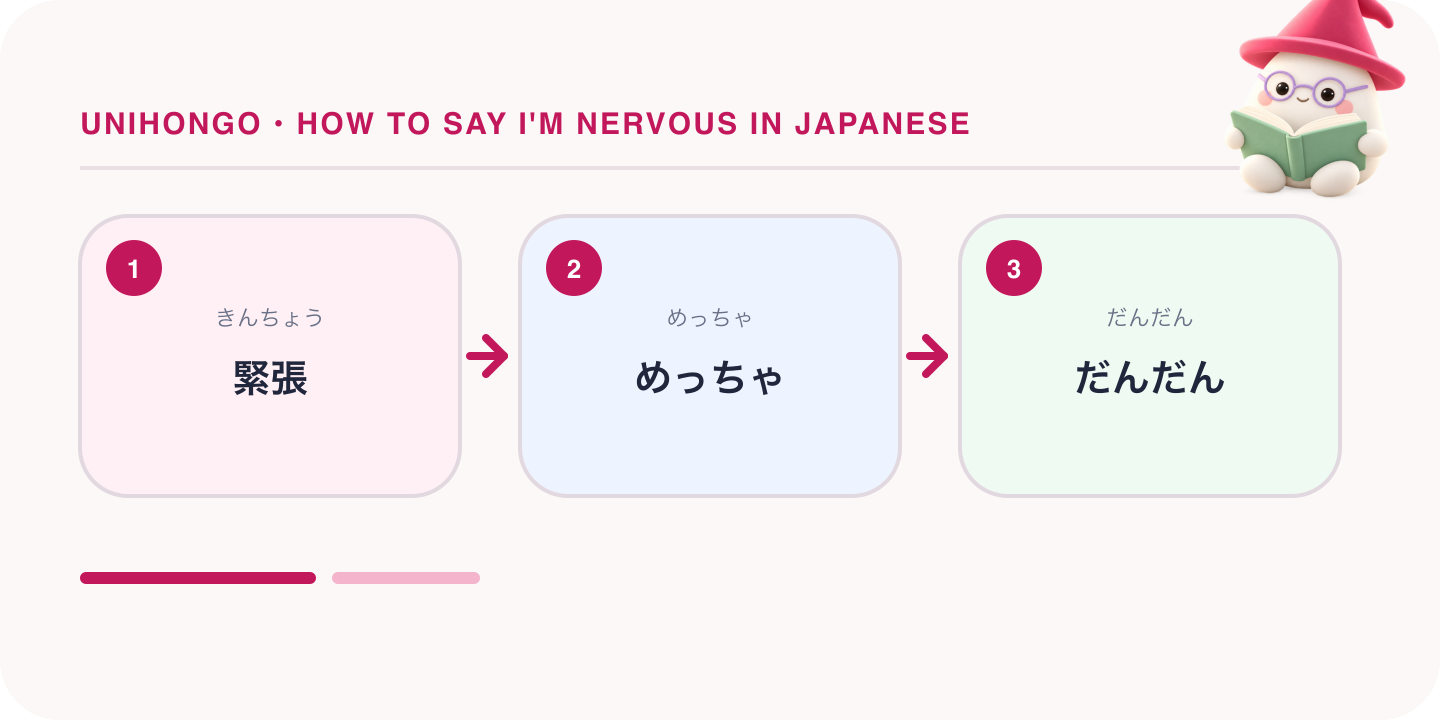
Japanese also often describes the feeling as it builds: kinchō shite kita, I'm getting nervous, is what you might say as your turn approaches. Use sugoku or metcha to intensify it with friends, and totemo or taihen in polite speech.
Kinchō is not only for people. Kinchō-kan, a sense of tension, can describe a room before a big announcement, and kinchō ga tokeru, the tension melts, is what happens when everyone relaxes.
| Japanese | Romaji | Meaning |
|---|---|---|
| 緊張してる。 | Kinchō shiteru. | I'm nervous. (casual) |
| 緊張しています。 | Kinchō shite imasu. | I'm nervous. (polite) |
| めっちゃ緊張する。 | Metcha kinchō suru. | I'm so nervous. (casual) |
| だんだん緊張してきた。 | Dandan kinchō shite kita. | I'm starting to get nervous. |
| 緊張で手が震える。 | Kinchō de te ga furueru. | My hands are shaking with nerves. |
| 少し緊張しております。 | Sukoshi kinchō shite orimasu. | I'm a little nervous. (humble) |
Dokidoki: a pounding heart
ドキドキ (dokidoki) imitates the sound of a heartbeat, and dokidoki suru means my heart is pounding. It is the word for the physical side of nerves: waiting for exam results, going on stage, or asking someone out. It is also used for excitement and romantic feelings, so context tells you which.
Harahara is related but different: it is the anxious feeling of watching something risky, such as a close football match or a child climbing a tree. Uzuuzu, on the other hand, is being itchy to do something, the positive restlessness before you get started.
| Japanese | Romaji | Meaning |
|---|---|---|
| ドキドキする。 | Dokidoki suru. | My heart is pounding. |
| 心臓がドキドキしてる。 | Shinzō ga dokidoki shiteru. | My heart is racing. |
| 結果発表、ドキドキだね。 | Kekka happyō, dokidoki da ne. | The results announcement is nerve-racking, isn't it? |
| 見ていてハラハラした。 | Mite ite harahara shita. | It was nerve-racking to watch. |
| 胸がドキドキして眠れない。 | Mune ga dokidoki shite nemurenai. | My heart is racing and I can't sleep. |
Agaru: stage fright and going blank
上がる (agaru) normally means to rise or go up, but it also means to get stage fright. When people say agatte shimatta, they mean they got so nervous in front of an audience that they went blank, stumbled over words or froze. Someone who gets stage fright easily is agari-shō.
Agaru is specifically about being in front of others: speeches, performances, presentations or sport. Atama ga masshiro ni natta, my mind went completely white, is the vivid way to describe what happened afterwards.
| Japanese | Romaji | Meaning |
|---|---|---|
| 人前だと上がってしまいます。 | Hitomae da to agatte shimaimasu. | I get stage fright in front of people. |
| 私、上がり症なんです。 | Watashi, agari-shō nan desu. | I get stage fright easily. |
| 上がって、何も言えなかった。 | Agatte, nani mo ienakatta. | I froze and couldn't say anything. |
| 頭が真っ白になった。 | Atama ga masshiro ni natta. | My mind went blank. |
| 声が震えちゃった。 | Koe ga furuechatta. | My voice was shaking. |
Fuan and shinpai: anxiety and worry
Nerves before a performance are kinchō; worry about something uncertain is 不安 (fuan) or 心配 (shinpai). Fuan is a more general unease or anxiety, often about the future or an unfamiliar situation: shigoto ga mitsukaru ka fuan desu, I'm anxious about whether I'll find work. Shinpai is worry about a specific thing or person: haha no kenkō ga shinpai desu, I'm worried about my mother's health.
Learners often say kinchō when they mean fuan. If there is no performance or event you are about to face, and you simply feel uneasy, fuan is usually the better word.
| Word | Romaji | Best used for |
|---|---|---|
| 緊張 | kinchō | Tension before an exam, speech, interview or match |
| ドキドキ | dokidoki | A pounding heart from nerves or excitement |
| 上がる | agaru | Stage fright in front of an audience |
| 不安 | fuan | General anxiety or unease, often about the future |
| 心配 | shinpai | Worry about a specific person or problem |
| ハラハラ | harahara | Nervous watching something risky |
Saying it politely in interviews and speeches
In Japan, briefly admitting nerves at the start of a formal situation is common and often received warmly. A speech at a wedding or farewell party often opens with hanahada kinchō shite orimasu ga, I am very nervous, but, followed by the speech itself. It signals humility and wins a little sympathy from the room.
In a job interview, one short line at the beginning is enough. After that, answer confidently. Repeating that you are nervous, or apologising for your Japanese at every answer, draws attention away from what you want to say.
| Japanese | Romaji | Meaning |
|---|---|---|
| 大変緊張しておりますが、よろしくお願いいたします。 | Taihen kinchō shite orimasu ga, yoroshiku onegai itashimasu. | I'm very nervous, but thank you for having me. (formal) |
| 甚だ緊張しておりますが、一言ご挨拶申し上げます。 | Hanahada kinchō shite orimasu ga, hitokoto go-aisatsu mōshiagemasu. | I am quite nervous, but please allow me to say a few words. |
| 緊張して、うまく話せるか分かりませんが… | Kinchō shite, umaku hanaseru ka wakarimasen ga... | I'm nervous and not sure I'll speak well, but... |
| 少し落ち着きました。 | Sukoshi ochitsukimashita. | I've calmed down a little. |
Calming phrases and what people say back
When you say you are nervous, friends usually reassure you. Daijōbu, it's fine, rirakkusu shite, relax, and ganbatte, good luck, are the everyday responses. Someone who knows you well may say itsumo dōri de ii yo, just do it the way you always do.
To calm yourself, people say ochitsuite, calm down, and shinkokyū shiyō, let's take a deep breath. A traditional trick, taught to many Japanese children, is to write the character for person, 人, on your palm three times and pretend to swallow it: te no hira ni hito to kaite nomu. It is a charm rather than a technique, but everyone will recognise it.
| Japanese | Romaji | Meaning |
|---|---|---|
| 大丈夫、リラックスして。 | Daijōbu, rirakkusu shite. | It's fine, relax. |
| いつも通りでいいよ。 | Itsumo dōri de ii yo. | Just do it the way you always do. |
| 落ち着いて。 | Ochitsuite. | Calm down. |
| 深呼吸しよう。 | Shinkokyū shiyō. | Let's take a deep breath. |
| 頑張ってね。応援してるよ。 | Ganbatte ne. Ōen shiteru yo. | Good luck. I'm rooting for you. |
| 手のひらに人と書いて飲むといいよ。 | Te no hira ni hito to kaite nomu to ii yo. | Write person on your palm and swallow it. |
Common learner mistakes
These errors come up again and again when learners talk about nerves.
- Saying watashi wa kinchō desu. Kinchō is a noun; use kinchō shite imasu for how you feel now.
- Using kinchō for general worry. For anxiety about the future, use fuan; for worry about something specific, shinpai.
- Using dokidoki in a formal interview. Keep it for friends and light conversation.
- Using agaru for any nerves. It is specifically about freezing in front of an audience.
- Saying kinchō shinaide to a boss. It is a little direct; a more respectful encouragement is ganbatte kudasai or o-ōen shite imasu.
- Repeating that you are nervous throughout an interview. One line at the start is enough.
Kinchō shite imasu is honest, natural and understood everywhere. Say it once, take a breath, and carry on.