
The short answer
Otsukaresama desu acknowledges that the person in front of you has been expending effort. That single job covers a surprising range: it greets, it closes, it thanks, and it signals that you and the other person are on the same team. English needs several sentences for those moments and Japanese uses one, which is why learners meet it everywhere and never find a stable translation.
The practical consequence is that you do not choose it by meaning. You choose it by moment. Learn the list of moments, and the phrase becomes automatic in a way it never does when you try to translate it first.
| Japanese | Romaji | Meaning |
|---|---|---|
| お疲れ様です。 | Otsukaresama desu. | Acknowledging ongoing effort, in passing or on a call. |
| お疲れ様でした。 | Otsukaresama deshita. | Acknowledging effort that has just finished. |
| お疲れ。 | Otsukare. | Casual, between peers. (casual) |
Its literal sense and why it is not thanks
Tsukareru means to become tired, so tsukare is tiredness, and the phrase attaches the honorific o and the respectful sama to it. The literal shape is something like honourable tiredness, which sounds absurd in English and explains why the word-by-word route fails. The sense being carried is not the tiredness itself but the effort that produced it.
That is the difference from thanks. Arigatō gozaimasu responds to something done for you and creates a small debt. Otsukaresama desu responds to effort spent in general, without saying it benefited you, and creates nothing. This is exactly why it can be said to a colleague you passed in a corridor whose work has nothing to do with yours.
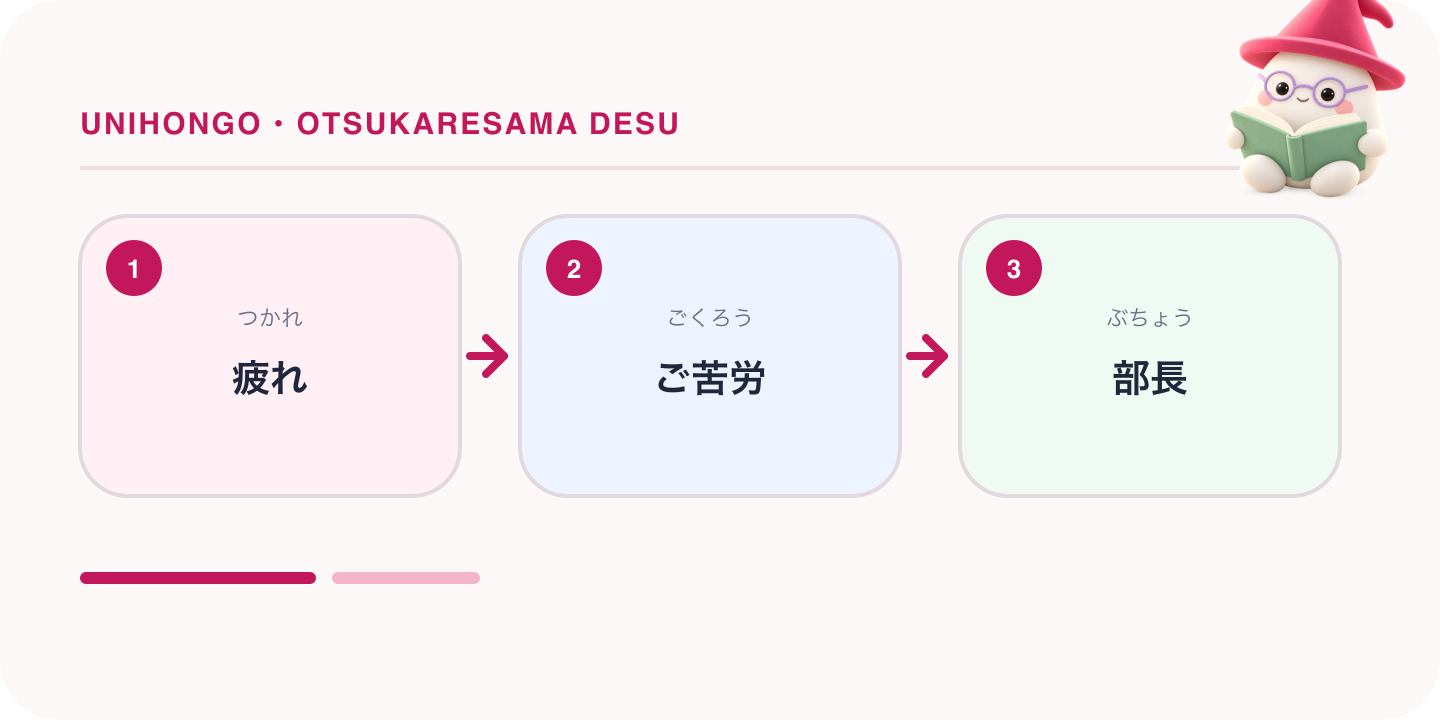
Otsukaresama and gokurōsama
Gokurōsama desu looks like a synonym and is often taught as one. In current usage it carries the flavour of an employer acknowledging a worker, so it moves from higher to lower position. A manager may say it to a team member and it sounds perfectly warm; a new employee saying it to a department head sounds off, sometimes rude.
You will still hear it, particularly toward delivery drivers or contractors, and older speakers use it more freely than younger ones. As a learner the rule is simple: never say gokurōsama upward, and if you are unsure, use otsukaresama, which works in every direction.
| Japanese | Romaji | Meaning |
|---|---|---|
| お疲れ様でした。 | Otsukaresama deshita. | Safe in every direction, including upward. |
| ご苦労様です。 | Gokurōsama desu. | Downward only; avoid toward a superior. |
| 部長、お疲れ様でした。 | Buchō, otsukaresama deshita. | Thank you for your work today, department head. |
| ご苦労様、助かったよ。 | Gokurōsama, tasukatta yo. | Good work, that helped. (a manager to a junior, casual) |
The moments it is said
| Moment | Version to use | Note |
|---|---|---|
| Passing a colleague in a corridor | お疲れ様です Otsukaresama desu | Works as hello during the working day |
| Answering an internal call | はい、お疲れ様です Hai, otsukaresama desu | Replaces moshi moshi inside the company |
| Someone joins a meeting room | お疲れ様です Otsukaresama desu | A greeting, not a comment on the meeting |
| End of a meeting | お疲れ様でした Otsukaresama deshita | The effort has just finished |
| A colleague back from a client visit | お疲れ様でした Otsukaresama deshita | Marks the trip as completed work |
| Leaving before others | お先に失礼します Osaki ni shitsurei shimasu | They reply with otsukaresama deshita |
| End of a shift | お疲れ様でした Otsukaresama deshita | Said to everyone still present |
| Team chat message | お疲れ様です Otsukaresama desu | Standard opening line of a message |
| After a finished project | お疲れ様でした Otsukaresama deshita | Often with a specific thanks added |
| Between close peers | お疲れ Otsukare | Casual only; never upward |
Reading down the middle column shows the whole system: desu while work continues, deshita once a stretch of it has ended. Everything else is context. Note the one row where you do not say otsukaresama at all, because when you are the one leaving early you apologise for going first and the phrase comes back to you.
Corridors, calls, and messages
During the working day the phrase functions as a general-purpose hello. Konnichiwa between colleagues can sound oddly formal or distant, as though you were greeting a stranger, so otsukaresama desu takes its place from mid-morning onward. In the early morning ohayō gozaimasu still leads, and many workplaces switch over once the day is underway.
On an internal line, answering with moshi moshi is considered casual and slightly unpolished, so people answer with their department and name plus the phrase. In team chat it opens the message, doing the work an English opener like hi there would do.
| Japanese | Romaji | Meaning |
|---|---|---|
| お疲れ様です。 | Otsukaresama desu. | Said in passing, with a small nod. |
| はい、営業部の佐藤です。お疲れ様です。 | Hai, eigyōbu no Satō desu. Otsukaresama desu. | Sales department, Sato speaking. (answering an internal call) |
| お疲れ様です。今、少しよろしいでしょうか。 | Otsukaresama desu. Ima, sukoshi yoroshii deshō ka. | Hello. Do you have a moment now? |
| お疲れ様です。会議の資料を送りました。 | Otsukaresama desu. Kaigi no shiryō o okurimashita. | Hi all. I have sent the meeting documents. (chat message) |
| お疲れ様です。確認いたしました。 | Otsukaresama desu. Kakunin itashimashita. | Hello. I have checked it. |
| おはようございます。 | Ohayō gozaimasu. | The early-morning greeting that comes first. |
Ends of things
When a stretch of work closes, the form moves to deshita. A meeting breaking up, a colleague returning from a client, a shift finishing, a project shipping: each of these is a completed effort, and the phrase marks it. In a meeting room it is usually said by everyone more or less at once as people gather their things.
For a returning colleague the phrase does double duty as welcome back and well done, which is why it often pairs with a simple question about how it went. Adding one specific line after it makes the acknowledgement feel real rather than reflexive.
| Japanese | Romaji | Meaning |
|---|---|---|
| お疲れ様でした。 | Otsukaresama deshita. | As a meeting breaks up. |
| 本日はお疲れ様でした。 | Honjitsu wa otsukaresama deshita. | Thank you all for today. |
| お疲れ様でした。いかがでしたか。 | Otsukaresama deshita. Ikaga deshita ka. | Welcome back. How did it go? |
| おかげさまで、うまくいきました。 | Okagesama de, umaku ikimashita. | It went well, thank you. (their reply) |
| 長い一日、お疲れ様でした。 | Nagai ichinichi, otsukaresama deshita. | That was a long day, well done. |
| プロジェクト、本当にお疲れ様でした。 | Purojekuto, hontō ni otsukaresama deshita. | Really well done on the project. |
| みなさん、お疲れ様でした。 | Minasan, otsukaresama deshita. | Well done, everyone. |
Leaving before others
Leaving while colleagues are still working has its own exchange. You do not say otsukaresama on your way out, because you are the one who has stopped. You apologise for going first with osaki ni shitsurei shimasu, and the people staying answer with otsukaresama deshita. Learners often reverse these two roles, which is the single most common mistake with the phrase.
If someone else is leaving and you are staying, your line is otsukaresama deshita, said toward them as they pass, sometimes with a small addition telling them to rest or to take care on the way home. You do not need to look up from your screen for it to count, and in most offices nobody expects a longer goodbye than that.
| Japanese | Romaji | Meaning |
|---|---|---|
| お先に失礼します。 | Osaki ni shitsurei shimasu. | I am leaving before you. (you, on the way out) |
| お疲れ様でした。 | Otsukaresama deshita. | Good work today. (them, staying) |
| お疲れ様でした。気をつけて。 | Otsukaresama deshita. Ki o tsukete. | Well done. Take care getting home. |
| すみません、今日はこれで失礼します。 | Sumimasen, kyō wa kore de shitsurei shimasu. | Sorry, I will finish here for today. |
| ゆっくり休んでください。 | Yukkuri yasunde kudasai. | Please get some rest. |
| お先です。お疲れ。 | Osaki desu. Otsukare. | Off before you. See you. (casual, between peers) |
The register ladder
| Form | Romaji | Who you say it to |
|---|---|---|
| お疲れ | Otsukare | Close peers, juniors, casual only |
| お疲れさま | Otsukaresama | Peers, light and friendly |
| お疲れ様です | Otsukaresama desu | The safe default with anyone at work |
| お疲れ様でした | Otsukaresama deshita | The same, for effort that has ended |
| お疲れ様でございます | Otsukaresama de gozaimasu | Very formal, toward senior figures or in set announcements |
De gozaimasu is the formal counterpart of desu, so the top rung is not a different phrase but the same one lifted. It is rarer in everyday speech than the ladder suggests, and in most companies otsukaresama desu covers even conversations with a department head. Reserve de gozaimasu for genuinely formal settings, and keep otsukare for people you would already speak to in plain form.
Where it does not belong
- To a shop assistant, waiter, or taxi driver: they are serving you, not working with you.
- From a company employee toward a customer or client, where it implies shared internal effort.
- As a general goodbye to a friend after a meal, unless you are joking about how much work it was.
- To family members at home, except playfully after a long shared task.
- As a replacement for a real thank you when someone has helped you specifically.
- Upward in the casual otsukare form, which is too familiar for a manager or a client.
There is a wide grey zone in club activities, volunteer groups, and rehearsals, where the group behaves like a workplace and uses the phrase freely. The test is whether you and the other person share the effort. If you do, it fits; if one of you is serving the other, it does not.
Full exchanges to rehearse
| Japanese | Romaji | Meaning |
|---|---|---|
| お疲れ様です。ちょっといいですか。 | Otsukaresama desu. Chotto ii desu ka. | Hello. Do you have a second? |
| はい、お疲れ様です。どうぞ。 | Hai, otsukaresama desu. Dōzo. | Hello, go ahead. (their reply) |
| お疲れ様です。田中は席を外しております。 | Otsukaresama desu. Tanaka wa seki o hazushite orimasu. | Hello. Tanaka is away from his desk. (on an internal call) |
| お疲れ様でした。また明日。 | Otsukaresama deshita. Mata ashita. | Good work. See you tomorrow. |
| お疲れ様でした。今日はありがとうございました。 | Otsukaresama deshita. Kyō wa arigatō gozaimashita. | Well done today, and thank you for your help. |
| 会議、お疲れ様でした。長かったですね。 | Kaigi, otsukaresama deshita. Nagakatta desu ne. | Good work in the meeting. That was long. |
| 本当にそうですね。 | Hontō ni sō desu ne. | It really was. (their reply) |
| 外回り、お疲れ様でした。 | Sotomawari, otsukaresama deshita. | Well done out on your rounds. |
| お疲れ様です。休憩に行ってきます。 | Otsukaresama desu. Kyūkei ni itte kimasu. | Excuse me, I am going on my break. |
| お疲れ様です。いってらっしゃい。 | Otsukaresama desu. Itterasshai. | Sure, off you go. (their reply) |
| お先に失礼します。お疲れ様でした。 | Osaki ni shitsurei shimasu. Otsukaresama deshita. | I am off now. Good work today. |
| お疲れ様でした。ゆっくり休んでください。 | Otsukaresama deshita. Yukkuri yasunde kudasai. | Well done. Get some rest. |
| お疲れー、今日きつかったね。 | Otsukarē, kyō kitsukatta ne. | Hey, that was a rough day. (casual) |
| ね、疲れた。 | Ne, tsukareta. | Right, I am shattered. (casual reply) |
| 夜勤お疲れ様でした。 | Yakin otsukaresama deshita. | Well done on the night shift. |
Practise these as pairs rather than single lines. Nearly every use of the phrase sits inside a two-turn exchange, and the reason learners freeze is not the phrase itself but the second line that has to follow it.