
How the race works
Ekiden (駅伝) is a long-distance road relay. The word comes from an old relay system of post stations along the highways, and the Hakone race follows part of the historic Tōkaidō road out of Tokyo. Each team has ten runners, each runs one leg, called a ku (区), and the cloth sash travels the whole distance. On the first day the teams race out to Hakone; on the second they race back, and the combined time decides the overall winner, the sōgō yūshō (総合優勝).
Because the two halves have separate results, a team can win the outbound day, ōro yūshō, or the return day, fukuro yūshō, without winning overall. Commentators talk about all three.
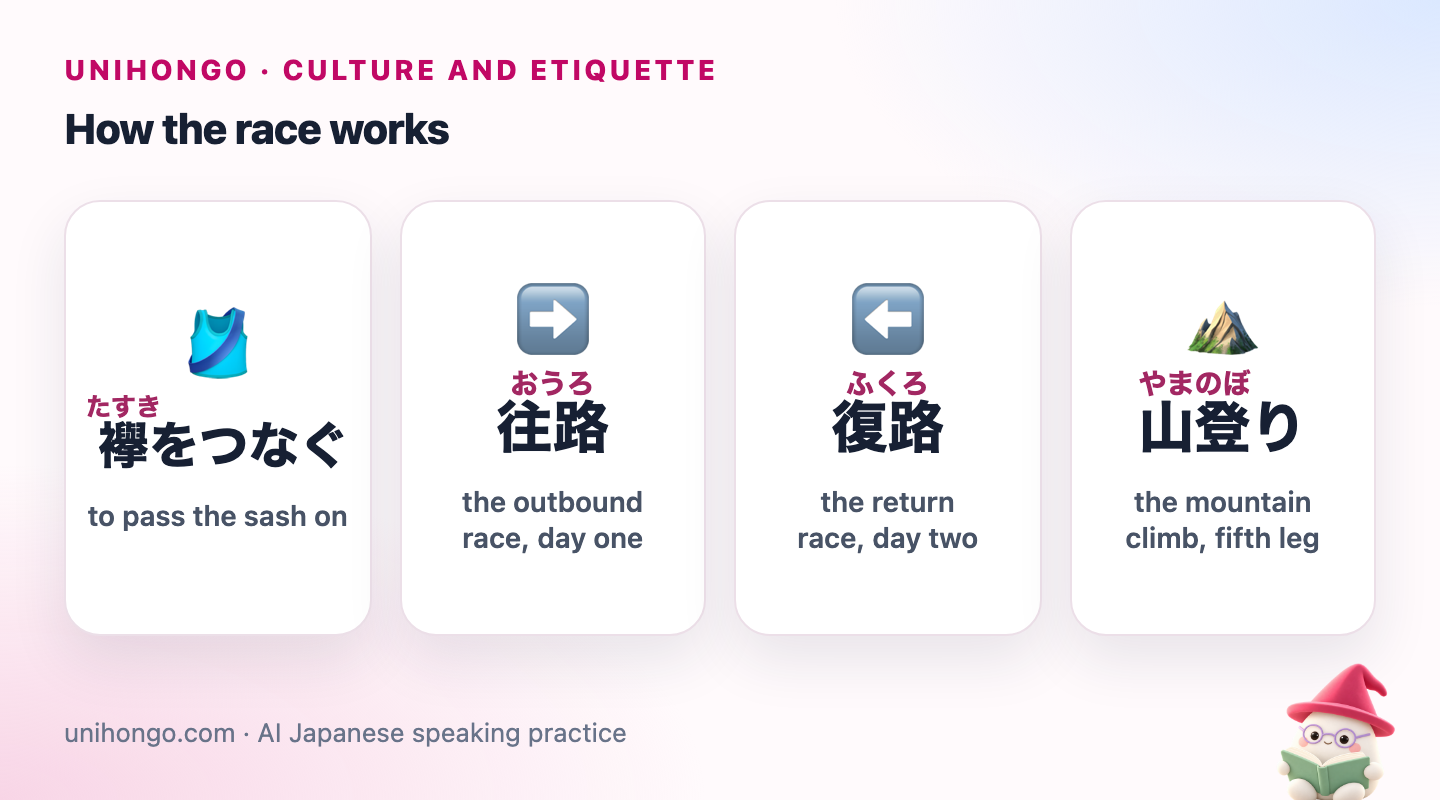
| Japanese | Romaji | Meaning |
|---|---|---|
| 襷をつなぐ | tasuki o tsunagu | to pass the sash on |
| 往路 | ōro | the outbound race, day one |
| 復路 | fukuro | the return race, day two |
| 山登り | yamanobori | the mountain climb, fifth leg |
| 総合優勝 | sōgō yūshō | overall victory |
| 今年は何区が見どころ? | Kotoshi wa nanku ga midokoro? | Which leg is the one to watch this year? |
The legs, the relay points and the mountain
The handover happens at a chūkeijo (中継所), relay point. The first leg, ikku, often starts in a tight pack, and the second leg, niku, is traditionally where many teams put a star runner, which gives it the nickname hana no niku, the flower of the second leg. The fifth leg, goku, climbs steeply into the Hakone mountains, and runners who are outstanding on it have been nicknamed yama no kami (山の神), god of the mountain, by the media. The sixth leg, rokku, is the descent, yamakudari (山下り), which is hard on the legs in a different way.
| Japanese | Romaji | Meaning |
|---|---|---|
| 一区 | ikku | the first leg |
| 花の二区 | hana no niku | the star second leg |
| 五区の山登り | goku no yamanobori | the fifth-leg mountain climb |
| 六区の山下り | rokku no yamakudari | the sixth-leg mountain descent |
| 中継所 | chūkeijo | relay point |
| 区間賞 | kukanshō | fastest runner on a leg |
| 区間新記録 | kukan shinkiroku | a new record for a leg |
| Word | Meaning | When you hear it |
|---|---|---|
| nuku (抜く) | To overtake | Commentators count overtakes: gonin nuki, five runners passed on one leg |
| kukanshō (区間賞) | Fastest time on a leg | Announced for each leg, even if the team finishes low |
| kuriage sutāto (繰り上げスタート) | Staggered start | When a team is too far behind at a relay point, the next runner starts without the sash |
| shīdoken (シード権) | Seeded place | Usually the top ten overall keep a place for next year |
The drama: staggered starts and seeded places
Two rules create much of the race's emotion. At some relay points, if a team arrives too long after the leader, the next runner is sent off on time without waiting, wearing a substitute sash. This is the kuriage sutāto, and seeing a runner arrive seconds too late, the sash unpassed, is one of the most painful images of the race. The time limits and relay points where it applies are set by the organisers.
The second rule is the seeded place. Teams that finish in the top places, usually the top ten, earn shīdoken and return the next year automatically. The rest must run the autumn qualifying race, the yosenkai (予選会). The battle for tenth place, far behind the leaders, is often as tense as the fight for victory.
| Japanese | Romaji | Meaning |
|---|---|---|
| 繰り上げスタートになってしまった。 | Kuriage sutāto ni natte shimatta. | They missed the handover cut-off. |
| あと少しで襷がつながったのに。 | Ato sukoshi de tasuki ga tsunagatta noni. | They were so close to handing over the sash. |
| シード権争いが熱い! | Shīdoken arasoi ga atsui! | The fight for a seeded place is intense! |
| 予選会から勝ち上がってきた。 | Yosenkai kara kachiagatte kita. | They fought their way up from the qualifying race. |
| 最後まであきらめないで! | Saigo made akiramenaide! | Don't give up till the end! |
Watching at home in the New Year
For many households, the race is part of how the first days of January feel. The broadcast covers the full race from the start, and families often keep it on while eating leftover osechi, the New Year dishes, or between visits to relatives and shrines. People who never follow athletics during the year still know the words and have opinions on which leg decided the race. Habits vary, of course: some families never watch it, and it is a much bigger topic in some regions than in others.
Because of this, the Hakone Ekiden is a common topic on the first working day of January. Asking a coworker whether they watched it is an easy, friendly opener.
| Japanese | Romaji | Meaning |
|---|---|---|
| 箱根駅伝、見ました? | Hakone Ekiden, mimashita? | Did you watch the Hakone Ekiden? |
| 毎年、家族で見ています。 | Maitoshi, kazoku de mite imasu. | My family watches it every year. |
| お正月といえば箱根駅伝ですね。 | Oshōgatsu to ieba Hakone Ekiden desu ne. | When you say New Year, you think of the Hakone Ekiden. |
| 山登りのところで泣いちゃった。 | Yamanobori no tokoro de naichatta. | I cried during the mountain climb. (casual) |
| 最後の追い上げがすごかったですね。 | Saigo no oiage ga sugokatta desu ne. | That final charge was amazing, wasn't it? |
Cheering at the roadside
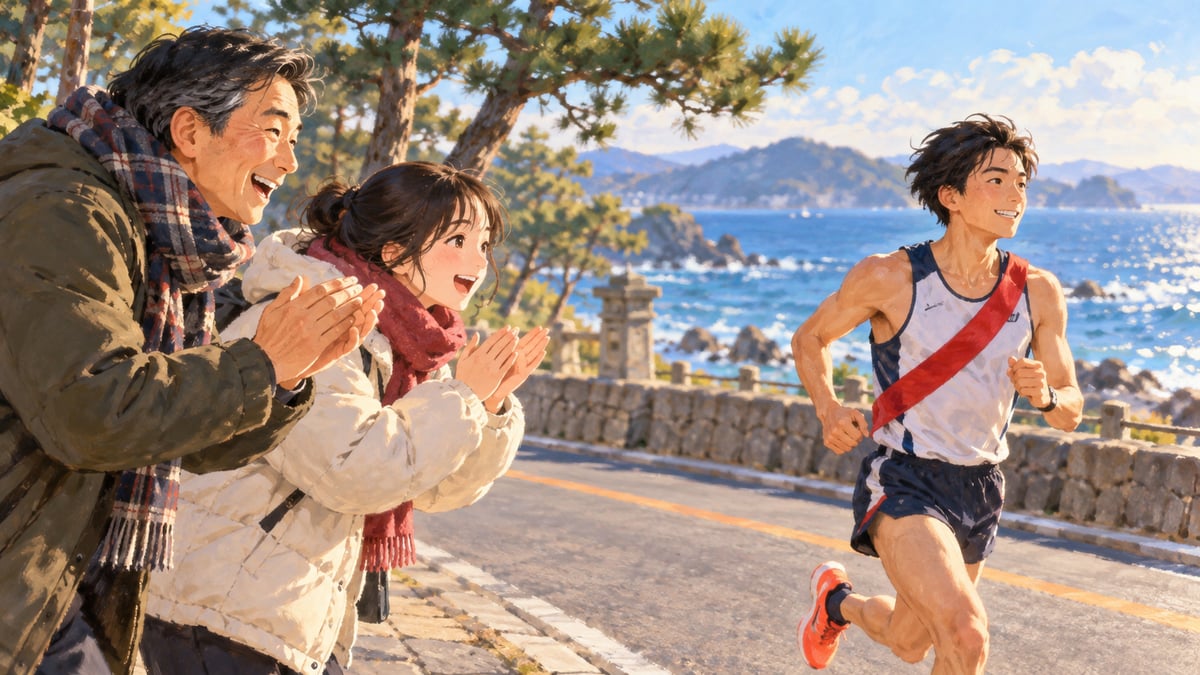
Watching in person is free and many people do it, especially near the start and finish in Tokyo, along the coast and on the mountain section. It is cold, the runners pass in seconds, and the crowd is often several people deep. Spectators cheer for every runner, not only their own university, and the most common words are simple.
| Japanese | Romaji | Meaning |
|---|---|---|
| がんばれ! | Ganbare! | Go for it! Keep going! |
| ファイト! | Faito! | Come on! You can do it! |
| あと少し! | Ato sukoshi! | Almost there! |
| いいペースだよ! | Ii pēsu da yo! | Great pace! |
| もうすぐ来るよ。 | Mō sugu kuru yo. | They're coming any minute. |
| 先頭が見えた! | Sentō ga mieta! | I can see the leader! |
Roadside manners matter, because runners pass at speed and the route is a public road. Stay on the pavement and behind any rope or barrier, do not step into the road for a photo, do not run alongside the runners, and follow the instructions of staff and police. Organisers have asked spectators to avoid crowding in some years, so check the official guidance before you go.
Mini dialogue: the first workday of the year
On the first workday in January, the race is a safe topic with almost anyone. Here a coworker starts the conversation, and you keep it going.
| Japanese | Romaji | Meaning |
|---|---|---|
| あけましておめでとうございます。駅伝、見ました? | Akemashite omedetō gozaimasu. Ekiden, mimashita? | Coworker: Happy New Year. Did you watch the ekiden? |
| はい、初めて全部見ました。 | Hai, hajimete zenbu mimashita. | You: Yes, I watched all of it for the first time. |
| どうでした? | Dō deshita? | Coworker: What did you think? |
| 五区の山登りがすごかったです。 | Goku no yamanobori ga sugokatta desu. | You: The fifth-leg climb was incredible. |
| ですよね。繰り上げスタートは見ていてつらかったけど。 | Desu yo ne. Kuriage sutāto wa mite ite tsurakatta kedo. | Coworker: Right? The staggered starts were hard to watch, though. |
| 来年は沿道で応援してみたいです。 | Rainen wa endō de ōen shite mitai desu. | You: Next year I'd like to cheer from the roadside. |
Endō (沿道) means along the road, the roadside, and endō de ōen suru, to cheer from the roadside, is the standard phrase. Ōen (応援) is cheering or supporting, and you also use it for supporting a friend: ōen shite imasu, I'm rooting for you.
Learn the race words before 2 January
- Ask Mocchi: Give me ten Hakone Ekiden words, ōro, fukuro, tasuki, kuriage sutāto and more, then quiz me in a few days. Mocchi remembers which ones you missed and picks up where you left off in the next quiz.
- Paste a news headline about the race into Mocchi with /explain, and it splits the sentence, names each particle and gives you the meaning.
- Before the first workday, open AI Sensei and ask Ibuki-sensei to play a coworker who loves the race. Tell her how you watched it and which leg you liked, then check the session report for the corrections.
Common learner mistakes
- Calling it a marathon. It is a relay, ekiden; marason is one runner over 42.195 km.
- Saying the runners are professionals. They are university students, and the race is a student event, although many go on to run professionally.
- Mixing up ōro and fukuro. Ō (往) is going, fuku (復) is returning; ōfuku is a round trip.
- Assuming any university can enter. Only teams from the Kanto student athletics association take part, so it is a regional race with national fame.
- Stepping into the road for a better photo. It can endanger runners and is against the organisers' requests.