
What the two words actually describe
Senpai and kouhai describe a position relative to you inside one group. They are not job grades and they do not exist in the abstract: someone is your senpai in a particular club, faculty or company, and outside that group the label simply does not apply. Between people who entered in the same year there is a third word, dōki, which marks equals and often produces the easiest friendships in a Japanese organisation.
The relationship is real but soft. Nobody enforces it with rules, and how heavily it is felt depends enormously on the group. A serious sports club may run on it almost entirely; a small design office may barely mention it. Treat it as a default expectation you can read and adjust to, not as a law you can break.
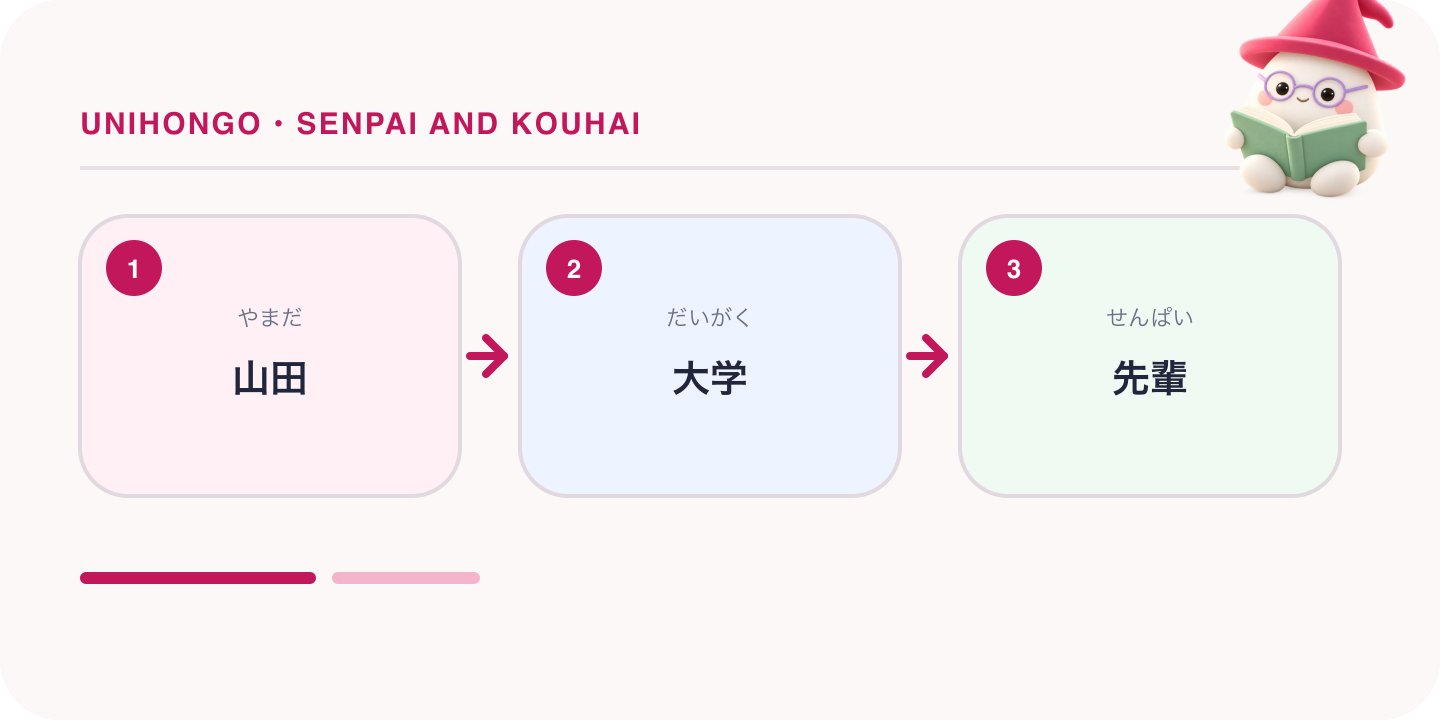
| Japanese | Romaji | Meaning |
|---|---|---|
| 山田さんは大学の先輩です。 | Yamada-san wa daigaku no senpai desu. | Yamada is my senior from university. |
| 私は彼の一年後輩です。 | Watashi wa kare no ichinen kōhai desu. | I am one year below him. |
| 同期の佐藤です。 | Dōki no Satō desu. | I am Sato, from the same intake. |
| 部活の先輩に教わりました。 | Bukatsu no senpai ni osowarimashita. | A senior in the club taught me. |
| 後輩の面倒をよく見る人です。 | Kōhai no mendō o yoku miru hito desu. | He looks after his juniors well. |
Entry date, not age or rank
The counting starts on the day you joined. In schools that means your year group, in companies your hiring cohort, in a club the term you first turned up. This is why the first questions in a new group are often about when you started rather than how old you are. Answering clearly is not immodest; it lets everyone place you and stop guessing which register to use with you.
| Japanese | Romaji | Meaning |
|---|---|---|
| 入社は何年ですか。 | Nyūsha wa nan-nen desu ka? | What year did you join the company? |
| 二年目です。 | Ni-nen-me desu. | I am in my second year. |
| 今年入りました。 | Kotoshi hairimashita. | I joined this year. |
| 一年生の李です。よろしくお願いします。 | Ichinensei no Ri desu. Yoroshiku onegaishimasu. | I am Lee, a first-year. Pleased to meet you. |
| 四月に入ったばかりです。 | Shigatsu ni haitta bakari desu. | I only joined in April. |
The same words in different rooms
| Setting | Who counts as senpai | What it usually means there | How you address them |
|---|---|---|---|
| School club (bukatsu) | Anyone in a year above you | They teach the basics and lead warm-ups; juniors handle equipment and tidying | Senpai, or surname plus senpai |
| University circle (sākuru) | Students from an earlier intake | Looser: advice on courses, exams and job hunting | Surname plus san, sometimes senpai |
| Part-time job (baito) | Whoever started the job first, even if younger | They train you on the till, the kitchen and closing up | Surname plus san |
| Company | Your hiring cohort ranked by year of entry | Mentoring, checking your work before it goes upward | Surname plus san, or the job title |
| Laboratory or seminar (zemi) | Students further along in the same lab | They show you the equipment and the paperwork | Surname plus san |
| Dojo or martial arts club | Grade and years in the dojo together | They correct your form and lead the line | Senpai, or surname plus senpai |
Read the room before you copy any row of this table. The strength of the relationship varies by region, generation and the personality of the group, and plenty of modern workplaces deliberately keep it light. The reliable move in any of these settings is to start polite, use surnames with san, and let people tell you what they prefer.
What each side owes the other
The relationship is an exchange, not a hierarchy of pure obedience. A senpai is expected to teach without being asked twice, to answer beginner questions patiently, to notice when a junior is struggling, and in many groups to pay a larger share when the group eats together. A kouhai is expected to greet first, to use polite language, to arrive early, to take on the small unglamorous jobs, and to ask before improvising.
- The senior explains a task once and then checks the result rather than criticising in front of others.
- The senior speaks for the junior upward, taking the blame when something the junior did goes wrong.
- The junior greets first, thanks specifically, and reports problems early rather than hiding them.
- The junior handles the small preparation tasks: setting up, carrying, clearing away, arriving before the start.
- Both sides drop the formality slowly, and it is the senior who signals when it may loosen.
None of this is written down anywhere, and none of it is absolute. If you are unsure whether a small job is yours, offering to do it is almost never wrong, and the offer itself is read as the right attitude even when the answer is no.
How the language moves in each direction
The default is asymmetric: the junior speaks in desu and masu forms upward, and the senior often speaks casually downward. That asymmetry is normal and is not rudeness in either direction. Notice that a good senpai still softens casual speech with ne and yo rather than issuing bare commands, and that many seniors keep polite forms with juniors they do not know well. The polite and casual guide covers the forms themselves in detail.
| Japanese | Romaji | Meaning |
|---|---|---|
| 先輩、ちょっといいですか。 | Senpai, chotto ii desu ka? | Senpai, do you have a moment? (junior to senior) |
| 田中先輩、教えていただけますか。 | Tanaka-senpai, oshiete itadakemasu ka? | Tanaka, could you show me how? (junior to senior) |
| 手伝いましょうか。 | Tetsudaimashō ka? | Shall I help? (junior to senior) |
| 私がやります。 | Watashi ga yarimasu. | I will do it. (junior to senior) |
| すみません、もう一度お願いします。 | Sumimasen, mō ichido onegaishimasu. | Sorry, once more please. (junior to senior) |
| ありがとうございます。助かりました。 | Arigatō gozaimasu. Tasukarimashita. | Thank you. That really helped. (junior to senior) |
| 分からなかったら聞いてね。 | Wakaranakattara kiite ne. | Ask me if you do not get it. (senior, casual) |
| ここ、こうやるんだよ。 | Koko, kō yarun da yo. | This bit, you do it like this. (senior, casual) |
| 最初はみんなそうだよ。 | Saisho wa minna sō da yo. | Everyone is like that at first. (senior, casual) |
| 無理しなくていいよ。 | Muri shinakute ii yo. | Do not push yourself too hard. (senior, casual) |
| 慣れれば大丈夫。 | Narereba daijōbu. | You will be fine once you get used to it. (senior, casual) |
| 今日はおごるよ。 | Kyō wa ogoru yo. | It is on me today. (senior, casual) |
| お疲れ。もう上がっていいよ。 | Otsukare. Mō agatte ii yo. | Good work. You can finish for today. (senior, casual) |
| 分からないところがあったら言ってください。 | Wakaranai tokoro ga attara itte kudasai. | Please tell me if anything is unclear. (senior, polite) |
| 一緒に確認しましょう。 | Issho ni kakunin shimashō. | Let us check it together. (senior, polite) |
Addressing a senpai, and why kouhai is never used
Senpai can be a title after a surname, as in Tanaka-senpai, or a stand-alone form of address, as in Senpai, sumimasen. It works because it points upward, which is what respectful address does in Japanese. Kouhai points downward, so it cannot be used the same way: calling someone kōhai to their face reduces them to their position. Address a junior with their surname plus san or kun, and mention kōhai only when describing the relationship to a third person.
| Japanese | Romaji | Meaning |
|---|---|---|
| 先輩、お疲れさまです。 | Senpai, otsukaresama desu. | Thanks for your work, senpai. (junior to senior) |
| 鈴木さん、これでよろしいでしょうか。 | Suzuki-san, kore de yoroshii deshō ka? | Suzuki, is this all right? (junior to senior) |
| 中村くん、これお願いできる? | Nakamura-kun, kore onegai dekiru? | Nakamura, could you take care of this? (senior, casual) |
| 新しく入った後輩です。 | Atarashiku haitta kōhai desu. | This is our new junior. (introducing to a third person) |
Anime and drama use senpai as a stand-alone call much more often than most adult workplaces do. In a school club it is completely ordinary; in an office it can sound theatrical. The honorifics guide covers san, kun, chan and the professional titles that do most of this work in adult life.
The workplace version and job titles
In companies two systems run at once. Job titles such as kachō and buchō describe formal authority, while senpai describes who joined first. They often line up, but not always: a colleague hired two years before you may hold no title at all and still be the person whose approval you seek before sending something upward. Out loud, the title or surname plus san wins, and the word senpai stays in the background as something you feel rather than say.
Practically, this means your questions go to a senpai first and your decisions go to a titled manager. Bringing a half-formed question straight to a section chief skips the person whose job it quietly is to catch it, and that is felt as a small breach even though no rule was broken.
| Japanese | Romaji | Meaning |
|---|---|---|
| 課長、お時間よろしいでしょうか。 | Kachō, o-jikan yoroshii deshō ka? | Section chief, do you have a moment? |
| 山田さん、この件を確認していただけますか。 | Yamada-san, kono ken o kakunin shite itadakemasu ka? | Yamada, could you check this matter? |
| 先に山田さんに見ていただきました。 | Saki ni Yamada-san ni mite itadakimashita. | I had Yamada look at it first. |
| これ、誰に聞けばいいですか。 | Kore, dare ni kikeba ii desu ka? | Who should I ask about this? |
| お先に失礼します。 | O-saki ni shitsurei shimasu. | Excuse me for leaving ahead of you. |
The daily greetings that carry this relationship, from ohayō gozaimasu on arrival to otsukaresama desu on the way out, are covered in the workplace greetings post. Here the point is only who you say them to first: the people who were there before you.
Your first weeks as a newcomer
As a foreign newcomer you get real latitude, and the best way to use it is not to perform the culture but to be easy to teach. Learn who joined when, use surnames with san, keep polite forms with everyone until you know the group, greet first, and ask your questions in batches rather than interrupting five times. People remember whether you were pleasant to train far longer than they remember your grammar.
| Japanese | Romaji | Meaning |
|---|---|---|
| やり方を教えていただけると助かります。 | Yarikata o oshiete itadakeru to tasukarimasu. | It would help if you could show me how it is done. |
| 分からないことがあったら、聞いてもいいですか。 | Wakaranai koto ga attara, kiite mo ii desu ka? | If there is something I do not understand, may I ask you? |
| 明日は何時に来ればいいですか。 | Ashita wa nan-ji ni kureba ii desu ka? | What time should I come tomorrow? |
| 覚えました。次からは自分でやります。 | Oboemashita. Tsugi kara wa jibun de yarimasu. | I have got it. I will do it myself from next time. |
| ご迷惑をおかけしてすみません。 | Go-meiwaku o okake shite sumimasen. | I am sorry for the trouble I have caused. |
| 日本語がまだ下手ですが、頑張ります。 | Nihongo ga mada heta desu ga, ganbarimasu. | My Japanese is still poor, but I will work at it. |
| ご馳走さまでした。ありがとうございました。 | Gochisōsama deshita. Arigatō gozaimashita. | Thank you for the meal, and thank you for today. |
- In week one, find out three names and roughly when each person joined; write them down.
- Default to surname plus san for everyone, including people your own age.
- Ask who you should bring questions to, then bring them to that person consistently.
- Say the task back in your own words before doing it, so mistakes surface before they happen.
- Say thank you specifically: name what they showed you rather than thanking in general.
- Offer to do the small preparation jobs once, and keep doing them without being asked again.
The internet version and the real one
Online, senpai has drifted into a joke about being noticed by someone you admire, usually with a romantic edge. That sense grew out of school stories where a crush happens to be a year above, and it now circulates in English almost independently of the Japanese word. It is not wrong to find it funny, but it is worth knowing that it describes a feeling, whereas the Japanese word describes a position.
The practical risk is small but real: using senpai jokingly with a Japanese colleague can read as flirtation or as mockery of a relationship they take seriously. Keep the meme in English-speaking company, and in Japanese use the word plainly for what it is, someone who was there first and is expected to help you.
| Japanese | Romaji | Meaning |
|---|---|---|
| 憧れの先輩です。 | Akogare no senpai desu. | She is the senior I look up to. |
| 先輩と後輩は上下関係の言葉です。 | Senpai to kōhai wa jōge kankei no kotoba desu. | Senpai and kouhai are words about a vertical relationship. |
| うちの部活は上下関係が厳しいです。 | Uchi no bukatsu wa jōge kankei ga kibishii desu. | Our club is strict about seniority. |
| 最近はあまり気にしない会社も多いです。 | Saikin wa amari ki ni shinai kaisha mo ōi desu. | These days plenty of companies do not worry much about it. |
Practise both roles, not just one
Learners rehearse the junior half endlessly and never the senior half, then freeze the first time somebody newer arrives and needs to be taught. Within a year of joining anything you will be somebody's senpai, and the language changes: you have to explain a task in simple Japanese, reassure without patronising, and offer help in a way that can be refused. Practise giving instructions as well as receiving them.
- Say the junior line and the senior reply back to back, changing register between them.
- Explain one task you already know how to do in three short Japanese sentences.
- Practise refusing help politely, since a junior who cannot say daijōbu desu ends up overloaded.
- Record a thirty-second self-introduction that states your name, your start date and one thing you want to learn.