
Otoshidama in four phrases
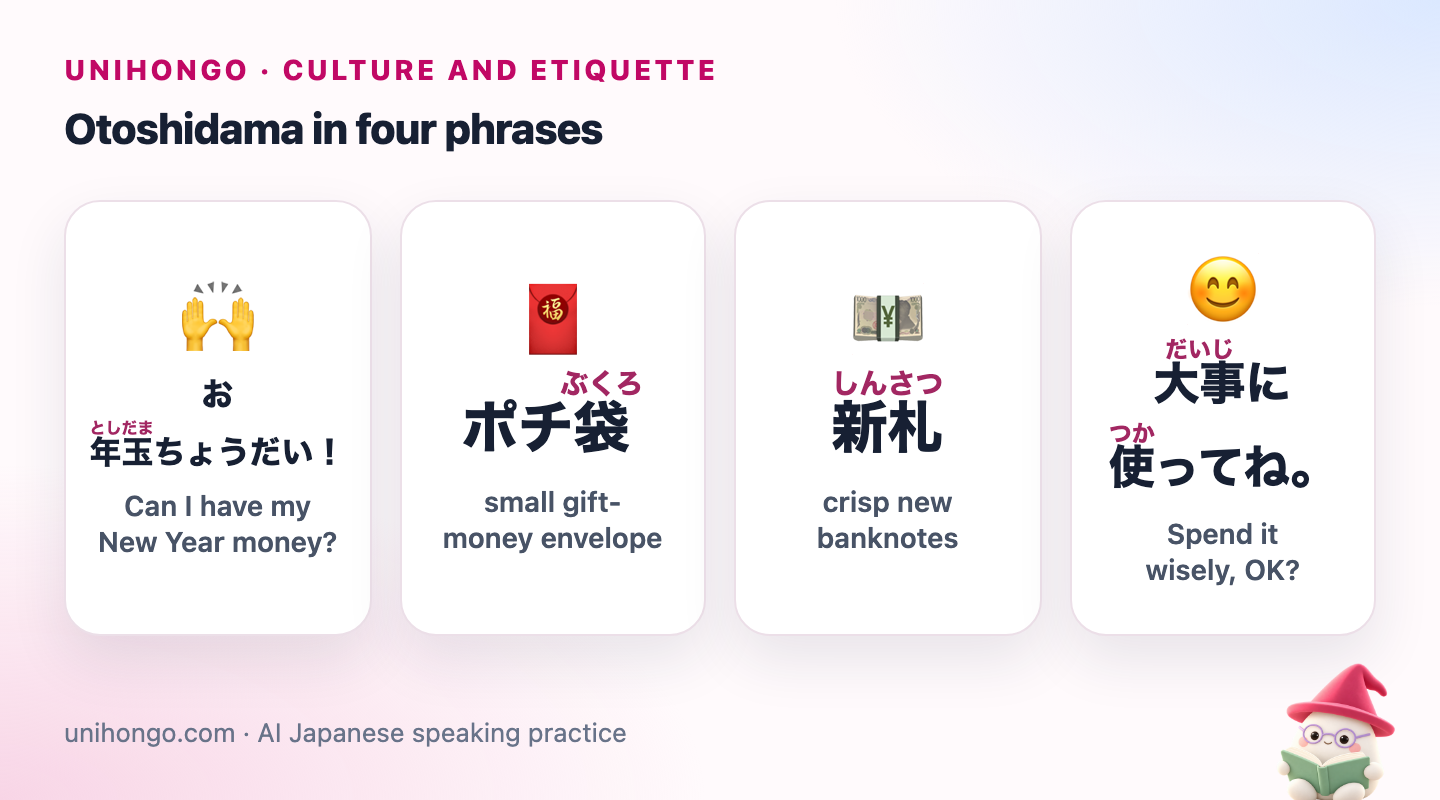
Otoshidama is written お年玉: 年 is year and 玉 is a ball or jewel. Children usually say it in one breath with a big smile, and the envelope it comes in, the pochibukuro, has a cute name of its own. The four phrases below are the ones every child in Japan knows.
| Japanese | Romaji | Meaning |
|---|---|---|
| お年玉ちょうだい! | Otoshidama chōdai! | Can I have my New Year money? |
| ポチ袋 | pochibukuro | small gift-money envelope |
| 新札 | shinsatsu | crisp new banknotes |
| 大事に使ってね。 | Daiji ni tsukatte ne. | Spend it wisely, OK? |
Chōdai is a casual, childish way of saying please give me. A child can say it to a grandparent with a grin; an adult should never use it to ask for anything at New Year.
Where it comes from, and who gives to whom
A common explanation is that otoshidama was originally an offering of round mochi to Toshigami, the New Year god, which was then shared out so that everyone received the god's spirit for the year. Over time the gift became money, and today it is almost always cash. Accounts of the origin differ, so treat this as the traditional story rather than a fact.
The rule of thumb is simple: older gives to younger. Within families, grandparents, aunts and uncles give to children, and sometimes older cousins who have started working give to younger ones.
| Japanese | Romaji | Meaning |
|---|---|---|
| 親戚の子どもにあげます。 | Shinseki no kodomo ni agemasu. | I give it to my relatives' children. |
| 祖父母からもらいました。 | Sofubo kara moraimashita. | I got it from my grandparents. |
| 何歳まであげるの? | Nansai made ageru no? | Until what age do you give it? (casual) |
| うちは高校生までかな。 | Uchi wa kōkōsei made kana. | In our family, until high school, I guess. |
| Giver | Receiver | Usual? |
|---|---|---|
| Grandparents | Grandchildren | Very common |
| Aunts and uncles | Nieces and nephews | Very common |
| A family friend you visit | Their young children | Common |
| You | Your boss's young children | Fine, especially when visiting |
| You | Your parents or anyone older | Not done; bring a gift instead |
Preparing the envelope
Pochibukuro are sold in stationery shops, convenience stores and hundred-yen shops from December, with cute characters for children and simpler designs for teenagers. Many people get new notes from a bank before the New Year holiday, because banks close in early January. Fold the notes neatly so they fit; many people fold them in three. Write the child's name on the front and your own name on the back, so parents know who gave what.
For very young children, some adults give coins or a small gift instead, since a toddler cannot use money.
| Japanese | Romaji | Meaning |
|---|---|---|
| 新札に両替してもらえますか。 | Shinsatsu ni ryōgae shite moraemasu ka. | Could I exchange these for new notes? |
| ポチ袋に名前を書きます。 | Pochibukuro ni namae o kakimasu. | You write the name on the envelope. |
| お札を三つに折ります。 | Osatsu o mittsu ni orimasu. | You fold the notes in three. |
| 小さい子には硬貨を入れることもあります。 | Chiisai ko ni wa kōka o ireru koto mo arimasu. | For small children, people sometimes use coins. |
Giving it: what the adults say
Hand the envelope over with both hands, usually after the New Year greeting. To the child, speak warmly and casually. To the parents, especially in a family you do not know well, add a modest polite line such as sukoshi desu ga, it is only a little. The parents will usually thank you on the child's behalf and remind the child to say thank you.
| Japanese | Romaji | Meaning |
|---|---|---|
| はい、お年玉。あけましておめでとう。 | Hai, otoshidama. Akemashite omedetō. | Here's your New Year money. Happy New Year. |
| 少しですが、お子さんに。 | Sukoshi desu ga, okosan ni. | It's only a little, but for your child. |
| すみません、気を遣っていただいて。 | Sumimasen, ki o tsukatte itadaite. | Parent: Oh, you shouldn't have. Thank you. |
| ほら、ちゃんとお礼を言って。 | Hora, chanto orei o itte. | Parent: Come on, say thank you properly. |
| ありがとうございます! | Arigatō gozaimasu! | Child: Thank you! |
Ki o tsukatte itadaite literally means you have used your consideration on us. It is how polite Japanese accepts a gift while showing that you did not expect it, and it is far more natural here than a simple arigatō.
Receiving it: the child's side
Children in Japan often hand most of their otoshidama to a parent, who puts it in a savings account, a scene so common it is a running joke. The questions children hear every year are what will you spend it on and how much will you save.
| Japanese | Romaji | Meaning |
|---|---|---|
| 何に使うの? | Nani ni tsukau no? | Adult: What will you spend it on? |
| ゲームを買いたい! | Gēmu o kaitai! | Child: I want to buy a game! |
| 半分は貯金する。 | Hanbun wa chokin suru. | Child: I'll save half of it. |
| お母さんが預かっておくね。 | Okāsan ga azukatte oku ne. | Mum: I'll look after it for you. |
| ここで開けちゃだめだよ。 | Koko de akecha dame da yo. | Parent: Don't open it here. |
Many parents teach children not to open the envelope in front of the giver, so that nobody compares amounts at the table. Customs vary, and plenty of families are relaxed about it, but waiting until later is the safe choice.
Mini dialogue: visiting a friend's family on 2 January
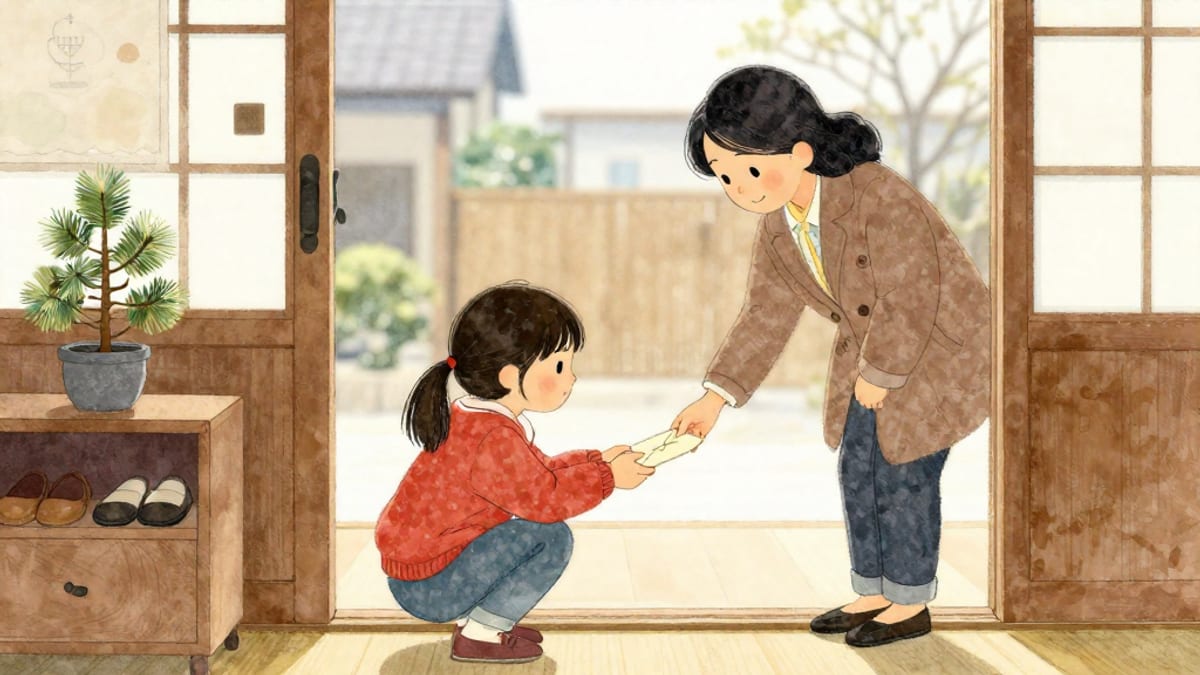
Visiting friends with children at New Year is a typical moment to give otoshidama. Greet the family first, then give the envelope to the child, ideally when the parents are present.
| Japanese | Romaji | Meaning |
|---|---|---|
| あけましておめでとうございます。 | Akemashite omedetō gozaimasu. | You: Happy New Year. |
| おめでとうございます。どうぞ上がって。 | Omedetō gozaimasu. Dōzo agatte. | Friend: Happy New Year. Come on in. |
| ゆいちゃん、はい、お年玉。 | Yui chan, hai, otoshidama. | You: Yui, here's your New Year money. |
| わあ、ありがとう! | Wā, arigatō! | Yui: Wow, thank you! |
| え、すみません。気を遣わせちゃって。 | E, sumimasen. Ki o tsukawasechatte. | Friend: Oh, sorry, you didn't have to. |
| いえいえ、少しだけだから。 | Ieie, sukoshi dake da kara. | You: Not at all, it's just a little. |
The tricky cases
Otoshidama is easy within your own family. Outside it, a few situations need care.
| Japanese | Romaji | Meaning |
|---|---|---|
| 目上の方にはお年賀を渡します。 | Meue no kata ni wa onenga o watashimasu. | For elders, you give a New Year gift. |
| 今年は喪中なので、お小遣いとして渡します。 | Kotoshi wa mochū na node, okozukai to shite watashimasu. | We're in mourning, so we give it as pocket money. |
| お子さんに渡してもいいですか。 | Okosan ni watashite mo ii desu ka. | May I give this to your child? |
- People older than you, including your own parents: do not give otoshidama. Bring a New Year gift, onenga, such as sweets, or give money as okozukai, pocket money, if your family does that.
- Your boss's children: fine when you visit their home, but follow your boss's lead. Some families prefer that colleagues do not give money.
- A mourning year, mochū: many families still give money to children but avoid celebratory envelopes and call it okozukai instead. Ask the family.
- Teenagers and university students: many families stop at a certain age; ask the parents what they do.
Polish your lines, then say them to Yamada-sensei
Write the three lines you would actually use, one to the child, one to the parent and one reply to their thanks, and send them to Mocchi with /correct. Mocchi fixes the Japanese, tells you whether each line is casual or polite, and remembers if keigo is a weak point, so your next quiz includes it.
Then open AI Sensei, choose Yamada-sensei, and ask him to play a grandfather welcoming you into his home at New Year. Greet him, give otoshidama to his grandchild and answer his questions; the session report shows which lines need work.
Common learner mistakes
- Handing over bare cash. Always use an envelope, even a plain one.
- Giving otoshidama to someone older or senior. Give onenga, a New Year gift, instead.
- Asking a child or parent how much they received. It is private, and adults avoid comparing.
- Answering ki o tsukatte itadaite with dō itashimashite. A softer ieie, iie, or sukoshi desu ga sounds more natural.
- Saying chōdai as an adult. It is a child's word for asking; adults just say arigatō gozaimasu when they receive something.