
Five rough words for you, at a glance
Japanese has many words for you, and most of them are risky. The five below are the ones fiction leans on. Anta and omae are heard in ordinary life, while kisama, temē and onore are almost pure drama.
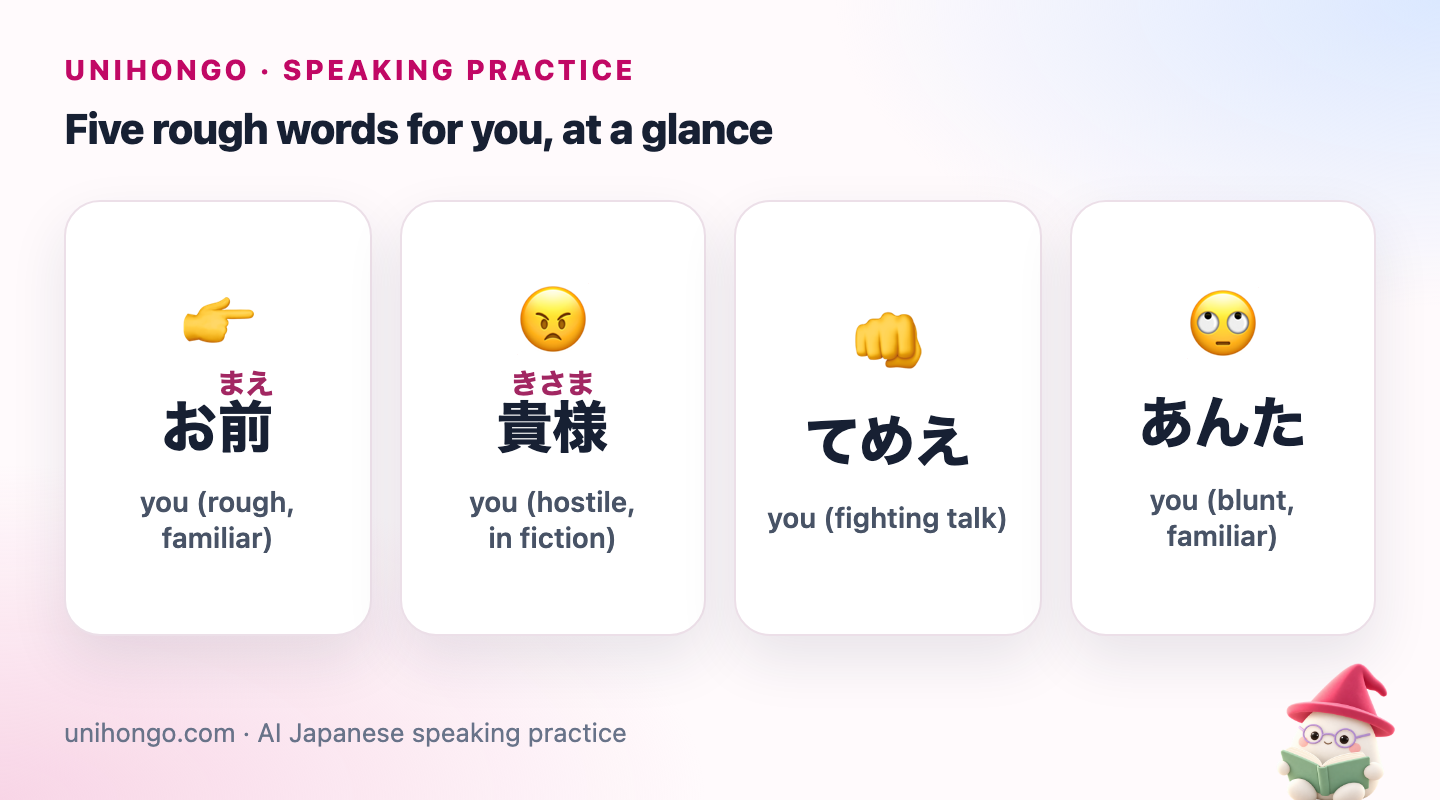
| Japanese | Romaji | Meaning |
|---|---|---|
| お前 | omae | you (rough, familiar) |
| 貴様 | kisama | you (hostile, in fiction) |
| てめえ | temē | you (fighting talk) |
| あんた | anta | you (blunt, familiar) |
| おのれ | onore | you! (a cry of rage, archaic) |
Omae: from honoured presence to buddy talk
Omae is written お前, or in older style 御前: the honorific o plus mae, front. It once meant the honoured one before me and was used with respect toward people of high rank. Over the centuries the respect wore off, and by modern times it had become a word for equals and juniors.
Today omae lives in a narrow zone. Men use it with close male friends, older brothers with younger siblings, seniors with juniors in clubs and some workplaces. Some men use it to a wife or girlfriend, and not every woman likes that. From a stranger it is a challenge. That is why the most famous omae in manga, omae wa mō shinde iru from Fist of the North Star, sounds so cold: the hero is talking down to an enemy.
| Japanese | Romaji | Meaning |
|---|---|---|
| お前、何やってんだ。 | Omae, nani yatte n da. | What are you doing? (rough, to a friend) |
| お前はもう死んでいる。 | Omae wa mō shinde iru. | You are already dead. (famous manga line) |
| お前ら、行くぞ。 | Omaera, iku zo. | Come on, you lot, let's go. (rough) |
Kisama: the honorific that became an insult
Look at the kanji and kisama should be the politest word in this article: 貴 means noble or precious, and sama is the honorific you still write on envelopes. It did begin as a respectful term among the warrior class, especially in letters. As it spread into common speech it was used toward equals, then inferiors, and finally only with contempt.
It was also common between soldiers in the old Japanese military, which is why officers in war films bark it. In modern life nobody says kisama except as a joke. In anime it marks villains, proud warriors and sworn enemies.
| Japanese | Romaji | Meaning |
|---|---|---|
| 貴様、何者だ。 | Kisama, nanimono da. | Who are you? (hostile, fictional) |
| 貴様ら | kisamara | you lot (hostile, fictional) |
Temē and onore: when I turns into you
Temē is a rough contraction of temae (手前), literally before the hand, meaning this side. Temae was a humble word for I, used by merchants about themselves and their shops. Thrown at the listener, the same word became a contemptuous you, and the Tokyo-style slur from ae to ē made it harsher still.
Onore (己) followed the same path. It means oneself, and classical Japanese used it for I. Aimed at someone else it became an insult, and today it survives as a howl of fury in period dramas: onore, usually from a villain who has just lost. Japanese has done this more than once. In parts of western Japan, jibun, self, is used casually to mean you.
| Japanese | Romaji | Meaning |
|---|---|---|
| てめえ、ふざけるな。 | Temē, fuzakeru na. | Don't mess with me. (very rough) |
| てめえら | temēra | you lot (very rough) |
| おのれ、許さん。 | Onore, yurusan. | Curse you, I won't forgive this. (period drama) |
Anta: the blunt everyday one
Anta is anata with the middle worn away. It is the only word here that many ordinary people use daily, mostly at home: a mother to a child, an older sister to a brother, a long-married couple to each other. It sounds familiar and a little impatient. In much of western Japan it is softer and more widely used.
Said to someone outside that close circle, anta sounds scornful, as if the speaker has already judged the listener. In anime it often belongs to sharp-tongued girls and no-nonsense older women.
| Japanese | Romaji | Meaning |
|---|---|---|
| あんた、誰? | Anta, dare? | Who are you? (blunt) |
| あんたには関係ないでしょ。 | Anta ni wa kankei nai desho. | It's none of your business, is it? (sharp) |
How rude is each one today?
The same word can be friendly in one mouth and an insult in another, so read the last column as a guide for learners.
| Romaji | Literal origin | Typical speaker in fiction | In real life today |
|---|---|---|---|
| anta | A shortened anata | Blunt mothers, older sisters, sharp-tongued girls | Common in families and some regions; scornful to outsiders |
| omae | The honoured one in front | Heroes, rivals, gruff mentors | Normal among close male friends; rude to strangers and seniors |
| kisama | Noble, honoured person | Villains, soldiers, proud warriors | Almost never said seriously; an open insult |
| temē | This side, once a humble I | Delinquents and brawlers | Fighting words; avoid completely |
| onore | Oneself | Samurai and defeated villains | Not used for you in standard modern speech |
Ore-sama: the same trick in the first person
Fiction also has a rude way to say I. Ore-sama (俺様) attaches the honorific sama to ore, the rough male I, so the speaker is honouring himself: my magnificent self. Arrogant rivals and comic braggarts use it. In real life it is only ever a joke, and ore-sama has become a label for a bossy, self-important type of character.
| Japanese | Romaji | Meaning |
|---|---|---|
| 俺様 | ore-sama | my great self (arrogant I) |
| 俺様に任せろ。 | Ore-sama ni makasero. | Leave it to the great me. (fictional) |
What to say instead: names, titles and nothing
Polite Japanese handles you by not saying it. Once the topic is clear, the listener is understood. When you need to name the person, use their family name plus san, or their role: sensei for a teacher or doctor, tenchō for a shop manager. Even anata, the textbook you, can feel distant or cold when overused.
| Japanese | Romaji | Meaning |
|---|---|---|
| 田中さんはどう思いますか。 | Tanaka-san wa dō omoimasu ka. | What do you think, Tanaka-san? |
| どちらからいらっしゃいましたか。 | Dochira kara irasshaimashita ka. | Where are you from? (respectful) |
| お名前を伺ってもいいですか。 | O-namae o ukagatte mo ii desu ka. | May I ask your name? |
| 先生はどうなさいますか。 | Sensei wa dō nasaimasu ka. | What will you do, teacher? (respectful) |
| そちらはどうですか。 | Sochira wa dō desu ka. | How about you? (polite, indirect) |
| コーヒー、飲みますか。 | Kōhī, nomimasu ka. | Will you have some coffee? |
If a friend your own age starts calling you omae, it is usually a sign of closeness. You do not need to answer in kind. Keep using their name and you will sound natural.