
The beach day in four phrases
Umi (海) means the sea, and in Japanese you go to the sea rather than to the beach. The word for a sandy beach, sunahama (砂浜), exists but is rarely needed in conversation. These four lines take you from the invitation to the end of the day.
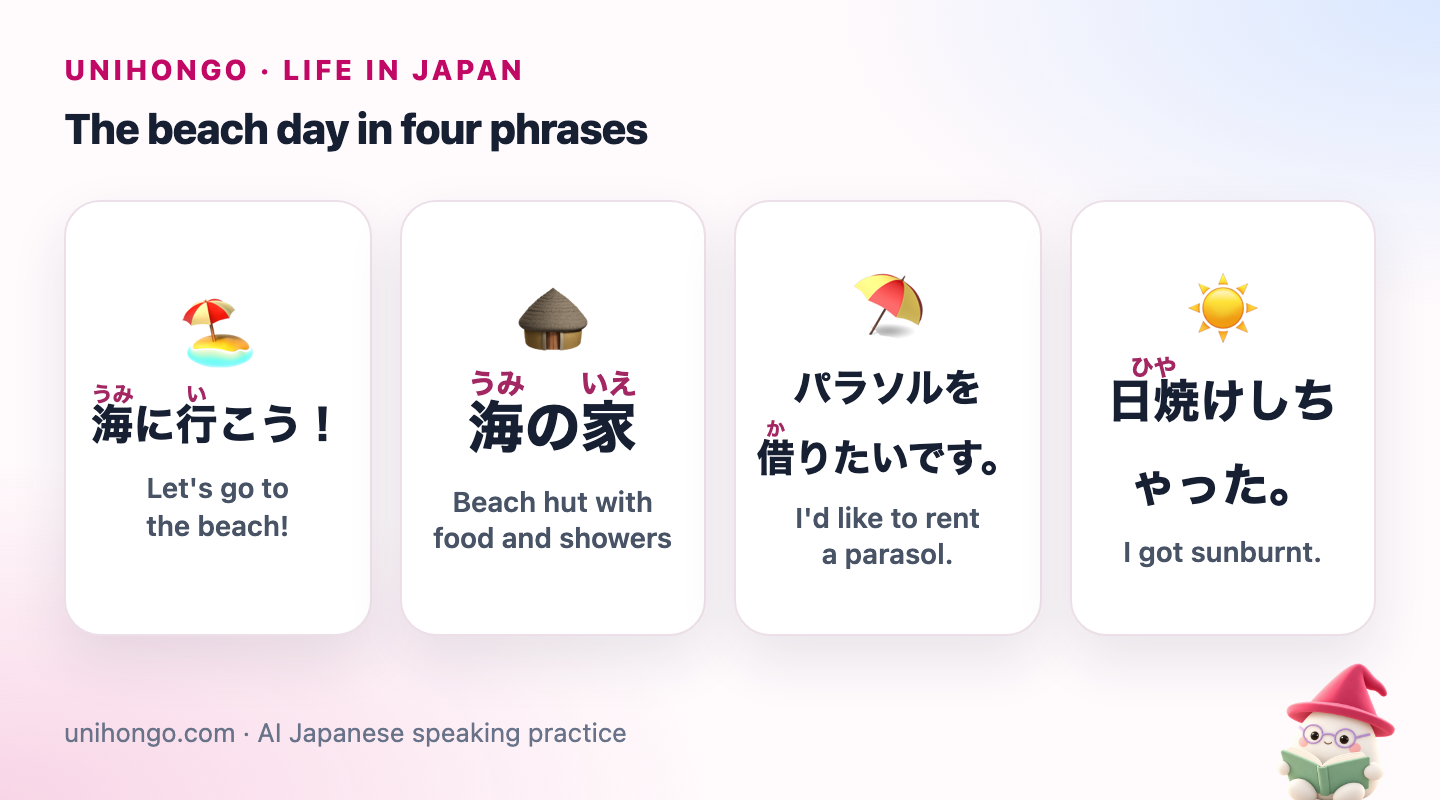
| Japanese | Romaji | Meaning |
|---|---|---|
| 海に行こう! | Umi ni ikō! | Let's go to the beach! |
| 海の家 | umi no ie | Beach hut with food and showers |
| パラソルを借りたいです。 | Parasoru o karitai desu. | I'd like to rent a parasol. |
| 日焼けしちゃった。 | Hiyake shichatta. | I got sunburnt. |
Umi ni ikō uses the volitional form, let's go. Umi ni ikanai?, won't you go?, is softer and leaves room to say no. Kariru (借りる) means to borrow, but it is also the normal verb for renting something for a short time, even when you pay.
Planning the trip with friends
Beach plans are made in group chats, in casual Japanese. Friends will ask what to bring, whether you can swim, and whether it is better to drive or take the train. A swimsuit is mizugi (水着), a beach towel is just taoru, and an inflatable ring is ukiwa (浮き輪). Many young people now wear a long-sleeved rash guard, rasshu gādo, over their swimsuit, partly to avoid the sun.
Beaches near big cities get crowded on summer weekends, so groups often send one person early to claim a spot, which is called bashotori (場所取り). Plan the trip home as well: trains from popular beaches are packed in the late afternoon, and everyone is sandy and tired. A common compromise is to leave before the evening rush and eat dinner somewhere on the way back.
| Japanese | Romaji | Meaning |
|---|---|---|
| 今度の土曜日、海に行かない? | Kondo no doyōbi, umi ni ikanai? | Want to go to the beach this Saturday? |
| 水着、持ってる? | Mizugi, motteru? | Do you have a swimsuit? |
| 泳げる? | Oyogeru? | Can you swim? |
| 浮き輪、持っていくね。 | Ukiwa, motte iku ne. | I'll bring an inflatable ring. |
| 電車で行く?車で行く? | Densha de iku? Kuruma de iku? | Train or car? |
| ごめん、その日はちょっと…。 | Gomen, sono hi wa chotto... | Sorry, that day's a bit difficult... |
At the umi no ie: renting a parasol and more
An umi no ie is part café, part locker room. You can usually rent a parasol, beach chairs or a mat, store your bag, shower off the sand and change clothes. Staff are often students on summer jobs, and the tone is friendly but polite. Use desu and masu forms, and ask about prices for the whole day, ichinichi (一日).
Some huts charge one fee for a rest area with showers and lockers, and rent parasols separately. If you are unsure, ask what is included: ... wa fukumarete imasu ka.
| Japanese | Romaji | Meaning |
|---|---|---|
| パラソルを一本借りたいです。 | Parasoru o ippon karitai desu. | I'd like to rent one parasol. |
| 一日いくらですか。 | Ichinichi ikura desu ka. | How much is it for the day? |
| シャワーは使えますか。 | Shawā wa tsukaemasu ka. | Can I use the shower? |
| ロッカーはありますか。 | Rokkā wa arimasu ka. | Do you have lockers? |
| 更衣室はどこですか。 | Kōishitsu wa doko desu ka. | Where is the changing room? |
| 焼きそばを二つください。 | Yakisoba o futatsu kudasai. | Two yakisoba, please. |
Parasols are counted with -hon (本), the counter for long, thin things: ippon, nihon, sanbon. Chairs are counted with -kyaku (脚) in careful speech, but hitotsu, futatsu is fine at a beach hut.
Flags, lifeguards and warnings
Staffed beaches have lifeguards, often called raifu gādo or kanshiin (監視員), and a lookout tower. Many beaches use coloured flags to show conditions, and red is widely used for no swimming, but the flag system is not the same everywhere, so check the explanation board at the entrance or ask. Announcements over loudspeakers may tell everyone to leave the water when the waves rise or lightning approaches.
Two hazards come up in conversation every summer. A rip current is rigan-ryū (離岸流), a current that pulls you away from the shore. Jellyfish, kurage (クラゲ), are commonly said to increase around Obon in mid-August, and many people stop swimming at that point; how true that is depends on the beach.
| Japanese | Romaji | Meaning |
|---|---|---|
| 遊泳禁止 | yūei kinshi | No swimming |
| 今日は泳げますか。 | Kyō wa oyogemasu ka. | Can we swim today? |
| 波が高いので、海から上がってください。 | Nami ga takai node, umi kara agatte kudasai. | Lifeguard: The waves are high, please leave the water. |
| ブイより先に行かないでください。 | Bui yori saki ni ikanaide kudasai. | Lifeguard: Please don't go beyond the buoys. |
| クラゲに刺された! | Kurage ni sasareta! | I got stung by a jellyfish! |
Mini dialogue: renting a parasol on a busy afternoon
You arrive with two friends and the sand is already crowded. You go to the hut to rent shade. Notice how the staff member uses polite but quick Japanese, and how you can keep up with short, clear answers.
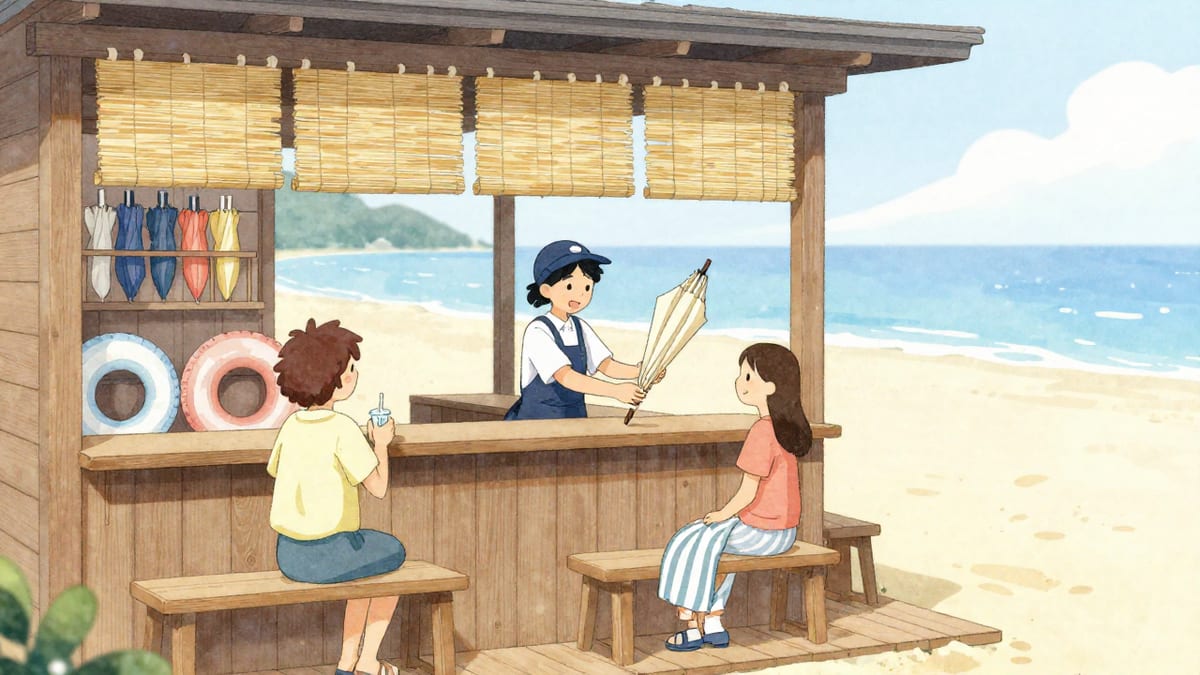
| Japanese | Romaji | Meaning |
|---|---|---|
| いらっしゃいませ。 | Irasshaimase. | Staff: Welcome. |
| パラソルを一本と、椅子を二つお願いします。 | Parasoru o ippon to, isu o futatsu onegai shimasu. | You: One parasol and two chairs, please. |
| 一日でよろしいですか。 | Ichinichi de yoroshii desu ka. | Staff: For the whole day? |
| はい。シャワーも使えますか。 | Hai. Shawā mo tsukaemasu ka. | You: Yes. Can we use the showers too? |
| はい、裏にあります。設置しましょうか。 | Hai, ura ni arimasu. Setchi shimashō ka. | Staff: Yes, round the back. Shall I set it up? |
| お願いします。助かります。 | Onegai shimasu. Tasukarimasu. | You: Yes, please. That's a great help. |
Setchi suru means to set up or install. At busy beaches staff often plant the parasol for you, because a badly fixed one can blow away in the wind.
Sun, sunscreen and sunburn talk
In Japan, many people, especially women, try hard not to tan: hats, arm covers, parasols and sunscreen are normal even on a short walk. At the beach, this leads to a lot of sunscreen conversation. The word hiyake (日焼け) covers both a tan and a burn, so learners need extra words to be clear. Kuroku natta, I got darker, describes a tan. Akaku natta, it went red, and hiri hiri suru, it stings, describe a burn.
| Japanese | Romaji | Meaning |
|---|---|---|
| 日焼け止め、塗った? | Hiyakedome, nutta? | Did you put on sunscreen? |
| 背中に塗ってくれる? | Senaka ni nutte kureru? | Could you do my back? |
| 日焼けしたくないんだ。 | Hiyake shitaku nai n da. | I don't want to get a tan. |
| 背中がヒリヒリする。 | Senaka ga hiri hiri suru. | My back stings. |
| すごく黒くなったね。 | Sugoku kuroku natta ne. | You got really tanned. |
Be careful with comments about someone's skin. Kuroku natta ne is usually friendly among close friends, but a person who tried hard to avoid the sun may not take it as a compliment.
Small talk on the sand and common mistakes
Once the parasol is up, the talk is easy and sensory: the water is cold, the sand is hot, the waves are big. A classic beach game is suikawari (スイカ割り), where a blindfolded player tries to split a watermelon with a stick while friends shout directions. Migi, hidari, massugu: right, left, straight on. Some beaches restrict it, so ask first.
| Japanese | Romaji | Meaning |
|---|---|---|
| 水、冷たい! | Mizu, tsumetai! | The water's cold! |
| 砂が熱い! | Suna ga atsui! | The sand's hot! |
| もうちょっと右! | Mō chotto migi! | A bit more to the right! |
| そろそろ帰ろうか。 | Sorosoro kaerō ka. | Shall we head home soon? |
- Saying bīchi ni ikō. It is understood, but umi ni ikō is what friends say.
- Mixing up kariru and kasu. Kariru is what you do (borrow or rent), kasu is what the hut does (lend). Parasoru o karitai desu and parasoru o kashite kudasai are both fine, but parasoru o kashitai desu means you want to lend one.
- Ignoring flags because the water looks calm. Rip currents are not visible from the beach.
- Assuming hiyake always means a burn. Add hiri hiri or akaku natta to be clear.