
Four lines for any game night
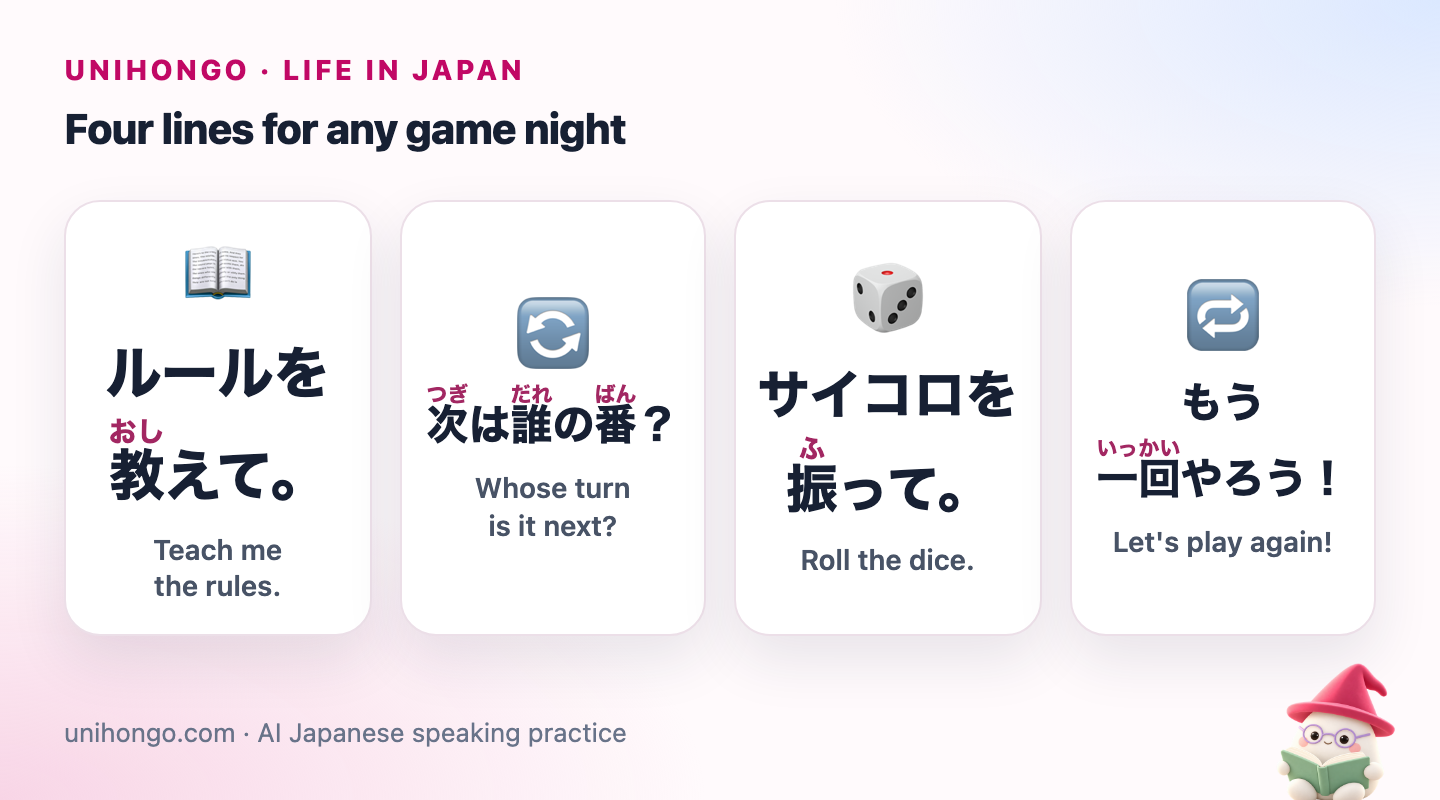
Whatever game is on the table, these four lines come up: asking for the rules, checking whose turn it is, a typical action, and the request for a rematch. They are casual, the register of friends at a table. Polite versions follow later in the guide.
| Japanese | Romaji | Meaning |
|---|---|---|
| ルールを教えて。 | Rūru o oshiete. | Teach me the rules. |
| 次は誰の番? | Tsugi wa dare no ban? | Whose turn is it next? |
| サイコロを振って。 | Saikoro o futte. | Roll the dice. |
| もう一回やろう! | Mō ikkai yarō! | Let's play again! |
Ban (番) means a turn in a sequence, and you will hear it constantly. Saikoro is a die or dice, and the verb is furu, to shake or roll. Learners often say saikoro o nageru, to throw, which is understood but sounds odd.
Understanding the rules when someone explains them
Rule explanations are the hardest part of a game night, because they are long, full of new nouns, and delivered quickly by an enthusiastic friend. You do not need to understand everything. Ask for the goal first, then ask them to play a practice round, which is the fastest way to learn. Checking with tsumari … tte koto?, so you mean …?, shows you are following and gives them a chance to correct you.
| Japanese | Romaji | Meaning |
|---|---|---|
| このゲームの目的は何? | Kono gēmu no mokuteki wa nani? | What's the goal of this game? |
| どうやったら勝ち? | Dō yattara kachi? | How do you win? |
| つまり、カードを全部出したら勝ちってこと? | Tsumari, kādo o zenbu dashitara kachi tte koto? | So you win when you've played all your cards? |
| もう一回説明してくれる? | Mō ikkai setsumei shite kureru? | Can you explain once more? |
| 一回、練習でやってみよう。 | Ikkai, renshū de yatte miyō. | Let's do one practice round. |
Turns, dice and cards
Turn order is often decided with rock-paper-scissors, janken (じゃんけん), and play usually goes clockwise, tokeimawari (時計回り). Cards have their own verbs: you draw (hiku, 引く), deal (kubaru, 配る), shuffle (shaffuru suru) and play or put down (dasu, 出す). If you forget whose turn it is, so does everyone else at some point.
| Japanese | Romaji | Meaning |
|---|---|---|
| じゃんけんで決めよう。 | Janken de kimeyō. | Let's decide with rock-paper-scissors. |
| 時計回りね。 | Tokeimawari ne. | Clockwise, OK? |
| 私の番だ。 | Watashi no ban da. | It's my turn. |
| 次、どうぞ。 | Tsugi, dōzo. | Your turn, go ahead. |
| 六が出た! | Roku ga deta! | I rolled a six! |
| Action | Japanese | Example |
|---|---|---|
| Draw a card | 引く hiku | Ichimai hiite: draw one |
| Deal | 配る kubaru | Watashi ga kubaru ne: I'll deal |
| Play a card | 出す dasu | Kore o dasu: I'll play this |
| Skip a turn | パスする pasu suru | Pasu shimasu: I pass |
| Roll the dice | 振る furu | Roku ga deta: I rolled a six |
Winning and losing gracefully
Japanese has a precise word for the sting of losing: kuyashii (悔しい). It is said with a laugh at the table and shows you cared about the game, so it is a good thing to say. Winners are often modest, putting it down to luck: tamatama, it just happened, or bigināzu rakku, beginner's luck. Teasing a strong player with tsuyosugi!, you're too good!, is a compliment.
| Japanese | Romaji | Meaning |
|---|---|---|
| 勝った! | Katta! | I won! |
| 負けた…。 | Maketa... | I lost... |
| 悔しい! | Kuyashii! | So frustrating! |
| 強すぎる! | Tsuyosugiru! | You're way too good! |
| たまたまだよ。 | Tamatama da yo. | It was just luck. |
| 手加減して! | Tekagen shite! | Go easy on me! |
Katta means I won (from katsu), but the same sound also means I bought (from kau); at a game table, context makes it clear. Maketa is for losing a game or a match. For losing an object, such as a card that fell under the table, the verb is nakusu.
At a board game café: choosing a game
At a board game café, staff usually ask how many people are in your group and how long you plan to stay, then show you to a table near the shelves. Many cafés have staff who know every game and will recommend one for your group size and level, and some will teach it at the table. Ask for a game that does not depend on reading, and tell them it is your first time.
A few manners are worth knowing. Count the pieces, koma (駒), back into the box when you finish, because a missing piece ruins the game for the next group. Keep drinks and snacks away from the cards, and wipe your hands before you play. Saying shitsurei shimashita if you knock something over is enough; people are relaxed.
| Japanese | Romaji | Meaning |
|---|---|---|
| 四人でできるゲームはありますか。 | Yonin de dekiru gēmu wa arimasu ka. | Do you have games for four people? |
| 初心者でもできるゲームはどれですか。 | Shoshinsha demo dekiru gēmu wa dore desu ka. | Which games work for beginners? |
| 文字が少ないゲームがいいです。 | Moji ga sukunai gēmu ga ii desu. | A game with little text would be good. |
| ルールを説明してもらえますか。 | Rūru o setsumei shite moraemasu ka. | Could you explain the rules? |
Mahjong basics: the calls you will hear
Japanese mahjong, mājan (麻雀), is played by four people with tiles, and it has its own rules, such as rīchi. You cannot learn the game from a blog post, but you can learn the calls, which players say out loud when they claim a tile or win. Knowing them lets you follow the table and join a beginners' session at a mahjong parlour or an online game with friends.
| Call | When you say it | Meaning |
|---|---|---|
| ポン pon | Another player discards a tile you have two of | Claim it to make three of a kind |
| チー chī | The player on your left discards a tile you need | Claim it to make a run of three |
| リーチ rīchi | Your hand is one tile from complete and you have claimed no tiles | Declare you are ready |
| ロン ron | Another player discards your winning tile | Win on their discard |
| ツモ tsumo | You draw your winning tile yourself | Win on your own draw |
Some beginners' sessions call themselves nōreto, no money stakes, to make clear that the game is for fun. Betting money on mahjong is illegal in Japan, and casual games among friends are typically played just for points. When you are new, say shoshinsha desu, I'm a beginner, and people will help you.
Mini dialogue: learning a new game at a board game café
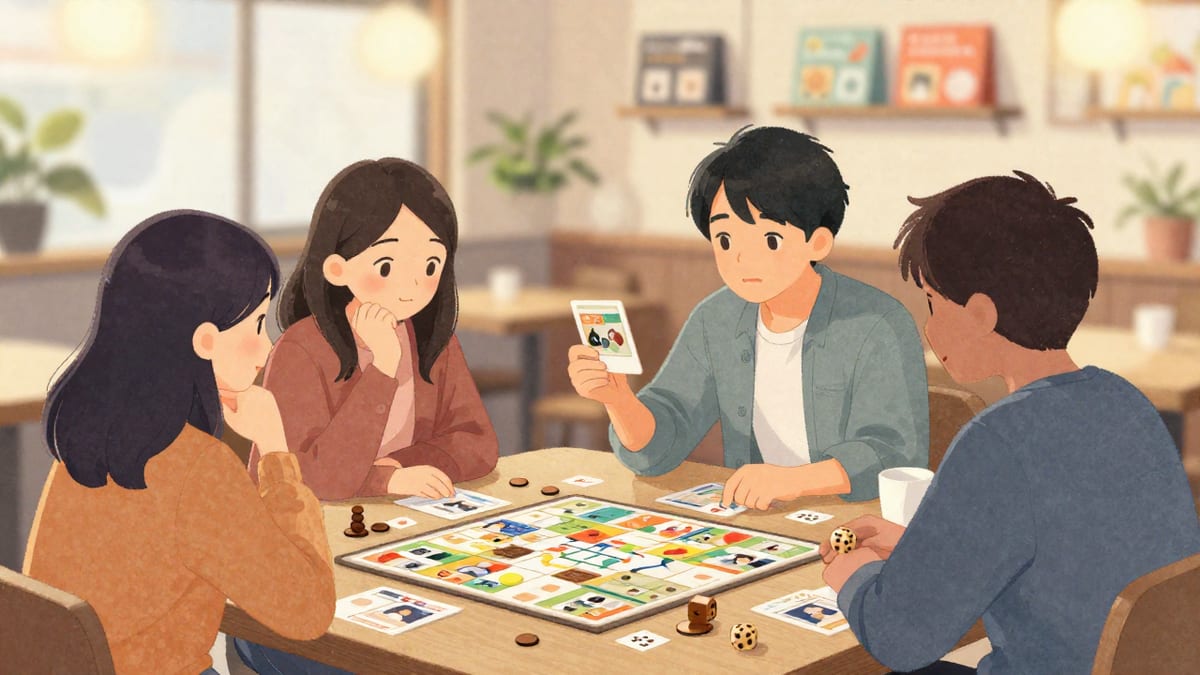
You are at a board game café with two Japanese friends and a stack of colourful boxes. One friend chooses a card game and starts explaining. Notice how you keep the explanation manageable with short questions.
| Japanese | Romaji | Meaning |
|---|---|---|
| これ、やったことある? | Kore, yatta koto aru? | Friend: Have you played this before? |
| ないよ。ルールを教えて。 | Nai yo. Rūru o oshiete. | You: No. Teach me the rules. |
| 同じ色か同じ数字のカードを出していくんだ。 | Onaji iro ka onaji sūji no kādo o dashite iku n da. | Friend: You play cards of the same colour or number. |
| つまり、出せなかったら一枚引くってこと? | Tsumari, dasenakattara ichimai hiku tte koto? | You: So if you can't play, you draw one? |
| そう!わかってるじゃん。 | Sō! Wakatteru jan. | Friend: Yes! You've got it. |
| じゃあ、始めよう。私から? | Jā, hajimeyō. Watashi kara? | You: Then let's start. Me first? |
Jan at the end of a sentence is casual, a friendly you know or see?, and is common among younger speakers. Watashi kara?, from me?, is a quick way to ask whether you start.
The most useful move in this dialogue is the check with tsumari … tte koto? You restate the rule in your own words, and your friend either confirms or corrects you. It turns a one-way explanation into a conversation, which is easier to follow and much better speaking practice than nodding along.
Polite versions and common mistakes
With coworkers you have just met, or at a café event with strangers, start in polite Japanese and let the table relax the tone. The game-specific words stay the same; only the endings change.
| Japanese | Romaji | Meaning |
|---|---|---|
| ルールを教えていただけますか。 | Rūru o oshiete itadakemasu ka. | Could you teach me the rules? |
| 私の番ですか。 | Watashi no ban desu ka. | Is it my turn? |
| もう一回やりませんか。 | Mō ikkai yarimasen ka. | Shall we play another round? |
- Using junban for a single turn. Junban is the order of play; one turn is ban.
- Saying saikoro o nageru. The natural verb is furu.
- Pretending to understand the rules. Asking for a practice round is normal and appreciated.
- Taking defeat too seriously. Kuyashii! with a smile is the right tone.