
Why roleplay beats free chat for Japanese speaking practice
Free chat has no edges. You can steer every question towards a topic you like, avoid counters and keigo, and never discover that you cannot ask for a receipt. A roleplay draws the edges for you. A pharmacy forces symptom vocabulary; a restaurant phone call forces dates, times, and the phrases people use when they cannot hear you. The scenario decides what you need, which is usually what you avoid.
Roleplay also trains register and pressure. Japanese changes shape depending on whether you address a friend, a clerk, or a manager, and free chat rarely makes you switch. In a roleplay the AI plays a specific person, so desu and masu, casual forms, or humble keigo become a live decision rather than a grammar table. And someone is waiting for an answer. That small pressure, repeated safely, is what makes real conversations feel slower and more manageable.
Beginner roleplay scenarios: short exchanges with fixed phrases
- Cafe order: order a drink and a size, then ask how much it costs using o kudasai and ikura desu ka.
- Convenience store: answer the clerk about a bag, warming your food, and payment with short replies.
- Asking directions: ask where the station is and confirm each turn with migi and hidari, then repeat the route back.
- Hotel check-in: give your name, confirm the nights, and ask about breakfast time with desu and arimasu ka.
- Train ticket: name your destination, ask which platform to use, and check the fare with made and doko desu ka.
- Introducing yourself: give your name, country, job, and one hobby, then ask the other person the same questions.
- Buying a SIM card: explain your length of stay and how much data you want, then ask the monthly price.
- Pharmacy: describe a headache or cold using ga itai desu and ask for a medicine you can take safely.
Intermediate roleplay scenarios: explaining and negotiating details
- Doctor visit: describe when symptoms started and how long they lasted using kara and te-form sequences.
- Apartment viewing: ask about rent, deposit, the station, and pet rules with arimasu ka and dekimasu ka.
- Phone reservation: book a table for a date and time, spell your name, and offer alternatives if it is full.
- Returning an item: explain what is wrong with a purchase and ask for a refund or exchange using n desu ga.
- Making weekend plans: suggest an activity, respond to a counter-proposal, and fix a time and place with mashō ka.
- Job interview basics: outline your background and explain why you want the role with te imasu and kara desu.
- Explaining a problem to a landlord: report a broken tap with te shimaimashita and ask when it can be fixed.
- Small talk with a coworker: comment on the weather or weekend and keep it going with sō desu ne and a follow-up question.
Advanced roleplay scenarios: opinions, repair, and workplace register
- Negotiating a deadline: request an extension with reasons and offer a compromise using itadakemasen ka and humble forms.
- Giving feedback to a colleague: open with something positive and phrase suggestions as tara dō deshō ka.
- Discussing news: summarise a recent story and give a measured opinion using ni yoru to and to omoimasu.
- Apologising for a mistake at work: apologise formally, explain the cause without excuses, and promise a fix with yō ni shimasu.
- Explaining your opinion in a meeting: state a position, concede a point with tashika ni, then defend it in keigo.
- Handling a customer complaint: listen, apologise with mōshiwake gozaimasen, and offer a solution using sasete itadakimasu.
- Giving a short presentation: structure three minutes with mazu, tsugi ni, and saigo ni, then take one question.
- Describing a cultural difference: compare a custom at home with Japan without judging, using ni kurabete and to chigatte.
- Talking through a misunderstanding: clarify what you meant, ask what was understood, and repair with tsumori deshita.
How to set up a roleplay with an AI tutor
A good setup has four parts: the AI's role, your level, your goal, and the stop conditions. Say them in one or two sentences before you begin: 'You are a hotel receptionist. I am an N4 learner, so use short sentences. My goal is to check in, confirm two nights, and ask about breakfast. Stay in character until I say owarimashita.' The role fixes the register, the level fixes the difficulty, and the goal tells you both when the scenario is finished.
Stop conditions matter more than people expect. Without them an AI tutor may break character to explain grammar after every line, turning speaking practice back into reading. Ask it to save corrections until the end, or to interrupt only when a mistake changes the meaning. Apps built around roleplay missions, such as the cafe, hotel, and interview missions in Unihongo, handle this for you, but the same instructions work anywhere.
Rescue phrases that keep the roleplay in Japanese
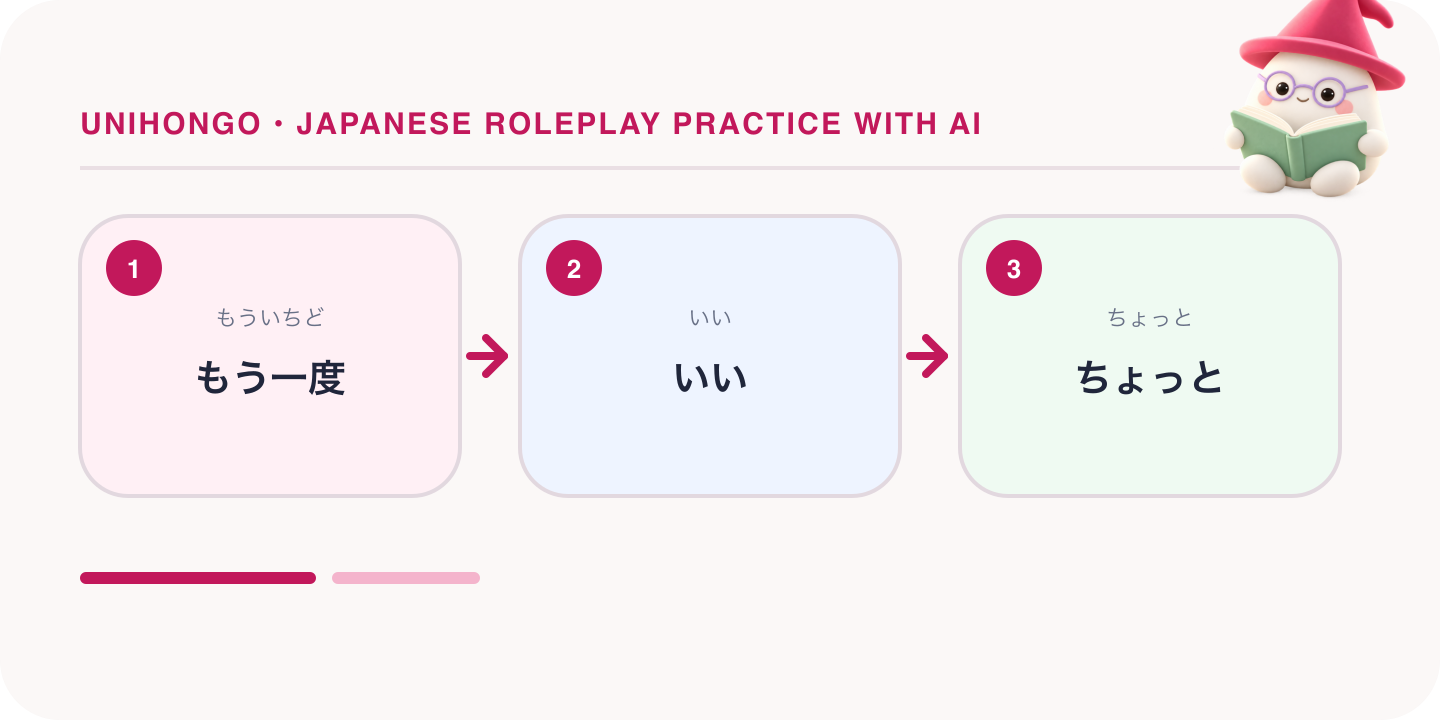
The moment you switch to English, the scenario loses most of its value. These phrases let you slow down, buy time, confirm meaning, or propose an alternative while staying in Japanese. Say them aloud before your first roleplay and keep them visible during early sessions. Practise them until they arrive without thought, because you will need them precisely when thinking is hardest.
| Japanese | Romaji | Meaning |
|---|---|---|
| すみません、もう一度いいですか。 | Sumimasen, mō ichido ii desu ka. | Sorry, could you say that once more? |
| ちょっと考えさせてください。 | Chotto kangaesasete kudasai. | Let me think for a moment. |
| つまり、明日は休みということですか。 | Tsumari, ashita wa yasumi to iu koto desu ka. | So you mean tomorrow is a day off? |
| 現金でもいいですか。 | Genkin demo ii desu ka. | Is cash all right? |
| もう少しゆっくり話してもらえますか。 | Mō sukoshi yukkuri hanashite moraemasu ka. | Could you speak a little more slowly? |
| それは日本語で何と言いますか。 | Sore wa Nihongo de nan to iimasu ka. | How do you say that in Japanese? |
| すみません、言い直します。 | Sumimasen, iinaoshimasu. | Sorry, let me say that again. |
| ちょっと自信がないんですが、水曜日でいいですか。 | Chotto jishin ga nai n desu ga, suiyōbi de ii desu ka. | I am not quite sure, but is Wednesday all right? |
Repeating scenarios with variation
The first run of any scenario is a diagnosis. You discover that you cannot say 'deposit' or that you froze when the receptionist asked something unexpected. Review the session report, choose two corrections, and run the scenario again straight away using them. The second run should feel noticeably easier. Judge yourself on how much the second attempt improved, not on the first.
After that, change one variable each time you return: the item, the number, the problem, the relationship, or the outcome. Order tea instead of coffee, book for four instead of two, let the landlord refuse, or swap the coworker for a manager. Variation proves you learned a pattern rather than a script. When a scenario feels automatic across three versions, retire it and move up a level.