
Why the Japanese stays in the room
When an art is taught abroad, the technical vocabulary usually travels with it. Instructors keep the Japanese because a single word names a movement precisely, because it links their class to the tradition they learned in, and because it works across languages when students come from everywhere. The practical result is that a beginner spends the first weeks half deaf, catching a name here and a number there.
The good news is how narrow the vocabulary is. A class uses perhaps thirty words in total, and it uses them in the same order every time. Once you can hear them, the instruction stops feeling like a foreign language and starts feeling like a familiar sequence with technical names attached. Everything below is standard enough to be useful, but customs differ by art, by school and by teacher, so treat your own dojo as the authority.
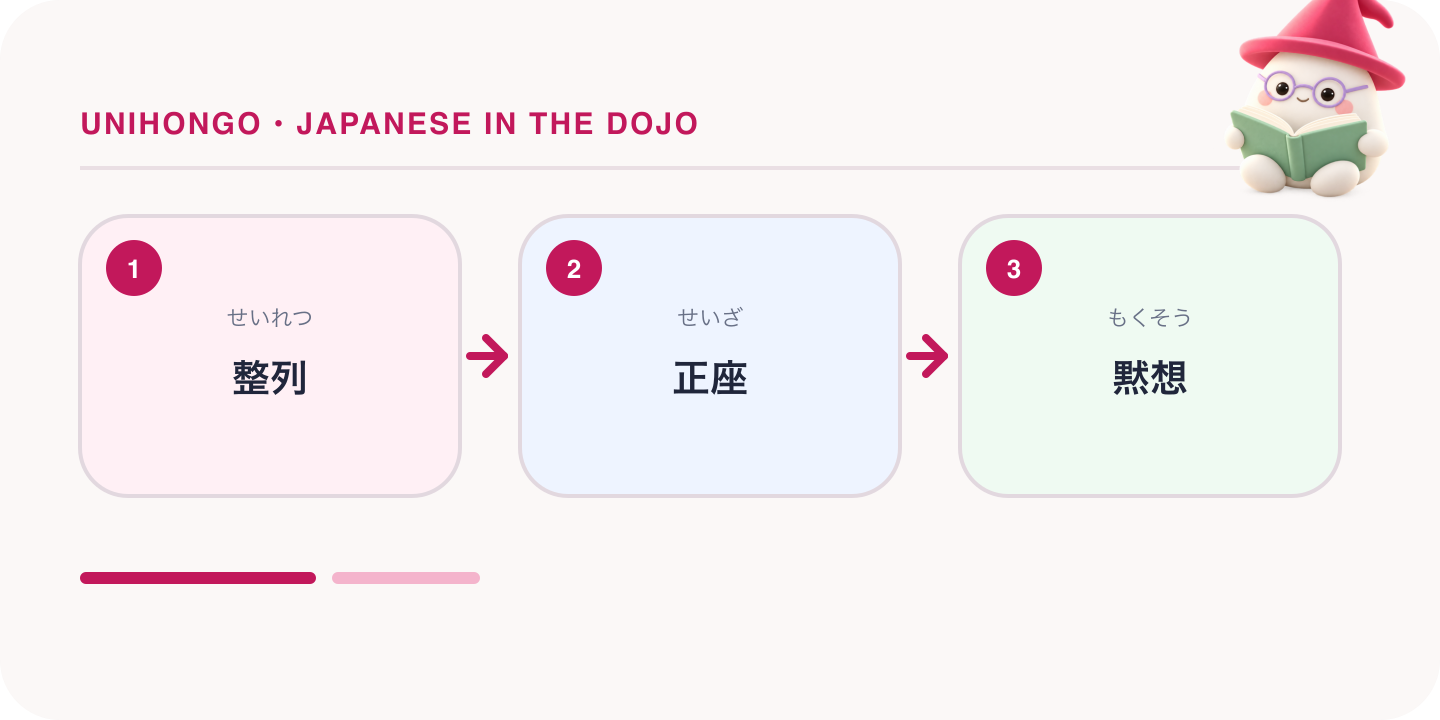
Commands you have to obey instantly
| Command | Reading | What to do |
|---|---|---|
| 整列 | Seiretsu | Line up, usually by grade |
| 正座 | Seiza | Kneel formally, sitting back on your heels |
| 黙想 | Mokusō | Sit still, eyes closed, breathe and settle |
| 黙想やめ | Mokusō yame | Open your eyes, meditation is over |
| 礼 | Rei | Bow |
| 起立 | Kiritsu | Stand up |
| 気をつけ | Ki o tsuke | Stand to attention, feet together |
| 休め | Yasume | At ease, relax the stance |
| 構えて | Kamaete | Take your stance or guard |
| 用意 | Yōi | Get ready, the command is coming |
| 始め | Hajime | Begin now |
| 止め | Yame | Stop immediately |
| 待て | Mate | Wait, hold where you are |
| そのまま | Sono mama | Freeze, stay exactly as you are |
| 直れ | Naore | Return to the neutral position |
| 続けて | Tsuzukete | Carry on, keep going |
| 交代 | Kōtai | Swap roles or change partners |
| 反対 | Hantai | Now do the other side |
| もう一度 | Mō ichido | One more time |
| 下がって | Sagatte | Step back |
| 前へ | Mae e | Move forward |
| 早く | Hayaku | Faster |
| ゆっくり | Yukkuri | Slowly |
| あと一回 | Ato ikkai | One repetition left |
Yame and mate are the two you must never miss, because both mean the movement stops now and both are used for safety. Sono mama is different again: it means do not move at all, usually because the instructor wants to correct a position while it is still wrong. Learners who translate before reacting always arrive a second late, which in partner work is the second that matters.
Not every art uses every command. Grappling classes lean on hajime, mate and yame; striking classes add kamaete and naore; weapon classes have a whole vocabulary of their own. Learn the ones your instructor actually says and ignore the rest until you meet them.
The opening sequence, line by line
Most classes open with a fixed ritual: line up, kneel, settle, then a short series of bows. The wording varies, and some dojo bow to the front of the room, some to a scroll or a shelf, some only to the instructor and each other. The pattern below is common enough to recognise almost anywhere, but follow the person next to you rather than this page.
| Japanese | Romaji | Meaning |
|---|---|---|
| 整列してください。 | Seiretsu shite kudasai. | Line up, please. (instructor) |
| 正座。 | Seiza. | Kneel. (instructor) |
| 黙想。 | Mokusō. | Close your eyes and settle. (instructor) |
| 正面に礼。 | Shōmen ni rei. | Bow to the front. (instructor) |
| 先生に礼。 | Sensei ni rei. | Bow to the teacher. (instructor) |
| お互いに礼。 | Otagai ni rei. | Bow to each other. (instructor) |
| お願いします。 | Onegaishimasu. | Please teach me. / Let's train. |
| よろしくお願いします。 | Yoroshiku onegaishimasu. | I look forward to training with you. |
| はい。 | Hai. | Yes. / Understood. |
Onegaishimasu is the single most useful word in the room. It opens the class, it opens every partner drill, and it is what you say when you ask an instructor to look at you. Its closing counterpart is arigatō gozaimashita, in the past form, because you are thanking someone for something that has finished.
Closing the class and leaving the mat
| Japanese | Romaji | Meaning |
|---|---|---|
| ありがとうございました。 | Arigatō gozaimashita. | Thank you for the training. |
| 先生、ありがとうございました。 | Sensei, arigatō gozaimashita. | Thank you, sensei. |
| お疲れ様でした。 | Otsukaresama deshita. | Good work today. |
| 失礼します。 | Shitsurei shimasu. | Excuse me. (said on entering or leaving) |
| お先に失礼します。 | Osaki ni shitsurei shimasu. | Excuse me for leaving before you. |
| また来週お願いします。 | Mata raishū onegaishimasu. | See you next week. |
Shitsurei shimasu is the phrase for crossing a boundary: stepping onto the mat, stepping off it, entering the room late or leaving early. Otsukaresama deshita is not specific to martial arts at all; it is the standard thing Japanese speakers say to each other after any shared effort, and in a dojo it is aimed at your training partners as much as the teacher.
Counting the repetitions
Repetitions are counted aloud, usually by the instructor with the class answering, and sometimes by the students in turn. Two series appear. The Sino-Japanese series ichi, ni, san is the general one and by far the more common. The older native series hitotsu, futatsu, mittsu is used in some arts and some schools, often for kata repetitions or warm-up counts. Note that in counting drills the fourth, seventh and ninth numbers are usually said shi, shichi and ku rather than yon, nana and kyū, which is the reverse of what many textbooks teach for everyday counting.
| Japanese | Romaji | Meaning |
|---|---|---|
| 十回お願いします。 | Jukkai onegaishimasu. | Ten repetitions, please. (instructor) |
| もう十回。 | Mō jukkai. | Ten more. (instructor) |
| 最後の一回です。 | Saigo no ikkai desu. | This is the last one. (instructor) |
| 何回ですか。 | Nankai desu ka? | How many repetitions? |
| Number | Sino-Japanese | Native series |
|---|---|---|
| 1 | Ichi | Hitotsu |
| 2 | Ni | Futatsu |
| 3 | San | Mittsu |
| 4 | Shi | Yottsu |
| 5 | Go | Itsutsu |
| 6 | Roku | Muttsu |
| 7 | Shichi | Nanatsu |
| 8 | Hachi | Yattsu |
| 9 | Ku | Kokonotsu |
| 10 | Jū | Tō |
| 20 | Nijū | Not used past ten |
| 30 | Sanjū | Not used past ten |
Past ten the native series is not used for this, so a set of twenty is counted nijū and a set of thirty sanjū. If you want the everyday counters for objects and people rather than repetitions, the numbers and counters guide on this blog covers them properly.
Teacher, senior, and how to address people
Sensei is the normal way to address the person teaching, used on its own or after a surname, and you never add san to it. Senpai means someone senior to you in the group and kōhai someone junior, though only senpai is used as a form of address. Some schools use further titles such as shihan or kanchō for senior instructors or the head of an organisation, and these carry different meanings in different arts, so use whatever your dojo uses and nothing more.
| Japanese | Romaji | Meaning |
|---|---|---|
| 先生、質問があります。 | Sensei, shitsumon ga arimasu. | Sensei, I have a question. |
| 田中先生、お願いします。 | Tanaka-sensei, onegaishimasu. | Tanaka-sensei, please train with me. |
| 先輩、教えていただけますか。 | Senpai, oshiete itadakemasu ka? | Senpai, could you show me? |
| すみません、もう一度お願いします。 | Sumimasen, mō ichido onegaishimasu. | Sorry, could you do that once more? |
| ゆっくりお願いできますか。 | Yukkuri onegai dekimasu ka? | Could you do it slowly, please? |
| 見せていただけますか。 | Misete itadakemasu ka? | Could you show me? |
| 分かりました。 | Wakarimashita. | I understand. |
| すみません、分かりませんでした。 | Sumimasen, wakarimasen deshita. | Sorry, I did not understand that. |
The room, the mat, and your kit
The training hall is the dōjō, the mat surface is usually tatami in grappling arts and a wooden or sprung floor elsewhere, and the front of the room is the shōmen. Many dojo treat the front as the respected side and the door side as the lower side, which is why students line up facing the front and senior grades stand at one end. Uniforms are called dōgi or keikogi depending on the art, the belt is the obi, and weapon and armour vocabulary is specific to each discipline.
| Word | Reading | Meaning |
|---|---|---|
| 道場 | Dōjō | Training hall |
| 正面 | Shōmen | The front of the hall |
| 畳 | Tatami | Mat |
| 稽古 | Keiko | Training, practice |
| 準備運動 | Junbi undō | Warm-up |
| 受け身 | Ukemi | Breakfalls, learning to land |
| 技 | Waza | Technique |
| 型 / 形 | Kata | Set form or pattern |
| 道着 | Dōgi | Training uniform |
| 帯 | Obi | Belt |
| 更衣室 | Kōishitsu | Changing room |
| 休憩 | Kyūkei | Break |
Shoes come off before the training area in essentially every dojo, and in many the sequence is shoes off at the entrance, then a short bow before stepping on and after stepping off. Watch what regulars do at the edge of the mat and copy it; it is the single fastest way to look like you belong.
What you say to your partner
Partner work is bracketed by two phrases: onegaishimasu at the start and arigatō gozaimashita at the end, both with a bow. In between you may need to slow things down, ask for another go, or check that someone is all right. These lines are short on purpose, because nobody wants a speech in the middle of a round.
| Japanese | Romaji | Meaning |
|---|---|---|
| お願いします。 | Onegaishimasu. | Please train with me. |
| よろしくお願いします。 | Yoroshiku onegaishimasu. | Nice to work with you. |
| ありがとうございました。 | Arigatō gozaimashita. | Thank you for the round. |
| もう一回いいですか。 | Mō ikkai ii desu ka? | Can we go one more time? |
| ゆっくりやりましょう。 | Yukkuri yarimashō. | Let's take it slowly. |
| 軽くお願いします。 | Karuku onegaishimasu. | Lightly, please. |
| 初めてです。 | Hajimete desu. | This is my first time. |
| 初心者です。 | Shoshinsha desu. | I am a beginner. |
| ここ、痛いです。 | Koko, itai desu. | It hurts here. |
| ちょっと待ってください。 | Chotto matte kudasai. | Please wait a moment. |
| 交代しましょう。 | Kōtai shimashō. | Let's swap. |
| 大丈夫ですか。 | Daijōbu desu ka? | Are you all right? |
| 大丈夫です。 | Daijōbu desu. | I am fine. |
Karuku onegaishimasu, meaning lightly please, is worth memorising before your first class. It is a normal request between adults of different sizes and experience, and no reasonable partner will think less of you for making it. In grappling, a tap is the universal signal and the words follow afterwards, not instead.
Apologising for a mistake or an accidental hit
Contact happens, and the expected response is immediate and short. Stop moving, look at the person, apologise and check on them. Sumimasen covers almost every case in the dojo; gomen nasai is softer and more personal and works with people you know; mōshiwake arimasen is very formal and is more likely aimed at an instructor than a training partner. What matters more than the exact word is that you stop first and say it second.
| Japanese | Romaji | Meaning |
|---|---|---|
| すみません。 | Sumimasen. | Sorry. / Excuse me. |
| すみません、大丈夫ですか。 | Sumimasen, daijōbu desu ka? | Sorry, are you all right? |
| 痛くありませんでしたか。 | Itaku arimasen deshita ka? | Did that hurt? |
| わざとではありません。 | Wazato de wa arimasen. | That was not on purpose. |
| 気をつけます。 | Ki o tsukemasu. | I will be careful. |
| ごめんなさい。 | Gomen nasai. | I'm sorry. (softer, more personal) |
| 申し訳ありません。 | Mōshiwake arimasen. | I sincerely apologise. (formal) |
| 少し休みます。 | Sukoshi yasumimasu. | I am going to rest for a moment. |
| 水を飲んでもいいですか。 | Mizu o nonde mo ii desu ka? | May I get some water? |
Belts, grades, and testing
Many arts organise progress in kyū grades below black belt and dan grades above it, with kyū numbers counting down as you improve and dan numbers counting up. Not every art uses belts at all, and the number of grades, the colours, the time between them and what a test contains are decided by the school or federation. Do not assume anything from one dojo transfers to another, and ask your own instructor what your grading involves rather than trusting a general description.
| Japanese | Romaji | Meaning |
|---|---|---|
| 審査はいつですか。 | Shinsa wa itsu desu ka? | When is the grading? |
| 昇級審査を受けたいです。 | Shōkyū shinsa o uketai desu. | I would like to take the next kyū grading. |
| 何級ですか。 | Nankyū desu ka? | What kyū grade are you? |
| 三級です。 | Sankyū desu. | I am third kyū. |
| 黒帯を目指しています。 | Kuro-obi o mezashite imasu. | I am working toward a black belt. |
| 帯の結び方を教えてください。 | Obi no musubikata o oshiete kudasai. | Please show me how to tie the belt. |
| 今日は見学してもいいですか。 | Kyō wa kengaku shite mo ii desu ka? | May I just watch today? |
| 怪我をしているので無理はしません。 | Kega o shite iru node muri wa shimasen. | I am injured, so I will not push it today. |
| 遅れてすみません。 | Okurete sumimasen. | Sorry I am late. |
Arriving late is handled by watching rather than walking in: most dojo expect you to kneel at the edge, wait for the instructor to acknowledge you, bow, and then join. Kengaku, meaning observing a class rather than taking part, is a normal and accepted thing to ask for, whether you are injured or just deciding whether to join.
Where schools differ, and what to do about it
- The bowing sequence: what the class bows to, how many bows and in what order all vary.
- Acknowledgements: some schools answer everything with osu, others with hai, others with nothing at all.
- Titles: sensei is near universal, but shihan, kanchō and similar titles mean different things in different organisations.
- Counting: which series is used, and whether students count along or stay silent.
- Grading: colours, intervals and test content are set by the school or federation, not by the language.
- The right move in a new dojo is to arrive early, watch the first five minutes, and copy the mid-grade students rather than the beginners.
None of this vocabulary is a rulebook. It is a shared shorthand that different schools use slightly differently, and the polite assumption is always that your own teacher is right about their own room. If you train abroad or visit another dojo, saying hajimete desu and onegaishimasu at the door will do more for you than a perfect accent.