
Why a filled pause helps
A silent pause is ambiguous: perhaps you are thinking, perhaps you did not understand, or perhaps your turn is over. A filler signals that speech is still coming. This is especially valuable in a second language, where retrieving a verb ending can take longer than the listener expects.
Fillers also manage social delicacy. Ano before a request warns the listener that you are about to introduce something; maa can present a judgement as measured rather than absolute. The best fillers are not decorations. They tell the listener what kind of pause or statement is happening.
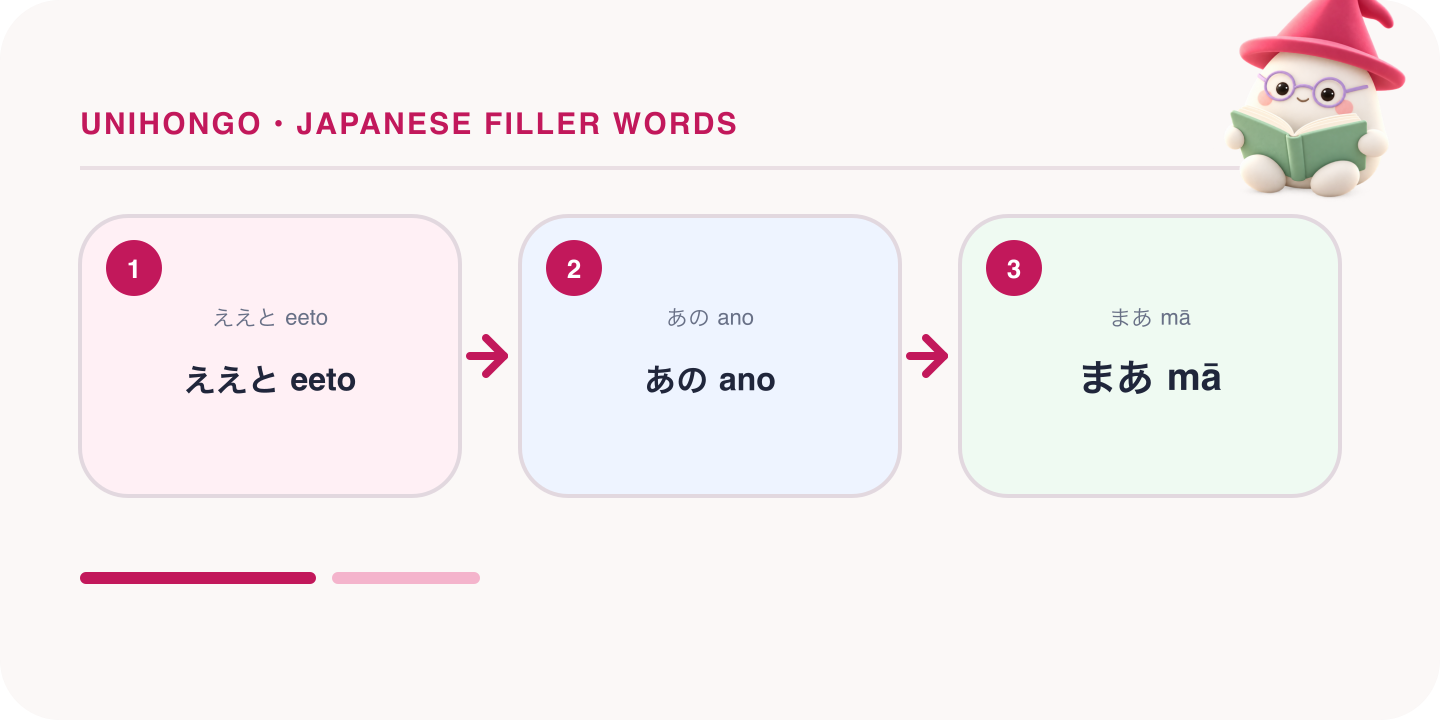
The essential filler map
| Filler | Main job | Register |
|---|---|---|
| ええと eeto | Search for an answer or recall information | Neutral |
| あの ano | Prepare a question, request, or delicate opening | Neutral |
| まあ mā | Soften an evaluation; well... | Neutral to casual |
| なんか nanka | Loosely frame or soften; kind of... | Casual |
| その sono | Search while referring to an idea; that... | Neutral |
| というか to iu ka | Repair or reframe; or rather... | Conversational |
| つまり tsumari | Summarise; in other words... | Neutral |
Eeto for recall, ano for approach
| Japanese | Romaji | Meaning |
|---|---|---|
| ええと、何時でしたか? | Eeto, nan-ji deshita ka? | Um, what time was it? |
| ええと、田中さんだと思います。 | Eeto, Tanaka-san da to omoimasu. | Let me see, I think it was Tanaka. |
| あの、ちょっと質問があります。 | Ano, chotto shitsumon ga arimasu. | Um, I have a quick question. |
| あの、駅はどこですか? | Ano, eki wa doko desu ka? | Excuse me, where is the station? |
These overlap, but the mental picture helps: eeto looks inward for content; ano reaches outward to begin an interaction or raise a topic. Neither needs a literal translation in the final sentence.
Maa, nanka, and to iu ka add stance
| Japanese | Romaji | Meaning |
|---|---|---|
| まあ、悪くないと思います。 | Mā, warukunai to omoimasu. | Well, I do not think it is bad. |
| なんか、ちょっと違う気がします。 | Nanka, chotto chigau ki ga shimasu. | Somehow, it feels a little different. |
| 難しいというか、時間がかかります。 | Muzukashii to iu ka, jikan ga kakarimasu. | It is not so much difficult as time-consuming. |
| つまり、明日は無理です。 | Tsumari, ashita wa muri desu. | In other words, tomorrow is not possible. |
Unlike a pure hesitation sound, these expressions shape the message. Nanka is casual and can become a verbal habit. To iu ka revises the label you just used, and tsumari promises a summary; use it only when a summary actually follows.
Repair phrases are better than panic
| Japanese | Romaji | Meaning |
|---|---|---|
| 何と言えばいいかな。 | Nan to ieba ii kana. | How should I put it? |
| 日本語で何と言いますか? | Nihongo de nan to iimasu ka? | How do you say it in Japanese? |
| 言い方を変えると… | Iikata o kaeru to... | To put it another way... |
| すみません、言い間違えました。 | Sumimasen, iimachigaemashita. | Sorry, I misspoke. |
When the pause comes from a missing word or a wrong start, name the problem. A repair phrase gives the listener a useful role and keeps you in Japanese longer than switching languages immediately.
How to avoid filler overload
- Use one filler at the start of a planning pause, not a chain of eeto-ano-maa.
- Finish a short sentence instead of filling while you design a complicated one.
- Record a minute of free speech and count each filler; repeated habits become obvious on paper.
- Replace some fillers with a breath or a short silent pause once your turn is clearly established.
- Copy fillers from speakers close to your age and setting, not from one dramatic media character.