

Why three cells in the kana chart break the pattern
The hiragana chart looks perfectly regular until you say it aloud. In the s row you expect sa, si, su, se, so, but the second cell is shi. In the t row you get chi and tsu instead of ti and tu. In the z row, the second cell is ji, not zi. This is not an accident of spelling. Before the vowel i, the tongue rises towards the hard palate, and over centuries the s, t and z sounds in that position shifted to shi, chi and ji. The kana kept their place in the grid; the sound moved.
The practical consequence is that these three sounds are palatal: the blade of the tongue, the flat part just behind the tip, does the work, and the tip stays low behind the bottom teeth. English sh, ch and j are often made with the tongue tip raised and the lips rounded. The difference is small enough that you will be understood, but large enough that you will sound noticeably foreign until you fix it.
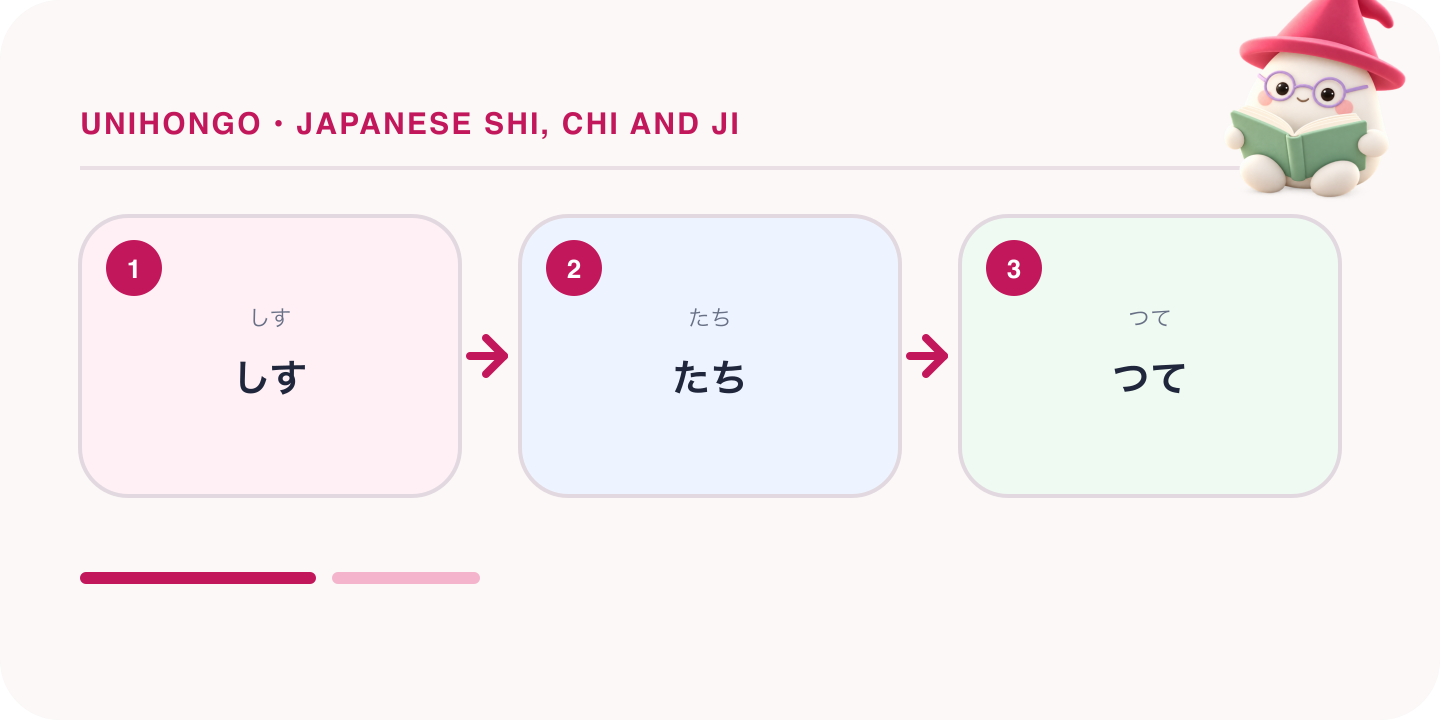
| Japanese | Romaji | Meaning |
|---|---|---|
| さしすせそ、たちつてと。 | Sa shi su se so, ta chi tsu te to. | The s row and the t row. |
| ざじずぜぞ。 | Za ji zu ze zo. | The z row. |
| 下に置いてください。 | Shita ni oite kudasai. | Please put it below. |
| 近くに駅があります。 | Chikaku ni eki ga arimasu. | There is a station nearby. |
| 時間がありません。 | Jikan ga arimasen. | There is no time. |
Mouth mechanics for shi
Start with the vowel i, as in the English word see but shorter. Feel where your tongue is: high and forward, sides touching the upper back teeth. Keep it exactly there and blow air over it. The hiss you get is Japanese shi, and it happens without any change of lip shape. That is the whole trick: shi is the i tongue position plus air.
English sh involves two extra moves that Japanese does not want. The lips push forward and round slightly, and the tongue draws back. Both make the sound darker and heavier. If you say shi with a slight smile, the lips cannot round and the tongue naturally stays forward, which is why teachers tell learners to smile on shi.
In desu, shita and shite iru, the i after sh is often whispered, so the word sounds like sh-ta and sh-te. Do not add a full English vowel there; keep the sh short and move straight to the next consonant.
| Japanese | Romaji | Meaning |
|---|---|---|
| 塩を取ってください。 | Shio o totte kudasai. | Please pass the salt. |
| 写真を撮ってもいいですか。 | Shashin o totte mo ii desu ka. | May I take a photo? |
| 知っています。 | Shitte imasu. | I know. |
| 失礼します。 | Shitsurei shimasu. | Excuse me (entering or leaving). |
| 新幹線で行きます。 | Shinkansen de ikimasu. | I'll go by bullet train. |
| 静かにしてください。 | Shizuka ni shite kudasai. | Please be quiet. |
Mouth mechanics for chi and its voiced partner ji
Chi is shi with a stop in front of it. Put the blade of your tongue against the front of the hard palate, the same place it sits for shi, block the air completely, then release into shi. The tongue tip stays down. Most English speakers start ch with the tip of the tongue on the ridge behind the upper teeth, which gives the sound a t-like edge that Japanese listeners hear as ti or even tsi. If you begin from the shi position and simply close it first, the edge disappears.
Ji is the voiced version of chi at the start of a word: same tongue position, same release, but the vocal cords vibrate. Between vowels the stop often relaxes and ji becomes a soft zh-like hiss. So jikan, time, begins with a firm j, while kaji, fire or housework, may have a softer one. Native speakers hear both as the same sound.
| Japanese | Romaji | Meaning |
|---|---|---|
| ちょっと待ってください。 | Chotto matte kudasai. | Please wait a moment. |
| 父は医者です。 | Chichi wa isha desu. | My father is a doctor. |
| 地下鉄はどこですか。 | Chikatetsu wa doko desu ka. | Where is the underground? |
| 自転車で来ました。 | Jitensha de kimashita. | I came by bicycle. |
| 十時に会いましょう。 | Jū-ji ni aimashō. | Let's meet at ten. |
| 火事です。 | Kaji desu. | There is a fire. |
| 正直に言います。 | Shōjiki ni iimasu. | I'll say it honestly. |
Romaji traps: si, ti, zi, and the two spellings of ji and zu
If you have ever typed Japanese on a computer, you know that si, ti and zi produce し, ち and じ. This is the Kunrei-shiki system, and it follows the grid rather than the sound. Nobody says si for し; the spelling just tells the input method which cell you want. The Hepburn system, used on road signs and in this guide, writes shi, chi and ji because it was designed for English readers.
The second trap is that ji and zu each have two kana. じ and ぢ are both ji; ず and づ are both zu. In standard Tokyo Japanese these pairs sound identical. The rarer spellings survive in words where a chi or tsu has been voiced inside a compound: hanaji, nosebleed, is hana plus chi, so it is written 鼻ぢ; tsuzuku, to continue, is written 続く with づ. When typing these you write di and du, which surprises everyone the first time. There is no pronunciation work to do here, only spelling to remember.
| Kana | Reading | Notes |
|---|---|---|
| し | shi | Hepburn shi, Kunrei si; smile, do not round the lips |
| ち | chi | Hepburn chi, Kunrei ti; tongue blade, not tip |
| つ | tsu | Hepburn tsu, Kunrei tu; a t released into su |
| じ | ji | Standard spelling for ji; type ji or zi |
| ぢ | ji | Voiced chi in compounds; type di; as in 鼻ぢ hanaji |
| ず | zu | Standard spelling for zu; type zu |
| づ | zu | Voiced tsu in compounds; type du; as in 続く tsuzuku |
| しゃ | sha | Shi plus small ya; one short syllable |
| ちゅ | chu | Chi plus small yu; as in 注文 chūmon |
| じょ | jo | Ji plus small yo; as in 女性 josei |
The small ya, yu, yo combinations in the last three rows are single syllables, not two. Sha is not shi-ya; the i is swallowed into the glide. Learners who pronounce josei as ji-yo-sei add a beat that native ears immediately notice.
Minimal pairs and drill words
A minimal pair is two words that differ by one sound. Practising pairs teaches your ear to hear the contrast and your mouth to produce it on demand. The pairs below cover the three main risks: shi against chi, chi against ji, and shi against su. Say each pair three times, then say them in a random order and ask a listener, or your AI Sensei, which one they heard.
| Japanese | Romaji | Meaning |
|---|---|---|
| 知る、散る。 | Shiru, chiru. | To know, to scatter. |
| 火事、勝ち。 | Kaji, kachi. | Fire, victory. |
| 時間、歯科医。 | Jikan, shikai. | Time, dentist. |
| 主人、囚人。 | Shujin, shūjin. | Husband, prisoner. |
| 地図、知事。 | Chizu, chiji. | Map, governor. |
| 寿司、辻。 | Sushi, tsuji. | Sushi, crossroads. |
| 七時、一時、八時。 | Shichi-ji, ichi-ji, hachi-ji. | Seven o'clock, one o'clock, eight o'clock. |
| 自信、地震。 | Jishin, jishin. | Confidence, earthquake. |
Common mistakes by first language
Learners from different language backgrounds make predictable errors with these three sounds, and knowing yours saves months of guessing.
- English speakers: rounding the lips on shi and starting chi with the tongue tip, giving a heavy sh and a t-coloured ch. Fix: smile on shi, start chi from the shi position.
- Spanish and Italian speakers: shi drifts towards si because the native language lacks sh, and ji becomes a y sound, so jikan sounds like yikan. Fix: practise sh with the tongue blade and add a clear stop at the start of ji.
- Mandarin speakers: shi is often made with the tongue curled back, the retroflex sh of Chinese, which sounds too dark. Fix: use the flat, forward tongue of Chinese xi instead, then add air.
- Cantonese and Vietnamese speakers: ji tends to come out as a voiceless chi or as a hard dz. Fix: hold the vowel before ji and let the voicing run through without a break.
- Korean speakers: chi may become too aspirated, with a strong puff of air, and ji is often unvoiced at the start of a word. Fix: reduce the puff on chi and hum into ji.
- Hindi and Urdu speakers: the sounds exist, but ji is sometimes replaced by a heavily aspirated jh. Fix: keep the tongue blade flat and the release soft.
- Everyone: adding a full i vowel after sh in shita, shite and desu, where it should be whispered. Fix: say sh-ta, not shee-ta.
None of these errors makes you incomprehensible on its own. The trouble comes when two or three stack up in a word like shichi-ji, seven o'clock, where a dark shi, a t-coloured chi and an unvoiced ji together produce something a station attendant may not catch on the first try.
A self-check routine with the AI Sensei
Pronunciation improves fastest with a short loop: produce, get judged, adjust. First, warm up by saying the s, t and z rows aloud twice. Second, say the eight minimal pairs in a scrambled order and ask the Sensei which word it heard each time; any pair it hears wrong twice becomes your focus pair for the week. Third, do a role-play that forces numbers and times, such as buying a ticket or agreeing a meeting time. Finally, read the corrections after the conversation and note which words were misheard.
If the Sensei consistently hears your chi as ti, the fix is the tongue tip: it is touching the ridge behind your teeth. If your shi is heard as su, you are not raising the blade enough. If ji is heard as chi, you are not voicing. Each has a single mechanical cause, and the sections above tell you which one to adjust.
| Japanese | Romaji | Meaning |
|---|---|---|
| もう一度言ってもいいですか。 | Mō ichido itte mo ii desu ka. | May I say it once more? |
| 「し」と「ち」の違いを聞いてください。 | Shi to chi no chigai o kiite kudasai. | Please listen for the difference between shi and chi. |
| 今のは「じ」に聞こえましたか。 | Ima no wa ji ni kikoemashita ka. | Did that sound like ji? |
| 発音を直してください。 | Hatsuon o naoshite kudasai. | Please correct my pronunciation. |
| ゆっくり言います。 | Yukkuri iimasu. | I'll say it slowly. |