
Ozōni in four words
Ozōni is written お雑煮: 雑 means mixed or various, and 煮 means simmered. The honorific o is almost always attached. Talk about ozōni nearly always starts with uchi no, our family's, because everyone assumes their version is the normal one until they meet someone from elsewhere.
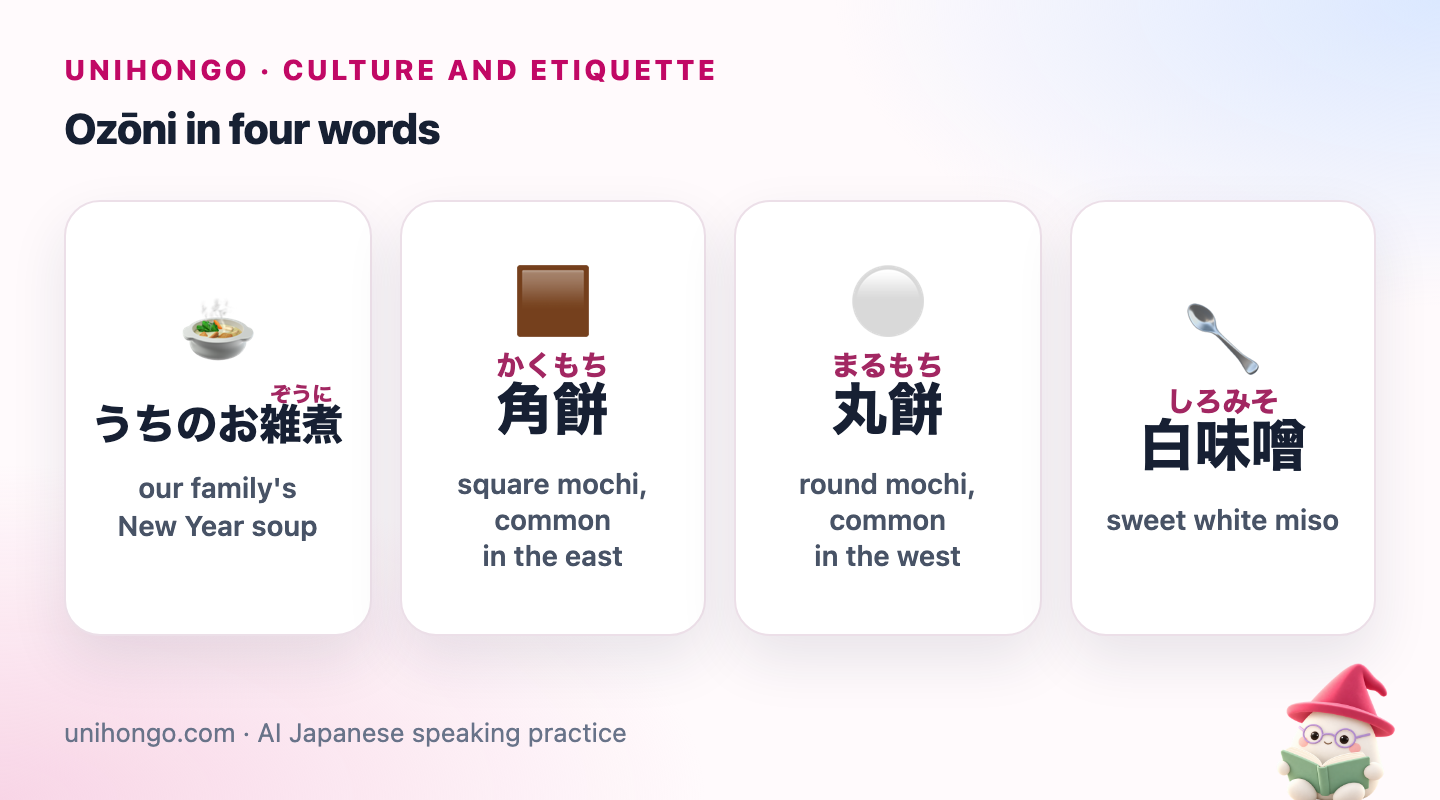
| Japanese | Romaji | Meaning |
|---|---|---|
| うちのお雑煮 | uchi no ozōni | our family's New Year soup |
| 角餅 | kakumochi | square mochi, common in the east |
| 丸餅 | marumochi | round mochi, common in the west |
| 白味噌 | shiromiso | sweet white miso |
| すまし汁 | sumashijiru | clear dashi-and-soy broth |
Uchi literally means inside or home, and uchi no means my family's or our company's. It is how Japanese people introduce anything that belongs to their group.
East and west: the basic split
The best-known division runs across central Japan. In much of the east, including Tokyo, mochi was traditionally made in a large slab and cut into squares, which are grilled before going into the soup. In much of the west, mochi was rolled into balls, and these round mochi are often boiled or simmered. The broth splits too, although less neatly: clear broth is common in the east and in many western areas, while white miso is the signature of Kyoto.
| Japanese | Romaji | Meaning |
|---|---|---|
| 角餅を焼いて入れます。 | Kakumochi o yaite iremasu. | We grill square mochi and add it. |
| 丸餅を煮ます。 | Marumochi o nimasu. | We simmer round mochi. |
| 関東風のお雑煮です。 | Kantō fū no ozōni desu. | It's Kantō-style ozōni. |
| 京都では白味噌を使うそうです。 | Kyōto de wa shiromiso o tsukau sō desu. | Apparently Kyoto uses white miso. |
| Feature | Kantō style (e.g. Tokyo) | Kyoto style |
|---|---|---|
| Mochi | Square, grilled | Round, boiled |
| Broth | Clear: dashi, soy sauce, salt | Sweet white miso |
| Typical ingredients | Chicken, komatsuna greens, kamaboko, mitsuba | Taro, daikon, carrot |
| Feel | Light and savoury | Rich, mild and slightly sweet |
Some well-known regional bowls
Beyond the east-west split, many areas have a famous local version. The examples below are often featured in Japanese food articles and TV programmes, but they describe a common style, not every household.
| Japanese | Romaji | Meaning |
|---|---|---|
| 香川ではあん餅を入れるそうです。 | Kagawa de wa anmochi o ireru sō desu. | Apparently in Kagawa they add bean-filled mochi. |
| 小豆のお雑煮もありますよ。 | Azuki no ozōni mo arimasu yo. | There's even red bean ozōni. |
| 鮭といくらが入っています。 | Sake to ikura ga haitte imasu. | It has salmon and salmon roe. |
| 地域によって全然違いますね。 | Chiiki ni yotte zenzen chigaimasu ne. | It's completely different by region. |
| Area | Style often described | Notable feature |
|---|---|---|
| Kagawa | White miso broth | Round mochi filled with sweet red bean paste |
| Parts of Tottori and Shimane | Sweet red bean soup | Looks more like a dessert than a soup |
| Niigata | Clear broth | Salmon and salmon roe on top |
| Fukuoka | Clear broth, often flying fish dashi | Yellowtail and local winter greens |
Sake here means salmon, 鮭, not rice wine, 酒. Both are read sake, though many people call the fish shake. Context makes it clear.
The ingredients you will hear about
Whatever the region, ozōni ingredients tend to be festive and seasonal, and some carry wordplay or wishes. Pink-and-white kamaboko fish cake brings New Year colours, and a twist of yuzu peel adds fragrance.
| Japanese | Romaji | Meaning |
|---|---|---|
| 出汁 | dashi | soup stock |
| 鶏肉 | toriniku | chicken |
| かまぼこ | kamaboko | fish cake |
| 小松菜 | komatsuna | Japanese mustard spinach |
| 三つ葉 | mitsuba | Japanese wild parsley |
| 里芋 | satoimo | taro |
| ゆずの皮 | yuzu no kawa | yuzu peel |
Komatsuna is often said to be named after the Komatsugawa area of Tokyo, which is why it is so closely linked with Tokyo-style ozōni.
A simple Kantō-style recipe
If you want to make ozōni at home, the eastern style is the easiest to start with. Make a light dashi from kelp and bonito flakes, or use instant dashi. Simmer small pieces of chicken and sliced carrot or daikon in it, then season with soy sauce and salt so it tastes clean, not salty. Grill square mochi in a toaster or a pan until puffed and lightly browned. Put the mochi in a bowl, add blanched greens and a slice of kamaboko, pour over the hot broth and finish with mitsuba or yuzu peel.
| Japanese | Romaji | Meaning |
|---|---|---|
| 出汁をとります。 | Dashi o torimasu. | Make the soup stock. |
| しょうゆと塩で味をつけます。 | Shōyu to shio de aji o tsukemasu. | Season with soy sauce and salt. |
| お餅をこんがり焼きます。 | Omochi o kongari yakimasu. | Grill the mochi until golden. |
| お椀に入れて、汁を注ぎます。 | Owan ni irete, shiru o sosogimasu. | Put it in a bowl and pour the broth over. |
At the New Year table
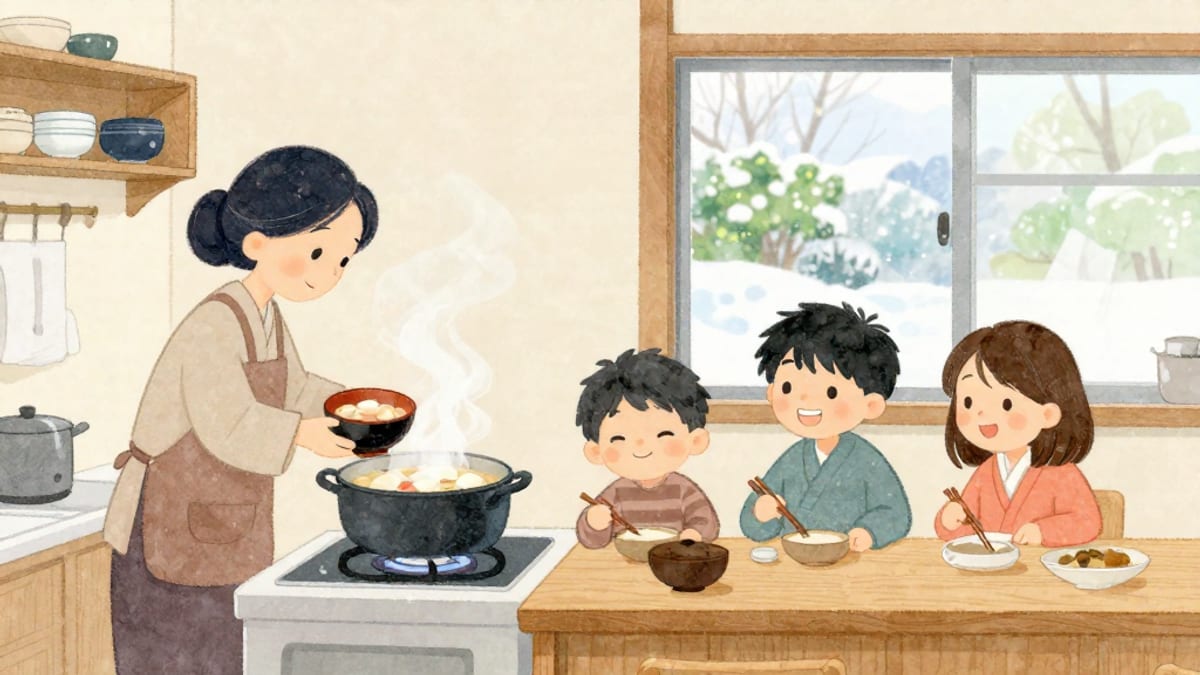
In many homes, ozōni is served on the morning of 1 January with osechi, and the host asks each person how many mochi they want. It is polite to say a number rather than leave it to the host. If you meet a style that is new to you, show interest and ask about it; families love explaining their version.
| Japanese | Romaji | Meaning |
|---|---|---|
| お餅はいくつ? | Omochi wa ikutsu? | Host: How many mochi? |
| 二つお願いします。 | Futatsu onegai shimasu. | Two, please. |
| 白味噌のお雑煮は初めてです。 | Shiromiso no ozōni wa hajimete desu. | It's my first white miso ozōni. |
| 甘くて、おいしいです。 | Amakute, oishii desu. | It's sweet and delicious. |
| 体が温まりますね。 | Karada ga atatamarimasu ne. | It warms you right up. |
| おかわりもあるよ。 | Okawari mo aru yo. | Host: There's more if you want it. |
At New Year, many families use iwaibashi, celebratory chopsticks tapered at both ends. One end is said to be for the gods, so people eat with one end only and do not flip them around.
Mini dialogue: whose ozōni is normal?
| Japanese | Romaji | Meaning |
|---|---|---|
| 実家のお雑煮はどんな感じ? | Jikka no ozōni wa donna kanji? | Friend: What's ozōni like at your parents' place? |
| うちは角餅で、すまし汁だよ。 | Uchi wa kakumochi de, sumashijiru da yo. | You: Ours is square mochi in clear broth. |
| えー、うちは丸餅で白味噌だよ。 | Ē, uchi wa marumochi de shiromiso da yo. | Friend: What? Ours is round mochi in white miso. |
| 白味噌って、甘いの? | Shiromiso tte, amai no? | You: Is white miso sweet? |
| ちょっと甘いけど、おいしいよ。今度作ってあげる。 | Chotto amai kedo, oishii yo. Kondo tsukutte ageru. | Friend: A little, but it's good. I'll make it for you sometime. |
This exact exchange happens between Japanese couples every year, often with a laugh. Asking jikka no ozōni wa? is a warm, easy question for coworkers and friends in January.
A short ozōni reading and a food-word game
Ask Mocchi: /read a short text about regional ozōni at my level. Mocchi writes a passage, asks you questions about it and remembers the food words you had to look up, so they appear in your next quiz or review.
Then warm up your food vocabulary in Sushi Sort, where you read a Japanese order and send the right plate. Ozōni ingredients such as kamaboko, mitsuba and toriniku slot right in alongside sushi words.
Common learner mistakes
- Calling ozōni miso soup. Some versions use miso, many do not, and it is a special New Year dish.
- Confusing ozōni with zōsui. Zōsui is a rice porridge made from leftover hot pot broth.
- Saying a family's version is wrong or strange. Say it is new to you: hajimete desu, or ~ mo oishii desu ne.
- Swallowing big pieces of mochi. Eat slowly in small bites; mochi is a choking risk.
- Presenting regional styles as rules. Use ~ sō desu or ~ ga ōi rashii, many seem to, because families vary.