

Full-service or self-service?
The first thing to check as you approach is the sign. Self-service stations say セルフ, serufu, usually in large letters; if the sign does not say serufu, assume full-service. Many stations are not open all night, especially outside cities, so plan ahead on long drives.
At a full-service station, fuel attendants, often young staff in caps, will call out irasshaimase and wave you into a bay with arm signals, saying ōrai, ōrai, meaning keep coming, until you should stop. Turn off the engine and open your window. At a self-service station you pull up at any free pump, making sure the fuel cap faces the pump.
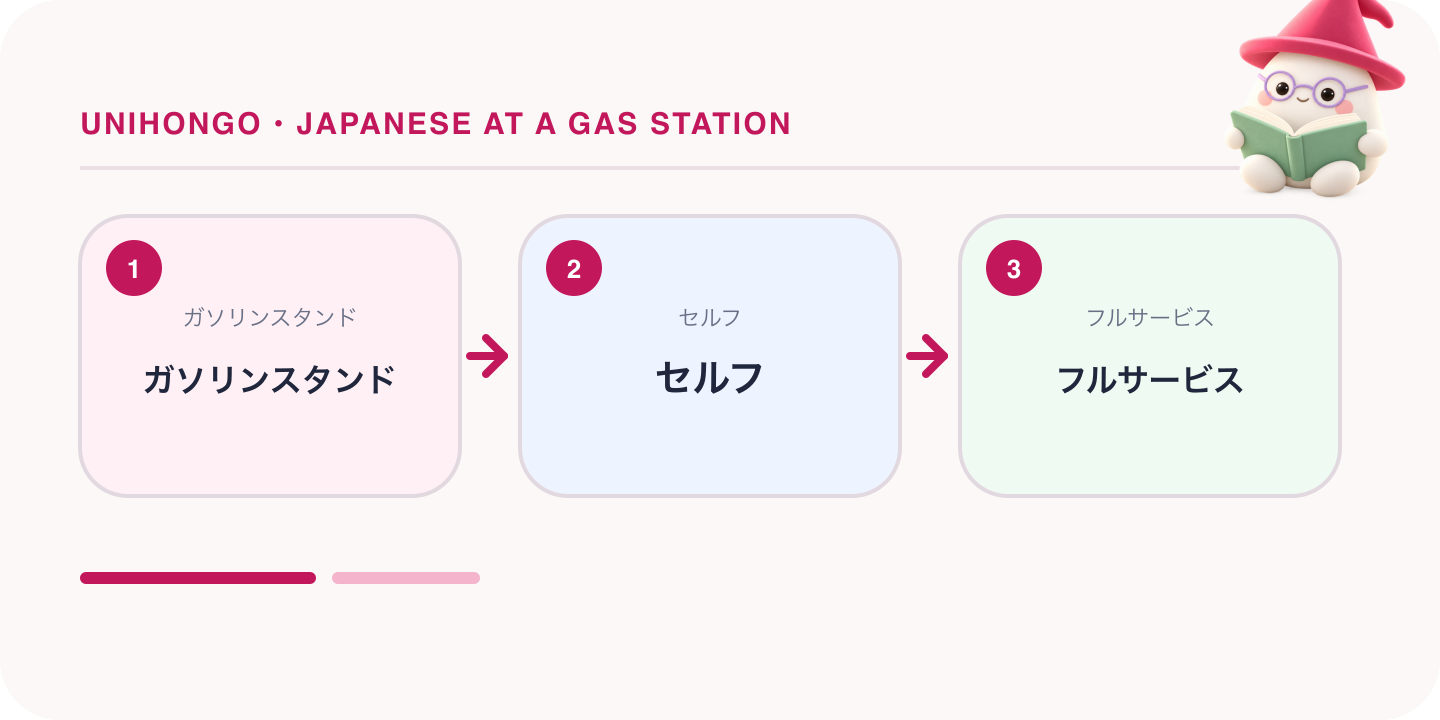
| Sign | Reading | Meaning |
|---|---|---|
| ガソリンスタンド | gasorin sutando | Petrol station |
| セルフ | serufu | Self-service |
| フルサービス | furu sābisu | Full-service |
| 給油 | kyūyu | Refuelling |
| 営業中 | eigyōchū | Open |
| 24時間営業 | nijūyo jikan eigyō | Open 24 hours |
| 洗車 | sensha | Car wash |
| 灯油あります | tōyu arimasu | Kerosene sold here |
Fuel types: regyurā, haioku, keiyu
Japanese pumps normally offer three vehicle fuels. Regyurā, regular petrol, is what most ordinary cars use, including rental cars in most cases. Haioku, high-octane or premium, is required by some imported and high-performance cars. Keiyu is diesel. Check the fuel type written inside the fuel flap or on your rental agreement; if in doubt, ask.
The trap for learners is keiyu. The kei means light, from light oil, which is the Japanese term for diesel, and it has nothing to do with kei cars, the small cars with yellow number plates, which normally run on regular petrol. Putting diesel into a petrol car, or petrol into a diesel, can cause serious damage.
A second trap is tōyu, kerosene. Many stations sell it for home heaters, and you will see people filling red or blue plastic tanks, poritanku, in winter. Tōyu and keiyu look similar in kanji, 灯油 and 軽油, and both end in yu, oil. Tōyu is never a car fuel.
| Fuel | Reading | What it is | Common nozzle colour |
|---|---|---|---|
| レギュラー | regyurā | Regular petrol | Red |
| ハイオク | haioku | High-octane petrol | Yellow |
| 軽油 | keiyu | Diesel | Green |
| 灯油 | tōyu | Kerosene for heaters, not for cars | Separate pump or tank |
Nozzle colours follow a common convention, but the label is what counts. Read the kanji on the nozzle and the screen every time, especially in a car you do not drive often.
At a full-service station
When the attendant comes to your window, they will usually ask which fuel and how much. The classic answer is regyurā mantan de onegai shimasu, regular, full tank, please. You can also ask for a fixed amount of money, such as sanzen-en bun, three thousand yen's worth, or a number of litres, jū rittoru.
While the tank fills, the attendant may offer to take your rubbish, wipe your windows or check your oil or tyre pressure. You are free to decline, and a simple daijōbu desu, I'm fine, works. They may also ask whether you have a point card or membership card, and whether you will pay by cash or card.
| Japanese | Romaji | Meaning |
|---|---|---|
| いらっしゃいませ。油種と量はどうなさいますか。 | Irasshaimase. Yushu to ryō wa dō nasaimasu ka. | Welcome. Which fuel and how much? |
| レギュラー満タンでお願いします。 | Regyurā mantan de onegai shimasu. | Regular, full tank, please. |
| ハイオクを3000円分お願いします。 | Haioku o sanzen-en bun onegai shimasu. | Three thousand yen of high-octane, please. |
| 軽油を20リットルお願いします。 | Keiyu o nijū rittoru onegai shimasu. | Twenty litres of diesel, please. |
| 窓をお拭きしましょうか。 | Mado o ofuki shimashō ka. | Shall I wipe your windows? |
| ゴミはございますか。 | Gomi wa gozaimasu ka. | Do you have any rubbish? |
| 大丈夫です。 | Daijōbu desu. | I'm fine, thank you. |
| ポイントカードはお持ちですか。 | Pointo kādo wa omochi desu ka. | Do you have a point card? |
Using a self-service pump
Self-service pumps walk you through a touch screen, usually in Japanese, sometimes with a voice guide. The order varies a little, but most screens ask for your payment method first, then the fuel type, then the amount, then ask you to touch a static-discharge pad before you open the fuel cap. That pad, the seidenki jokyo shīto, is a safety step against sparks and appears at almost every pump.
After fuelling, hang the nozzle back, close the cap and take your receipt. If you paid cash in advance for mantan, the pump usually prints a slip, and you take it to a change machine, seisanki, to collect your change. Staff in the kiosk monitor every pump and must authorise fuelling, so if the pump does not start, wait a moment or press the call button.
| Screen word | Reading | Meaning |
|---|---|---|
| お支払い方法 | oshiharai hōhō | Payment method |
| 現金 | genkin | Cash |
| クレジットカード | kurejitto kādo | Credit card |
| 油種を選択 | yushu o sentaku | Choose fuel type |
| 満タン | mantan | Full tank |
| 金額指定 | kingaku shitei | Set an amount of money |
| 数量指定 | sūryō shitei | Set a number of litres |
| 静電気除去シート | seidenki jokyo shīto | Static discharge pad |
| ノズルを戻してください | nozuru o modoshite kudasai | Please return the nozzle |
| 精算機 | seisanki | Change or payment machine |
Paying and receipts
At full-service stations, the attendant usually takes your cash or card at the window and brings back the change and a receipt. Accepted payment methods differ by station, and some take only certain cards, so if you plan to pay by card, ask before fuelling.
If you are returning a rental car full, keep the receipt, reshīto, since rental offices sometimes ask for it as proof that you filled up nearby.
| Japanese | Romaji | Meaning |
|---|---|---|
| カードは使えますか。 | Kādo wa tsukaemasu ka. | Can I pay by card? |
| 現金でお願いします。 | Genkin de onegai shimasu. | Cash, please. |
| レシートをください。 | Reshīto o kudasai. | Could I have the receipt? |
| おつりは精算機でお受け取りください。 | Otsuri wa seisanki de ouketori kudasai. | Please collect your change at the payment machine. |
| 領収書をお願いできますか。 | Ryōshūsho o onegai dekimasu ka. | Could I have a formal receipt? |
Being guided out onto the road
One of the most distinctive parts of a full-service station is the send-off. When you are ready to leave, an attendant walks to the exit, checks the traffic and signals you out, sometimes stepping into the road to hold traffic briefly. They may call out dōzo when it is safe to go, and finish with a bow and arigatō gozaimashita.
Follow their signals, but you remain the driver: check for yourself before pulling out. A small nod or raised hand as you leave is a polite way to say thanks.
| Japanese | Romaji | Meaning |
|---|---|---|
| オーライ、オーライ。 | Ōrai, ōrai. | Keep coming, keep coming. |
| はい、ストップです。 | Hai, sutoppu desu. | OK, stop there. |
| 右から車が来ます。 | Migi kara kuruma ga kimasu. | A car is coming from the right. |
| どうぞ。 | Dōzo. | Go ahead. |
| ありがとうございました。お気をつけて。 | Arigatō gozaimashita. Oki o tsukete. | Thank you. Drive safely. |
When something goes wrong: wrong fuel and other problems
If you realise you have put in the wrong fuel, do not start the engine. Tell the staff immediately and, if it is a rental car, call the rental company too. Staff will know how to arrange for the tank to be drained; starting the engine can spread the wrong fuel through the system and make the damage much worse.
Other common problems are a fuel cap that will not open, a pump that stops early and a warning light on the dashboard. The phrases below cover each of these.
| Japanese | Romaji | Meaning |
|---|---|---|
| 間違えて軽油を入れてしまいました。 | Machigaete keiyu o irete shimaimashita. | I put diesel in by mistake. |
| エンジンはかけていません。 | Enjin wa kakete imasen. | I haven't started the engine. |
| 給油口が開きません。 | Kyūyuguchi ga akimasen. | The fuel cap won't open. |
| 給油が途中で止まりました。 | Kyūyu ga tochū de tomarimashita. | The pump stopped partway through. |
| 警告ランプがついています。 | Keikoku ranpu ga tsuite imasu. | A warning light is on. |
| タイヤの空気を見てもらえますか。 | Taiya no kūki o mite moraemasu ka. | Could you check my tyre pressure? |