

Ryōshūsho or reshīto: which receipt to ask for
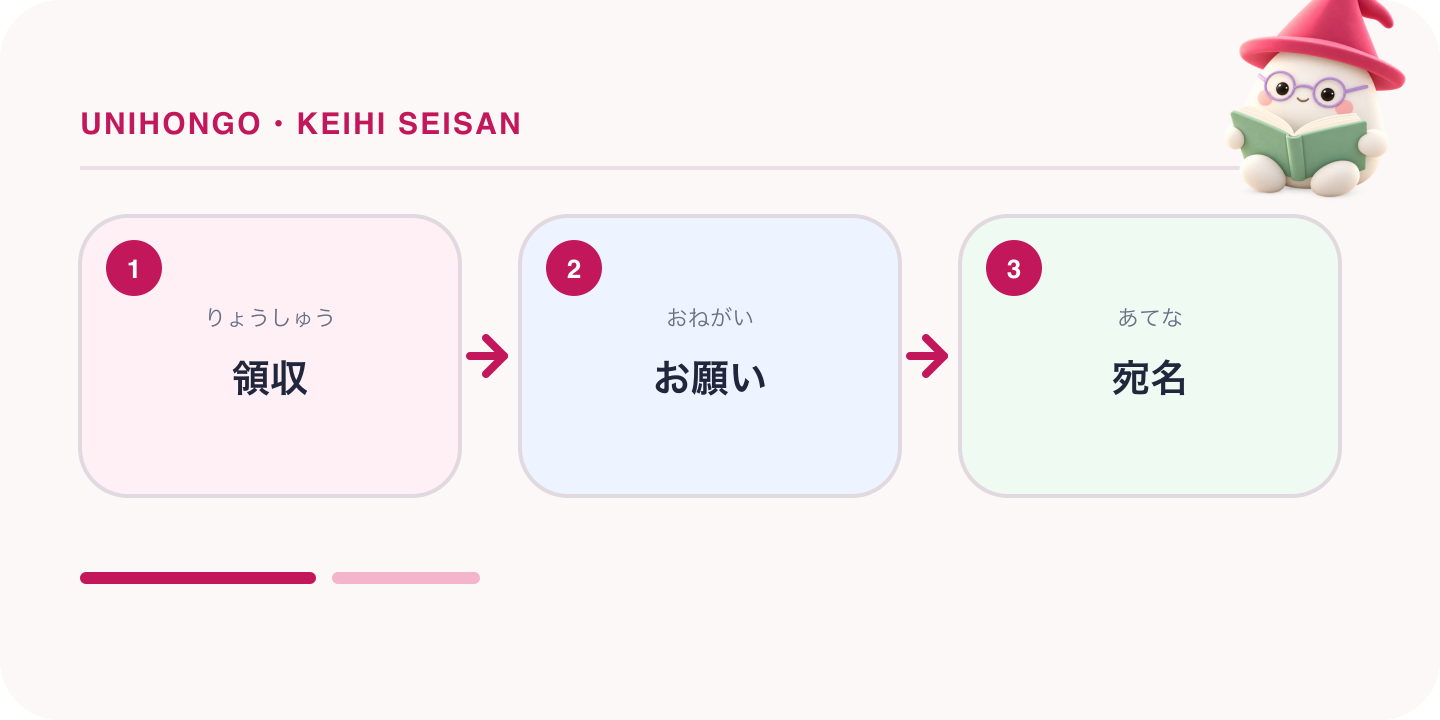
The first decision happens at the till. A reshīto is the itemised slip the register prints; a ryōshūsho is a formal receipt with a payee line, atena, a purpose line, tadashigaki, the date, the amount and the shop's name and stamp. Some shops print a ryōshūsho from the register; small restaurants often write one by hand. Ask for it with ryōshūsho o onegai shimasu, and expect two questions: the name to write and the purpose.
Whether you need a ryōshūsho depends on your company and often on the amount. Many accept a reshīto for everyday items because it is itemised, while a ryōshūsho for a client dinner or a large purchase is common. When in doubt, take both. If you lose a receipt, most companies have a form or a note explaining the loss, but they may not accept the claim, so ask keiri before assuming.
| Japanese | Romaji | Meaning |
|---|---|---|
| 領収書をお願いします。 | Ryōshūsho o onegai shimasu. | A receipt, please. |
| 宛名はどうなさいますか。 | Atena wa dō nasaimasu ka. | What name should I write on it? |
| 株式会社ABCでお願いします。 | Kabushiki-gaisha ABC de onegai shimasu. | ABC Corporation, please. |
| 但し書きは飲食代でお願いします。 | Tadashigaki wa inshokudai de onegai shimasu. | Please write the purpose as food and drink. |
| 領収書をなくしてしまったのですが、どうすればいいですか。 | Ryōshūsho o nakushite shimatta no desu ga, dō sureba ii desu ka. | I've lost the receipt; what should I do? |
Kōtsūhi and tatekae: how the money flows
Kōtsūhi, transport costs, are the most frequent claim and the one with the fewest receipts. For trains and buses you record the date, the route from station to station, the purpose and the fare, usually the cheapest reasonable route; the company may check it against a fare search. Keep your IC card history, riyō rireki, which you can print at many station machines, because some companies ask for it. Taxis need a receipt and usually a reason, such as heavy luggage or a late finish. Commuting is separate: tsūkin teate is paid as an allowance and is not claimed through keihi seisan.
The money itself usually moves by tatekae: you pay first and claim back. For a large or planned expense, ask for karibarai, an advance, before you travel. Reimbursement is normally added to salary or paid by transfer on a fixed day, and the day varies by company.
| Japanese | Romaji | Meaning |
|---|---|---|
| 交通費は経路と金額を書けばいいですか。 | Kōtsūhi wa keiro to kingaku o kakeba ii desu ka. | For transport, is it enough to write the route and fare? |
| ICカードの利用履歴を印刷してきました。 | Ai-shī kādo no riyō rireki o insatsu shite kimashita. | I've printed my IC card usage history. |
| 終電がなかったので、タクシーを使いました。 | Shūden ga nakatta node, takushī o tsukaimashita. | There was no last train, so I took a taxi. |
| 出張の費用は仮払いをお願いできますか。 | Shutchō no hiyō wa karibarai o onegai dekimasu ka. | Could I have an advance for the business trip costs? |
| 立替分はいつ振り込まれますか。 | Tatekae-bun wa itsu furikomaremasu ka. | When will the amount I paid be transferred? |
The form fields: hizuke, kingaku, tekiyō, kanjō kamoku
Whether the form is paper or a web system, each line has the same four fields. Hizuke is the date the money was spent, not the date you file. Kingaku is the amount, tax included unless the form separates zeinuki and zeikomi. Tekiyō is the description or purpose, and it is the field accounting reads most carefully: write who, what and why in a few words, such as A-sha uchiawase, kōhī nimei-bun, coffee for two at a meeting with A company. Kanjō kamoku is the account category, chosen from a list.
The category names look alike, so learn the common ones: ryohi kōtsūhi for travel and transport, kōsaihi for entertaining clients, kaigihi for meeting refreshments, shōmōhinhi for supplies, tsūshinhi for phone and postage, shinbun toshohi for books. Which category a given expense goes into is a company decision; if the list is unclear, ask rather than guess, because a wrong category is the most common reason a line is bounced.
| Japanese | Romaji | Meaning |
|---|---|---|
| この費用の勘定科目は何になりますか。 | Kono hiyō no kanjō kamoku wa nani ni narimasu ka. | What account category does this expense come under? |
| 摘要にはどこまで書けばいいですか。 | Tekiyō ni wa doko made kakeba ii desu ka. | How much detail should I put in the description? |
| 金額は税込みで書きますか。 | Kingaku wa zeikomi de kakimasu ka. | Do I write the amount including tax? |
| 日付は支払った日でよろしいですか。 | Hizuke wa shiharatta hi de yoroshii desu ka. | Is the date the day I paid? |
| 会議費と交際費の違いを教えていただけますか。 | Kaigihi to kōsaihi no chigai o oshiete itadakemasu ka. | Could you tell me the difference between meeting costs and entertainment? |
Pre-approval, submitting and deadlines
Many companies require jizen shōnin, pre-approval, for anything beyond small routine spending: client dinners, equipment, travel. This may be a form, a ringisho circulated for stamps, or a message to your manager. Ask before you spend, giving the purpose, the people and a rough amount; a manager who approved in advance rarely questions the claim afterwards.
Submission, teishutsu, follows the company's shime, cut-off, often monthly. Attach the receipts in date order, stapled or in a clear file, or upload photos to the system, and hand the form to your manager for approval before it goes to keiri. Confirm the deadline and the payment day when you join, because both vary widely, and note which claims need the original receipt rather than a photo.
| Japanese | Romaji | Meaning |
|---|---|---|
| 来週、A社との会食を予定しています。事前承認をお願いできますか。 | Raishū, A-sha to no kaishoku o yotei shite imasu. Jizen shōnin o onegai dekimasu ka. | I'm planning a dinner with A company next week. Could I get pre-approval? |
| 三名で、一人あたり五千円程度を見込んでいます。 | Sanmei de, hitori atari gosen-en teido o mikonde imasu. | Three people, and I expect roughly five thousand yen a head. |
| 経費精算はいつまでに提出すればいいですか。 | Keihi seisan wa itsu made ni teishutsu sureba ii desu ka. | By when should I submit expense claims? |
| 今月分の経費精算を提出します。ご確認をお願いします。 | Kongetsu-bun no keihi seisan o teishutsu shimasu. Go-kakunin o onegai shimasu. | I'm submitting this month's expenses. Please check them. |
| 締め日を過ぎてしまったのですが、まだ受け付けていただけますか。 | Shimebi o sugite shimatta no desu ga, mada uketsukete itadakemasu ka. | I've missed the cut-off; could you still accept it? |
Asking keiri a question politely
The accounting team, keiri, answers the same questions from everyone all month, so the way you ask matters. Open with o-isogashii tokoro sumimasen, name the topic with keihi no ken de, and ask one clear question. In email, put the month and your name in the subject line. Avoid demanding when: hayaku shite kudasai is a mistake even when you are waiting for money. Ask itsu goro ni narimasu ka instead.
If a claim is returned, sashimodoshi, thank them, fix it and resubmit the same day. Keiri remembers who makes their work easy, and that goodwill matters when you need an exception.
| Japanese | Romaji | Meaning |
|---|---|---|
| お忙しいところすみません、経費の件で少しお伺いしてもよろしいですか。 | O-isogashii tokoro sumimasen, keihi no ken de sukoshi o-ukagai shite mo yoroshii desu ka. | Sorry to bother you, may I ask something about expenses? |
| この領収書で問題ないでしょうか。 | Kono ryōshūsho de mondai nai deshō ka. | Is this receipt acceptable? |
| 先月分の振り込みは、いつ頃になりますか。 | Sengetsu-bun no furikomi wa, itsu goro ni narimasu ka. | Roughly when will last month's payment be made? |
| 差し戻しの理由を教えていただけますか。 | Sashimodoshi no riyū o oshiete itadakemasu ka. | Could you tell me why it was returned? |
| 修正して、本日中に再提出します。 | Shūsei shite, honjitsu-chū ni sai-teishutsu shimasu. | I'll correct it and resubmit today. |
| ご指摘ありがとうございます。 | Go-shiteki arigatō gozaimasu. | Thank you for pointing that out. |
The questions you may be asked back
Accounting's questions are predictable. Who was there and how many, dare to nanmei de: this decides the category. What was the purpose, nan no tame ni. Why this route or this taxi. Whether a receipt covers personal items; a till slip with a drink for yourself on it will be queried. Whether the amount is over a company limit that needs a manager's stamp. Prepare the answers before you submit and write the key ones in the tekiyō field so they are never asked.
Answer factually and briefly. If something was a genuine mistake, such as claiming a personal coffee, say so with sumimasen, watashi no kojin-teki na mono deshita and ask them to remove the line. Trying to justify it costs more than the coffee.
| Japanese | Romaji | Meaning |
|---|---|---|
| こちらの会食は、どなたと何名で行かれましたか。 | Kochira no kaishoku wa, donata to nanmei de ikaremashita ka. | This dinner, who did you go with and how many people? |
| A社の佐藤様と、当社から二名の計三名です。 | A-sha no Satō-sama to, tōsha kara nimei no kei sanmei desu. | Mr Sato of A company and two from our side, three in total. |
| このタクシー代の理由を教えてください。 | Kono takushī-dai no riyū o oshiete kudasai. | Please tell me the reason for this taxi fare. |
| このレシートに私物が含まれていませんか。 | Kono reshīto ni shibutsu ga fukumarete imasen ka. | Does this receipt include any personal items? |
| すみません、一点は私の個人的なものでした。その分は外してください。 | Sumimasen, itten wa watashi no kojin-teki na mono deshita. Sono bun wa hazushite kudasai. | Sorry, one item was personal. Please remove that amount. |
Expense vocabulary
These are the words on the form, in the system menus and in the email from keiri.
| Word | Reading | Meaning |
|---|---|---|
| 経費精算 | keihi seisan | expense settlement, expense claim |
| 領収書 | ryōshūsho | formal receipt |
| レシート | reshīto | itemised till slip |
| 宛名 | atena | name the receipt is made out to |
| 但し書き | tadashigaki | purpose line on a receipt |
| 交通費 | kōtsūhi | transport costs |
| 立替 | tatekae | paying out of pocket first |
| 仮払い | karibarai | cash advance |
| 摘要 | tekiyō | description, purpose field |
| 勘定科目 | kanjō kamoku | account category |
| 事前承認 | jizen shōnin | pre-approval |
| 締め日 | shimebi | cut-off date |
| 差し戻し | sashimodoshi | a claim sent back for correction |
Mistakes that get a claim sent back
The same problems account for most sashimodoshi. A receipt with no atena when the company requires one. A tekiyō that says only uchiawase, with no company or headcount. A category guessed wrong. Transport claimed for a route longer than the sensible one. A photo of a receipt that is blurred or cropped. A claim filed after the shime and rolled into next month without warning. And, most awkward, a personal item on a work receipt, which raises questions about every other line.
Rules on all of these are company decisions: limits, categories, whether photos are accepted and how late is too late. The safe habits are the same everywhere. Ask for the right receipt at the till, note the purpose on the back or in the app the same day, ask keiri when unsure, and submit before the deadline, not on it.
- Ask atena wa kaisha-mei de at the till when a ryōshūsho is needed
- Write the purpose, company and headcount in the tekiyō field
- Choose the category from the list; ask when two seem to fit
- Claim the sensible route and keep the IC card history
- Get pre-approval for dinners, equipment and travel
- Submit before the shime and fix any returned line the same day