
Why learners get stuck in polite forms
Polite Japanese is taught first because it is safe, and it is. The unintended consequence is that many learners have no experience of any other register and no sense of when to leave, so they stay indefinitely.
The cost is real but invisible. Continuing to use desu and masu with someone who has switched to casual speech with you signals a distance you may not intend, and after long enough it becomes awkward to change, because the change itself would then be an event.
There is a second cost. Casual forms are most of what you will hear in ordinary conversation, on television and among friends, so a learner who never produces them is training only half the language.
Reading the signals
The switch is rarely announced. It is signalled, usually by the other person relaxing their own speech and waiting to see whether you follow. Learning to notice this is most of the skill.
Listen for the sentence endings rather than the vocabulary. Endings are where register lives, and they change before anything else does.
- They have dropped desu and masu with you, consistently, over several conversations.
- They use casual sentence endings: da yo, jan, kana, no.
- They use your given name, or a shortened form of your name.
- The setting has moved outside work: a meal, a drink, a weekend.
- They are noticeably younger, or the same age and in the same position.
Any two of these together is a reasonable basis for trying. One on its own, particularly the setting, is not.
Proposing the switch
Sometimes it is worth proposing explicitly rather than drifting. Proposing is normal, has standard phrases, and removes the ambiguity that keeps both people in polite forms out of caution.
The convention is that the older or more senior person proposes. If that is not you, the safe version is to invite them to be casual with you, which is different from announcing that you will be casual with them.
| Japanese | Romaji | Meaning |
|---|---|---|
| 敬語じゃなくても大丈夫ですよ。 | Keigo ja nakute mo daijōbu desu yo. | You do not have to use polite language. |
| もっとカジュアルに話しませんか。 | Motto kajuaru ni hanashimasen ka. | Shall we talk more casually? |
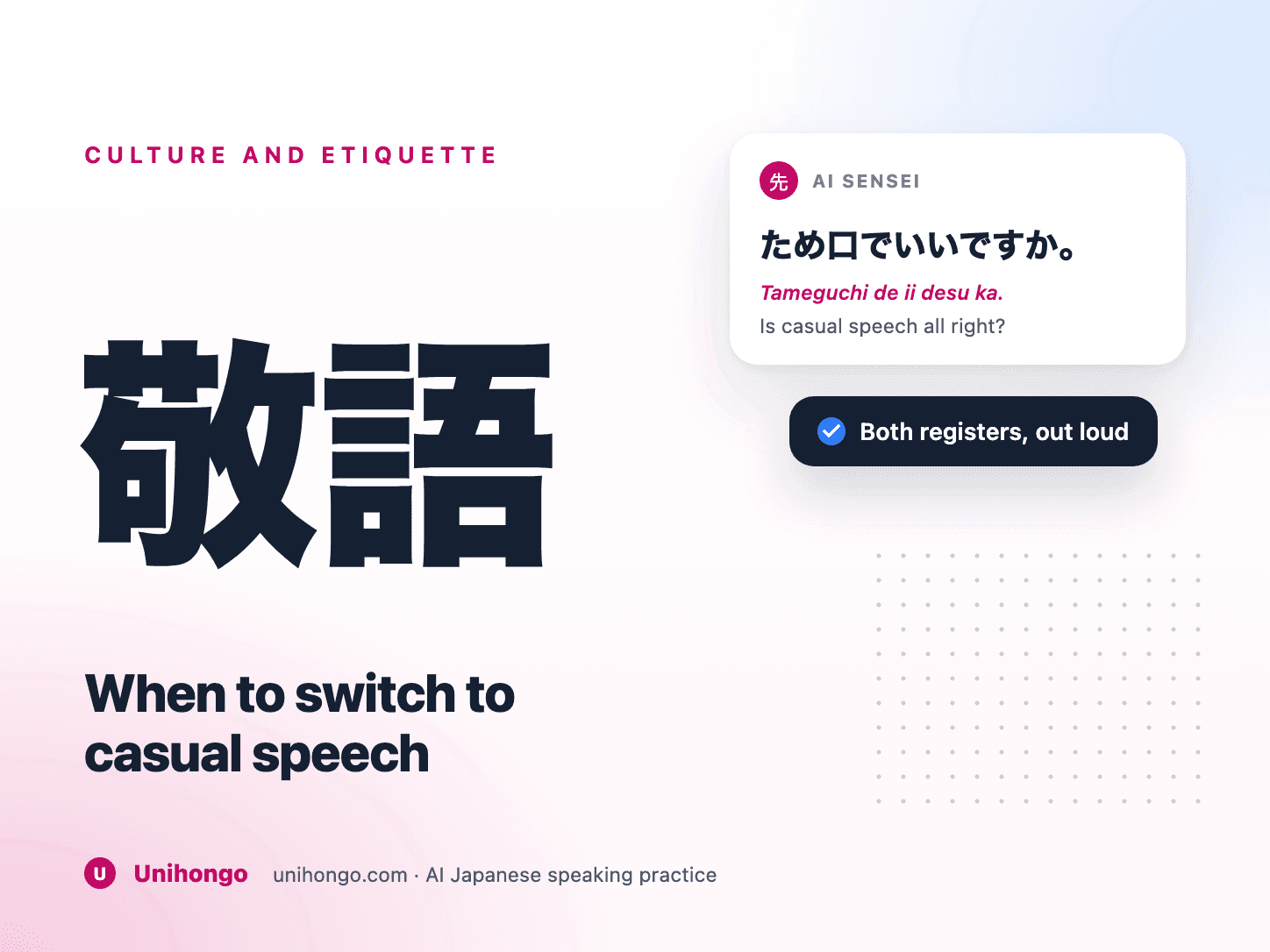
| ため口でいいですか。 | Tameguchi de ii desu ka. | Is casual speech all right? |
| 同い年だし、普通に話そう。 | Onaidoshi da shi, futsū ni hanasō. | We are the same age, let us talk normally. |
| 私にはため口で大丈夫です。 | Watashi ni wa tameguchi de daijōbu desu. | You can be casual with me. |
| まだ慣れないので、少しずつで。 | Mada narenai node, sukoshi zutsu de. | I am not used to it yet, so gradually. |
Switching gradually
The switch is rarely a clean break, and trying to make it one produces speech that sounds studied. In practice people move in stages, and mixed register is normal during the transition rather than a mistake.
A sensible order is to relax the endings first, keep the polite forms for requests and for anything that asks something of the other person, and let the rest follow.
| Stage | What changes | What stays |
|---|---|---|
| One | Sentence endings soften | Desu and masu mostly |
| Two | Plain forms in statements | Polite requests |
| Three | Casual questions | Polite forms with others present |
| Four | Fully casual | Polite forms in front of seniors |
The last row matters. Even with a close friend, polite forms usually return when a senior person joins the conversation, and switching back is expected rather than odd.
If you misjudge it
Getting this wrong is a small event. Casual speech used slightly too early with someone who was not ready produces a brief adjustment and nothing more, particularly for a learner, whose register choices are read as inexperience rather than as a statement.
The repair is to step back into polite forms in the next sentence and say nothing about it. Apologising at length makes the moment much larger than it was.
| Japanese | Romaji | Meaning |
|---|---|---|
| あ、すみません、つい。 | A, sumimasen, tsui. | Ah, sorry, it slipped out. |
| 失礼しました。 | Shitsurei shimashita. | Excuse me. |
| まだ使い分けが難しくて。 | Mada tsukaiwake ga muzukashikute. | Telling them apart is still hard for me. |
| 敬語のほうがいいですか。 | Keigo no hō ga ii desu ka. | Would polite language be better? |
| 気をつけます。 | Ki o tsukemasu. | I will be careful. |
| 教えてくれてありがとうございます。 | Oshiete kurete arigatō gozaimasu. | Thank you for telling me. |
Getting comfortable in both registers
The reason learners hesitate is usually not social judgement but production. Casual forms are less practised, so switching means speaking worse, and it is easier to stay polite and fluent than to be casual and halting.
That is a practice problem with a practice solution. Producing both registers deliberately, before the social moment arrives, means the switch costs you nothing in fluency when it comes. Running the same conversation twice with an AI Sensei in Unihongo's immersive 3D classroom, once polite and once casual, is a direct way to do it, and it is one of the things a spoken classroom does better than a chat window, where register is easy to fake with editing time.
The session report is worth reading specifically for leakage in the other direction: casual forms appearing in a polite conversation, which is the error that actually costs you something.
Aim to be equally fluent in both rather than to move permanently to one. Switching between them fluently is what native-like use of register actually looks like.