

The kanji: ten thousand years
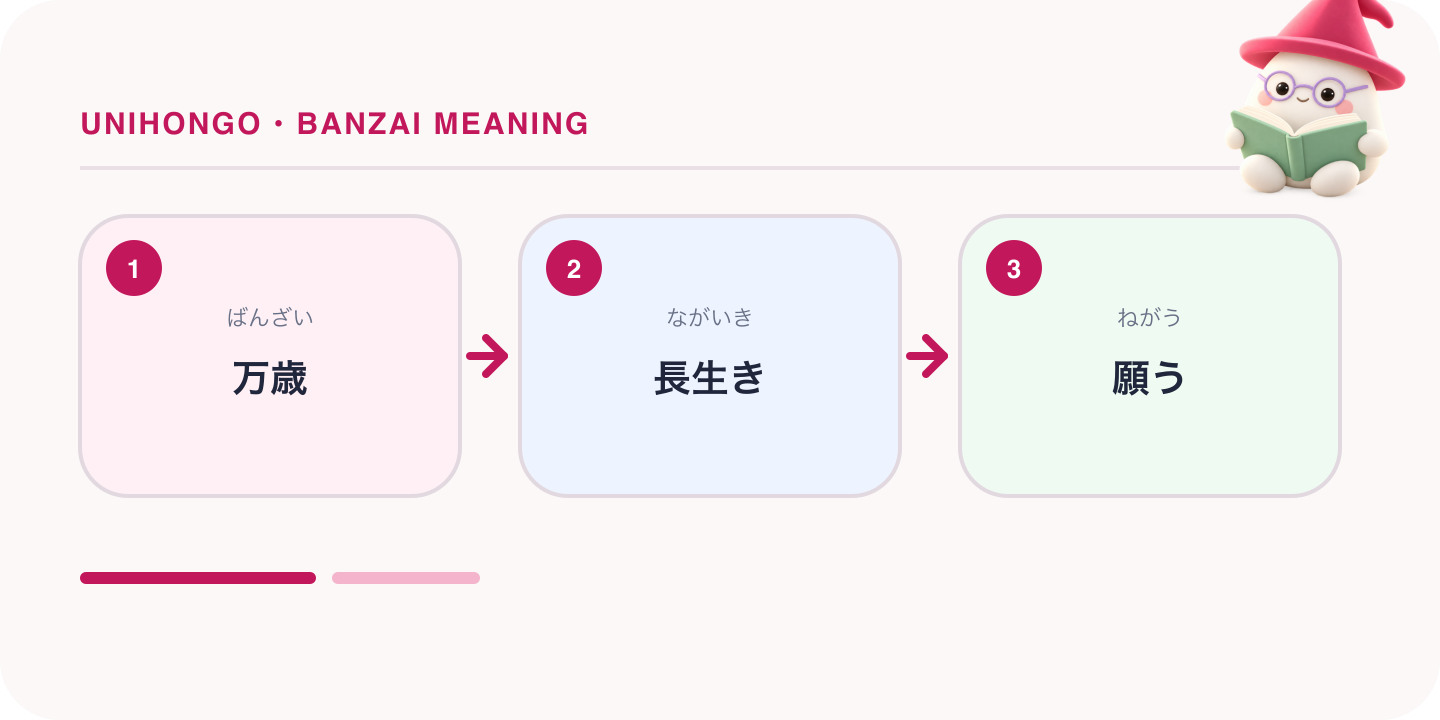
Banzai is written 万歳. The first character, man or ban, means ten thousand, and the second, sai or zai, means years of age, the same character used when you say how old someone is. Ten thousand years is a poetic number for forever, so the phrase is a wish that something, or someone, may live and flourish for a very long time. The Japanese cheer grew from an older East Asian tradition of wishing a ruler long life.
In modern Japanese the phrase has two lives. Shouted, it is a cheer, and that is the use this guide is about. Written or spoken calmly, it can be a noun meaning a state of joy or surrender: banzai suru can describe a child throwing both arms up, and o-tetsuage, hands raised, is the same gesture as giving up. The comic genre manzai is written with different characters and is unrelated, though learners often confuse the sounds.
| Japanese | Romaji | Meaning |
|---|---|---|
| 万歳は万年、つまり長生きを願う言葉です。 | Banzai wa mannen, tsumari nagaiki o negau kotoba desu. | Banzai means ten thousand years, in other words a wish for long life. |
| 万歳三唱で締めましょう。 | Banzai sanshō de shimemashō. | Let's close with three cheers of banzai. |
| 子どもが万歳して喜んでいます。 | Kodomo ga banzai shite yorokonde imasu. | The child is throwing up both arms with joy. |
| 漫才と万歳は別の言葉です。 | Manzai to banzai wa betsu no kotoba desu. | Manzai, comic dialogue, and banzai are different words. |
| 両手を上げて万歳と叫びます。 | Ryōte o agete banzai to sakebimasu. | You raise both hands and shout banzai. |
How banzai sanshō works
The full cheer is banzai sanshō, three shouts of banzai, and it follows a fixed form that everyone learns by watching. A leader, called the ondo o toru hito, the person who sets the tune, takes the microphone near the end of an event. He or she asks everyone to stand, go-kiritsu kudasai, and to join in, go-shōwa o onegai shimasu. Then comes the reason: for the couple's happiness, for the company's growth, for the person leaving. Finally the leader calls banzai, everyone answers banzai, and this repeats three times.
The arms matter. On each shout you raise both arms straight up, together, palms facing inward. There is a small point of etiquette here: raising the arms with palms forward looks like surrender, so people are gently taught to keep the palms facing each other. Timing also matters: you shout with the group, not before the leader. After the third shout the room applauds, and often the leader adds arigatō gozaimashita and asks everyone to sit down.
| Japanese | Romaji | Meaning |
|---|---|---|
| それでは皆様、ご起立ください。 | Sore de wa mina-sama, go-kiritsu kudasai. | Well then, everyone, please stand. |
| 万歳三唱のご唱和をお願いいたします。 | Banzai sanshō no go-shōwa o onegai itashimasu. | Please join me in three cheers of banzai. |
| 新郎新婦の幸せを願って、万歳。 | Shinrō shinpu no shiawase o negatte, banzai. | Wishing the bride and groom happiness, banzai! |
| 万歳、万歳、万歳。 | Banzai, banzai, banzai. | Banzai, banzai, banzai! |
| ありがとうございました。ご着席ください。 | Arigatō gozaimashita. Go-chakuseki kudasai. | Thank you. Please be seated. |
| 手のひらは内側に向けます。 | Te no hira wa uchigawa ni mukemasu. | Turn the palms inward. |
Where you will hear banzai today
The most common place for a foreign guest to meet banzai is a wedding reception, hirōen, where a senior guest or the couple's boss often leads a banzai for the newlyweds near the end of the party. Company events use it too: an end-of-year party may close with a banzai for the company's success, a project launch with one for the team, and a retirement party with one for the person leaving. Sports fans shout it after a championship, and you may see it on the pitch after a team wins promotion.
Election night is the other classic scene. When a candidate's victory is confirmed, supporters gather in the campaign office, hands are raised and the whole room shouts banzai three times, a scene that appears on television every election. Send-offs are older still: a colleague leaving for a distant posting or a school team leaving for a tournament may be sent off from a station platform with banzai and waving. Graduation and entrance ceremonies also use it.
| Japanese | Romaji | Meaning |
|---|---|---|
| 披露宴の最後に上司が万歳の音頭を取りました。 | Hirōen no saigo ni jōshi ga banzai no ondo o torimashita. | At the end of the reception, the boss led the banzai. |
| 当選が決まって、事務所は万歳の声でいっぱいでした。 | Tōsen ga kimatte, jimusho wa banzai no koe de ippai deshita. | When the win was confirmed, the office was full of shouts of banzai. |
| 優勝の瞬間、みんなで万歳しました。 | Yūshō no shunkan, minna de banzai shimashita. | At the moment of victory, we all cheered banzai. |
| ホームで万歳をして見送りました。 | Hōmu de banzai o shite miokurimashita. | We saw them off with a banzai on the platform. |
| 忘年会は万歳三唱で締めるのが恒例です。 | Bōnenkai wa banzai sanshō de shimeru no ga kōrei desu. | It's customary to close the year-end party with three banzai cheers. |
A short, careful note on history
Banzai as a public cheer was introduced in the Meiji era for state ceremonies, and it was shouted for the emperor as tennō heika banzai. During the wars of the early twentieth century the cry became bound up with the military. Soldiers shouted it before charging, and English speakers still use banzai charge for a desperate attack, which is why the word can sound alarming to people outside Japan. In Japan the wartime associations are known, and they are one reason the word stayed formal and ceremonial rather than becoming a casual expression.
Today, most Japanese people use banzai without thinking of any of this. Still, it is worth being aware: shouting banzai as a joke, or striking a pose with it, can look ignorant or worse. Used properly, at a celebration, with the group, it is warm and inclusive. Treat it as a ritual you take part in, not a catchphrase you perform.
| Japanese | Romaji | Meaning |
|---|---|---|
| 万歳は明治時代に広まった言葉です。 | Banzai wa Meiji jidai ni hiromatta kotoba desu. | Banzai spread as a word in the Meiji era. |
| 戦争のイメージがあるので、ふざけて使わないほうがいいです。 | Sensō no imēji ga aru node, fuzakete tsukawanai hō ga ii desu. | Because it has wartime associations, it's better not to use it as a joke. |
| 今はお祝いの場でしか使いません。 | Ima wa o-iwai no ba de shika tsukaimasen. | These days it's only used at celebrations. |
| 歴史を知ったうえで参加すると気持ちが違います。 | Rekishi o shitta ue de sanka suru to kimochi ga chigaimasu. | Joining in after knowing the history feels different. |
Why banzai is not a casual hooray: yatta and friends
Because banzai is a group ritual with a fixed form, it does not work as a personal shout of joy. If you pass the JLPT, get a seat on a crowded train or find a lost umbrella, the natural word is yatta, I did it, or yokatta, thank goodness. Saying banzai alone at your desk sounds theatrical, like shouting three cheers to an empty room. The table gathers the everyday expressions of joy and celebration so you can see where banzai sits among them.
| Expression | Reading | When to use it |
|---|---|---|
| 万歳 | banzai | Formal group cheer, three times, at ceremonies |
| やった | yatta | Personal shout of success: I did it |
| よかった | yokatta | Relief or gladness: thank goodness |
| おめでとう | omedetō | Congratulations to another person |
| おめでとうございます | omedetō gozaimasu | Polite congratulations |
| すごい | sugoi | Amazing, great, on hearing good news |
| やりました | yarimashita | We did it, polite, reporting success |
| 乾杯 | kanpai | Cheers, when raising glasses |
| いえーい | iēi | Casual yay, among friends |
| ばんざーい | banzāi | Playful stretched form, children and comedy |
Kanpai deserves a mention because English speakers sometimes reach for banzai when they mean a toast. A toast is kanpai, said once with glasses raised. Banzai comes later, if at all, with arms raised and no glass in hand.
Phrases for leading and joining a banzai
If you are ever asked to lead, the form is fixed enough that you can prepare it in advance. If you are a guest, all you need is to follow the leader, stand when asked and shout with the room. The list gives you both roles.
- Sore de wa, banzai sanshō o okonaitai to omoimasu: Now I'd like to do three cheers of banzai
- Mina-sama go-kiritsu no ue, go-shōwa o onegai itashimasu: Everyone please stand and join in
- Watashi ga ondo o torasete itadakimasu: Allow me to lead the cheer
- Kabushiki gaisha ABC no hatten o negatte, banzai: Wishing ABC Company success, banzai
- Tanaka-san no korekara no go-katsuyaku o negatte, banzai: Wishing Tanaka success in what comes next, banzai
- Banzai no ondo o onegai dekimasu ka: Could you lead the banzai for us?
- Ryōte o agete, issho ni onegai shimasu: Raise both hands and join in together, please
The word negatte, wishing, is the hinge of every leader's line: state who or what you are cheering for, add negatte, then call banzai. Change the name and the wish and the same sentence works for a wedding, a company or a friend leaving town.
Mistakes and awkward moments
The classic mistake is timing: shouting banzai before the leader, or on the leader's first syllable, so that your voice stands alone. Wait for the room. A second is the arms: half-raised arms or a single fist look like a different gesture, so raise both arms fully and bring them down between shouts. A third is treating banzai as a chant to repeat many times; three is the number, and a fourth shout will be met with laughter.
The most awkward moment is using banzai as a joke where the history matters, or performing it for a photo in front of older people. If you are not sure whether an occasion calls for it, do not propose it; join in if someone else does. If you make a mistake, a smile and a light sumimasen, machigaemashita is all the repair needed. Japanese guests get the timing wrong too.
| Japanese | Romaji | Meaning |
|---|---|---|
| タイミングを間違えて、一人で叫んでしまいました。 | Taimingu o machigaete, hitori de sakende shimaimashita. | I got the timing wrong and ended up shouting alone. |
| 万歳は三回だけです。 | Banzai wa sankai dake desu. | Banzai is only three times. |
| ふざけて万歳するのは失礼になることがあります。 | Fuzakete banzai suru no wa shitsurei ni naru koto ga arimasu. | Doing banzai as a joke can be rude. |
| すみません、間違えました。 | Sumimasen, machigaemashita. | Sorry, I got it wrong. |
| 合格したので、心の中でやったと叫びました。 | Gōkaku shita node, kokoro no naka de yatta to sakebimashita. | I passed, so I shouted yatta inside my head. |