
Takopa in four lines
From invitation to first bite, a takoyaki party runs on a handful of short, casual lines. These four carry you through the key moments: getting invited, contributing, cooking and celebrating.
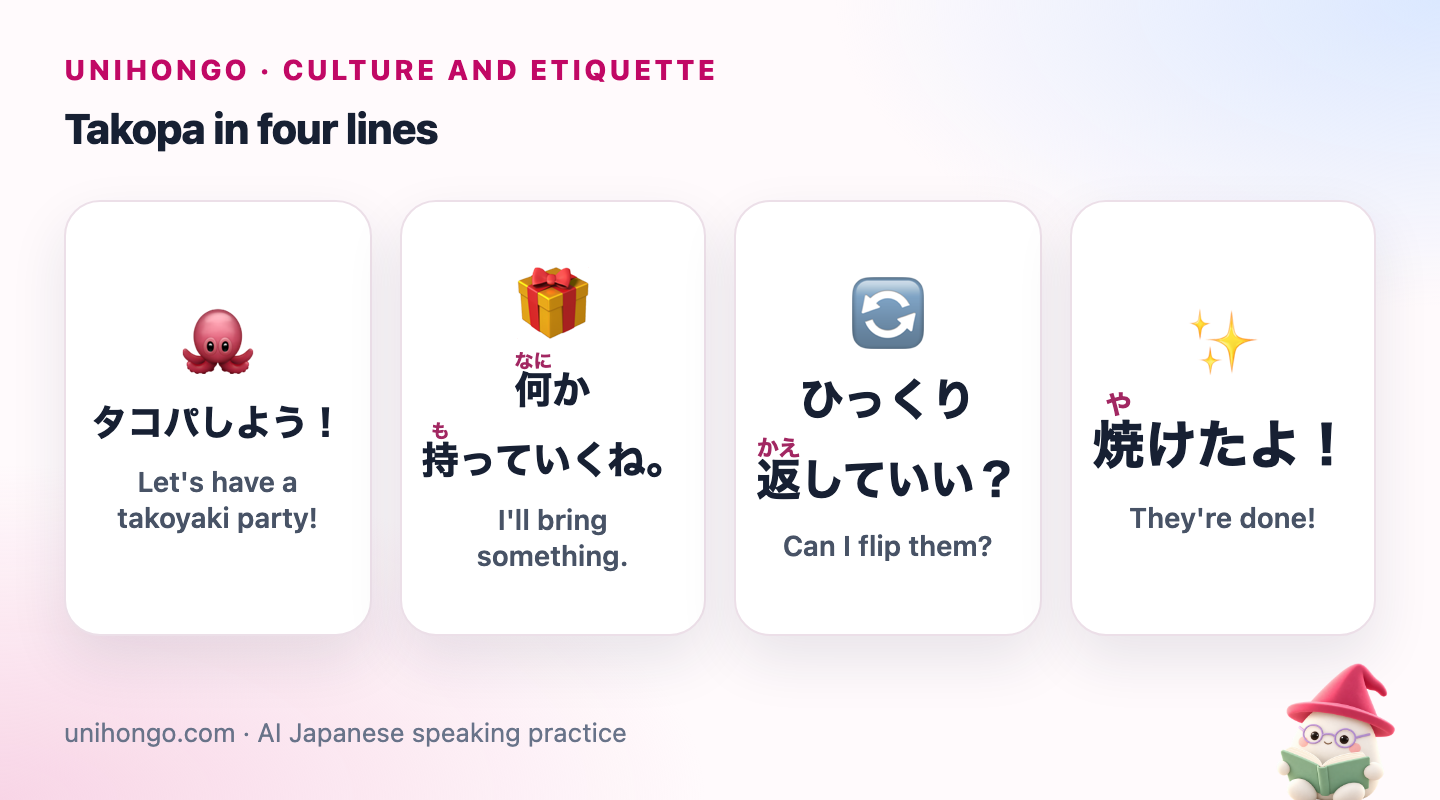
| Japanese | Romaji | Meaning |
|---|---|---|
| タコパしよう! | Takopa shiyō! | Let's have a takoyaki party! |
| 何か持っていくね。 | Nanika motte iku ne. | I'll bring something. |
| ひっくり返していい? | Hikkurikaeshite ii? | Can I flip them? |
| 焼けたよ! | Yaketa yo! | They're done! |
All four lines are casual, because a takopa is a party among friends. Shiyō is the casual let's form of suru, and the yo and ne at the ends make each line friendly. If the host is a coworker or someone older, you can stay a little more polite, for example nanika motte ikimashō ka, but most takopa quickly settle into casual speech once everyone is crowded around the pan.
Yaketa comes from yakeru, to be cooked or grilled. You will hear it again and again, along with its hopeful question form, yaketa?, every time someone leans over the pan to check.
What a takopa is, and getting invited
Takoyaki are balls of batter with a piece of octopus inside, cooked in a pan with round moulds and topped with sauce, mayonnaise, green laver and bonito flakes. They are famous as Osaka street food, but many households own an electric takoyaki pan, and it is often said that in the Kansai region most homes have one. A takopa is what happens when friends bring that pan out.
Invitations are casual and often come by message. Accepting with enthusiasm is part of the fun: iku iku! (I'm in!) is warmer than a plain ikimasu.
| Japanese | Romaji | Meaning |
|---|---|---|
| 今度の土曜、うちでタコパしない? | Kondo no doyō, uchi de takopa shinai? | Host: Want to do a takopa at my place this Saturday? |
| いいね、行く行く! | Ii ne, iku iku! | You: Sounds great, I'm in! |
| 何時から? | Nanji kara? | You: What time does it start? |
| 誰が来るの? | Dare ga kuru no? | You: Who's coming? |
Offering to bring something
It is polite to offer to contribute, and the host will usually tell you what is needed. Drinks, snacks and extra fillings are common. Many groups split the cost of ingredients, a custom called warikan (割り勘), and offering your share is appreciated even if the host refuses.
| Japanese | Romaji | Meaning |
|---|---|---|
| 何持っていけばいい? | Nani motte ikeba ii? | What should I bring? |
| 飲み物買っていくよ。 | Nomimono katte iku yo. | I'll pick up some drinks. |
| チーズとか入れても楽しいよ。 | Chīzu toka irete mo tanoshii yo. | Host: It's fun to add things like cheese. |
| 材料費、いくら? | Zairyōhi, ikura? | How much do I owe for the ingredients? |
Arriving and helping with the prep
Even at a casual party, you say ojama shimasu as you step inside and take your shoes off at the entrance. Then offer to help. There is plenty to do: chopping octopus and green onions, mixing the batter, setting out sauces.
| Japanese | Romaji | Meaning |
|---|---|---|
| おじゃまします。 | Ojama shimasu. | Hello, thanks for having me. (entering) |
| 何か手伝おうか? | Nanika tetsudaō ka? | Can I help with anything? |
| ネギ切ろうか? | Negi kirō ka? | Shall I chop the green onions? |
| じゃあ、タコお願い。 | Jā, tako onegai. | Host: Then, could you do the octopus? |
At the pan: words for cooking takoyaki
The technique is the main topic of conversation. You pour batter until it overflows the moulds, add the fillings, and wait. When the edges set, you tuck the overflow in and turn each ball a quarter or half turn with a pick, then keep turning until they are round and golden. Everyone has an opinion about the right moment.
| Japanese | Romaji | Meaning |
|---|---|---|
| まだ早いかな? | Mada hayai ka na? | Is it too early? |
| くるっと回して。 | Kurutto mawashite. | Give it a quick turn. |
| あ、崩れちゃった。 | A, kuzurechatta. | Oops, it fell apart. |
| 熱いから気をつけて。 | Atsui kara ki o tsukete. | Careful, they're hot. |
| Word | Meaning | When you hear it |
|---|---|---|
| kiji | Batter | Kiji o nagasu: pouring the batter |
| tako | Octopus | One piece in each mould |
| tenkasu | Crunchy tempura bits | Sprinkled over the batter |
| benishōga | Red pickled ginger | A pinch in each ball |
| pikku / takegushi | Pick / bamboo skewer | For turning the balls |
| aonori, katsuobushi | Green laver, bonito flakes | Toppings at the end |
Small talk around the table
While the balls cook, there are long pauses of waiting, which are perfect for conversation. Questions about the host's takoyaki habits, where people are from and food back home come up naturally. If anyone at the table is from the Kansai region, expect strong opinions about the right way to make takoyaki, and enjoy them.
Asking before you take photos is polite, especially of people. Food photos are almost always welcome, and a group photo with the pan is a common way to end the evening.
| Japanese | Romaji | Meaning |
|---|---|---|
| 家でよくやるの? | Ie de yoku yaru no? | Do you do this often at home? |
| 関西出身なの? | Kansai shusshin na no? | Are you from Kansai? |
| 私の国にも似た料理があるよ。 | Watashi no kuni ni mo nita ryōri ga aru yo. | There's a similar dish in my country. |
| 写真撮っていい? | Shashin totte ii? | Can I take a photo? |
| みんなで撮ろう! | Minna de torō! | Let's take one all together! |
Scenario: around the pan
The first batch is almost ready. Your friend Riko is in charge of the pan, and you finally get to try turning them yourself. Notice how many lines end in yo, ne and ka na: this is relaxed, friendly speech.
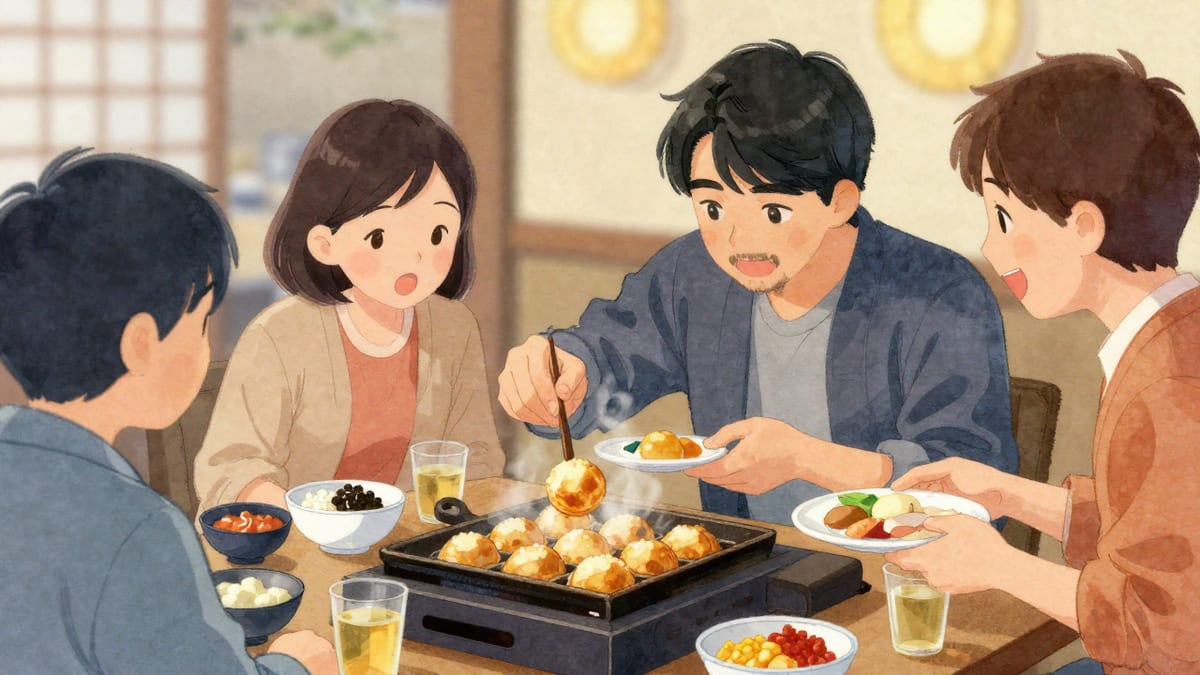
| Japanese | Romaji | Meaning |
|---|---|---|
| ひっくり返していい? | Hikkurikaeshite ii? | You: Can I flip them? |
| いいよ、ゆっくりね。 | Ii yo, yukkuri ne. | Riko: Sure, slowly. |
| お、きれいに回った! | O, kirei ni mawatta! | Riko: Oh, that turned perfectly! |
| 外はカリカリ、中はトロトロ! | Soto wa karikari, naka wa torotoro! | You: Crispy outside, gooey inside! |
| 上手だね! | Jōzu da ne! | Riko: You're good at this! |
| 次は一個だけわさび入れよう。 | Tsugi wa ikko dake wasabi ireyō. | You: Next round, let's put wasabi in just one. |
The one-with-wasabi game, sometimes with mustard or a very spicy filling, is a common takopa joke: everyone eats at the same time and waits to see who reacts. Karikari and torotoro are sound words for crispy and gooey, and they are the classic takoyaki compliment.
Cleaning up and saying goodbye
At the end, offering to help tidy up is one of the most appreciated things a guest can do, and it is a natural moment for conversation. The host may say ii yo, ii yo (it's fine, don't worry). Offer once more, then follow the host's lead.
| Japanese | Romaji | Meaning |
|---|---|---|
| 片付け手伝うよ。 | Katazuke tetsudau yo. | I'll help tidy up. |
| お皿洗おうか? | Osara araō ka? | Shall I wash the plates? |
| ごちそうさま!楽しかった。 | Gochisōsama! Tanoshikatta. | Thanks for the food! That was fun. |
| おじゃましました。 | Ojama shimashita. | Thanks for having me. (leaving) |
| 次はうちでやろう。 | Tsugi wa uchi de yarō. | Next time, let's do it at my place. |
- Do take your shoes off and line them up at the entrance.
- Do let others have a turn at the pan instead of keeping the pick.
- Do let takoyaki cool a moment: the centre stays very hot.
- Do send a short thank-you message afterwards, such as kyō wa arigatō! tanoshikatta.