
Four lines that describe your cut
The barber will usually begin with kyō wa dō saremasu ka (what would you like today?). The clearest answer goes part by part: the sides, the back, then the top. Japanese uses the comparative endings -me to mean a bit more of something: mijikame is shortish, nagame is longish. These four lines cover most men's cuts.
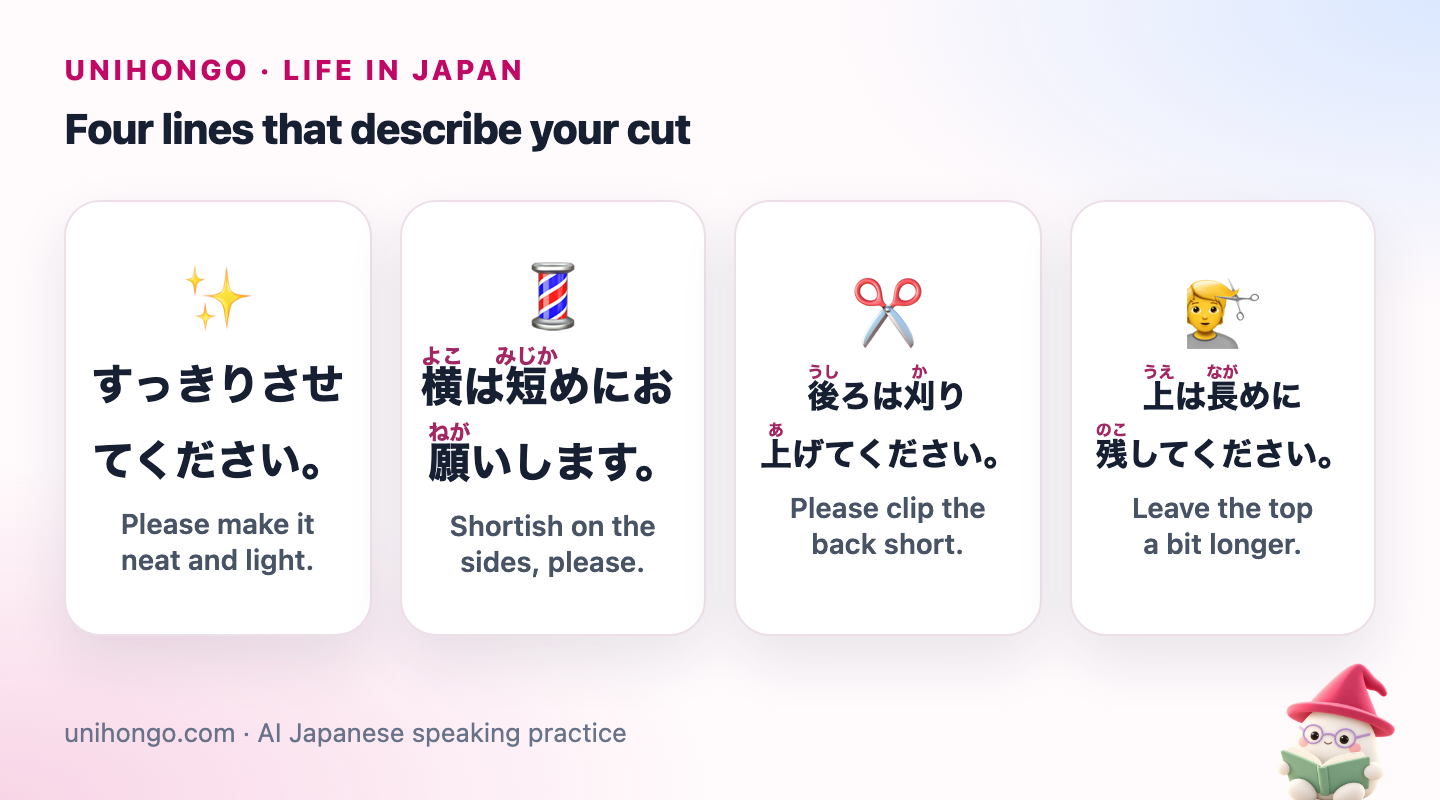
| Japanese | Romaji | Meaning |
|---|---|---|
| すっきりさせてください。 | Sukkiri sasete kudasai. | Please make it neat and light. |
| 横は短めにお願いします。 | Yoko wa mijikame ni onegai shimasu. | Shortish on the sides, please. |
| 後ろは刈り上げてください。 | Ushiro wa kariagete kudasai. | Please clip the back short. |
| 上は長めに残してください。 | Ue wa nagame ni nokoshite kudasai. | Leave the top a bit longer. |
| 今日はどうされますか。 | Kyō wa dō saremasu ka. | Barber: What would you like today? |
| この写真みたいにしてください。 | Kono shashin mitai ni shite kudasai. | Please make it like this photo. |
Clipper lengths: millimetres, not guard numbers
Clippers are barikan (バリカン) in Japanese, and lengths are always given in millimetres. The barber may ask nan miri ni shimasu ka (how many millimetres?). If you are used to guard numbers from home, convert first: guard sizes differ between brands, so look up the millimetre length of your usual guard before you go.
Kariage (刈り上げ) means clipping the hair short at the back and sides, from the neckline up. Tsū burokku (two-block) is a popular style where the lower sides and back are clipped short and the top is left long over them. Some barbers also say fēdo for a fade.
| Japanese | Romaji | Meaning |
|---|---|---|
| バリカンは何ミリにしますか。 | Barikan wa nan miri ni shimasu ka. | Barber: How many millimetres with the clippers? |
| 3ミリでお願いします。 | San miri de onegai shimasu. | Three millimetres, please. |
| 横と後ろは6ミリで、上ははさみでお願いします。 | Yoko to ushiro wa roku miri de, ue wa hasami de onegai shimasu. | Six millimetres on the sides and back, and scissors on top, please. |
| ツーブロックにしたいです。 | Tsū burokku ni shitai desu. | I'd like a two-block cut. |
| もみあげはどうしますか。 | Momiage wa dō shimasu ka. | Barber: What about your sideburns? |
| もみあげは残してください。 | Momiage wa nokoshite kudasai. | Please keep the sideburns. |
What sukkiri really means
Sukkiri (すっきり) is a feeling word: refreshed, clear, with nothing extra. After a good night's sleep you feel sukkiri; a tidy room is sukkiri. At a barber, sukkiri sasete kudasai asks for a neat, light, tidy cut: thinned out, cleared around the ears and neckline. For many barbers that means noticeably shorter.
If you want only a tidy-up, say soroeru dake de (just even it out) or sukoshi dake kitte kudasai (just cut a little). The difference between these and sukkiri is the most common cause of a surprise haircut.
| What you say | What the barber usually hears |
|---|---|
| sukkiri | Neat and light, often clearly shorter |
| soroeru dake | Just even the length, keep the style |
| sukoshi dake | Take off only a little |
| bassari | Cut a lot off, a big change |
| karuku suku | Thin it out so it feels lighter |
During the cut: the questions you will hear
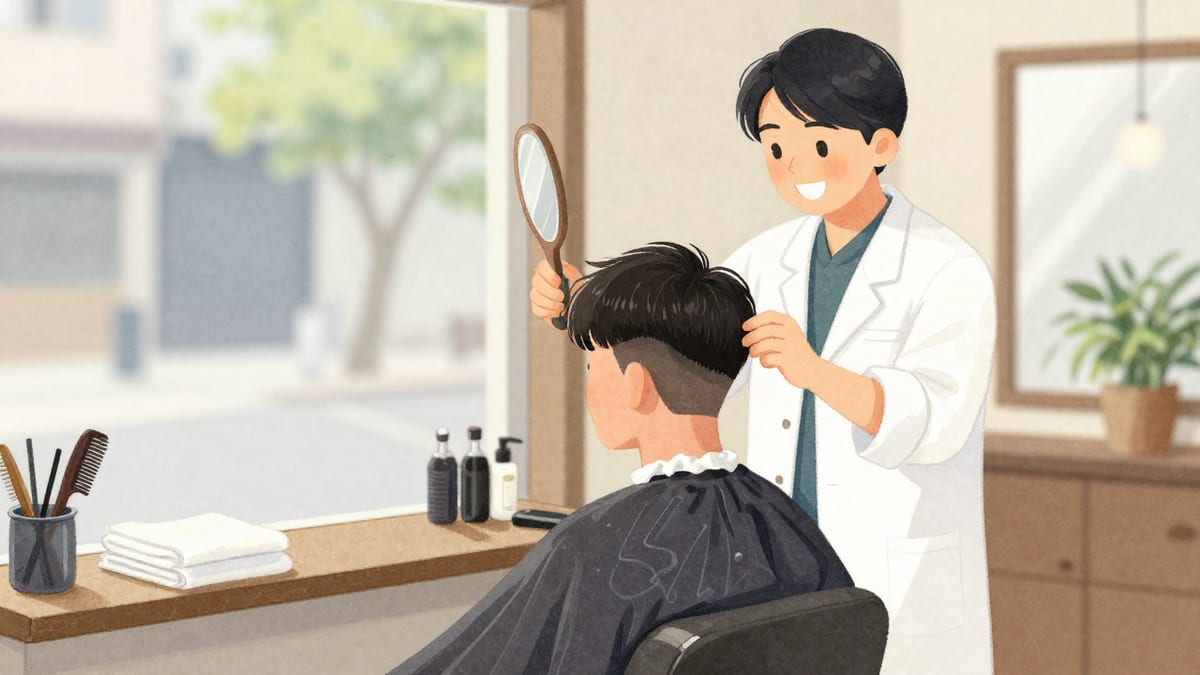
Japanese barbers check in at fixed moments. During the shampoo, which is often done leaning forward over the basin at a traditional barber, you may hear the famous kayui tokoro wa gozaimasen ka (is there anywhere itchy?). Most people simply answer daijōbu desu. At the end, the barber holds up a mirror behind your head and asks how it looks.
| Japanese | Romaji | Meaning |
|---|---|---|
| かゆいところはございませんか。 | Kayui tokoro wa gozaimasen ka. | Barber: Is there anywhere itchy? |
| 大丈夫です。 | Daijōbu desu. | I'm fine, thanks. |
| お湯加減はいかがですか。 | Oyu kagen wa ikaga desu ka. | Barber: Is the water temperature all right? |
| こんな感じでいかがでしょうか。 | Konna kanji de ikaga deshō ka. | Barber: How does this look? |
| もう少し短くしてください。 | Mō sukoshi mijikaku shite kudasai. | Please make it a little shorter. |
| ちょうどいいです。 | Chōdo ii desu. | That's just right. |
| お疲れさまでした。 | Otsukaresama deshita. | Barber: All done, thank you for your patience. |
Otsukaresama deshita at the end of a haircut is not about work. It thanks you for sitting through it and signals that the service is finished.
Face shaves and extras
Under Japanese licensing, barbers and beauty salons are separate trades, and shaving the face with a razor is a classic barber service. A traditional barber may offer kaozori (顔剃り), a face shave with hot towels and lather, and may also tidy your eyebrows. Quick-cut shops usually skip the shampoo and shave and remove loose hair with a vacuum nozzle instead, so ask if you are not sure what is included.
| Japanese | Romaji | Meaning |
|---|---|---|
| 顔剃りもお願いします。 | Kaozori mo onegai shimasu. | A face shave too, please. |
| 眉毛も整えますか。 | Mayuge mo totonoemasu ka. | Barber: Shall I tidy your eyebrows as well? |
| ひげは残してください。 | Hige wa nokoshite kudasai. | Please leave my beard. |
| シャンプーは付いていますか。 | Shanpū wa tsuite imasu ka. | Is a shampoo included? |
Quick-cut shops and traditional barbers
You will find two main kinds of barber in Japan. Traditional barbers, often small family-run shops with a spinning striped pole outside, offer the full service: consultation, cut, shampoo, a face shave, hot towels and sometimes a shoulder massage. A visit takes time, and many regulars book ahead by phone.
Quick-cut shops focus on a fast cut. Many have a ticket machine at the entrance and a screen or lamp showing the waiting time, and they usually skip the shampoo and shave. The talk is shorter, so have your length ready: the barber may only ask dono kurai kirimasu ka (how much shall I cut?) before starting. Either kind is fine for a learner; the quick-cut shop is good for a first try because the conversation is short and predictable.
| Japanese | Romaji | Meaning |
|---|---|---|
| 予約しなくても大丈夫ですか。 | Yoyaku shinakute mo daijōbu desu ka. | Is it okay without a booking? |
| どのくらい待ちますか。 | Dono kurai machimasu ka. | How long is the wait? |
| どのくらい切りますか。 | Dono kurai kirimasu ka. | Barber: How much shall I cut? |
| 全体的に二センチくらい切ってください。 | Zentaiteki ni ni senchi kurai kitte kudasai. | Please take about two centimetres off all over. |
A full mini dialogue
| Japanese | Romaji | Meaning |
|---|---|---|
| いらっしゃいませ。今日はどうされますか。 | Irasshaimase. Kyō wa dō saremasu ka. | Barber: Welcome. What would you like today? |
| すっきりさせたいです。横と後ろは3ミリでお願いします。 | Sukkiri sasetai desu. Yoko to ushiro wa san miri de onegai shimasu. | Customer: I want it neat. Three millimetres on the sides and back, please. |
| 上はどうしますか。 | Ue wa dō shimasu ka. | Barber: And the top? |
| 上は少しだけ切ってください。 | Ue wa sukoshi dake kitte kudasai. | Customer: Just a little off the top. |
| かしこまりました。 | Kashikomarimashita. | Barber: Certainly. |
| ありがとうございました。さっぱりしました。 | Arigatō gozaimashita. Sappari shimashita. | Customer: Thank you. I feel refreshed. |
Sappari shimashita (I feel refreshed) is a natural thing to say after a haircut or a bath, and barbers love to hear it.
Common mistakes to avoid
- Saying only mijikaku shite kudasai. Short means different things to different people; add a number or the part of the head.
- Giving a guard number from home. Convert it to millimetres first.
- Using sukkiri when you only want a trim. Say soroeru dake de instead.
- Answering kayui tokoro wa gozaimasen ka with a long explanation. Daijōbu desu is the normal reply; name a spot only if it really itches.
- Staying silent at the mirror check. This is the moment to ask for changes; after you stand up, it is harder.