

Replying to the invitation
A formal invitation, shōtaijō, usually arrives by post with a reply postcard, henshin hagaki, and a deadline. Reply promptly: it helps the couple plan seating and meals, and a quick reply is itself a courtesy. Many couples now also accept replies through an online form, in which case follow their instructions.
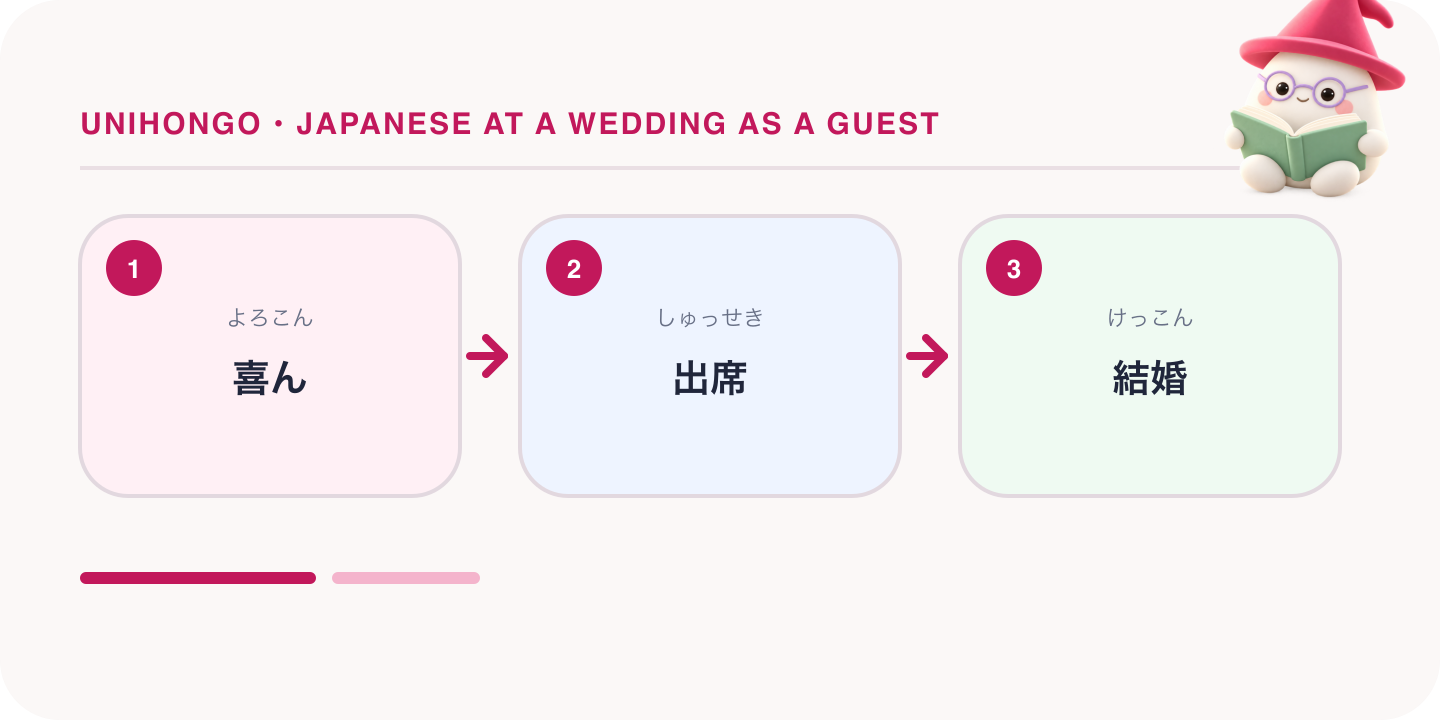
The paper card has its own etiquette. The printed words include honorifics aimed at you, such as the go in go-shusseki, attendance, and go-hōmei, your name. Because it would be odd to use honorifics about yourself, you cross them out with two neat diagonal or horizontal lines. Many people also write yorokonde, gladly, before shusseki and sasete itadakimasu after it, turning the answer into I will gladly attend. On the front, the printed yuki, to, is crossed out and replaced with sama or onchū as appropriate for the return address.
Add a short message of congratulations in the space provided, such as go-kekkon omedetō gozaimasu. If you cannot attend, give a brief, positive reason or simply say you regret you cannot come, and send congratulations anyway; it is common to send a gift or money later.
| Japanese | Romaji | Meaning |
|---|---|---|
| 喜んで出席させていただきます。 | Yorokonde shusseki sasete itadakimasu. | I will gladly attend. |
| ご結婚おめでとうございます。 | Go-kekkon omedetō gozaimasu. | Congratulations on your marriage. |
| お招きいただきありがとうございます。 | O-maneki itadaki arigatō gozaimasu. | Thank you for inviting me. |
| 当日を楽しみにしております。 | Tōjitsu o tanoshimi ni shite orimasu. | I'm looking forward to the day. |
| 残念ながら、やむを得ない事情で欠席させていただきます。 | Zannen nagara, yamu o enai jijō de kesseki sasete itadakimasu. | Unfortunately, circumstances prevent me from attending. |
Preparing go-shūgi
Go-shūgi is the money gift that guests bring to the wedding, and it effectively replaces a wedding present. It goes in a shūgi-bukuro, a special envelope sold at stationery shops and convenience stores, decorated with mizuhiki cords tied in a knot that cannot be undone, such as musubi-kiri or awaji musubi. This symbolises something that happens once. Avoid envelopes with a bow knot, chōchō musubi, which can be retied and is used for celebrations that can happen again.
Use new, crisp notes, shinsatsu, which you can request at a bank. The amount depends on your relationship, age and region, and there is no single rule. People usually avoid amounts that divide evenly, which suggest the couple splitting, and numbers involving four and nine. Write the amount on the inner envelope and your name on the front of the outer one. Envelopes range from simple to very elaborate, and the design is usually matched roughly to the amount inside.
Carry the envelope in a fukusa, a cloth wrapper, rather than loose in a bag. For weddings, choose a bright or warm colour; purple works for both happy and sad occasions.
| Word | Reading | Meaning |
|---|---|---|
| ご祝儀 | go-shūgi | Money gift for the couple |
| 祝儀袋 | shūgi-bukuro | Wedding money envelope |
| 水引 | mizuhiki | Decorative cords on the envelope |
| 結び切り | musubi-kiri | Knot that cannot be undone; for weddings |
| 蝶結び | chōchō musubi | Bow knot; not for weddings |
| 新札 | shinsatsu | New, uncreased banknotes |
| 中袋 | nakabukuro | Inner envelope for the notes |
| 袱紗 | fukusa | Cloth wrapper for carrying the envelope |
| 会費制 | kaihi-sei | Fixed attendance fee instead of go-shūgi |
In some regions, notably Hokkaido, weddings are often kaihi-sei: guests pay a fixed fee stated on the invitation instead of bringing go-shūgi. If the invitation mentions kaihi, follow that instead of the envelope custom.
At the reception desk: uketsuke
When you arrive, go first to the cloakroom if you have a coat or large bag, then to the uketsuke, the reception desk. It is usually staffed by friends or relatives of the couple, often one table for the groom's side and one for the bride's. Go to the side you were invited by.
The exchange is short and formal. Bow, congratulate them, say your connection to the couple, then take the envelope out of the fukusa and hand it over with both hands, facing so they can read your name. The humble phrase kokoro bakari desu ga, it's only a small token, is traditional. You will then be asked to sign the guest book, hōmeichō, or fill in a guest card, and given a seating chart, sekijihyō.
| Japanese | Romaji | Meaning |
|---|---|---|
| 本日はおめでとうございます。 | Honjitsu wa omedetō gozaimasu. | Congratulations on this day. |
| 新郎の友人のスミスです。 | Shinrō no yūjin no Sumisu desu. | I'm Smith, a friend of the groom. |
| 新婦の同僚の田中と申します。 | Shinpu no dōryō no Tanaka to mōshimasu. | My name is Tanaka, a colleague of the bride. |
| 心ばかりですが、お祝いです。 | Kokoro bakari desu ga, o-iwai desu. | It's only a small token, but please accept this gift. |
| こちらにご記帳をお願いいたします。 | Kochira ni go-kichō o onegai itashimasu. | Please sign the guest book here. |
| 席次表でございます。 | Sekijihyō de gozaimasu. | Here is the seating chart. |
| お手荷物はクロークでお預かりします。 | O-tenimotsu wa kurōku de o-azukari shimasu. | We'll keep your bags in the cloakroom. |
During the ceremony and reception
A Japanese wedding usually has two parts: the kyoshiki, the ceremony, which may be Shinto, Christian-style or a civil-style ceremony in front of guests, and the hirōen, the reception. Not every guest attends the ceremony; the invitation will say which parts you are invited to.
The reception follows a programme run by an MC, shikaisha. Expect speeches, supīchi, from bosses and friends, a toast, kanpai, a cake-cutting called kēki nyūtō, and often an o-ironaoshi, when the couple leave to change outfits. Near the end, the bride often reads a letter to her parents, and the couple's families thank the guests. When you leave, you receive a gift bag of hikidemono, return gifts from the couple.
| Word | Reading | Meaning |
|---|---|---|
| 挙式 | kyoshiki | Wedding ceremony |
| 披露宴 | hirōen | Wedding reception |
| 新郎 | shinrō | Groom |
| 新婦 | shinpu | Bride |
| 司会者 | shikaisha | Master of ceremonies |
| 乾杯 | kanpai | Toast |
| ケーキ入刀 | kēki nyūtō | Cake cutting |
| お色直し | o-ironaoshi | Outfit change |
| 引出物 | hikidemono | Return gifts for guests |
| お開き | o-hiraki | The end of the party |
Congratulating the couple
During the reception there is usually a moment when guests can go up to the couple's table for photos, or the couple come round to the tables. Keep your words short and warm. The most useful set phrase is suenagaku o-shiawase ni, may you be happy for ever, which carries exactly the right tone.
Compliments on the day, the outfits and the venue are always welcome. If you know one of them well, a sentence about how happy you are for them goes a long way. There is no need for anything elaborate; a smile and two sentences are ideal while the couple are busy greeting everyone.
| Japanese | Romaji | Meaning |
|---|---|---|
| ご結婚おめでとう。末永くお幸せに。 | Go-kekkon omedetō. Suenagaku o-shiawase ni. | Congratulations. Wishing you happiness for ever. |
| ドレス、とても素敵です。 | Doresu, totemo suteki desu. | Your dress is lovely. |
| お二人とも本当にお似合いです。 | O-futari tomo hontō ni o-niai desu. | You really are perfect for each other. |
| 自分のことのように嬉しいです。 | Jibun no koto no yō ni ureshii desu. | I'm as happy as if it were my own wedding. |
| 素敵な式でした。 | Suteki na shiki deshita. | It was a beautiful ceremony. |
| 一緒に写真を撮ってもいいですか。 | Issho ni shashin o totte mo ii desu ka. | May I take a photo with you? |
Imikotoba: words to avoid
Imikotoba are words considered unlucky on a particular occasion. At weddings, they are words that suggest separation, breaking, ending or repetition, since a marriage should happen once and last. Guests are not expected to be perfect, but in a speech or a written message it is good manners to avoid them.
The trickiest group is kasane-kotoba, doubled words such as tabitabi, often, or iroiro, various, because repetition suggests remarriage. In everyday speech almost nobody will notice iroiro, but in a formal speech people swap it for a different expression. Even the end of the party is not called owari; the MC will say o-hiraki, the opening out.
| Avoid | Reading | Why, and what to say |
|---|---|---|
| 別れる | wakareru | To part; say something else entirely |
| 切れる | kireru | To be cut off; avoid in speeches |
| 離れる | hanareru | To move apart |
| 終わる | owaru | To end; say o-hiraki ni suru |
| 戻る | modoru | To go back |
| 再び | futatabi | Again; suggests a second marriage |
| 重ね重ね | kasanegasane | Repeatedly; say fukaku instead |
| たびたび | tabitabi | Often; a doubled word |
| 忙しい | isogashii | Busy; its kanji contains the part for death |
If you are giving a speech, the existing guide to Japanese wedding speeches covers structure and set phrases in more detail. For a short congratulation at the table, simply using the phrases above keeps you safely clear of imikotoba.
The nijikai after-party
The nijikai, literally second party, starts after the reception, often at a nearby bar or restaurant. It is organised by the couple's friends, kanji, rather than by the venue, and the mood is much more relaxed: games, prizes and plenty of drinking. Guests pay a kaihi, a set fee, in cash at the door; the amount is announced in advance and varies.
You do not bring go-shūgi to the nijikai if you already gave it at the reception. Dress is usually the same formal outfit, though some people remove a jacket or change into something lighter. If you were only invited to the nijikai, smart casual clothes are normally fine unless the organisers say otherwise.
| Japanese | Romaji | Meaning |
|---|---|---|
| 二次会にも参加します。 | Nijikai ni mo sanka shimasu. | I'll come to the after-party too. |
| 会費はおいくらですか。 | Kaihi wa o-ikura desu ka. | How much is the fee? |
| 幹事さん、ありがとうございます。 | Kanji-san, arigatō gozaimasu. | Thank you, organisers. |
| 明日早いので、お先に失礼します。 | Ashita hayai node, osaki ni shitsurei shimasu. | I have an early start tomorrow, so I'll be leaving first. |
When something goes wrong
Common problems are forgetting new notes, arriving late, or realising you have written something unlucky in your message. For notes, banks are the easiest source, but if you are stuck on the day, iron slightly used notes flat or choose the crispest ones you have; nobody will inspect them. If you are running late, contact the person who invited you, or tell the uketsuke staff quietly when you arrive and follow their instructions about when to enter.
If you cannot attend after replying yes, tell the couple as soon as possible, because the venue charges them for every seat. It is common to send go-shūgi or a gift anyway, since a meal was prepared for you.
| Japanese | Romaji | Meaning |
|---|---|---|
| 遅れてしまい、申し訳ありません。 | Okurete shimai, mōshiwake arimasen. | I'm terribly sorry for being late. |
| 今から入っても大丈夫ですか。 | Ima kara haitte mo daijōbu desu ka. | Is it all right to go in now? |
| 急用で出席できなくなってしまいました。 | Kyūyō de shusseki dekinaku natte shimaimashita. | Something urgent has come up and I can no longer attend. |
| せめてお祝いだけでも送らせてください。 | Semete o-iwai dake demo okurasete kudasai. | Please at least let me send a gift. |