
Four dark kanji to start with
These four kanji cover the main dark images in Japanese: a shadow, total darkness, the early night and a deep, mysterious black. The first three are ordinary words; only the last is a common real given name.
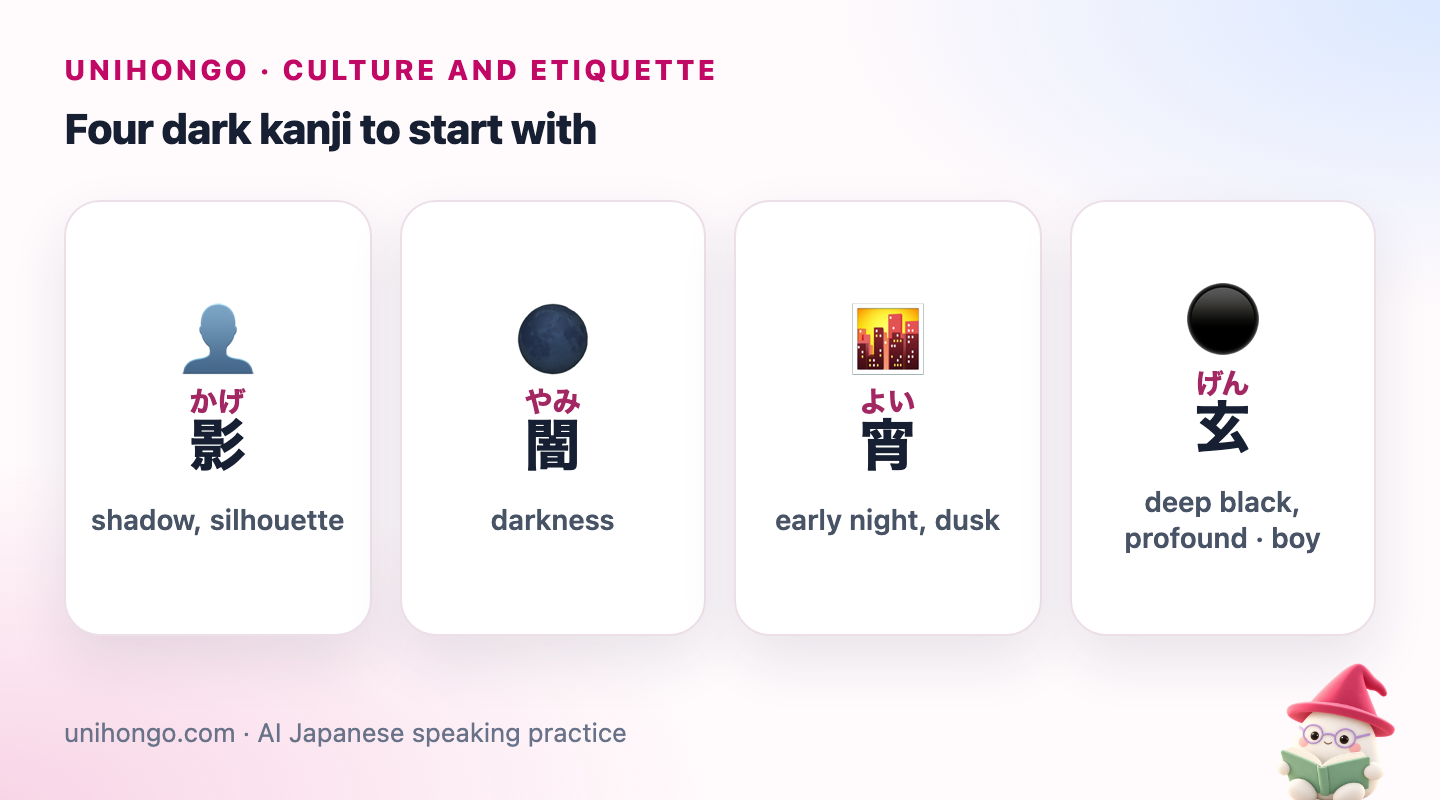
| Japanese | Romaji | Meaning |
|---|---|---|
| 影 | kage | shadow, silhouette |
| 闇 | yami | darkness |
| 宵 | yoi | early night, dusk |
| 玄 | Gen | deep black, profound · boy |
宵 is the first part of the night, just after the sun goes down; 今宵 (koyoi) is a poetic word for tonight. 玄 means a deep, dark black, but also something profound and hard to fathom. It appears in the everyday word 玄人 (kurōto), an expert or professional, and in 玄関 (genkan), the entrance of a house.
Real names and fictional names
In Japan, a given name can only use kanji from two official lists, the common-use kanji and the extra kanji approved for names, plus hiragana and katakana. Since 2025, the reading of a name is also recorded in the family register, and readings far from accepted ones may be questioned. Within those limits parents are free, but social feeling matters more than law: a name is supposed to carry a good wish, and darkness, shadow and evil do not.
That is why dark kanji live in two different places. In real life they appear mainly in surnames, which describe the landscape where a family lived long ago: a black rice field, a dark river, a shady mountain. In fiction they appear in given names, because a writer wants the reader to feel something immediately.
| Japanese | Romaji | Meaning |
|---|---|---|
| 黒田 | Kuroda | black rice field · surname |
| 黒川 | Kurokawa | black river · surname |
| 影山 | Kageyama | shadow mountain · surname |
| Kanji | In real given names | In surnames | In fiction |
|---|---|---|---|
| 影 | Very rare | 影山 Kageyama | Common: Kage, Kagemaru |
| 闇 | Almost never | Very rare | Common for villains |
| 黒 | Rare | 黒田, 黒川, 黒木 | Common: Kuro, Kuroha |
| 夜 | Some, e.g. 小夜子 | Rare | Common: Yoru, Yogiri |
| 玄 | Common for boys | Some | Used for wise, calm types |
Dark kanji in real given names
Real parents who like a dark, deep or nocturnal image choose kanji with a positive second meaning: profound, the hour before dawn, a quiet evening. These names sound calm and intelligent rather than sinister.
| Japanese | Romaji | Meaning |
|---|---|---|
| 朔夜 | Sakuya | new moon + night · boy |
| 黎 | Rei | the dark before dawn · unisex |
| 小夜子 | Sayoko | little night child · girl, classic |
| 夕奈 | Yūna | evening + soft ending · girl |
| 玄太 | Genta | profound + big · boy |
黎 means black, and it appears in 黎明 (reimei), the dawn or the first light after darkness, which also means the beginning of an age. That double meaning, dark but about to turn light, makes it attractive for a name. 小夜 (sayo) is an old poetic word for night, and Sayoko feels classic and elegant. 朔夜 joins 朔, the new moon and the darkest night of the old lunar month, to 夜, night, and sounds modern and quiet. 夕 is evening, warm rather than dark.
影 and 陰: shadow, shade and even light
Two kanji are read kage. 影 is a shadow cast by something, a silhouette or a reflection. 陰 is shade, the side the light does not reach, and it also means hidden or behind the scenes. The surprise is that in older Japanese 影 could also mean light itself, or the form of something seen in the light. That is why 月影 means moonlight, not the moon's shadow.
| Japanese | Romaji | Meaning |
|---|---|---|
| 月影 | tsukikage | moonlight |
| 面影 | omokage | a trace of someone's face, a memory |
| 影絵 | kagee | shadow puppets, shadow pictures |
| 日陰 | hikage | the shade, out of the sun |
| 木陰 | kokage | the shade of a tree |
| 陰陽師 | onmyōji | a yin-yang diviner |
面影 is used when you see a trace of someone in another face: Haha no omokage ga aru, she has something of her mother about her. 陰陽師 were court diviners of the Heian period, and they are now a favourite figure in novels, films and games, which is one reason the kanji 陰 feels mystical to Japanese readers. A writer who knows that 影 can mean light can give a character a name with a hidden double meaning.
Night and twilight words for atmosphere
Instead of putting darkness into a character's name, many Japanese writers put it into the setting. These words are real, they appear in songs and poems, and they give a scene a dark, beautiful mood.
| Japanese | Romaji | Meaning |
|---|---|---|
| 宵闇 | yoiyami | the darkness of early night |
| 黄昏 | tasogare | twilight, dusk |
| 逢魔が時 | ōmagatoki | dusk, the hour of meeting spirits |
| 真夜中 | mayonaka | the middle of the night |
| 朧月 | oborozuki | a hazy spring moon |
逢魔が時 is the traditional name for the dusk, when people once believed spirits and monsters were most likely to appear. 朧 (oboro) means hazy or dim, and 朧月 is the soft, misty moon of spring nights. Oboro on its own is a popular name for mysterious characters in fiction.
Building a believable dark character name
The simplest recipe for a modern, realistic character is to let the surname carry the darkness and keep the given name ordinary. Japanese readers will find the character credible, and the surname will still set the mood. For a historical or fantasy character, older endings such as -maru, once common in boys' childhood names, and poetic single words work well.
| Japanese | Romaji | Meaning |
|---|---|---|
| 影山玄 | Kageyama Gen | a believable modern name |
| 黒川夕奈 | Kurokawa Yūna | a believable modern name |
| 影丸 | Kagemaru | shadow + old boy's ending · fiction |
| 朧 | Oboro | hazy, dim · fiction |
| 夜霧 | Yogiri | night mist · fiction |
| 黒羽 | Kuroha | black feather · fiction-style |
Notice the Japanese order: surname first, then given name. In a story set in Japan, other characters will mostly call this person Kageyama-san, and only close friends will use Gen. Names like Kagemaru and Oboro sound like ninja, assassins or spirits; that is perfect for a fantasy world and odd for a high-school romance.
Mini dialogue: is my villain's name too much?
You are drawing characters for a game with a Japanese friend in the evening, and you ask for an honest opinion. You are close friends, so the speech is casual.
| Japanese | Romaji | Meaning |
|---|---|---|
| このキャラの名前、どう思う? | Kono kyara no namae, dō omou? | You: What do you think of this character's name? |
| 闇丸?ちょっと中二病っぽいかも。 | Yamimaru? Chotto chūnibyō ppoi kamo. | Friend: Yamimaru? A bit edgy-teen, maybe. |
| 中二病って何? | Chūnibyō tte nani? | You: What's chūnibyō? |
| 中学生が考えそうな、かっこつけた感じ。 | Chūgakusei ga kangaesō na, kakkotsuketa kanji. | Friend: Trying too hard, like a middle schooler's idea. |
| じゃあ、影山玄は? | Jā, Kageyama Gen wa? | You: Then how about Kageyama Gen? |
| それならリアルで、かっこいいね。 | Sore nara riaru de, kakkoii ne. | Friend: That's realistic, and it sounds cool. |
中二病 (chūnibyō) literally means second-year-of-middle-school syndrome. It is joking slang for the dramatic, self-important fantasies of a fourteen-year-old: dark powers, secret names, a cursed right arm. It is mostly used affectionately, but it can sting, so use it about names and ideas rather than about the person.
Test your character names with Mocchi
Mocchi is a patient first reader for names. Try: Does Kageyama Gen sound like a real Japanese name? Is Yamimaru chūnibyō? Mocchi explains each kanji, says how a Japanese reader is likely to react, and keeps notes on the characters you are building, so you can pick up the conversation next time with a new character in mind.
Then ask for /create-flashcards with the dark and twilight words from this post, choose a photo for each, perhaps a moonlit street or a tree's shade, and play Vocabulary Dash with your own cards to learn them at speed.
Common mistakes with dark names
- Giving a realistic modern character a given name like 闇 or 影. Japanese readers will hear a manga villain, not a person.
- Assuming dark means evil. 玄 and 黎 are dark kanji with calm, positive meanings, and 月影 is moonlight.
- Ignoring surname order. In Japanese, Kageyama Gen is the natural order, and most people would call him Kageyama-san.
- Using kanji only for how they look. Check the meaning and reading of each one, and ask a native speaker about the overall feel.
- Calling a real person's name chūnibyō. It is a joke about fiction and ideas, not a comment to make about someone's real name.