
Four lines for a booth
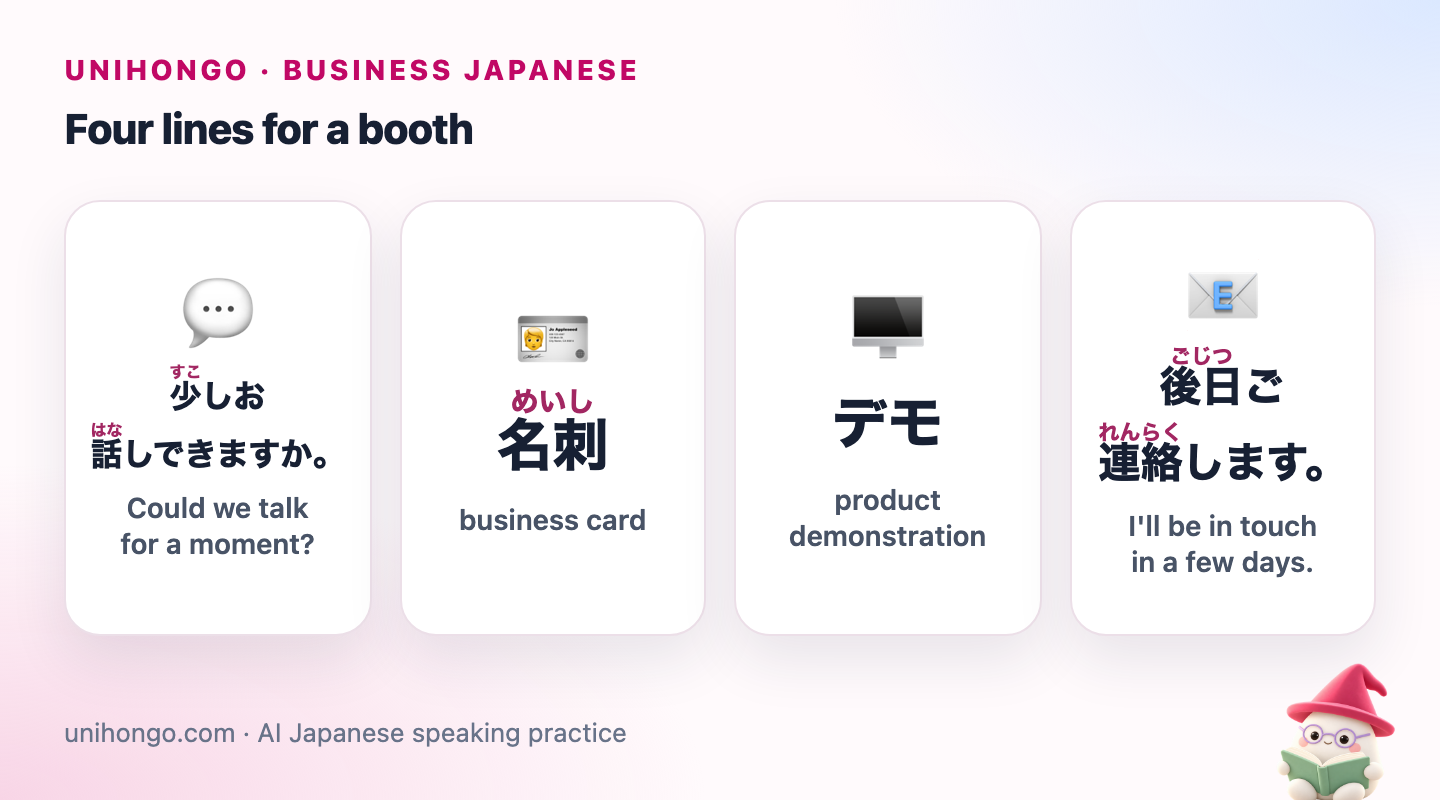
Sukoshi ohanashi dekimasu ka, could we talk for a moment, opens a conversation with a staffer who is between visitors. The meishi (名刺), business card, is exchanged within the first minute. Demo is the same loanword as in English and is what you ask to see. Gojitsu gorenraku shimasu, I will be in touch in a few days, closes the conversation with a promise you then keep. Around them sit tenjikai (展示会), the show; shutten (出展), exhibiting; and raijōsha (来場者), the visitors.
| Japanese | Romaji | Meaning |
|---|---|---|
| 少しお話しできますか。 | Sukoshi ohanashi dekimasu ka. | Could we talk for a moment? |
| 名刺 | meishi | business card |
| デモ | demo | product demonstration |
| 後日ご連絡します。 | Gojitsu gorenraku shimasu. | I'll be in touch in a few days. |
| 展示会 | tenjikai | trade show |
| 出展 | shutten | exhibiting |
| 来場者 | raijōsha | visitor, attendee |
Approaching a booth as a visitor
Booth staff will often greet you first with irasshaimase or a nod; you can simply ask what the service is. Introduce your own company with heisha (弊社), the humble word for our company, and refer to theirs as onsha (御社) in speech. Say what you are interested in and what you want to learn in one sentence; staff will shape the explanation to it. If you are only scouting, mata ato de ukagaimasu, I will come back later, lets you leave without awkwardness.
| Japanese | Romaji | Meaning |
|---|---|---|
| どのようなサービスですか。 | Dono yō na sābisu desu ka. | What kind of service is it? |
| 御社の製品に興味があります。 | Onsha no seihin ni kyōmi ga arimasu. | I'm interested in your products. |
| 資料をいただけますか。 | Shiryō o itadakemasu ka. | Could I have some materials? |
| 弊社は海外向けの物流をしています。 | Heisha wa kaigai muke no butsuryū o shite imasu. | We handle logistics for overseas markets. |
| また後で伺います。 | Mata ato de ukagaimasu. | I'll come back later. |
| Word | Whose company | Where it is used |
|---|---|---|
| 御社 onsha | Yours (respectful) | In speech |
| 貴社 kisha | Yours (respectful) | In writing |
| 弊社 heisha | Ours (humble) | Speech and writing, to outsiders |
| 当社 tōsha | Ours (neutral) | Formal statements, documents |
Exchanging cards
The exchange is quick but has a shape. Stand, say your company and name with to mōshimasu, and offer your card with both hands, print facing the other person, slightly lower than theirs if you are the visitor or the junior party. Receive theirs with both hands and chōdai itashimasu, then actually read it. Asking how to read a name is polite, not rude, since many Japanese names have several readings. If you have run out of cards, there is a stock apology. During a seated talk, cards stay on the table, usually in the order the people sit.
| Japanese | Romaji | Meaning |
|---|---|---|
| パテルと申します。 | Pateru to mōshimasu. | My name is Patel. |
| 頂戴いたします。 | Chōdai itashimasu. | Thank you, I'll take it (receiving a card). |
| 恐れ入りますが、お名前はどう読みますか。 | Osoreirimasu ga, onamae wa dō yomimasu ka. | Excuse me, how do you read your name? |
| 名刺を切らしてしまいまして。 | Meishi o kirashite shimaimashite. | I'm afraid I've run out of cards. |
| よろしくお願いいたします。 | Yoroshiku onegai itashimasu. | I look forward to working with you. |
Asking for a demo and asking real questions
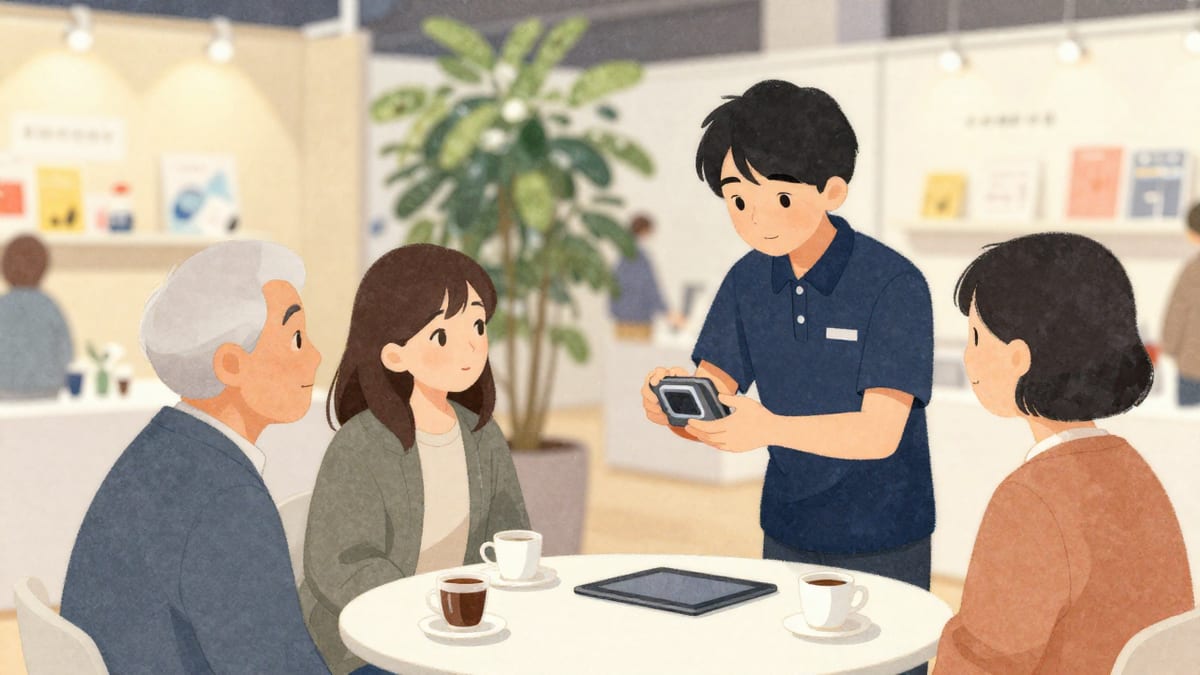
A demo is where the conversation becomes useful. Ask for it with the respectful itadakemasu ka, then ask the questions that reveal whether the product fits: case studies (dōnyū jirei), the difference from competitors, rough price, language support and how long implementation takes. Dōnyū (導入) is the word for adopting or implementing a system, and you will hear it constantly. For price, dono kurai asks for a rough figure, which is how business prices are discussed; exact quotes come later.
| Japanese | Romaji | Meaning |
|---|---|---|
| デモを見せていただけますか。 | Demo o misete itadakemasu ka. | Could you show me a demo? |
| 導入事例はありますか。 | Dōnyū jirei wa arimasu ka. | Do you have case studies? |
| 他社製品との違いは何ですか。 | Tasha seihin to no chigai wa nan desu ka. | How does it differ from other products? |
| 価格はどのくらいですか。 | Kakaku wa dono kurai desu ka. | Roughly how much does it cost? |
| 英語対応はありますか。 | Eigo taiō wa arimasu ka. | Is there English support? |
| 導入までどのくらいかかりますか。 | Dōnyū made dono kurai kakarimasu ka. | How long does implementation take? |
Working the booth as an exhibitor
On the other side of the table the goal is to qualify quickly and politely. Offer an explanation rather than launching into one: yoroshikereba gosetsumei itashimasu. Ask what problem the visitor has, kadai (課題), which tells you which part of the product to show. Collect contact details with a form or a card scan, promise materials, and thank them for stopping by. Humble forms, itashimasu and ookuri shimasu, are standard here because you are the one serving.
| Japanese | Romaji | Meaning |
|---|---|---|
| よろしければご説明いたします。 | Yoroshikereba gosetsumei itashimasu. | If you like, I can explain. |
| どのような課題をお持ちですか。 | Dono yō na kadai o omochi desu ka. | What challenges are you facing? |
| こちらにご記入いただけますか。 | Kochira ni gokinyū itadakemasu ka. | Could you fill this in? |
| 後ほど詳しい資料をお送りします。 | Nochihodo kuwashii shiryō o ookuri shimasu. | I'll send detailed materials later. |
| お立ち寄りいただき、ありがとうございました。 | Otachiyori itadaki, arigatō gozaimashita. | Thank you for stopping by. |
Seminars and the reception
Most shows run seminars and a kichō kōen (基調講演), a keynote, and many end with a konshinkai (懇親会), a networking reception with drinks. This is where conversations loosen. Praising a talk is a natural opener with a speaker, and dochira kara okoshi desu ka, where have you come from, works with anyone. Jōhō kōkan (情報交換), exchanging information, is the polite name for a future chat that is not yet a sales meeting.
At the reception, people pour drinks for each other rather than for themselves; holding your glass with both hands while someone pours, then returning the favour, is a small gesture that Japanese attendees notice. The food is secondary, so circulate with your cards. If a senior person invites you on to a second venue, a nijikai (二次会), the invitation is a good sign; accepting is easy, and declining politely because of an early start the next day is also perfectly normal.
| Japanese | Romaji | Meaning |
|---|---|---|
| 講演、とても参考になりました。 | Kōen, totemo sankō ni narimashita. | Your talk was very informative. |
| 名刺交換をお願いできますか。 | Meishi kōkan o onegai dekimasu ka. | May we exchange cards? |
| どちらからお越しですか。 | Dochira kara okoshi desu ka. | Where have you come from? |
| どのようなお仕事をされていますか。 | Dono yō na oshigoto o sarete imasu ka. | What kind of work do you do? |
| ぜひ一度、情報交換させてください。 | Zehi ichido, jōhō kōkan sasete kudasai. | Let's exchange information sometime. |
The follow-up email
Send it within a few days, while the person remembers your face. The structure is fixed: a thank-you that names the show, one line recalling what you discussed, one concrete request, attachments, and a closing. Senjitsu (先日) means the other day and is the standard opener when a few days have passed; if you write the same evening, use honjitsu. In writing, their company becomes kisha (貴社).
| Japanese | Romaji | Meaning |
|---|---|---|
| 先日は展示会でお話しさせていただき、ありがとうございました。 | Senjitsu wa tenjikai de ohanashi sasete itadaki, arigatō gozaimashita. | Thank you for talking with me at the show. |
| 改めてご説明の機会をいただけますでしょうか。 | Aratamete gosetsumei no kikai o itadakemasu deshō ka. | Could I have a chance to explain in more detail? |
| 来週のご都合はいかがでしょうか。 | Raishū no gotsugō wa ikaga deshō ka. | How is your schedule next week? |
| 資料を添付いたします。 | Shiryō o tenpu itashimasu. | I attach the materials. |
| 引き続きよろしくお願いいたします。 | Hikitsuzuki yoroshiku onegai itashimasu. | I look forward to continuing our talks. |
Common mistakes
- Saying anata no kaisha. Use onsha in speech and kisha in writing; anata is avoided in business Japanese.
- Pocketing a card without reading it. The pause to read is part of the exchange and costs five seconds.
- Asking ikura desu ka at an enterprise booth. It is not wrong, but dono kurai fits the setting and gets a more useful answer.
- Promising to follow up and not doing it. Gojitsu gorenraku shimasu is heard as a commitment; send the email.
- Dropping keigo when tired. Late in the day, itashimasu and itadakemasu ka still matter; the people you meet last may be the ones who remember you.