

Begin with a word you already understand
Choose a familiar word containing ん and identify where it appears. Tell Mocchi whether you tend to rush it, replace it with another sound, or add a vowel. This makes the next activity more focused. A broad request to fix your accent may introduce several targets before you can hear the effect of one adjustment.
Use a comfortable pace and a quiet recording environment. If background noise or microphone placement changes, the feedback may be harder to compare. Keep those conditions steady when you are trying to judge a small timing difference.
Notice the timing in a familiar language word
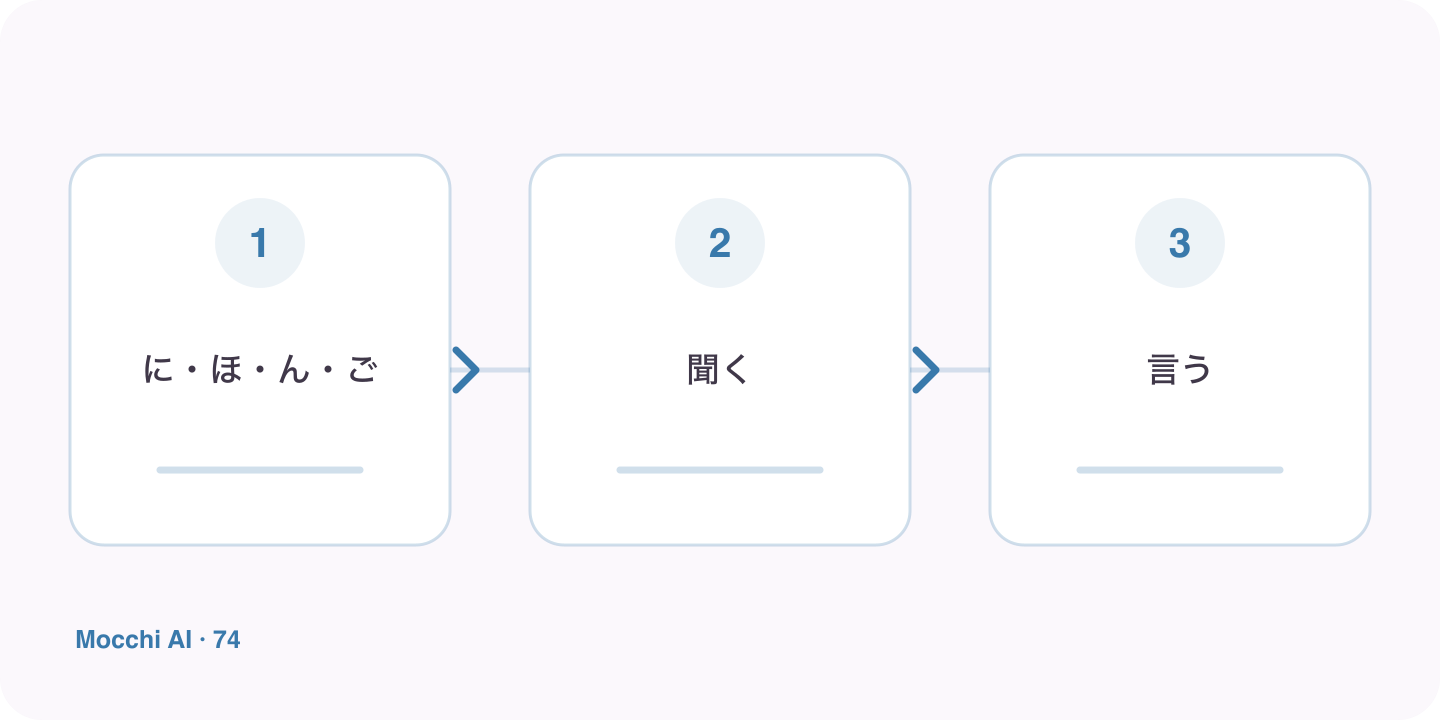
にほんご can be separated for timing as に・ほ・ん・ご. Read the word, listen to a model, and keep the nasal present without inserting another full vowel after it. Then say a short sentence such as 日本語を勉強しています. The phrase checks whether the feature remains available when you are thinking about the message as well as the sound.
| Japanese | Romaji | Meaning |
|---|---|---|
| 日本語を勉強しています。 | Nihongo o benkyō shite imasu. | I am studying Japanese. |
| 本を読みます。 | Hon o yomimasu. | I read a book. |
Listen to context rather than memorizing one articulation
The sounds around ん affect how it is realized. Keep the practice attached to complete words and phrases instead of treating the sound as one isolated English letter. Ask Mocchi for a concrete comparison when you encounter another context, and avoid assuming that a single mouth-position instruction should override what you hear in every example.
Make one deliberate change in the coached activity
Use the pronunciation interface's supplied lines and inspect the actual feedback. Focus on one adjustment, such as preserving the timing, before changing pace or several other sounds. If the activity offers a different mode because of support or account limits, follow the options shown and do not interpret ungraded practice as a reported score.
Check another phrase after the first success
A familiar line can become easy through repetition, so use a new short phrase later. Notice whether you still keep the nasal timing without overemphasizing it. Ask Mocchi to help choose a next focus from the session result and your listening observations. The aim is a feature that remains present in new speech, not one recording that happened to receive a pleasing number.