
Understood is a register decision, not a translation
In English you can say got it to your closest friend and to a company director, and adjust the tone of voice to carry the difference. Japanese loads that difference into the words themselves. Choosing between ryōkai and kashikomarimashita is not a matter of formality in the abstract, it is a statement about who is above whom, whether the person is inside or outside your organisation, and whether this is speech or a written message. Nobody will correct you, which is exactly why the mistake persists for years.
The good news is that the ladder is short. Four rungs cover almost every situation a working learner meets, and one of them, wakarimashita, is safe enough to fall back on whenever you cannot read the room. This post handles only the acknowledgement itself; the wider system of raising the other person and lowering yourself is covered in the dedicated sonkeigo and kenjougo guide.
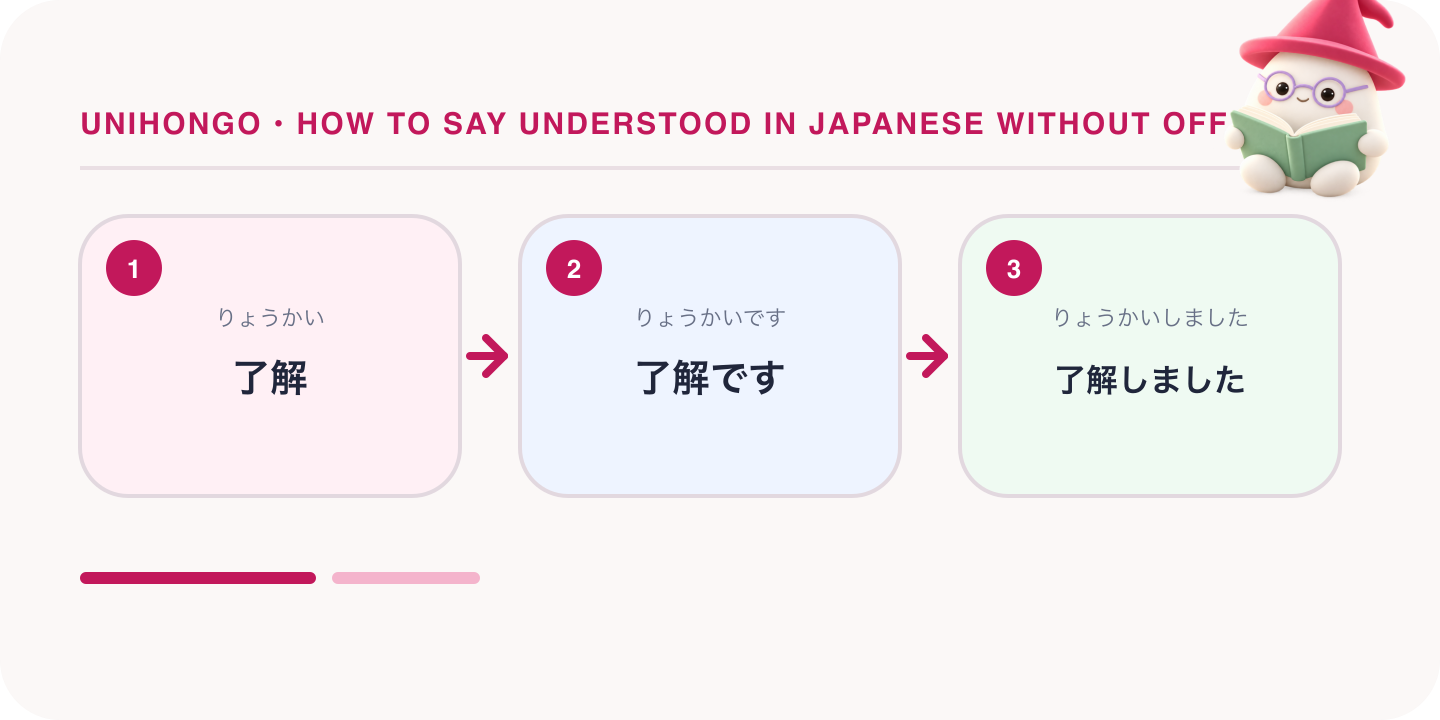
The ladder at a glance
| Form | Romaji | Use it with | Typical setting |
|---|---|---|---|
| 了解 | Ryōkai | Close peers, juniors | Team chat, quick spoken reply |
| 了解です | Ryōkai desu | Peers, a friendly senior colleague | Team chat, informal office talk |
| 了解しました | Ryōkai shimashita | Peers; risky upward | Chat and email between equals |
| 分かりました | Wakarimashita | Almost anyone | Spoken reply when unsure of rank |
| 承知しました | Shōchi shimashita | Seniors, other departments | Standard business speech and email |
| 承知いたしました | Shōchi itashimashita | Clients, senior management | Formal email, client calls |
| かしこまりました | Kashikomarimashita | Customers and guests | Shops, hotels, reception, phone |
| 承りました | Uketamawarimashita | Customers placing an order | Taking orders and requests |
Read the table as a line rather than a set of boxes. Moving one rung up is always safe and costs you nothing but a syllable or two. Moving one rung down is where the damage happens, because a reply that is too casual reads as a claim about your standing that you probably did not intend to make.
Ryōkai: fast, flat and strictly horizontal
Ryōkai originally belongs to the language of orders and radio traffic, which is where its clipped feel comes from. In a modern office it lives mostly in chat between people at the same level, where speed matters more than ceremony and a one-word reply is a kindness rather than a slight. Between peers it is completely normal and slightly warm, the written equivalent of a nod.
The trap is that ryōkai shimashita looks polite. It has the correct polite past ending, so learners reasonably assume it climbs the ladder. Many Japanese workers do not read it that way, because the politeness sits in the ending while the stem still sounds like acknowledging a subordinate's report. Plenty of companies never mention this rule out loud and simply notice who follows it.
| Japanese | Romaji | Meaning |
|---|---|---|
| 了解。 | Ryōkai. | Got it. (casual, between peers) |
| 了解です。 | Ryōkai desu. | Understood. (casual-polite, common in team chat) |
| 了解しました。 | Ryōkai shimashita. | Understood. (polite in form, still best kept to peers) |
| 了解、あとでやっておきます。 | Ryōkai, ato de yatte okimasu. | Got it, I will take care of it later. |
| 了解です。ありがとうございます。 | Ryōkai desu. Arigatō gozaimasu. | Understood, thank you. |
Wakarimashita: the neutral middle
Wakarimashita is the plainest of the four and the one that never causes offence. It says the content has landed, without any claim about rank. That neutrality makes it the right default in your first weeks somewhere, in mixed groups, with people whose position you cannot judge, and in any spoken exchange where you have to answer immediately.
Its one weakness is that it reports comprehension rather than commitment. If your manager gave you a task, wakarimashita on its own can sound like you followed the explanation, not like you will act. Adding what you will do and by when turns it into a proper acknowledgement, and this habit is worth more than any single vocabulary upgrade.
| Japanese | Romaji | Meaning |
|---|---|---|
| 分かりました。 | Wakarimashita. | I understand. |
| はい、分かりました。すぐに始めます。 | Hai, wakarimashita. Sugu ni hajimemasu. | Yes, understood. I will start right away. |
| 分かりました。今日中に送ります。 | Wakarimashita. Kyō-jū ni okurimasu. | Understood. I will send it by the end of today. |
| よく分かりました。ありがとうございます。 | Yoku wakarimashita. Arigatō gozaimasu. | That is very clear now, thank you. |
Shōchi shimashita, the business standard
Shōchi shimashita is what a Japanese office runs on. It is humble without being ceremonial, it works spoken and written, and it is correct toward your manager, another department, a supplier and a senior colleague alike. If you replace every ryōkai in your working vocabulary with this one phrase, you have solved most of the problem in a single move.
Shōchi itashimashita is the same phrase with the humble verb itashimasu in place of shimasu, which lowers you a little further. Save it for clients, for senior management, and for written messages that leave the company. Shōchi shite orimasu is a slightly different animal: it means I am already aware of that, which is useful when someone tells you something you had been told before.
| Japanese | Romaji | Meaning |
|---|---|---|
| 承知しました。 | Shōchi shimashita. | Understood. (standard business reply) |
| 承知いたしました。 | Shōchi itashimashita. | Understood. (more humble, for clients and seniors) |
| 承知しました。本日中に提出いたします。 | Shōchi shimashita. Honjitsu-chū ni teishutsu itashimasu. | Understood. I will submit it by the end of today. |
| 承知いたしました。修正のうえ、改めてお送りいたします。 | Shōchi itashimashita. Shūsei no ue, aratamete o-okuri itashimasu. | Understood. I will revise it and send it again. |
| 承知しております。 | Shōchi shite orimasu. | I am already aware of that. |
| お引き受けいたします。 | Ohikiuke itashimasu. | I will take it on. |
Kashikomarimashita at the counter and on client calls
Kashikomarimashita is the most deferential of the everyday forms and it carries a service relationship with it. A waiter, a hotel receptionist, a call centre agent and a shop assistant all use it dozens of times a shift, and it sounds warm and professional in those seats. It usually opens a sentence that says what you are about to do, because in service work an acknowledgement without an action is only half an answer.
Inside your own team the same word can feel odd, since it casts your colleague as a customer. Uketamawarimashita is narrower still: it means your order or request has been received, and belongs to taking bookings, orders and instructions from outside the company rather than to general agreement.
| Japanese | Romaji | Meaning |
|---|---|---|
| かしこまりました。 | Kashikomarimashita. | Certainly. (service and client-facing) |
| かしこまりました。少々お待ちくださいませ。 | Kashikomarimashita. Shōshō omachi kudasaimase. | Certainly. Please wait just a moment. |
| かしこまりました。ただいまお持ちいたします。 | Kashikomarimashita. Tadaima omochi itashimasu. | Certainly. I will bring it right away. |
| かしこまりました。確認のうえ、折り返しご連絡いたします。 | Kashikomarimashita. Kakunin no ue, orikaeshi gorenraku itashimasu. | Certainly. I will check and get back to you. |
| 承りました。 | Uketamawarimashita. | Your order has been received. |
Written chat versus what you say out loud
The medium changes the calculation. In chat tools a bare ryōkai between peers is efficient and completely normal, and typing shōchi itashimashita to the person sitting next to you can look stiff. In email, which is more permanent and often forwarded, most people climb at least to shōchi shimashita, because the reader may not be the person you wrote to.
Spoken acknowledgement has one extra job that writing does not: it has to arrive fast enough to show you are following. A slow perfect phrase is worse than a prompt hai followed by the fuller reply. Train the hai as a reflex, then let the rest of the sentence catch up behind it.
| Japanese | Romaji | Meaning |
|---|---|---|
| 承知しました。よろしくお願いします。 | Shōchi shimashita. Yoroshiku onegai shimasu. | Understood. Thank you in advance. |
| 確認しました。問題ありません。 | Kakunin shimashita. Mondai arimasen. | I have checked it. There is no problem. |
| 拝見しました。ありがとうございます。 | Haiken shimashita. Arigatō gozaimasu. | I have read it, thank you. |
| ご連絡ありがとうございます。承知しました。 | Gorenraku arigatō gozaimasu. Shōchi shimashita. | Thank you for letting me know. Understood. |
When you understood but cannot start yet
The worst answer to a request you cannot fit in is silence, and the second worst is an acknowledgement you will not honour. Japanese workplaces handle this with a two-part move: accept the instruction, then negotiate the timing in the same breath. Because the acceptance comes first, the negotiation does not read as a refusal.
Asking for the deadline is part of the same skill. Requests often arrive without one, and a person who asks itsu made ni is heard as organised rather than difficult. If the task has to leave your hands and come back later, say so plainly with a line about checking and reporting back.
| Japanese | Romaji | Meaning |
|---|---|---|
| 承知しました。いつまでに必要でしょうか。 | Shōchi shimashita. Itsu made ni hitsuyō deshō ka. | Understood. By when do you need it? |
| 承知しました。本日は立て込んでおりまして、明日の午前中でもよろしいでしょうか。 | Shōchi shimashita. Honjitsu wa tatekonde orimashite, ashita no gozen-chū demo yoroshii deshō ka. | Understood. Today is very full, so would tomorrow morning be acceptable? |
| 少しお時間をいただけますでしょうか。 | Sukoshi ojikan o itadakemasu deshō ka. | Could I have a little time? |
| 一度持ち帰って確認いたします。 | Ichido mochikaette kakunin itashimasu. | Let me take this back and check on it. |
| 今の作業が終わり次第、取りかかります。 | Ima no sagyō ga owari shidai, torikakarimasu. | I will start on it as soon as my current task is finished. |
When you did not understand at all
Every learner has said wakarimashita to something they did not catch, and every one of them has paid for it later. Asking again immediately is the cheaper option by a wide margin, and there is a well-worn set of phrases for doing it without embarrassment. Opening with osoreirimasu ga or sumimasen takes the edge off, and naming what you missed, the speed, a word, one step, makes it easy for the other person to help.
It also helps to separate two different failures. Not hearing the words is kikitoremasen deshita, and it invites a repetition. Hearing them but not knowing the term is a vocabulary question, and asking directly for the meaning is normal even between Japanese colleagues when a piece of jargon appears.
| Japanese | Romaji | Meaning |
|---|---|---|
| 恐れ入りますが、もう一度おっしゃっていただけますか。 | Osoreirimasu ga, mō ichido osshatte itadakemasu ka. | I am sorry, could you say that once more? |
| すみません、聞き取れませんでした。 | Sumimasen, kikitoremasen deshita. | Sorry, I could not catch that. |
| もう少しゆっくりお願いできますか。 | Mō sukoshi yukkuri onegai dekimasu ka. | Could you speak a little more slowly? |
| 勉強不足で申し訳ありません。この言葉の意味を教えていただけますか。 | Benkyō-busoku de mōshiwake arimasen. Kono kotoba no imi o oshiete itadakemasu ka. | I am sorry for my lack of knowledge. Could you tell me what this word means? |
| 念のため確認させてください。 | Nen no tame kakunin sasete kudasai. | Let me confirm, just to be sure. |
Checking that you understood the same thing
| Japanese | Romaji | Meaning |
|---|---|---|
| 私の理解では、まず見積もりを作るということでよろしいでしょうか。 | Watashi no rikai de wa, mazu mitsumori o tsukuru to iu koto de yoroshii deshō ka. | As I understand it, I make the estimate first. Is that correct? |
| 確認ですが、締め切りは金曜日ということでしょうか。 | Kakunin desu ga, shimekiri wa kin-yōbi to iu koto deshō ka. | Just to confirm, the deadline is Friday? |
| 認識に相違がないか確認させていただきます。 | Ninshiki ni sōi ga nai ka kakunin sasete itadakimasu. | Let me check that we are understanding this the same way. |
| 承知しました。不明な点があればご連絡します。 | Shōchi shimashita. Fumei na ten ga areba gorenraku shimasu. | Understood. I will contact you if anything is unclear. |
A read-back is the single most valuable habit on this list. It converts a vague nod into a checkable statement, it gives the other person a chance to correct you cheaply, and it makes your acknowledgement mean something. In many teams the person who reads instructions back is trusted with more, not less, precisely because the loop is closed out loud.
Drills that make the ladder automatic
- Say one instruction back four times, climbing ryōkai, wakarimashita, shōchi shimashita, kashikomarimashita, and feel where each stops fitting.
- For a week, replace every ryōkai you would send upward with shōchi shimashita and see whether anything is lost.
- Pair every acknowledgement with an action and a time, so shōchi shimashita never travels alone.
- Practise a hai that arrives within half a second, then a full sentence behind it.
- Rehearse the two repair lines until they are faster than the silence they replace.
- Read back one instruction a day as a question, and check whether the reply corrects anything.