
Four lines that get you the right product
Staff can only help you if they know two things: your skin type and what kind of product you want. Binkanhada nan desu uses the explanatory n desu: you are giving background so that they can help. O sagashite imasu, I am looking for, is the standard way to start in any shop.
Osusume wa dore desu ka asks for their recommendation among the products in front of you. In Japan, staff are usually happy to answer, and the product they pick is often a popular choice for that skin type.
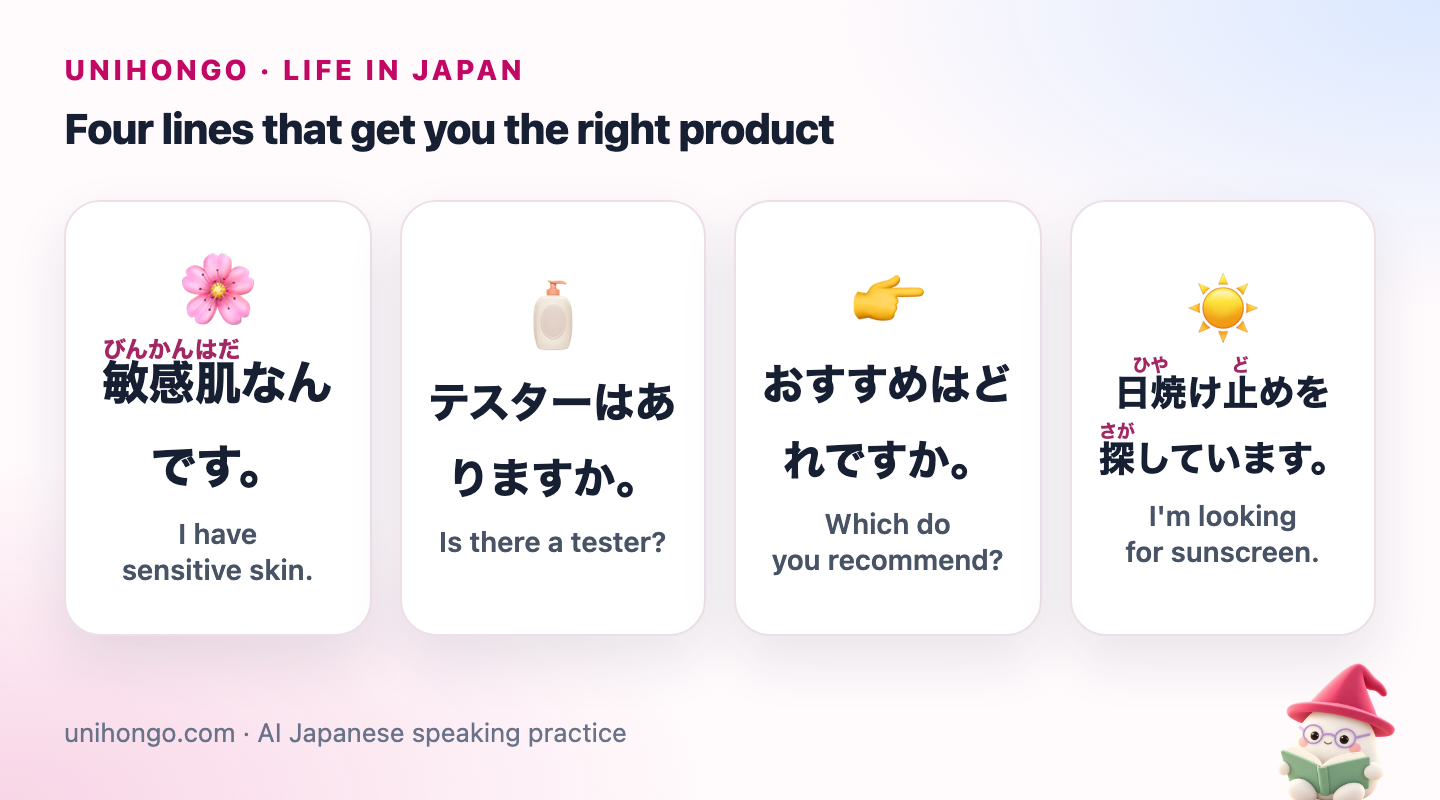
| Japanese | Romaji | Meaning |
|---|---|---|
| 敏感肌なんです。 | Binkanhada na n desu. | I have sensitive skin. |
| テスターはありますか。 | Tesutā wa arimasu ka. | Is there a tester? |
| おすすめはどれですか。 | Osusume wa dore desu ka. | Which do you recommend? |
| 日焼け止めを探しています。 | Hiyakedome o sagashite imasu. | I'm looking for sunscreen. |
| 肌が乾燥しやすいんです。 | Hada ga kansō shiyasui n desu. | My skin gets dry easily. |
Skin type words
Japanese products are usually labelled by skin type, and the same words appear on the packaging, on shelf labels and in staff questions. If a staff member asks hada no taipu wa, or o-hada no nayami wa arimasu ka (do you have any skin concerns?), these are your answers.
| Japanese | Romaji | Meaning |
|---|---|---|
| 乾燥肌 | kansōhada | dry skin |
| 脂性肌 | shiseihada | oily skin |
| 混合肌 | kongōhada | combination skin |
| 普通肌 | futsūhada | normal skin |
| ニキビができやすいです。 | Nikibi ga dekiyasui desu. | I get spots easily. |
| 赤みが出やすいです。 | Akami ga deyasui desu. | My skin turns red easily. |
| アレルギーがあります。 | Arerugī ga arimasu. | I have an allergy. |
The pattern verb stem plus yasui (easily, tends to) is the most useful grammar in this guide: kansō shiyasui (gets dry easily), dekiyasui (forms easily), deyasui (appears easily).
Product types in the order you use them
Japanese skincare routines are often described as steps. The names below are what you will see on shelves and on the front of packages. Many brands also sell oru in wan (all-in-one) gels that combine several steps, popular with busy people.
| Japanese | Romaji | Meaning |
|---|---|---|
| 化粧水 | keshōsui | hydrating lotion, toner |
| 乳液 | nyūeki | milky emulsion |
| 美容液 | biyōeki | serum |
| 日焼け止め | hiyakedome | sunscreen |
| 化粧水と乳液はどう違いますか。 | Keshōsui to nyūeki wa dō chigaimasu ka. | How are lotion and emulsion different? |
| Step | Word in romaji | What it is |
|---|---|---|
| 1. Remove makeup | kurenjingu | Cleansing oil, gel or balm |
| 2. Wash | senganryō | Face wash, often a foam |
| 3. Hydrate | keshōsui | Watery lotion, patted in after washing |
| 4. Treat | biyōeki | Serum for a specific concern |
| 5. Seal in moisture | nyūeki | Light milky emulsion |
| 6. Protect by day | hiyakedome | Sunscreen, sometimes also a makeup base |
Reading the claims on the label
Packaging in Japan is crowded with short claims. Most are written in kanji compounds that are easy to recognise once you know a few characters: mu (無) means without, and fushiyō (不使用) means not used. Yakuyō (薬用) marks a medicated product with an approved active ingredient, a category called quasi-drugs. Remember that claims such as gentle or low-irritation do not guarantee that a product will suit you.
| Japanese | Romaji | Meaning |
|---|---|---|
| 無香料 | mukōryō | fragrance-free |
| 無着色 | muchakushoku | no added colour |
| 低刺激 | teishigeki | low irritation |
| 保湿 | hoshitsu | moisturising |
| 薬用 | yakuyō | medicated (quasi-drug) |
| 石けんで落とせる | sekken de otoseru | removable with soap |
| これはアルコールが入っていますか。 | Kore wa arukōru ga haitte imasu ka. | Does this contain alcohol? |
Sunscreens list two ratings. SPF is for UVB, and PA, with one to four plus signs, is for UVA. Labels may also say wōtāpurūfu (waterproof), or that the product uses no chemical UV absorbers, shigaisen kyūshūzai fushiyō, which some people with sensitive skin look for.
Testers and trying products
Many drugstores put testers on the shelf next to the products, and some have a counter with a beauty adviser for particular brands. Use only testers, never open a sealed product, and use the back of your hand rather than your face unless staff offer otherwise. Single-use sample sachets, sanpuru, are sometimes available at counters.
| Japanese | Romaji | Meaning |
|---|---|---|
| 試してもいいですか。 | Tameshite mo ii desu ka. | May I try it? |
| 手の甲で試してみます。 | Te no kō de tameshite mimasu. | I'll try it on the back of my hand. |
| サンプルはありますか。 | Sanpuru wa arimasu ka. | Do you have a sample? |
| もっとさっぱりしたものはありますか。 | Motto sappari shita mono wa arimasu ka. | Do you have something lighter? |
| しっとりタイプとさっぱりタイプ、どちらがいいですか。 | Shittori taipu to sappari taipu, dochira ga ii desu ka. | Which is better, the rich type or the light type? |
Scenario: a sunscreen for sensitive skin
It is early summer and you need a sunscreen your skin can tolerate. At a large drugstore you find the beauty counter. A beauty adviser greets you, and you explain. Staff in Japanese shops use very polite language, such as kochira (this one), gozaimasu (there is) and o-hada (your skin), but you can answer in normal desu and masu forms.
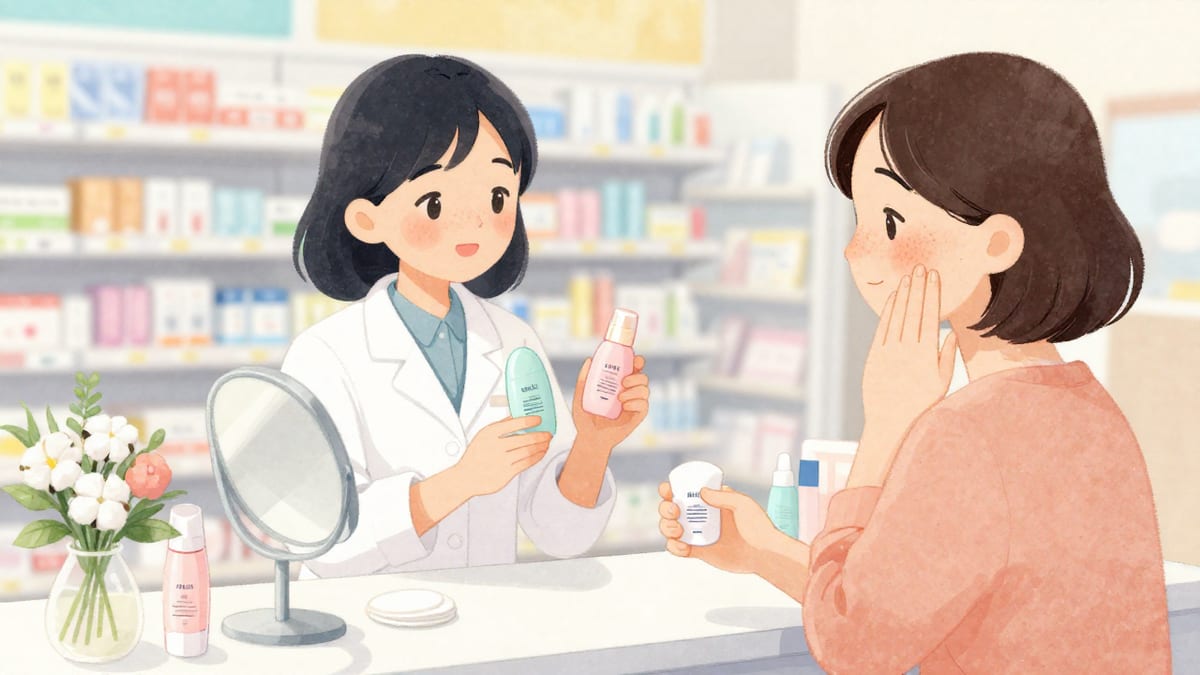
| Japanese | Romaji | Meaning |
|---|---|---|
| 店員:何かお探しですか。 | Ten'in: Nanika osagashi desu ka. | Staff: Are you looking for something? |
| あなた:敏感肌でも使える日焼け止めはありますか。 | Anata: Binkanhada demo tsukaeru hiyakedome wa arimasu ka. | You: Is there a sunscreen for sensitive skin? |
| 店員:こちらは低刺激で、石けんで落とせます。 | Ten'in: Kochira wa teishigeki de, sekken de otosemasu. | Staff: This one is gentle and comes off with soap. |
| あなた:テスターで試してもいいですか。 | Anata: Tesutā de tameshite mo ii desu ka. | You: May I try the tester? |
| 店員:どうぞ、手の甲にお付けしますね。 | Ten'in: Dōzo, te no kō ni otsuke shimasu ne. | Staff: Of course, I'll put some on your hand. |
| あなた:白くならないですね。これにします。 | Anata: Shiroku naranai desu ne. Kore ni shimasu. | You: It doesn't leave a white cast. I'll take this one. |
Makeup: shade matching and long-lasting products
For makeup, the main challenge is colour. Foundation, fandēshon, and concealer, konshīrā, come in shades that are usually numbered or named by brightness and tone, and the range at some shops can be narrow, especially for very fair or deep skin tones. Ask to test on your jawline or the back of your hand, and look at it near a window if you can, because shop lighting is bright. Many people also use a makeup base, shitaji (下地), under foundation, and many bases include sunscreen.
In Japan's hot, humid summer, long-lasting products are popular. Ochinikui, hard to come off, and kuzurenikui, hard to smudge, are the words you will see on labels and hear from staff. Matte is matto and dewy is tsuyakan, literally a sense of gloss.
| Japanese | Romaji | Meaning |
|---|---|---|
| 私の肌の色に合うのはどれですか。 | Watashi no hada no iro ni au no wa dore desu ka. | Which one matches my skin tone? |
| もう少し明るい色はありますか。 | Mō sukoshi akarui iro wa arimasu ka. | Do you have a slightly lighter shade? |
| もう少し暗い色はありますか。 | Mō sukoshi kurai iro wa arimasu ka. | Do you have a slightly darker shade? |
| 崩れにくいものがいいです。 | Kuzurenikui mono ga ii desu. | I'd like something that doesn't smudge easily. |
| ツヤ感が出るタイプはどれですか。 | Tsuyakan ga deru taipu wa dore desu ka. | Which type gives a dewy finish? |
| 免税はできますか。 | Menzei wa dekimasu ka. | Can I buy this tax-free? |
Visitors can often shop tax-free, menzei, at larger drugstores by showing a passport, but the rules and procedures change from time to time, so ask at the till. Residents are not eligible.
Common mistakes
- Calling keshōsui toner and expecting it to be astringent. Most keshōsui is hydrating, not drying.
- Treating bihaku as skin whitening. On Japanese products it generally refers to preventing sun spots.
- Opening a box to look inside. Ask for a tester or sample instead; sealed products are for sale.
- Forgetting the n desu. Binkanhada desu states a fact, while binkanhada na n desu explains why you are asking.