
Four lines that start every dog-walk chat
Most conversations between dog owners in Japan follow the same path. Someone admires the other dog, asks to pet it, then asks its age and whether it is a boy or a girl. You then return the questions. It is short, warm and predictable, which makes it ideal practice.
Note that people ask about the dog with polite desu forms even when talking about a pet. The tone stays friendly and slightly playful, and many owners answer on behalf of the dog.
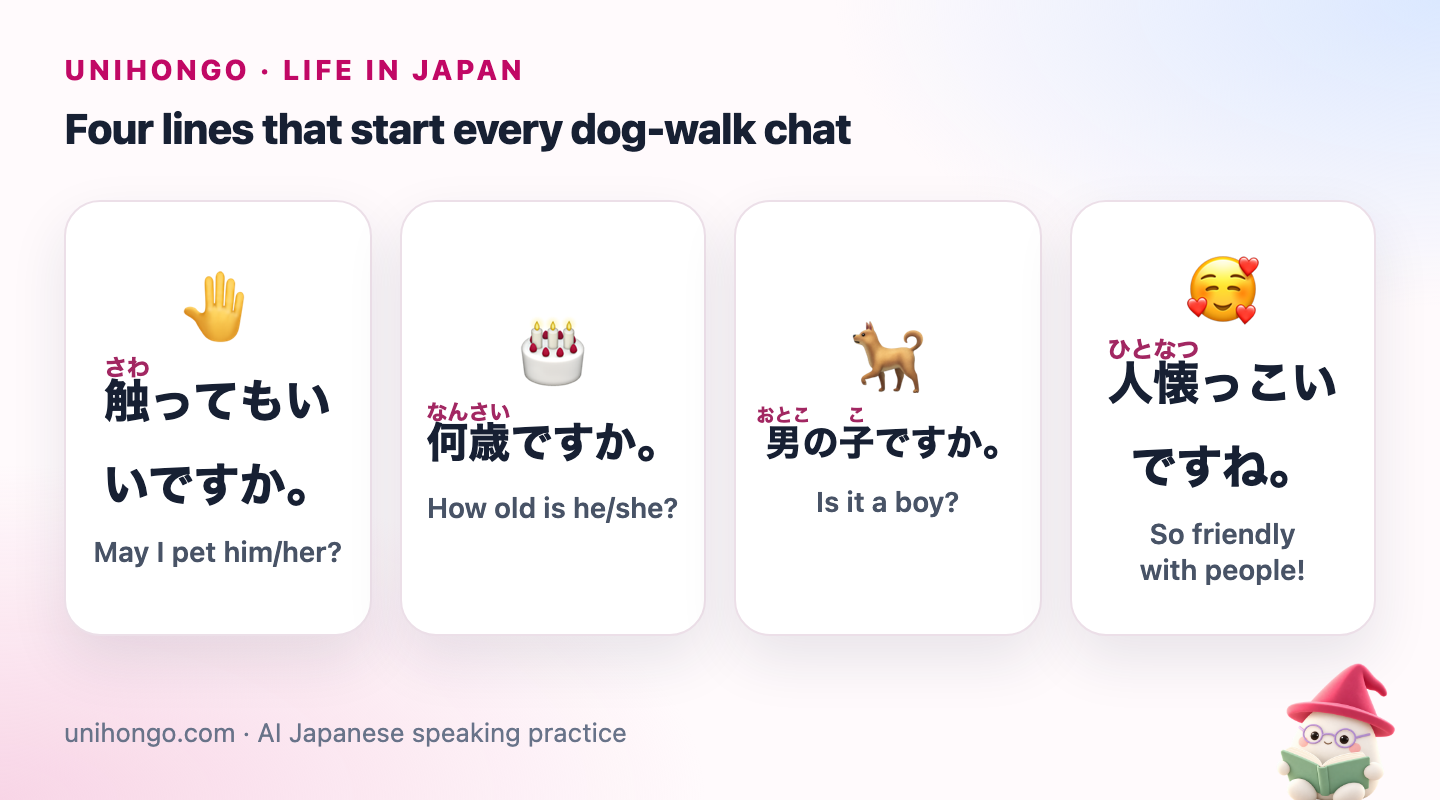
| Japanese | Romaji | Meaning |
|---|---|---|
| 触ってもいいですか。 | Sawatte mo ii desu ka. | May I pet him/her? |
| 何歳ですか。 | Nansai desu ka. | How old is he/she? |
| 男の子ですか。 | Otoko no ko desu ka. | Is it a boy? |
| 人懐っこいですね。 | Hitonatsukkoi desu ne. | So friendly with people! |
| 男の子ですか、女の子ですか。 | Otoko no ko desu ka, onna no ko desu ka. | Boy or girl? |
| お名前は何ですか。 | Onamae wa nan desu ka. | What's his/her name? |
Talking about your own dog
When the questions come back to you, these patterns let you answer and add a little more. Uchi no ko (our child) is the affectionate way owners refer to their own dog. Use it with other owners; with people who are not into dogs, uchi no inu is fine.
| Japanese | Romaji | Meaning |
|---|---|---|
| うちの子は三歳です。 | Uchi no ko wa sansai desu. | Ours is three. |
| 女の子です。名前はモモです。 | Onna no ko desu. Namae wa Momo desu. | She's a girl. Her name is Momo. |
| 保護犬なんです。 | Hogoken na n desu. | She's a rescue dog. |
| ちょっと怖がりなんです。 | Chotto kowagari na n desu. | He's a bit timid. |
| 散歩が大好きなんです。 | Sanpo ga daisuki na n desu. | She loves walks. |
| 犬種は何ですか。 | Kenshu wa nan desu ka. | What breed is he/she? |
| ミックスです。 | Mikkusu desu. | A mixed breed. |
Hogoken (保護犬), a dog taken in from a shelter or rescue group, has become a familiar word in Japan. People often respond warmly to it. Kowagari means easily scared; it is a useful word to warn other owners before their dog rushes up.
When the dogs meet: reactions and compliments
When two dogs meet, owners narrate what the dogs are doing, often with a laugh. Aisatsu shite masu ne, they're saying hello, is a classic. Compliments about the dog are frequent and you should return them; they are part of the ritual.
| Japanese | Romaji | Meaning |
|---|---|---|
| あいさつしてますね。 | Aisatsu shitemasu ne. | They're saying hello. |
| 仲良しですね。 | Nakayoshi desu ne. | They're getting along well. |
| 毛がふわふわですね。 | Ke ga fuwafuwa desu ne. | Such fluffy fur. |
| おとなしいですね。 | Otonashii desu ne. | He's so calm. |
| 元気ですね。 | Genki desu ne. | She's so lively. |
Apologising when your dog misbehaves
Barking, jumping up or pulling towards another dog happens to everyone. A quick, sincere apology is expected. The te-shimau ending, shortened in speech to -chau or -chatte, shows that something happened that you did not want, which is exactly the right nuance. Use sumimasen with neighbours and strangers, and add a short explanation if it helps.
| Japanese | Romaji | Meaning |
|---|---|---|
| すみません、吠えちゃって。 | Sumimasen, hoechatte. | Sorry he barked. |
| すみません、飛びついちゃって。 | Sumimasen, tobitsuichatte. | Sorry she jumped up at you. |
| 服、汚れませんでしたか。 | Fuku, yogoremasen deshita ka. | Did she get your clothes dirty? |
| まだ子犬で、しつけ中なんです。 | Mada koinu de, shitsukechū na n desu. | He's still a puppy and in training. |
| 相手:大丈夫ですよ、元気でいいですね。 | Aite: Daijōbu desu yo, genki de ii desu ne. | Other person: It's fine, he's lively! |
Shitsukechū, in training, is the phrase that makes other owners sympathetic. If your dog bites or someone is genuinely hurt, a casual sumimasen is not enough: say mōshiwake arimasen, take it seriously, and exchange contact details.
Dog run rules and manners on walks
Dog runs, doggu ran, are often run by parks, pet shops or cafés. At the entrance you may be asked to register and to show certificates for rabies vaccination, kyōkenbyō no yobō chūsha, and other vaccines, so bring photos or copies. Many have separate areas for small and large dogs.
On walks, neighbours notice manners. Owners are expected to carry bags and pick up droppings, fun, and many carry a bottle of water to rinse away urine, called manā-mizu. Keep your dog on a short lead, rīdo, on narrow streets, and give way to children, cyclists and people who look nervous around dogs.
| Japanese | Romaji | Meaning |
|---|---|---|
| 初めて利用するんですが。 | Hajimete riyō suru n desu ga. | It's my first time using this. |
| ワクチンの証明書はこれです。 | Wakuchin no shōmeisho wa kore desu. | Here is the vaccination certificate. |
| 小型犬エリアはどこですか。 | Kogataken eria wa doko desu ka. | Where is the small dog area? |
| リードを外してもいいですか。 | Rīdo o hazushite mo ii desu ka. | May I take the lead off? |
- Pick up every time; carrying bags is part of being a good neighbour.
- Rinse urine on walls, poles and shop fronts with manā-mizu.
- Ask before letting your dog approach another dog: aisatsu shite mo ii desu ka.
- Keep the lead short near children and older people.
Scenario: a neighbour stops you on an evening walk
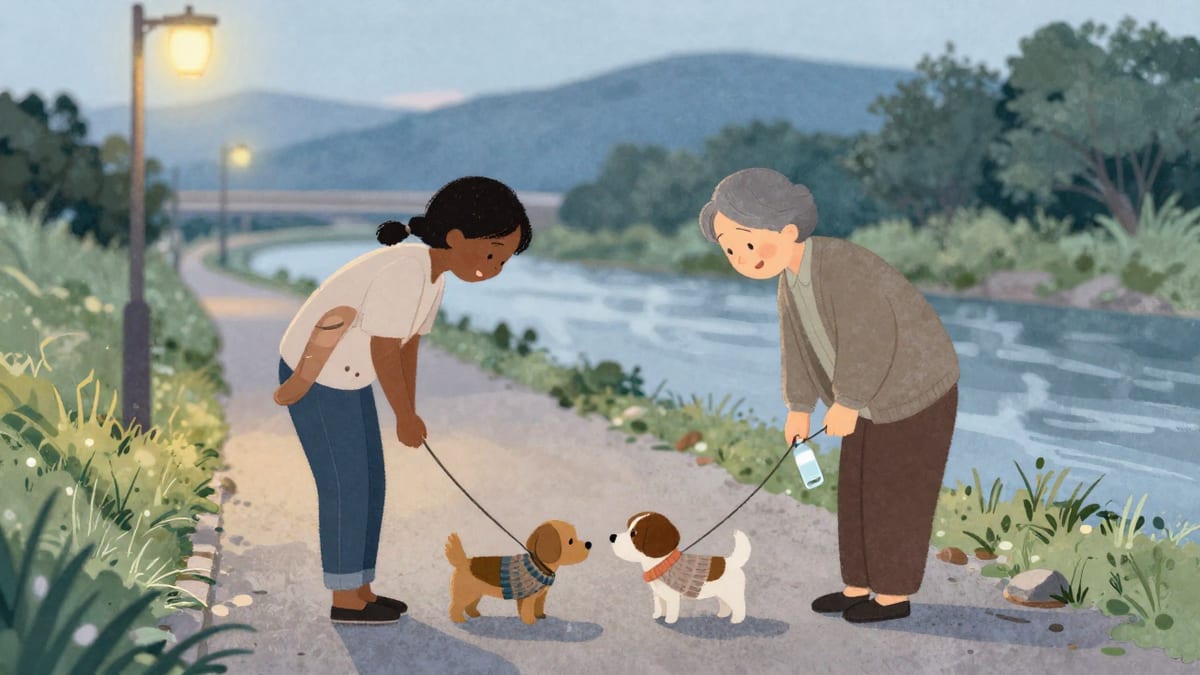
It is a cool evening and you are walking your dog along a river path. A woman from your building is coming the other way with a small dog in a knitted jumper. The dogs spot each other, tails start wagging, and before you know it the leads are tangled. This is the moment that turns a neighbour you nod to into a neighbour you talk to.
| Japanese | Romaji | Meaning |
|---|---|---|
| 近所の人:こんばんは。あら、仲良しですね。 | Kinjo no hito: Konbanwa. Ara, nakayoshi desu ne. | Neighbour: Good evening. Oh, they get along! |
| あなた:こんばんは。すみません、リードが… | Anata: Konbanwa. Sumimasen, rīdo ga... | You: Good evening. Sorry, the leads... |
| 近所の人:大丈夫ですよ。何歳ですか。 | Kinjo no hito: Daijōbu desu yo. Nansai desu ka. | Neighbour: No problem. How old is yours? |
| あなた:二歳です。そちらの子は? | Anata: Nisai desu. Sochira no ko wa? | You: Two. And yours? |
| 近所の人:もう十歳のおばあちゃんなんです。 | Kinjo no hito: Mō jissai no obāchan na n desu. | Neighbour: She's ten already, a little old lady. |
| あなた:えー、若く見えますね! | Anata: Ē, wakaku miemasu ne! | You: Really? She looks young! |
Sochira no ko wa is a polite and natural way to return the question about the other person's dog. Owners often call older dogs ojīchan or obāchan, grandpa or grandma, affectionately.
Living with a dog in Japanese housing
Not every apartment in Japan allows pets. Listings that do are marked petto ka (ペット可), pets allowed, or petto sōdan, pets negotiable, and many limit the size or number of animals. Building rules often ask owners to carry small dogs or use a cart in shared areas such as lifts and corridors, and to avoid barking at night. If you are moving, ask the agent early, because pet-friendly rooms are fewer and may need an extra deposit.
When you travel, many owners use a petto hoteru, a pet hotel, or a vet that boards animals. Ask other owners for recommendations; it is another natural topic on the morning walk.
| Japanese | Romaji | Meaning |
|---|---|---|
| ペット可の部屋を探しています。 | Petto ka no heya o sagashite imasu. | I'm looking for a pet-friendly apartment. |
| 小型犬なら大丈夫ですか。 | Kogataken nara daijōbu desu ka. | Is a small dog all right? |
| 共用部分では抱っこしてください。 | Kyōyō bubun de wa dakko shite kudasai. | Please carry your dog in shared areas. |
| おすすめのペットホテルはありますか。 | Osusume no petto hoteru wa arimasu ka. | Can you recommend a pet hotel? |
| 夜は吠えないように気をつけています。 | Yoru wa hoenai yō ni ki o tsukete imasu. | I make sure he doesn't bark at night. |
Common mistakes
- Touching a dog before asking. Many Japanese owners are careful, and some dogs are nervous with strangers.
- Using osu and mesu in chat. They are correct but sound technical; otoko no ko and onna no ko sound friendly.
- Saying gomen to an older neighbour. Use sumimasen or mōshiwake arimasen.
- Thinking you must know every breed name. Breeds are mostly katakana loanwords; if you miss one, kenshu wa nan desu ka works.