
What ward Japanese asks of you
The hardest part of nursing Japanese is not any single sentence. It is switching register a dozen times an hour. With a patient you are slow, warm and concrete, and you speak in short clauses with ne and yo on the end. With a doctor or at handover you are fast and nominal: a room number, a name, a symptom, a number, a request for instructions. Both are polite desu and masu Japanese, but the vocabulary and the rhythm are different, and the patient must never hear the clinical version.
The other constant is announcement. Japanese nurses narrate: I am measuring now, this will prick, this is finished. The narration is not chatter, it is consent and reassurance built into the grammar, and a foreign nurse who works silently will be read as cold even when technically excellent. Most of the phrases below are announcements, and most of them end in ne.
Introducing yourself and checking identity
Start every shift and every new encounter with your name and your role, and confirm the patient's identity before anything else. Identity checks in Japan usually ask the patient to state their own full name and date of birth rather than answering yes to a name, and the wristband is checked as you listen. Say the pattern the same way each time; patients come to expect it, and a stable script is easier to say quickly when the ward is busy.
| Japanese | Romaji | Meaning |
|---|---|---|
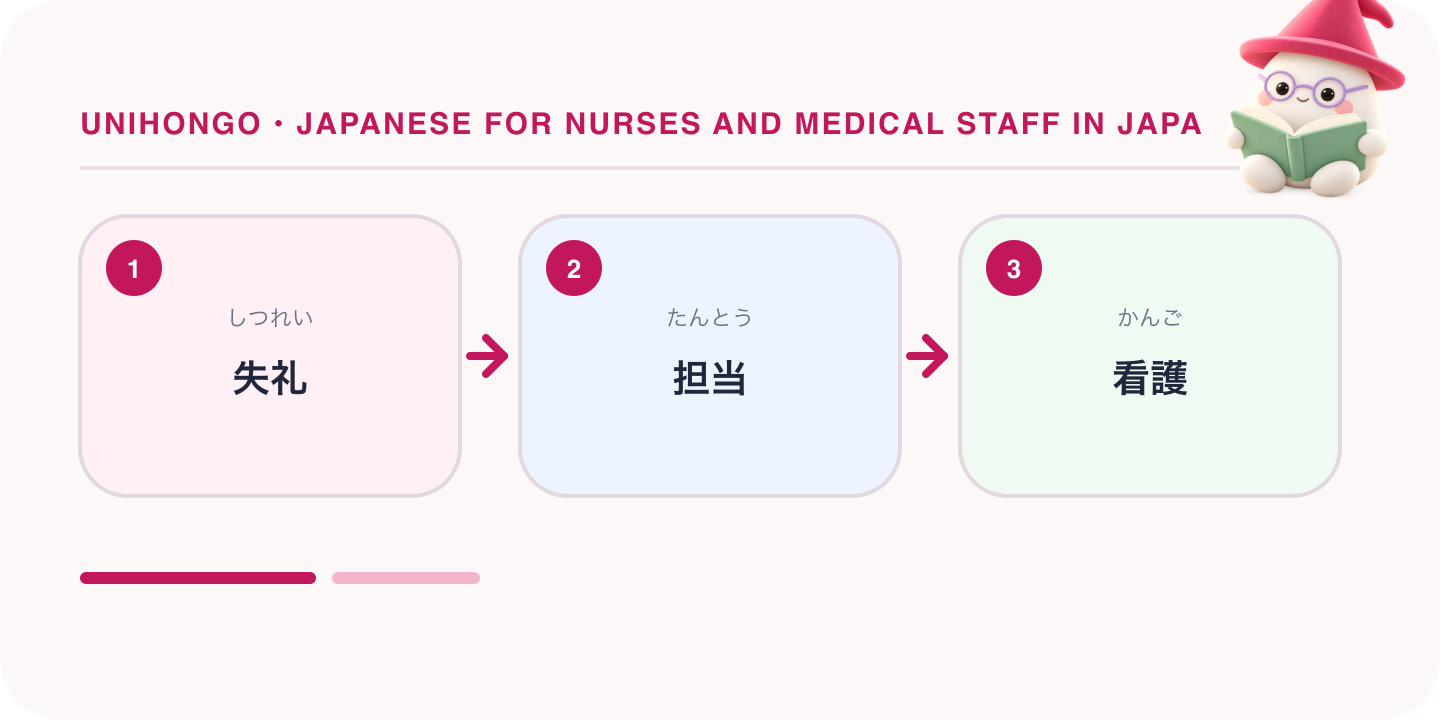
| 失礼します。担当の看護師のマリアです。 | Shitsurei shimasu. Tantō no kangoshi no Maria desu. | Excuse me. I am Maria, the nurse looking after you. |
| 今日一日、よろしくお願いします。 | Kyō ichinichi, yoroshiku onegai shimasu. | I will be with you today. |
| お名前をフルネームで教えていただけますか? | Onamae o furunēmu de oshiete itadakemasu ka? | Could you tell me your full name? |
| 生年月日もお願いします。 | Seinengappi mo onegai shimasu. | And your date of birth, please. |
| 山田花子です。昭和三十年五月二日です。 | Yamada Hanako desu. Shōwa sanjū-nen gogatsu futsuka desu. | Hanako Yamada. Second of May, Showa 30. (a typical reply) |
| リストバンドを確認させてください。 | Risutobando o kakunin sasete kudasai. | Let me check your wristband. |
| ありがとうございます。山田さんですね。 | Arigatō gozaimasu. Yamada-san desu ne. | Thank you. Mrs Yamada, confirmed. |
Explaining what you are about to do
The shape is verb plus masu ne for a routine action and masu yo for something the patient will feel. Add one sentence about the sensation, chikutto shimasu for a needle or sukoshi shimetsukemasu for a cuff, and close with owarimashita so the patient knows it is over. Keep the verbs everyday: hakaru, toru, kaeru, ireru. The clinical noun can wait for the chart.
| Japanese | Romaji | Meaning |
|---|---|---|
| 今から血圧を測りますね。 | Ima kara ketsuatsu o hakarimasu ne. | I am going to take your blood pressure now. |
| 腕をまくっていただけますか? | Ude o makutte itadakemasu ka? | Could you roll up your sleeve? |
| 少し締めつけますよ。 | Sukoshi shimetsukemasu yo. | It will squeeze a little. |
| 体温を測ります。脇に挟んでください。 | Taion o hakarimasu. Waki ni hasande kudasai. | I will take your temperature. Please hold this under your arm. |
| 採血をします。チクッとしますよ。 | Saiketsu o shimasu. Chikutto shimasu yo. | I am going to take some blood. You will feel a small prick. |
| 点滴を交換しますね。 | Tenteki o kōkan shimasu ne. | I will change your drip now. |
| ガーゼを替えますね。少ししみるかもしれません。 | Gāze o kaemasu ne. Sukoshi shimiru kamo shiremasen. | I will change the dressing. It may sting a little. |
| 終わりました。お疲れさまでした。 | Owarimashita. Otsukaresama deshita. | All done. Thank you for bearing with it. |
Asking about pain and symptoms
Ask one symptom per question and use the plain word. Pain scales are common, so itami o jū dankai de iu to will be understood by most adults. For the character of pain, Japanese uses sound words: zukizuki for throbbing, chikuchiku for prickling, kirikiri for a sharp stomach pain, and patients will often reach for them unprompted. Listen for the reply shape, because a Japanese patient who says chotto may mean quite a lot.
| Japanese | Romaji | Meaning |
|---|---|---|
| 痛みはありますか?どこが痛いですか? | Itami wa arimasu ka? Doko ga itai desu ka? | Do you have pain? Where does it hurt? |
| どんな痛みですか?ズキズキしますか、チクチクしますか? | Donna itami desu ka? Zukizuki shimasu ka, chikuchiku shimasu ka? | What kind of pain is it? Throbbing, or prickling? |
| 痛みを十段階で言うと、いくつですか? | Itami o jū dankai de iu to, ikutsu desu ka? | On a scale of ten, how bad is the pain? |
| 吐き気はありますか? | Hakike wa arimasu ka? | Do you feel nauseous? |
| 息苦しくないですか? | Ikigurushiku nai desu ka? | Are you short of breath? |
| めまいはしますか? | Memai wa shimasu ka? | Do you feel dizzy? |
| 昨夜は眠れましたか? | Sakuya wa nemuremashita ka? | Did you sleep last night? |
| お通じはありましたか? | Otsūji wa arimashita ka? | Have you had a bowel movement? |
| ちょっと気持ち悪いです。 | Chotto kimochi warui desu. | I feel a bit sick. (a typical reply) |
Patient-facing phrases by moment
| Moment | Phrase | Romaji |
|---|---|---|
| Entering the room | 失礼します。看護師のマリアです。 | Shitsurei shimasu. Kangoshi no Maria desu. |
| Identity check | お名前と生年月日をお願いします。 | Onamae to seinengappi o onegai shimasu. |
| Before a measurement | 血圧を測りますね。 | Ketsuatsu o hakarimasu ne. |
| Before a needle | チクッとしますよ。 | Chikutto shimasu yo. |
| Medication round | お薬の時間です。食後に飲んでください。 | Okusuri no jikan desu. Shokugo ni nonde kudasai. |
| After a meal | お食事はどのくらい食べられましたか? | Oshokuji wa dono kurai taberaremashita ka? |
| Night round | 見回りです。眠れていますか? | Mimawari desu. Nemurete imasu ka? |
| Before leaving | 何かあればナースコールを押してくださいね。 | Nanika areba nāsu kōru o oshite kudasai ne. |
| Family at the bedside | ご家族の方ですか?いつもお世話になっております。 | Gokazoku no kata desu ka? Itsumo osewa ni natte orimasu. |
| Discharge | お大事になさってください。 | Odaiji ni nasatte kudasai. |
Every one of these is a fixed line, and that is the point. Patients recognise the script, so a slightly accented version still reads as the nurse doing her job properly. Where your own version drifts, it is usually the sentence ending: a missing ne makes hakarimasu sound like a statement of fact rather than a gentle warning.
Medication times and procedures in plain words
Medication instructions are given in the same order every time: what it is for, when to take it, how, and one thing to watch for. Use itamidome rather than the drug name unless the patient asks, and say the schedule as asa hiru ban rather than as the chart shorthand. For procedures, one sentence of what, one of sensation, one of duration. Patients cope well with sukoshi iwakan ga arimasu; they cope badly with a long technical explanation they cannot follow.
| Japanese | Romaji | Meaning |
|---|---|---|
| このお薬は痛み止めです。 | Kono okusuri wa itamidome desu. | This medicine is a painkiller. |
| 一日三回、朝昼晩、食後に飲んでください。 | Ichinichi sankai, asa hiru ban, shokugo ni nonde kudasai. | Three times a day, morning, noon and evening, after meals. |
| お水で飲んでください。 | Omizu de nonde kudasai. | Please take it with water. |
| 眠くなることがあります。 | Nemuku naru koto ga arimasu. | It can make you drowsy. |
| お薬のアレルギーはありますか? | Okusuri no arerugī wa arimasu ka? | Are you allergic to any medicines? |
| 明日、検査があります。今夜九時から、食べないでください。 | Ashita, kensa ga arimasu. Kon'ya ku-ji kara, tabenaide kudasai. | You have a test tomorrow. Please do not eat from nine tonight. |
| 管を入れます。少し違和感がありますが、すぐ終わります。 | Kuda o iremasu. Sukoshi iwakan ga arimasu ga, sugu owarimasu. | I am going to put in a tube. It will feel strange for a moment, but it will be over quickly. |
| 傷口を見せてください。 | Kizuguchi o misete kudasai. | Please show me the wound. |
Reassuring and asking for repetition without alarm
Reassurance has a small fixed vocabulary: daijōbu desu yo, yoku aru koto desu, sugu kimasu kara ne. Use it generously, because a patient hears silence as bad news. When you do not catch what a patient said, do not say wakarimasen, which sounds like you cannot help them. Instead confirm a piece of it back as a question, or narrow it with a choice. The patient hears attentiveness, not a language gap, and you get the answer in a form you can chart.
| Japanese | Romaji | Meaning |
|---|---|---|
| 大丈夫ですよ。よくあることです。 | Daijōbu desu yo. Yoku aru koto desu. | It is all right. This is common. |
| すぐ来ますからね。 | Sugu kimasu kara ne. | I will be right back. |
| 先生に確認してきますね。 | Sensei ni kakunin shite kimasu ne. | I will go and check with the doctor. |
| つらいときは我慢しないで言ってくださいね。 | Tsurai toki wa gaman shinaide itte kudasai ne. | When it is hard, tell me rather than putting up with it. |
| すみません、もう一度お願いできますか? | Sumimasen, mō ichido onegai dekimasu ka? | Sorry, could you say that once more? |
| 痛いのは、こちら側ですか? | Itai no wa, kochira-gawa desu ka? | The pain is on this side? |
| 確認ですが、朝からずっとですか? | Kakunin desu ga, asa kara zutto desu ka? | Just to confirm, it has been since this morning? |
| ゆっくりで大丈夫ですよ。 | Yukkuri de daijōbu desu yo. | Take your time. |
Clinical words and the word you say to the patient
Japanese medicine has a double vocabulary. The chart, the doctor and the handover use Sino-Japanese compounds, often two or four kanji, read with on readings. The patient uses the native word or a wrapped polite form. You need both, and you need to know which one you are holding, because saying tōtsū to an eighty-year-old is confusing and saying itami at handover sounds unprofessional. Learn them as pairs, and say each pair aloud as you learn it.
| Chart or handover term | Say to the patient | Meaning |
|---|---|---|
| 疼痛 tōtsū | 痛み itami | pain |
| 発熱 hatsunetsu | 熱 netsu | fever |
| 嘔気 ōki | 吐き気 hakike | nausea |
| 嘔吐 ōto | 吐く haku | vomiting |
| 咳嗽 gaisō | 咳 seki | cough |
| 呼吸困難 kokyū konnan | 息苦しい ikigurushii | difficulty breathing |
| 倦怠感 kentaikan | だるさ darusa | fatigue, heaviness |
| 浮腫 fushu | むくみ mukumi | swelling |
| 掻痒感 sōyōkan | かゆみ kayumi | itching |
| 排尿 hainyō | お小水 oshōsui | urination |
| 排便 haiben | お通じ otsūji | bowel movement |
| 創部 sōbu | 傷 kizu | wound |
| 輸液 yueki | 点滴 tenteki | IV infusion, drip |
| 内服 naifuku | お薬を飲む okusuri o nomu | oral medication |
| 絶食 zesshoku | 食べないでください tabenaide kudasai | nothing to eat |
| 安静 ansei | 横になって休む yoko ni natte yasumu | bed rest |
| 体位変換 taii henkan | 向きを変える muki o kaeru | repositioning |
| 脈拍 myakuhaku | 脈 myaku | pulse |
Handover and reporting a change
Colleague-facing Japanese is nominal and ordered. A report opens with the room and the name, gives the time and the observation with numbers, adds what you did, and ends with a request. Many wards follow a situation, background, assessment, request structure, and the workplace habit of hōkoku, renraku, sōdan, meaning report, inform, consult, applies here with more urgency than in an office. Say the numbers in full; hyaku-sanjū no hachijū for a blood pressure is what the doctor expects to hear.
| Japanese | Romaji | Meaning |
|---|---|---|
| 三〇二号室の山田さんについて報告します。 | San-maru-ni gōshitsu no Yamada-san ni tsuite hōkoku shimasu. | Reporting on Mrs Yamada in room 302. |
| 十四時に三十八度二分の発熱がありました。 | Jū-yo-ji ni sanjū-hachi do ni bu no hatsunetsu ga arimashita. | At 14:00 she had a fever of 38.2. |
| 血圧は百三十の八十です。 | Ketsuatsu wa hyaku-sanjū no hachijū desu. | Blood pressure is 130 over 80. |
| 右下腹部に疼痛の訴えがあります。 | Migi kafukubu ni tōtsū no uttae ga arimasu. | She is complaining of pain in the lower right abdomen. |
| クーリングを開始しました。 | Kūringu o kaishi shimashita. | I have started cooling. |
| 指示をお願いします。 | Shiji o onegai shimasu. | Please give instructions. |
| そのほかは特変ありません。 | Sono hoka wa tokuhen arimasen. | Otherwise no particular change. |
| 夜勤の間、経過観察でお願いします。 | Yakin no aida, keika kansatsu de onegai shimasu. | Please keep her under observation during the night shift. |
Asking a doctor and repeating an instruction back
Doctors are addressed as sensei, approached with a permission line, and given one question at a time. The safety habit that matters most is fukushō, repeating the instruction back: drug, dose, route, timing, then desu ne. Japanese nurses do this every time, so it never sounds like doubt in your listening. If the answer comes too fast, ask for it again in the same neutral tone. A doctor who has to slow down is mildly inconvenienced; a doctor whose instruction was carried out wrong is something else entirely.
| Japanese | Romaji | Meaning |
|---|---|---|
| 先生、今よろしいですか? | Sensei, ima yoroshii desu ka? | Doctor, do you have a moment? |
| 山田さんの発熱について相談してもよろしいですか? | Yamada-san no hatsunetsu ni tsuite sōdan shite mo yoroshii desu ka? | May I ask your advice about Mrs Yamada's fever? |
| 一点、確認させてください。 | Itten, kakunin sasete kudasai. | Let me confirm one thing. |
| 復唱します。アセトアミノフェン五百ミリグラム、一錠、内服ですね。 | Fukushō shimasu. Asetoaminofen gohyaku miriguramu, ichijō, naifuku desu ne. | I will repeat that back. Acetaminophen 500 milligrams, one tablet, by mouth, correct? |
| 生食百ミリを三十分でですね。 | Seishoku hyaku miri o sanjuppun de desu ne. | Normal saline 100 ml over thirty minutes, correct? |
| すみません、聞き取れませんでした。もう一度お願いします。 | Sumimasen, kikitoremasen deshita. Mō ichido onegai shimasu. | Sorry, I did not catch that. Once more, please. |
| 承知しました。すぐに実施します。 | Shōchi shimashita. Sugu ni jisshi shimasu. | Understood. I will do it straight away. |
The reading load of charts and medication names
Speaking is only half the job. The electronic chart, the karute, is written in dense kanji compounds, and medication names are katakana strings that are long, similar to one another, and read at speed. The strategy that works for most nurses is narrow and deep: collect the hundred or so kanji that actually appear on your ward, learn each as a spoken word, not a shape, and read every drug name aloud when you pick up the packet. Reading silently trains recognition; the ward needs you to hear the word in your head and say it to a colleague.
- Learn dose units as sounds: miriguramu, jō for tablets, hō for a sachet, kai for times a day, and the shorthand bun-ichi to bun-san for once to three times daily.
- Read katakana drug names aloud syllable by syllable and pair each one with its purpose word, such as itamidome or kōseibusshitsu, so the packet and the patient explanation are linked.
- Keep a personal list of the abbreviations your ward uses in Roman letters and their spoken Japanese, because a doctor will say them aloud, not spell them.
- Before each shift, read yesterday's notes for your patients aloud under your breath; the kanji you stumble on are tomorrow's study list.
- Ask a senior nurse to confirm any reading you are unsure of, using the same kakunin sasete kudasai line you use with doctors.
A final note on paperwork. Working as a registered nurse in Japan generally means passing the national nursing examination in Japanese, and partnership routes exist for candidates from some countries, with a period of language study and supervised work built in. Assistant roles have different requirements. All of this changes, so confirm the current route with your employer or the relevant authority. This article is language help, not clinical guidance; the procedures themselves come from your training and your ward's protocols.