
Bonsai in four cards
Four words take you from the art itself to its daily care: the tree in its tray, the pot, the pruning and the watering that every bonsai lover talks about.
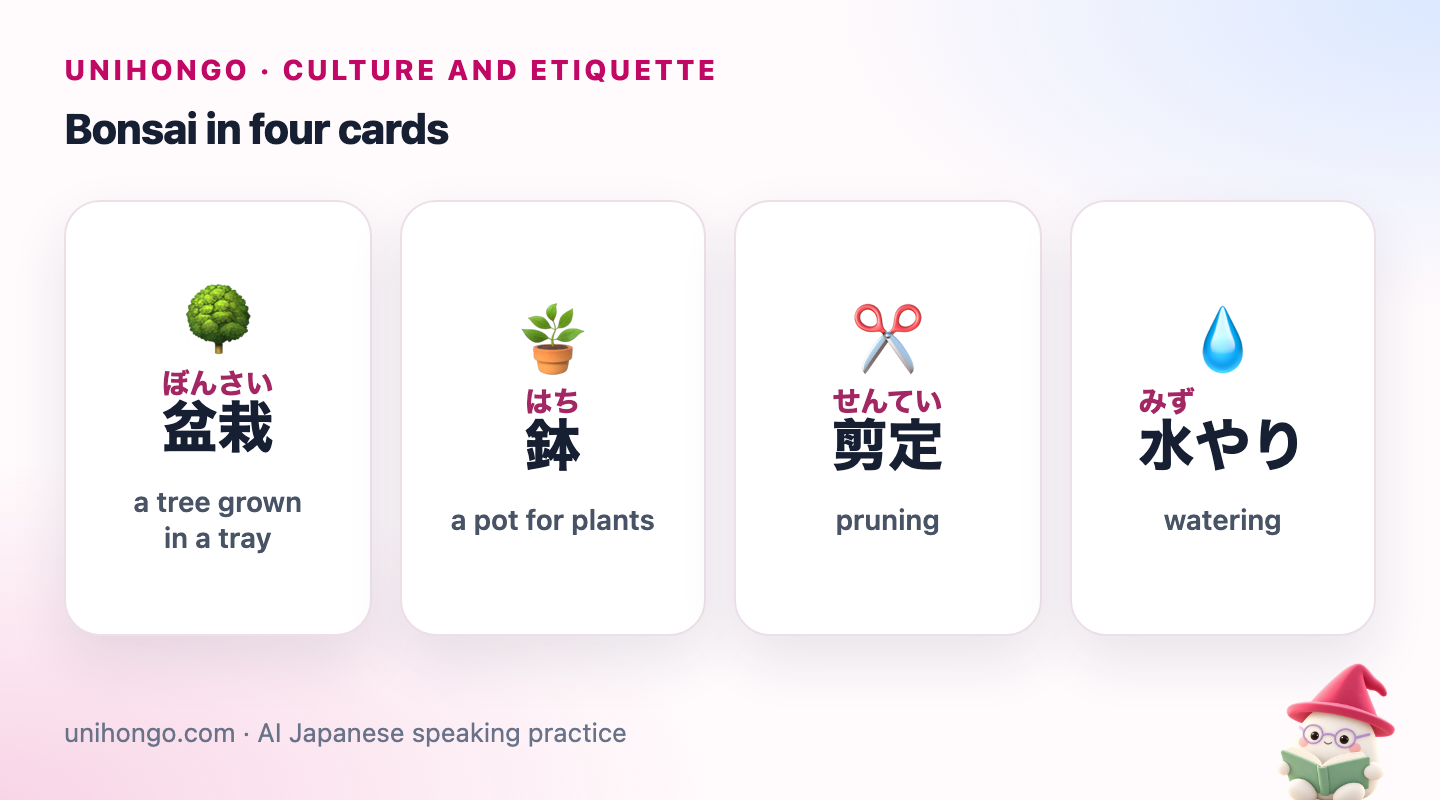
| Japanese | Romaji | Meaning |
|---|---|---|
| 盆栽 | bonsai | a tree grown in a tray |
| 鉢 | hachi | a pot for plants |
| 剪定 | sentei | pruning |
| 水やり | mizuyari | watering |
Hachi is the general word for a plant pot; for bonsai you will also hear bonsai bachi, a bonsai pot, where hachi changes to bachi in the compound. Mizuyari literally means giving water and is the everyday word for watering any plant.
The two kanji: 盆 and 栽
盆 (bon, 9 strokes) means a tray or shallow basin, and its lower part is 皿, a dish. It is the same kanji as in Obon (お盆), the summer festival of the ancestors, and in obon meaning a serving tray; context tells you which is meant. 栽 (sai, 10 strokes) means to plant or cultivate. On its own it is rare, but you see it in saibai (栽培), cultivation, and in a few gardening words.
So bonsai is, quite literally, tray planting. The word refers both to the art and to an individual tree: you can say bonsai ga shumi desu, my hobby is bonsai, or kono bonsai wa kirei desu ne, this bonsai is beautiful.
| Japanese | Romaji | Meaning |
|---|---|---|
| お盆 | obon | a serving tray; also the Obon festival |
| 栽培 | saibai | cultivation, growing plants |
| 盆栽が趣味です。 | Bonsai ga shumi desu. | My hobby is bonsai. |
| この盆栽はきれいですね。 | Kono bonsai wa kirei desu ne. | This bonsai is beautiful. |
Where bonsai came from
The art of growing small trees and landscapes in containers developed in China, where it is known as penjing. It reached Japan many centuries ago, and paintings and scrolls from the Kamakura period already show potted trees. Over time, Japanese growers developed their own styles, and in the Edo period bonsai became popular among samurai, merchants and townspeople alike. Exact dates and routes are discussed by historians, so treat these as broad strokes.
In the early twentieth century, a group of bonsai growers moved from Tokyo to Ōmiya, now part of Saitama City, and founded what is known as the Ōmiya Bonsai Village. It still has several bonsai gardens, and a public bonsai art museum stands nearby. From Japan, the word bonsai spread around the world, and today there are enthusiasts and clubs in many countries.
| Japanese | Romaji | Meaning |
|---|---|---|
| 盆栽は中国から伝わりました。 | Bonsai wa Chūgoku kara tsutawarimashita. | Bonsai came over from China. |
| 大宮盆栽村に行ってみたいです。 | Ōmiya bonsai mura ni itte mitai desu. | I'd like to visit the Ōmiya Bonsai Village. |
| 海外でも人気があります。 | Kaigai de mo ninki ga arimasu. | It's popular abroad too. |
Common styles, and what makes a good bonsai
Bonsai are classified by the shape of the trunk and branches, the jukei (樹形). These are the styles you are most likely to see at a show. Enthusiasts admire a tree that looks old and natural, with a strong base, a trunk that tapers upwards, balanced branches and a pot that suits the tree. Many connect bonsai with ideas of patience and quiet beauty, but people describe its appeal in many different ways.
| Japanese | Romaji | Meaning |
|---|---|---|
| 直幹 | chokkan | formal upright style |
| 懸崖 | kengai | cascade style |
| 寄せ植え | yoseue | group planting |
| Style | Japanese | What it looks like |
|---|---|---|
| Formal upright | Chokkan | A straight trunk rising to a point |
| Informal upright | Moyōgi | A trunk that curves gently as it rises |
| Slanting | Shakan | A trunk that leans to one side, as if in the wind |
| Cascade | Kengai | Branches that fall below the pot, like a tree on a cliff |
| Literati | Bunjingi | A slim, elegant trunk with few branches high up |
| Group planting | Yoseue | Several trees in one pot, like a small forest |
Care words every grower uses
Bonsai care has its own vocabulary, but most of it is everyday gardening Japanese. These words will help you follow a nursery owner or a video.
| Japanese | Romaji | Meaning |
|---|---|---|
| 針金かけ | harigane kake | wiring branches into shape |
| 植え替え | uekae | repotting |
| 芽摘み | metsumi | pinching off new buds |
| 苔 | koke | moss |
| 幹 | miki | trunk |
| 枝 | eda | branch |
| 根張り | nebari | the spread of the surface roots |
| 樹齢 | jurei | the age of a tree |
Popular bonsai trees include matsu (pine), momiji (Japanese maple), ume (Japanese plum), satsuki (a kind of azalea) and shinpaku (a type of juniper). Bonsai grown for flowers are called hanamono and those grown for fruit mimono.
At a bonsai show or nursery
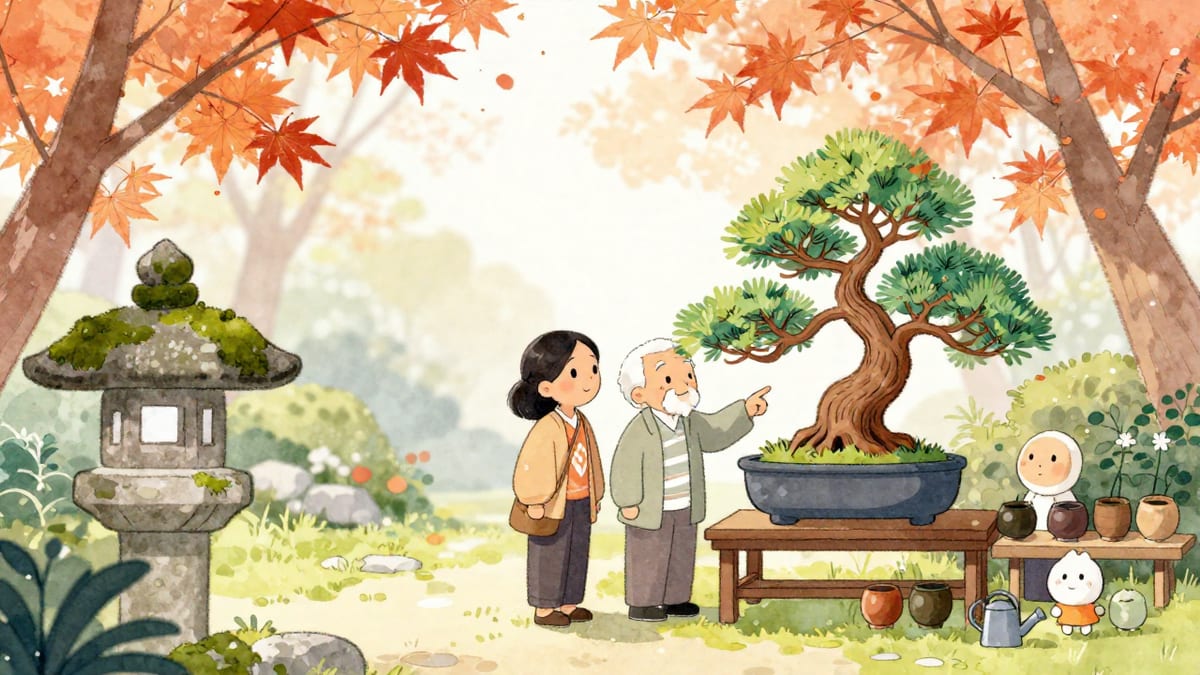
Bonsai exhibitions and nurseries are friendly places, and owners usually enjoy talking about their trees. Look from the front, the shōmen, which the grower has chosen as the best view. Do not touch the trees, and ask before taking photos at private gardens.
| Japanese | Romaji | Meaning |
|---|---|---|
| 立派な盆栽ですね。 | Rippa na bonsai desu ne. | What a magnificent bonsai. |
| 樹齢は何年ぐらいですか。 | Jurei wa nannen gurai desu ka. | About how old is it? |
| 五十年ぐらいです。 | Gojūnen gurai desu. | Owner: About fifty years. |
| 手入れは大変ですか。 | Teire wa taihen desu ka. | Is it hard to look after? |
| 毎日水やりが欠かせません。 | Mainichi mizuyari ga kakasemasen. | Owner: You can't skip watering a single day. |
| 写真を撮ってもいいですか。 | Shashin o totte mo ii desu ka. | May I take a photo? |
| 初心者向けの木はありますか。 | Shoshinsha muke no ki wa arimasu ka. | Do you have a tree for beginners? |
Mini dialogue: choosing a first tree
Many nurseries sell small, inexpensive trees for beginners, and owners are usually happy to give advice. Here is a typical exchange.
| Japanese | Romaji | Meaning |
|---|---|---|
| 盆栽を始めてみたいんですが。 | Bonsai o hajimete mitai n desu ga. | You: I'd like to try starting bonsai. |
| 初めてなら、この真柏がおすすめです。 | Hajimete nara, kono shinpaku ga osusume desu. | Owner: For a first tree, I'd recommend this juniper. |
| 水やりはどのぐらいしますか。 | Mizuyari wa dono gurai shimasu ka. | You: How often do I water it? |
| 土が乾いたら、たっぷりあげてください。 | Tsuchi ga kawaitara, tappuri agete kudasai. | Owner: When the soil is dry, give it plenty. |
| 部屋の中に置いてもいいですか。 | Heya no naka ni oite mo ii desu ka. | You: Can I keep it indoors? |
| 外の方が元気に育ちますよ。 | Soto no hō ga genki ni sodachimasu yo. | Owner: It will grow better outside. |
Many traditional bonsai trees, such as pines and junipers, are outdoor plants that need sun, wind and the change of seasons. If you want a tree for indoors, ask the nursery specifically: heya de sodateraremasu ka, can I grow it in a room?
Learn bonsai kanji and words with Mocchi
Type /kanji 栽 and Mocchi gives you its meaning, readings and the words it appears in, then shows how it differs from 裁 and 載. Ask for a short quiz on the style names afterwards; Mocchi keeps track of the ones you forget, such as bunjingi, and works them into a later review.
Once the words are saved as flashcards, play Vocabulary Dash with your own deck. Running through words in 3D is a light way to recall kengai and yoseue fast.
Common learner mistakes
- Saying banzai for bonsai. Banzai (万歳) is a cheer; bonsai is the tree art.
- Calling any small potted plant a bonsai. In Japanese, bonsai implies a tree shaped with care, not just a small houseplant.
- Touching the trees at a show. Look closely, but keep your hands back.
- Writing 盆才 or 盆裁. The correct kanji is 栽, with 木 at the bottom left.