
The crossing in four cards
These four expressions cover almost every Japanese crossing: waiting at red, the moment it turns green, the crossing itself, and the push button you find on quieter roads.
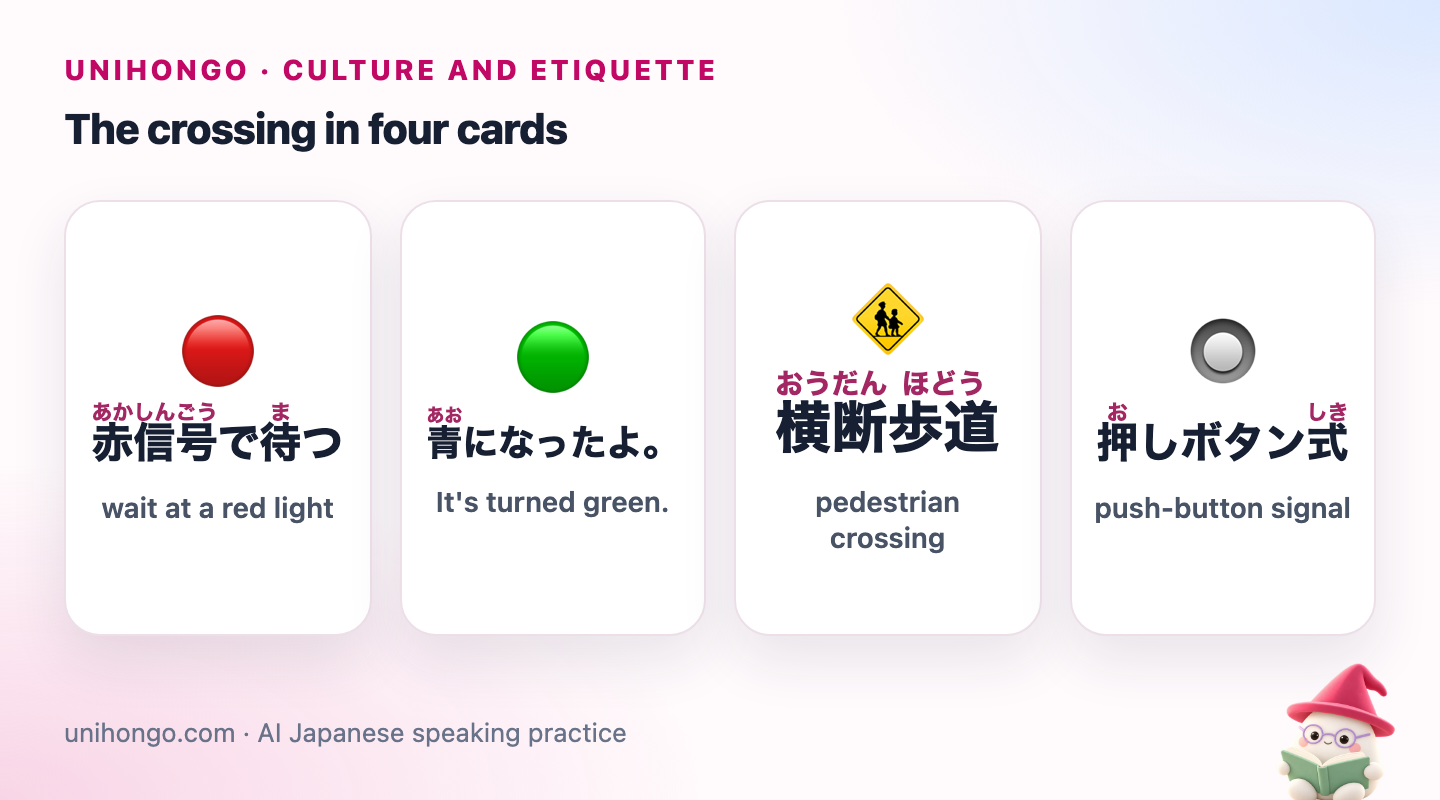
| Japanese | Romaji | Meaning |
|---|---|---|
| 赤信号で待つ | akashingō de matsu | wait at a red light |
| 青になったよ。 | Ao ni natta yo. | It's turned green. |
| 横断歩道 | ōdan hodō | pedestrian crossing |
| 押しボタン式 | oshibotan shiki | push-button signal |
Shingō (信号) means traffic signal. Akashingō is a red light and aoshingō a green one, while kiiro, yellow, is the amber light for cars. At push-button crossings, the light will not change for pedestrians until someone presses the button, which surprises many visitors who wait for a long time.
Reason 1: it starts in childhood
Japanese children usually walk to school, often in small groups, from the age of six. Before and after they start, they learn crossing rules at home, at kindergarten and at school, often in road safety classes, kōtsū anzen kyōshitsu, sometimes led by local police officers. Children are taught to stop at the kerb, look right, left and right again, and raise a hand as they cross so drivers can see them.
Adults who grew up with these lessons tend to keep the habit. Crossing on red can feel wrong in a way that is hard to explain, rather like dropping litter.
| Japanese | Romaji | Meaning |
|---|---|---|
| 右見て、左見て、もう一度右。 | Migi mite, hidari mite, mō ichido migi. | Look right, look left, right again. |
| 手を挙げて渡りましょう。 | Te o agete watarimashō. | Raise your hand when you cross. |
| 交通安全教室がありました。 | Kōtsū anzen kyōshitsu ga arimashita. | We had a road safety class. |
Reason 2: children are watching
Ask Japanese adults why they wait on an empty street, and a very common answer is kodomo ga mite iru kara, because children are watching. Even if you are sure it is safe, a child who copies you might not be. Many adults who would cross on red at night when alone will wait during the day near a school, a park or a group of children.
This connects to a wider idea in Japanese public life: behaving in a way that does not set a bad example, or cause trouble for others. Not everyone thinks about it this way, but you will hear the reason often.
| Japanese | Romaji | Meaning |
|---|---|---|
| 子どもが見ているから。 | Kodomo ga mite iru kara. | Because children are watching. |
| 悪いお手本になりたくない。 | Warui otehon ni naritaku nai. | I don't want to set a bad example. |
| 車が来ないけど、待とう。 | Kuruma ga konai kedo, matō. | No cars are coming, but let's wait. |
Reason 3: rules, the law and other eyes
Under Japan's Road Traffic Act, dōro kōtsū hō, pedestrians must follow traffic signals, so crossing on red, shingō mushi, is technically a violation. Police rarely fine pedestrians, but they may call out a warning, especially at busy junctions. Many people simply feel that rules exist for everyone, and that following them, even when it is inconvenient, keeps public life smooth.
There is also a social element sometimes described as hito no me, other people's eyes. In a crowd where everyone is waiting, stepping out alone draws attention, and most people would rather not stand out. That pressure is weaker late at night and in quiet places, which is why you will see more people cross on red when nobody is around.
| Japanese | Romaji | Meaning |
|---|---|---|
| 信号無視はだめだよ。 | Shingō mushi wa dame da yo. | Don't cross on red. (casual) |
| みんな待っているね。 | Minna matte iru ne. | Everyone's waiting, aren't they? |
| ルールはルールだから。 | Rūru wa rūru da kara. | Rules are rules. |
Reason 4: practical safety
Habit and example are only part of the story. Many Japanese streets are narrow, with blind corners and no pavement, and cars turning left or right often cross the pedestrian crossing at the same time as people walk. Bicycles share pavements in many areas and can appear quickly. In big cities, scramble crossings stop all cars at once so that pedestrians can cross in every direction, and stepping out early can put you in the path of the last turning cars.
| Feature | Japanese | What to watch for |
|---|---|---|
| Flashing green for pedestrians | Tenmetsu | Do not start crossing; finish if you are already on it |
| Scramble crossing | Sukuranburu kōsaten | All directions go at once; wait for the full green |
| Pedestrian bridge | Hodōkyō | Used on wide, busy roads |
| Crossing sounds | Onkyō shingō | Birdsong or melody while the light is green |
The sounds at crossings, often a chirping piyo piyo or a cuckoo-like kakkō, help visually impaired pedestrians know when it is safe to cross. In some places they are switched off at night to avoid disturbing residents, and you may need to press a button for them.
Why the green light is called ao
Learners are often puzzled to hear Japanese people call a green light ao, the word they learned for blue. In older Japanese, ao covered a wide range of colours from blue to green, and it still does in many everyday words: fresh green leaves are aoba, a green apple is an aoringo, and green vegetables are aomono. Midori, the more specific word for green, became common later.
When traffic lights arrived in Japan in the twentieth century, people soon called the go light ao, and the name stuck in speech and in official wording. Japanese traffic lights today are green, but many are a slightly bluish green, perhaps to fit the name. Whatever the reason, say ao, not midori, when you talk about traffic lights.
| Japanese | Romaji | Meaning |
|---|---|---|
| 青信号 | aoshingō | green light |
| 青葉 | aoba | fresh green leaves |
| 青りんご | aoringo | green apple |
| 信号が青に変わりました。 | Shingō ga ao ni kawarimashita. | The light changed to green. |
Mini dialogue: waiting with a friend
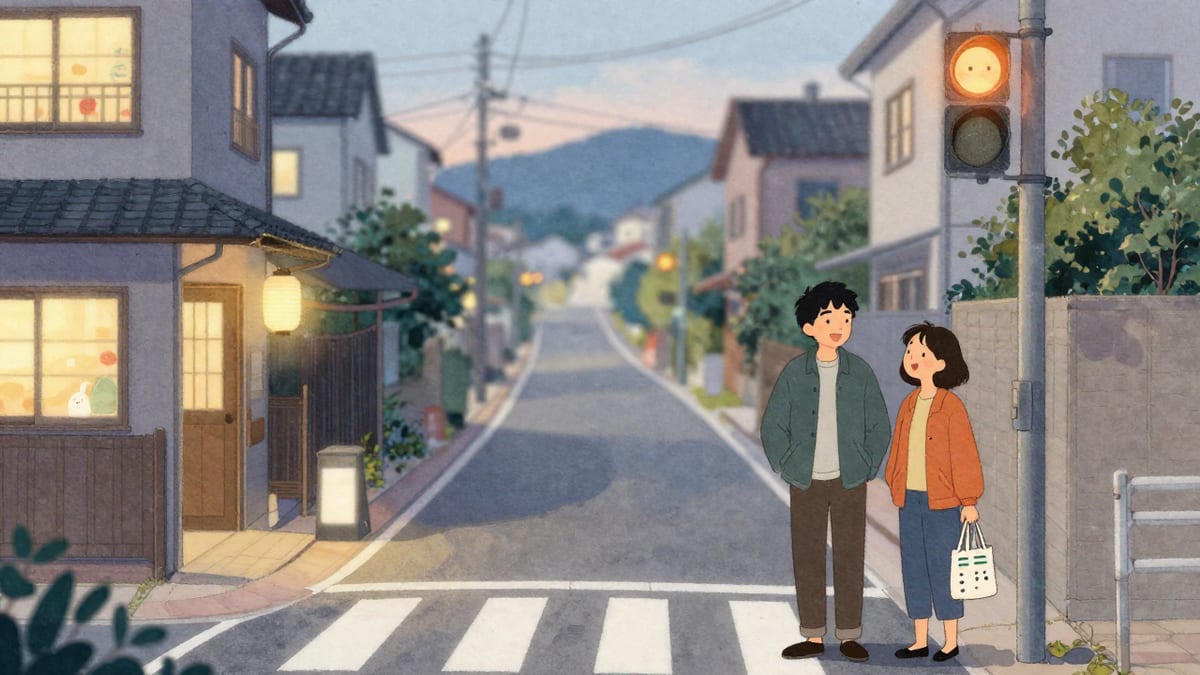
Late in the evening, you and a Japanese friend reach a small crossing. The road is empty, the light is red, and you are in a hurry.
| Japanese | Romaji | Meaning |
|---|---|---|
| 車、全然来ないね。渡っちゃう? | Kuruma, zenzen konai ne. Watatchau? | You: No cars at all. Shall we just cross? |
| うーん、赤だから待とうよ。 | Ūn, aka da kara matō yo. | Friend: Hmm, it's red, let's wait. |
| 誰も見てないよ。 | Daremo mitenai yo. | You: Nobody's watching. |
| そこの家の子が見てるかもしれないし。 | Soko no ie no ko ga miteru kamoshirenai shi. | Friend: The kid in that house might be watching. |
| なるほど。あ、青になった。 | Naruhodo. A, ao ni natta. | You: Fair enough. Oh, it's turned green. |
| よし、渡ろう。 | Yoshi, watarō. | Friend: Right, let's go. |
Shi at the end of a sentence gives one reason while implying there are others. It softens the friend's answer: it is not a lecture, just one more reason to wait.
Make the traffic words stick with Mocchi
- Type /kanji 信 and Mocchi explains the kanji in shingō, with its meaning, readings and other words that use it, such as shinjiru, to believe, and tsūshin, communication.
- Ask Mocchi to quiz you on the traffic words from this post. It notices which ones you mix up, perhaps tenmetsu and hodōkyō, and keeps them in your next review.
- Save the words as flashcards and play Kotoba Stack with your own deck, building a tower word by word; each correct word is one more block.
What a visitor should do
- Wait for the green light, especially near schools, parks and children.
- Do not start crossing when the green is flashing.
- Look out for turning cars and bicycles, even on green.
- Press the button at push-button crossings; otherwise the light may never change.
- If a local friend crosses on red late at night, that is their choice; you can still wait.