
Why I'm proud of you is tricky in Japanese
In English, I'm proud of you works from a parent to a child, between friends and even between colleagues. In Japanese, praise is shaped by the relationship. Praising someone's result can sound like grading them, which is natural from a teacher or parent but odd from a junior. Japanese also tends to praise the effort more than the talent, and to share the happiness rather than announce the speaker's own pride.
So instead of one sentence you need a small set of expressions. Here are the four to start with.
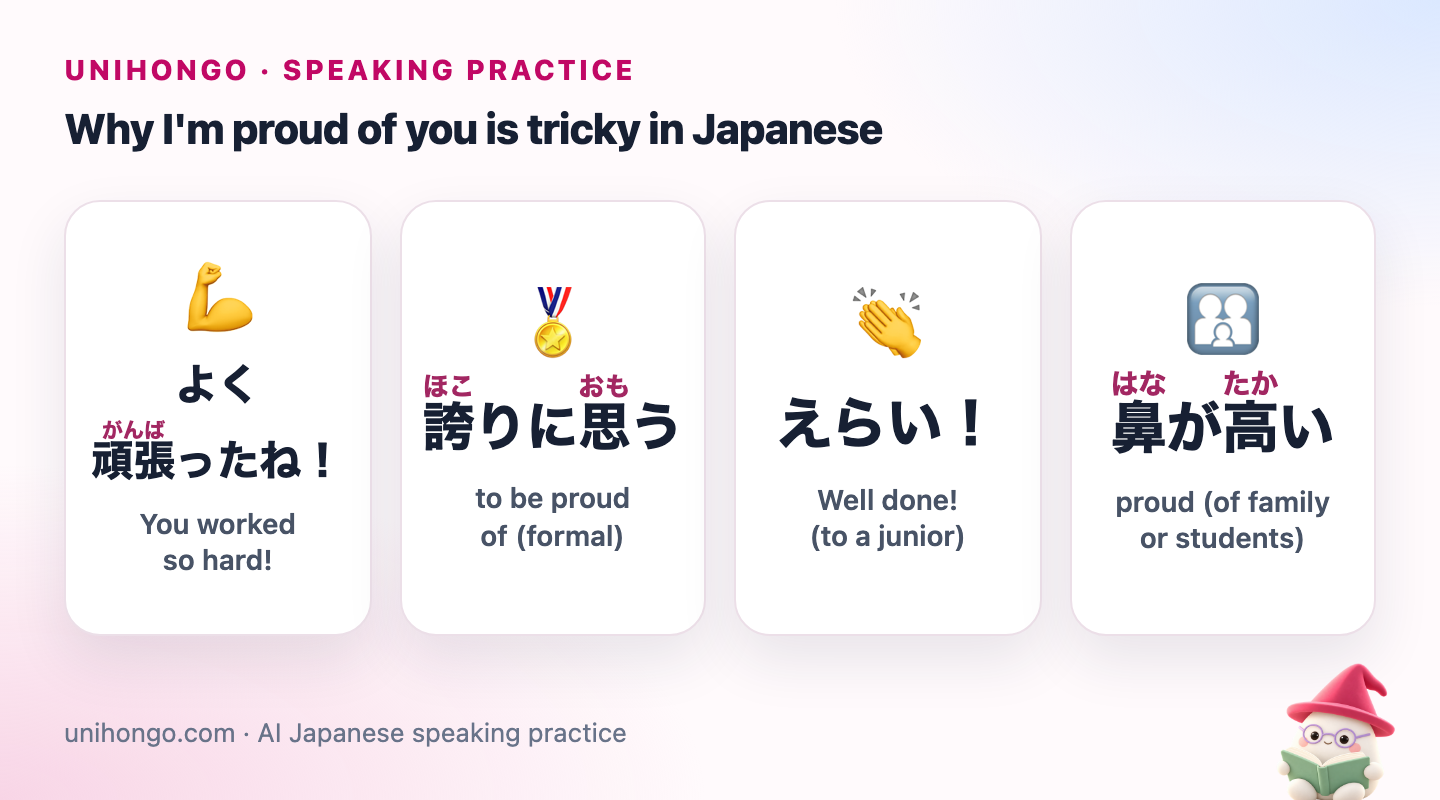
| Japanese | Romaji | Meaning |
|---|---|---|
| よく頑張ったね! | Yoku ganbatta ne! | You worked so hard! |
| 誇りに思う | hokori ni omou | to be proud of (formal) |
| えらい! | Erai! | Well done! (to a junior) |
| 鼻が高い | hana ga takai | proud (of family or students) |
Hokori ni omou: the literal, formal phrase
Hokori (誇り) means pride, and hokori ni omou means to think of something as your pride. It is correct and you will hear it, but mostly in formal or emotional settings: a parent's speech at a wedding, a company praising its staff, a coach after a championship, a letter. Said face to face over coffee it can sound like a line from a drama.
The adjective hokorashii (誇らしい), proud, is a little easier to use, especially about a feeling you had: I felt proud.
| Japanese | Romaji | Meaning |
|---|---|---|
| あなたを誇りに思います。 | Anata o hokori ni omoimasu. | I am proud of you. (formal) |
| チームのみんなを誇りに思います。 | Chīmu no minna o hokori ni omoimasu. | I'm proud of everyone on the team. |
| 誇らしい気持ちになりました。 | Hokorashii kimochi ni narimashita. | It made me feel proud. |
Hokori also expresses group pride: a town proud of its festival, a team proud of its history. Chiiki no hokori, the pride of the area, is a common phrase for a local hero or landmark. That collective use is more natural than one person telling another I'm proud of you.
Everyday ways to say it: praise the effort
The warm, everyday choice is to praise what the person did. Yoku ganbatta ne, you really did your best, fits friends, family and younger colleagues, and it says what English means by I'm proud of you: I saw how hard you worked. Sugoi ne, that's amazing, is lighter and works almost anywhere among peers. Jibun no koto mitai ni ureshii, I'm as happy as if it were me, carries the shared joy that English proud also contains.
Our separate guide on how to say good job in Japanese covers praising a piece of work. Here the focus is the emotion behind the praise.
| Japanese | Romaji | Meaning |
|---|---|---|
| 本当によく頑張ったね。 | Hontō ni yoku ganbatta ne. | You really worked hard. |
| すごいね!おめでとう! | Sugoi ne! Omedetō! | That's amazing! Congratulations! |
| 自分のことみたいにうれしい。 | Jibun no koto mitai ni ureshii. | I'm as happy as if it were me. |
| 努力が実ったね。 | Doryoku ga minotta ne. | Your effort paid off. |
| ずっと見てたよ。 | Zutto miteta yo. | I saw how hard you worked. |
Notice how many of these talk about the effort or about your own happiness. That is the core strategy: instead of judging the result, say what you saw and how it made you feel. It works in almost every relationship.
Erai and yoku dekita: praise that flows downward
Erai literally means great or important, and as praise it means good for you, well done. Parents say it to children who tidy their room, and friends say it to each other half joking: you got up at six to study? Erai! Yoku dekita, well done, is the classic praise from a teacher or parent. Both evaluate the other person, so they flow downward or sideways.
To someone senior, such as a teacher, a boss or an older relative, switch to expressions that admire rather than judge.
| Japanese | Romaji | Meaning |
|---|---|---|
| さすがですね。 | Sasuga desu ne. | I'd expect nothing less of you. |
| おめでとうございます。 | Omedetō gozaimasu. | Congratulations. (polite) |
| 本当に尊敬します。 | Hontō ni sonkei shimasu. | I really admire you. |
| Expression | Direction | Feel |
|---|---|---|
| Erai! | To children, juniors, close peers | Good for you, well done |
| Yoku dekita ne | Parent or teacher to a child | You did it well |
| Yoku ganbatta ne | To peers and juniors | You worked so hard |
| Sasuga desu ne | To seniors and peers | As expected of you |
| Omedetō gozaimasu | To anyone, politely | Congratulations |
If you are unsure, congratulations plus a question is always safe: omedetō gozaimasu, dō yatte junbi shita n desu ka, congratulations, how did you prepare? Asking about the process shows admiration without any hint of grading.
Hana ga takai: proud of your own family
Hana ga takai, literally my nose is high, means I'm proud, usually of someone close to you whose success reflects well on you: a child, a student, a younger sibling. It is said about the person, often to a third party, rather than to the person directly. Jiman no musume, my daughter who is my pride, works the same way. Japanese modesty usually discourages boasting about family, so these are often said with a smile, or when someone else has praised them first.
| Japanese | Romaji | Meaning |
|---|---|---|
| 息子が合格して、鼻が高いです。 | Musuko ga gōkaku shite, hana ga takai desu. | My son passed, and I'm so proud. |
| 自慢の娘です。 | Jiman no musume desu. | She is my pride and joy. |
| 教え子が活躍していて、うれしいです。 | Oshiego ga katsuyaku shite ite, ureshii desu. | I'm happy my former students are doing so well. |
When someone else praises your family member, accept it modestly: arigatō gozaimasu, honnin ni tsutaemasu, thank you, I'll pass that on. This shows your pride without boasting.
A spoken exchange: a friend passes the Japanese exam
Your friend has been studying every evening for the Japanese Language Proficiency Test and has just seen the results. Notice that you never say hokori ni omou. The pride comes through in praising the effort and sharing the joy.

| Japanese | Romaji | Meaning |
|---|---|---|
| 日本語の試験、合格した! | Nihongo no shiken, gōkaku shita! | Friend: I passed the Japanese exam! |
| 本当?おめでとう! | Hontō? Omedetō! | You: Really? Congratulations! |
| 毎日勉強してたもんね。よく頑張ったね! | Mainichi benkyō shiteta mon ne. Yoku ganbatta ne! | You: You studied every day. You worked so hard! |
| ありがとう。自分を褒めたい。 | Arigatō. Jibun o hometai. | Friend: Thanks. I want to give myself credit. |
| 褒めていいよ!自分のことみたいにうれしい。 | Homete ii yo! Jibun no koto mitai ni ureshii. | You: You should! I'm as happy as if it were me. |
| 今度お祝いしよう! | Kondo oiwai shiyō! | You: Let's celebrate soon! |
Being proud of yourself
Saying I'm proud of myself directly can sound boastful in Japanese, so people usually frame it as giving themselves credit or a reward. Jibun o hometai, I want to praise myself, is a common and endearing way to say it. Ganbatta jibun ni gohōbi, a treat for my hard-working self, is the classic excuse for a nice cake after a hard week.
| Japanese | Romaji | Meaning |
|---|---|---|
| 自分を褒めてあげたいです。 | Jibun o homete agetai desu. | I'd like to give myself some credit. |
| 頑張った自分にご褒美。 | Ganbatta jibun ni gohōbi. | A treat for my hard-working self. |
| 少し自信がつきました。 | Sukoshi jishin ga tsukimashita. | I've gained a little confidence. |
Ganbatta, I did my best, said quietly to yourself after a hard day, is perhaps the most everyday way to be proud of yourself in Japanese. Friends often say it for you: otsukare, ganbatta ne.
Praising a child
With children, Japanese praise is generous and direct. Erai ne, sugoi ne and yoku dekita ne are the everyday trio, and parents and teachers praise effort and behaviour as much as results: helping a sibling, finishing homework, trying something scary. Ganbatta ne after a sports day or a recital tells the child that the trying counted, whatever the result.
Many parents in Japan are modest about their children in front of others, even while praising them warmly at home. If someone compliments your child, ie ie, mada mada desu, oh no, there's still a long way to go, is a common modest reply.
| Japanese | Romaji | Meaning |
|---|---|---|
| えらいね、一人でできたね。 | Erai ne, hitori de dekita ne. | Well done, you did it by yourself. |
| 最後まで頑張ったね。 | Saigo made ganbatta ne. | You kept going right to the end. |
| お母さん、うれしいよ。 | Okāsan, ureshii yo. | Mum is so happy. (parent to child) |
| いえいえ、まだまだです。 | Ie ie, mada mada desu. | Oh no, still a long way to go. (modest) |