
A snow day in four phrases
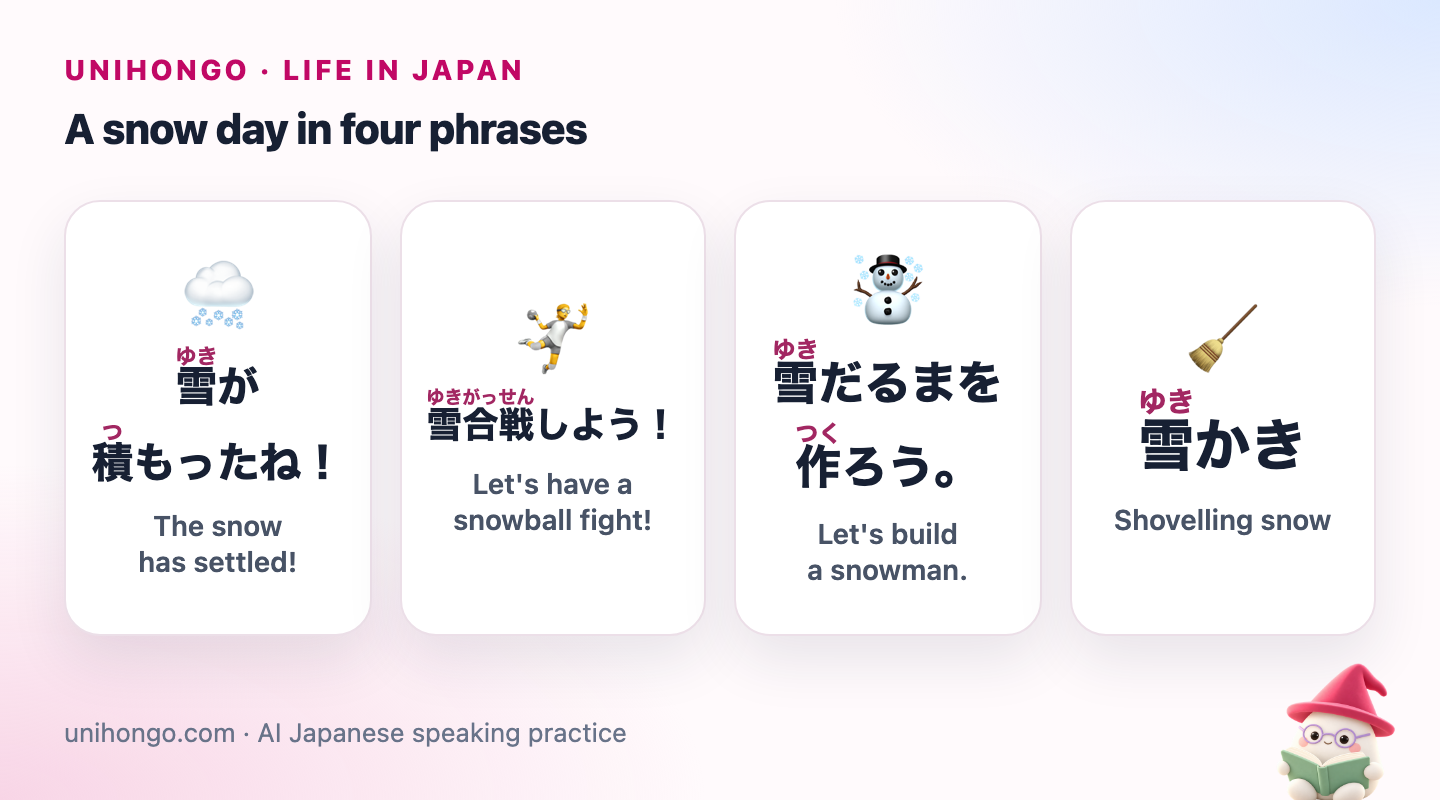
These four lines cover the joy and the work of a snow day: the first look outside, the invitation to play, building something, and the chore that follows. The first three are casual, as you would say them to friends.
| Japanese | Romaji | Meaning |
|---|---|---|
| 雪が積もったね! | Yuki ga tsumotta ne! | The snow has settled! |
| 雪合戦しよう! | Yukigassen shiyō! | Let's have a snowball fight! |
| 雪だるまを作ろう。 | Yukidaruma o tsukurō. | Let's build a snowman. |
| 雪かき | yukikaki | Shovelling snow |
Shiyō and tsukurō are volitional forms: let's do, let's make. Yukikaki is from yuki (snow) and kaku (to scrape or rake), and the verb is yukikaki o suru.
Snow verbs: furu, tsumoru, kōru, tokeru
English uses snow as a verb, but Japanese describes what the snow does in stages. Snow falls (furu), settles and piles up (tsumoru), freezes into ice (kōru), and melts (tokeru). Learners often say only yuki ga futta, which describes falling, when they want to say the ground is white. For that, use tsumotta.
| Verb | Meaning | Example |
|---|---|---|
| 降る furu | To fall | Yuki ga futte iru: it's snowing |
| 積もる tsumoru | To settle, pile up | Jussenchi tsumotta: 10 cm settled |
| 凍る kōru | To freeze | Michi ga kōtte iru: the road is frozen |
| 溶ける tokeru | To melt | Yuki ga tokete kita: the snow is melting |
| 滑る suberu | To slip, slide | Suberanai yō ni: so you don't slip |
Kinds of snow have names too. Konayuki (粉雪) is fine, powdery snow; botan-yuki (ぼたん雪) is big, heavy flakes; fubuki (吹雪) is a blizzard; and ōyuki (大雪) is heavy snowfall, the word in weather warnings.
Playing in the snow
In places where snow is rare, a snow day turns adults into children for a morning. Snowball fights, yukigassen (雪合戦), are the classic, and a snowball is yukidama (雪玉). A Japanese snowman, yukidaruma (雪だるま), is commonly built from two balls, a body and a head, like the daruma doll it is named after, rather than three. In the snow country, children build kamakura (かまくら), snow huts big enough to sit inside, and some towns hold kamakura festivals in winter.
| Japanese | Romaji | Meaning |
|---|---|---|
| 雪玉、投げるよ! | Yukidama, nageru yo! | I'm throwing a snowball! |
| 顔はやめて! | Kao wa yamete! | Not in the face! |
| 冷たい! | Tsumetai! | Cold! |
| 目は何にする? | Me wa nani ni suru? | What shall we use for the eyes? |
| かまくら、作ってみたい。 | Kamakura, tsukutte mitai. | I'd like to try making a snow hut. |
Mini dialogue: building a snowman with friends
It snowed overnight in Tokyo and you meet two friends in a small park near your apartment. The talk is excited and casual, and full of the snow words from this guide.
| Japanese | Romaji | Meaning |
|---|---|---|
| 見て、こんなに積もってる! | Mite, konna ni tsumotteru! | Friend: Look how much has settled! |
| 東京でこんなに降るの、珍しいよね。 | Tōkyō de konna ni furu no, mezurashii yo ne. | You: It's rare for Tokyo to get this much, right? |
| 雪だるま作ろうよ。私、頭やる。 | Yukidaruma tsukurō yo. Watashi, atama yaru. | Friend: Let's build a snowman. I'll do the head. |
| じゃあ、体は私が作るね。 | Jā, karada wa watashi ga tsukuru ne. | You: Then I'll make the body. |
| 手が冷たすぎて、感覚がない! | Te ga tsumetasugite, kankaku ga nai! | Friend: My hands are so cold I can't feel them! |
| 終わったら、温かいもの飲みに行こう。 | Owattara, atatakai mono nomi ni ikō. | You: When we're done, let's go get a hot drink. |
Mezurashii means rare or unusual, and it is the word everyone in Tokyo uses on a snow day. Kankaku ga nai, I have no feeling, is an easy way to describe numb fingers.
Notice how the friends divide the work with wa and ga: atama yaru (I'll do the head) and karada wa watashi ga tsukuru (as for the body, I'll make it). The same pattern is useful whenever a group splits a task, from cooking to cleaning up. Ending with an invitation to a warm drink is a natural way to keep the day going once everyone is too cold to continue.
Ice, trains and staying safe
The day after the snow is often more dangerous than the snowfall itself. Melted snow freezes overnight, and pavements turn tsurutsuru. Each winter, Japanese news reports people injured in falls on icy streets, especially in cities that rarely see snow, so walk slowly with short steps. Trains in snow-light regions can be delayed or suspended, and many companies let people start late or work from home when heavy snow is forecast. Ōyuki keihō (大雪警報) is a heavy snow warning from the weather agency.
| Japanese | Romaji | Meaning |
|---|---|---|
| 道がつるつるだから気をつけて。 | Michi ga tsurutsuru da kara ki o tsukete. | The road is icy, so be careful. |
| 足元に気をつけてください。 | Ashimoto ni ki o tsukete kudasai. | Please watch your step. |
| 雪で電車が遅れています。 | Yuki de densha ga okurete imasu. | The trains are delayed because of the snow. |
| 今日は在宅勤務にします。 | Kyō wa zaitaku kinmu ni shimasu. | I'll work from home today. |
| 大雪警報が出ています。 | Ōyuki keihō ga dete imasu. | There's a heavy snow warning. |
Shovelling snow with the neighbours
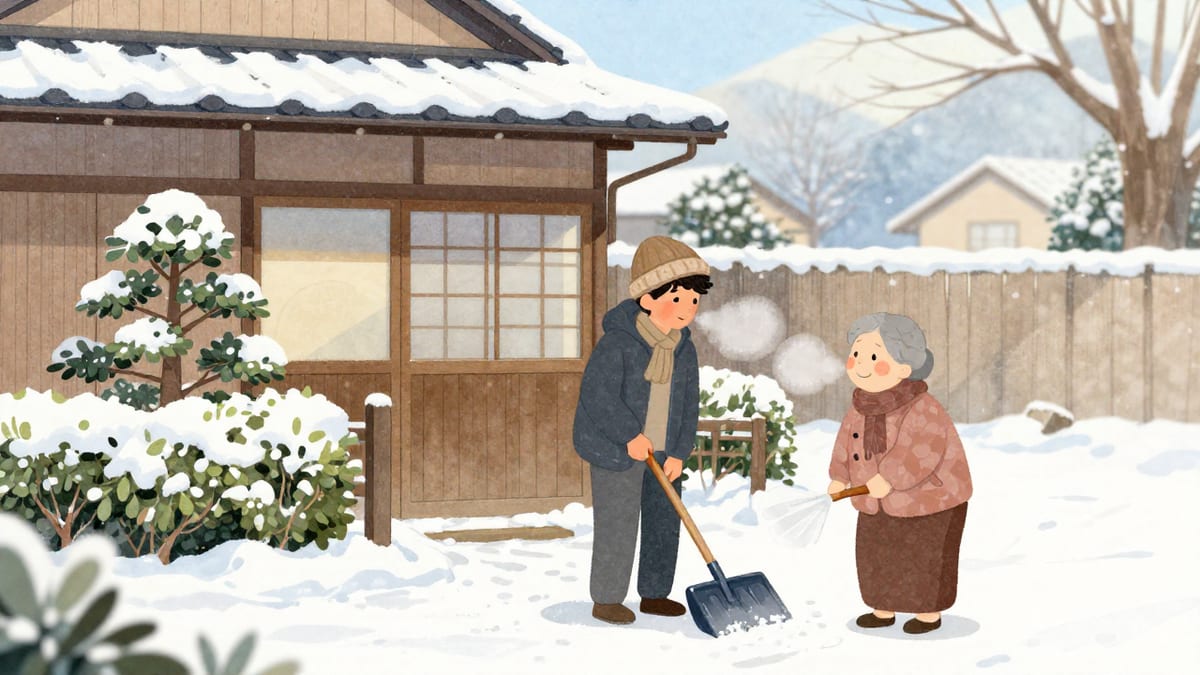
After heavy snow, residents clear the path in front of their homes and shops. In the snow country it is a daily winter chore, often done early in the morning, and in some places roofs must be cleared too, which is dangerous work best left to experienced people. In cities, yukikaki is a rare event that brings neighbours outside together. Joining in, or at least greeting the people who are doing it, is a simple way to become part of your street.
| Japanese | Romaji | Meaning |
|---|---|---|
| おはようございます。お疲れさまです。 | Ohayō gozaimasu. Otsukaresama desu. | You: Good morning. Thanks for your hard work. |
| よく降りましたね。 | Yoku furimashita ne. | Neighbour: It really snowed, didn't it? |
| 手伝いましょうか。 | Tetsudaimashō ka. | You: Shall I help? |
| 助かります。そのスコップ、使ってください。 | Tasukarimasu. Sono sukoppu, tsukatte kudasai. | Neighbour: That's kind. Please use that shovel. |
| 屋根から雪が落ちてくるので、気をつけてくださいね。 | Yane kara yuki ga ochite kuru node, ki o tsukete kudasai ne. | Neighbour: Snow falls off the roof, so be careful. |
Snow sliding off roofs, rakusetsu (落雪), is a real hazard in snowy areas, so take the warning seriously and avoid walking right under the eaves. Clearing snow from a roof is called yukioroshi (雪下ろし).
Weather small talk in the snow country
If you live in a snowy region, snow is not an event but a season, and the small talk changes. People compare this winter with last winter, check the forecast for tomorrow, and swap tips about boots and heating. Visitors from warm countries are often asked whether they have ever seen snow before, and how they are coping with the cold. Answering with a little humour, such as samusa ni wa mada narete imasen, I'm not used to the cold yet, is a good way to keep the conversation going.
The word yukiguni (雪国), snow country, describes regions with heavy snowfall, and people there are often proud of how they handle winter. Asking a local how they prepare, fuyu no junbi wa dō shite imasu ka, usually gets you practical advice and a longer conversation.
| Japanese | Romaji | Meaning |
|---|---|---|
| 今年は雪が多いですね。 | Kotoshi wa yuki ga ōi desu ne. | There's a lot of snow this year. |
| 明日も降るらしいですよ。 | Ashita mo furu rashii desu yo. | Apparently it'll snow tomorrow too. |
| 雪を見るのは初めてです。 | Yuki o miru no wa hajimete desu. | It's my first time seeing snow. |
| 寒さにはまだ慣れていません。 | Samusa ni wa mada narete imasen. | I'm not used to the cold yet. |
Common learner mistakes
- Saying yuki ga futta when you mean the ground is white. Use tsumotta for snow that has settled.
- Mixing up tsumetai and samui. Snow and your hands are tsumetai, cold to the touch; the weather and the air are samui.
- Using casual warnings with neighbours. Ki o tsukete kudasai is the polite form.
- Calling a snowman sunōman. People will understand, but yukidaruma is the everyday word.