
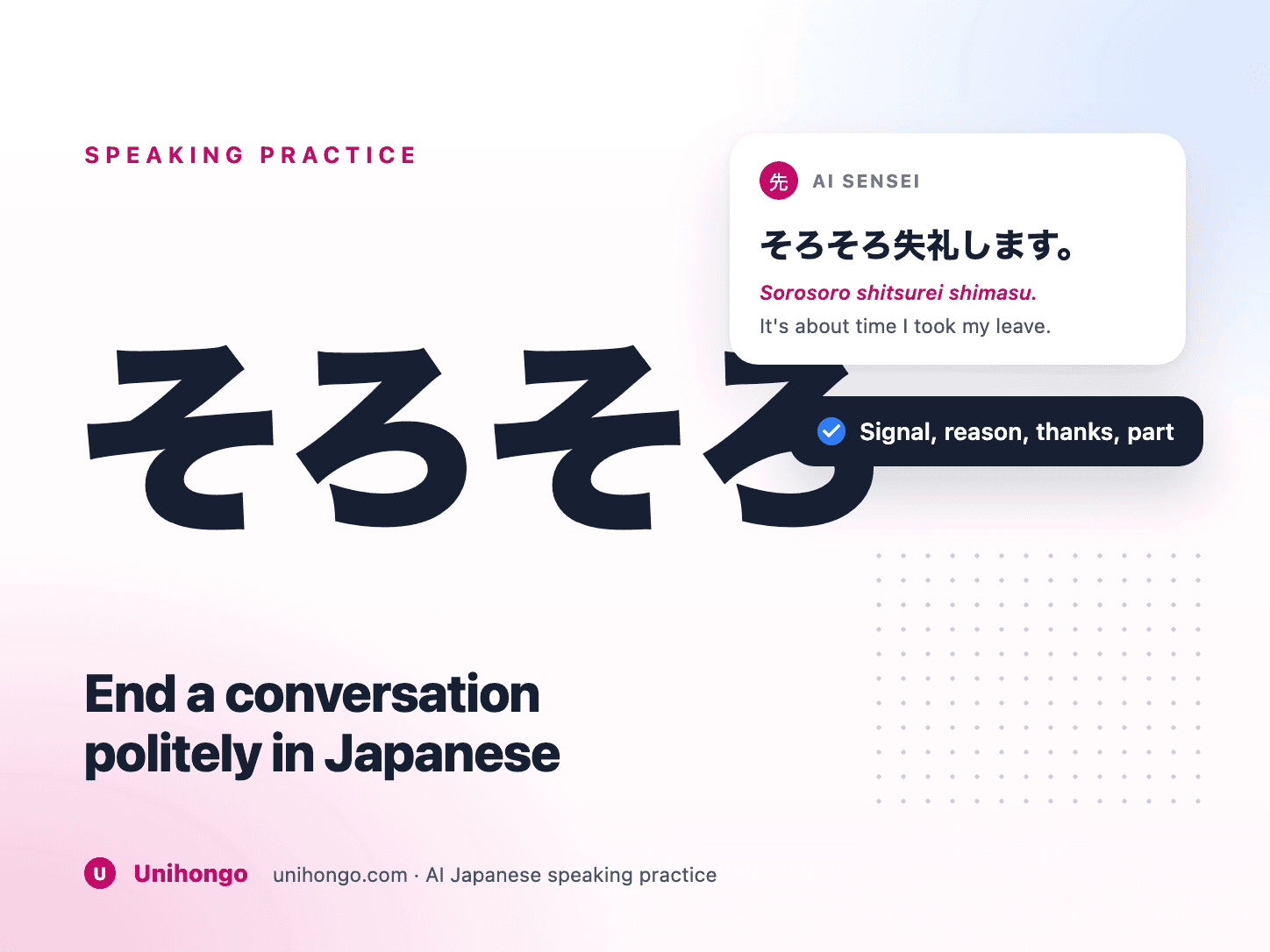
An ending is a sequence, not a word
The mistake is looking for the Japanese for goodbye. There is no single word that does the job, because the work is spread across three or four short moves. First you signal that the conversation is approaching its end, which gives the other person a chance to add anything they were holding. Then you give a light reason, so leaving is attributed to circumstances rather than to boredom. Then you thank them for their time or the conversation. Only then do you use a parting phrase.
Each move is a fixed phrase, so the whole sequence is four things to memorise, not four things to compose. Once you have said it twenty times it becomes a single reflex, which is exactly what you want, because endings tend to arrive when you are already tired from speaking a second language.
| Step | What it does | Typical phrase |
|---|---|---|
| 1. Signal | Warns that the end is near | そろそろ… Sorosoro... |
| 2. Reason | Attributes leaving to circumstance | ちょっと用事があって Chotto yōji ga atte |
| 3. Thank | Values the time you were given | 今日はありがとうございました Kyō wa arigatō gozaimashita |
| 4. Part | Closes and points forward | また来週 Mata raishū |
In a very short exchange you can compress steps two and three, but never skip step one. The signal is what stops the ending feeling abrupt.
The pre-closing signals
Sorosoro is the workhorse. It means before long, and placing it at the front of a sentence announces a departure without stating it bluntly. Sorosoro shitsurei shimasu, sorosoro ikanakya and sorosoro kaerimasu are three registers of the same move.
Ja and dewa are the other signal, and they are what makes a conversation feel finished. Dropping a ja in front of a farewell converts it from an announcement into a natural close, which is why ja mata sounds warm and mata alone sounds clipped. A trailing sore ja, sonna kanji de or the softened ja, kore de works the same way.
| Japanese | Romaji | Meaning |
|---|---|---|
| そろそろ失礼します。 | Sorosoro shitsurei shimasu. | It is about time I took my leave. |
| そろそろ行かなきゃ。 | Sorosoro ikanakya. | I should get going. (casual) |
| そろそろ帰りますね。 | Sorosoro kaerimasu ne. | I will head home soon. |
| じゃ、そういうことで。 | Ja, sō iu koto de. | Right, let us leave it there. |
| では、このへんで。 | Dewa, kono hen de. | Well then, let us stop about here. |
| 長くなってすみません。 | Nagaku natte sumimasen. | Sorry for keeping you so long. |
Giving a reason without sounding rude
A reason makes the ending about your schedule rather than about the other person, which is why it matters even when the reason is thin. The convention is to be vague. Chotto yōji ga arimasu node covers everything from a dentist appointment to wanting to go home, and nobody will ask what the yōji is.
Keep it short. A detailed explanation reads as justification, and justification implies that leaving needs excusing. One clause, ending in node or kara or the te-form, is the whole thing.
| Japanese | Romaji | Meaning |
|---|---|---|
| ちょっと用事があるので。 | Chotto yōji ga aru node. | I have something to take care of, so... |
| この後、予定があって。 | Kono ato, yotei ga atte. | I have plans after this, so... |
| 電車の時間があるので。 | Densha no jikan ga aru node. | I have a train to catch, so... |
| 明日早いので。 | Ashita hayai node. | I have an early start tomorrow, so... |
| すみません、次の打ち合わせがありまして。 | Sumimasen, tsugi no uchiawase ga arimashite. | Sorry, I have another meeting. |
| お忙しいところ、ありがとうございました。 | Oisogashii tokoro, arigatō gozaimashita. | Thank you for your time when you are busy. |
The farewells, by relationship
The parting phrase is where learners most often reach for sayōnara, and it is usually the wrong choice. Sayōnara carries a sense of a real parting, and used casually at the office door it lands strangely. The everyday alternatives are built around either seeing each other again or acknowledging the other person's work.
Otsukaresama desu deserves special mention. It is the standard exit line in a Japanese workplace and roughly means thank you for your efforts. Osaki ni shitsurei shimasu, excuse me for leaving before you, is what you say when you go home before your colleagues, and the usual reply is otsukaresama deshita.
| Situation | What to say | Notes |
|---|---|---|
| Leaving a friend | じゃあ、またね Jā, mata ne | Add mata raishū or mata kondo to point forward |
| Leaving work before colleagues | お先に失礼します Osaki ni shitsurei shimasu | They reply お疲れさまでした Otsukaresama deshita |
| Leaving a colleague generally | お疲れさまです Otsukaresama desu | The default workplace goodbye at any hour |
| Leaving a teacher or senior | 失礼します Shitsurei shimasu | Add ありがとうございました first |
| Leaving a shop as the customer | ありがとうございます Arigatō gozaimasu | A nod is enough; no farewell needed |
| A genuine long parting | さようなら / お元気で Sayōnara / Ogenki de | Correct here, and only here |
Notice how many of these are thanks rather than goodbyes. In Japanese, gratitude does much of the work that farewell does in English.
Pointing forward is what makes it warm
The line that turns a correct ending into a friendly one is the one about next time. It costs three words and it is the part learners most often leave out, which is why their endings can feel polite but cool. Mata raishū, mata kondo, or a slightly more committed line such as mata gohan ikimashō, all do it.
In work contexts the equivalent is a line about what happens next: hikitsuzuki yoroshiku onegaishimasu, thank you for continuing to work with me, or a concrete confirmation of the next step. Ending on the next action is standard, and it doubles as a summary.
| Japanese | Romaji | Meaning |
|---|---|---|
| また来週。 | Mata raishū. | See you next week. |
| また今度ゆっくり話しましょう。 | Mata kondo yukkuri hanashimashō. | Let us talk properly again next time. |
| 今度ご飯行きましょうね。 | Kondo gohan ikimashō ne. | Let us go and eat sometime. |
| 引き続きよろしくお願いします。 | Hikitsuzuki yoroshiku onegaishimasu. | Thank you for your continued help. |
| では、金曜日までにお送りします。 | Dewa, kin-yōbi made ni ookuri shimasu. | Then I will send it to you by Friday. |
| 気をつけて帰ってください。 | Ki o tsukete kaette kudasai. | Please get home safely. |
Phone calls and online meetings
A call has no body language, so the closing sequence carries all of the signalling and is correspondingly more fixed. The standard shape is a summary of what was agreed, thanks, then shitsurei shimasu. On business calls, the caller normally closes, and the more junior party waits before hanging up rather than cutting off the moment the words end.
Online meetings borrow the phone pattern with one extra difficulty: the lag makes overlapping goodbyes common, so people often end with a short otsukaresama desu and a wave rather than a full exchange. Say your closing line, wait a beat for the others, then leave the call.
| Japanese | Romaji | Meaning |
|---|---|---|
| では、そのように進めます。失礼します。 | Dewa, sono yō ni susumemasu. Shitsurei shimasu. | Then I will proceed that way. Goodbye. |
| お忙しいところ、失礼しました。 | Oisogashii tokoro, shitsurei shimashita. | Sorry to have taken your time. |
| ご確認のほど、よろしくお願いいたします。 | Gokakunin no hodo, yoroshiku onegaiitashimasu. | I would be grateful if you could check it. |
| それでは、失礼いたします。 | Sore de wa, shitsurei itashimasu. | Then I will say goodbye. (formal) |
| お疲れさまでした。退出しますね。 | Otsukaresama deshita. Taishutsu shimasu ne. | Thank you for your work. I will leave the call. |
When you are the one being kept
Sometimes the other person is not closing and you need to. The polite way is to take the blame for the interruption rather than assigning it to their talking. Sumimasen, sorosoro jikan ga puts the constraint on the clock, and osoreirimasu ga, kono hen de puts it on you.
If it is a customer or a senior person, add a line that values the conversation before you leave, so the ending reads as reluctance rather than escape. Mō sukoshi ukagaitai n desu ga, I would like to hear more, followed by the constraint, is the standard shape.
| Japanese | Romaji | Meaning |
|---|---|---|
| すみません、そろそろ時間が… | Sumimasen, sorosoro jikan ga... | Sorry, I am running out of time... |
| 恐れ入りますが、このへんで。 | Osoreirimasu ga, kono hen de. | I am sorry, but let us stop here. |
| もう少し伺いたいんですが、次の予定がありまして。 | Mō sukoshi ukagaitai n desu ga, tsugi no yotei ga arimashite. | I would like to hear more, but I have another appointment. |
| 続きはまたメールで送ります。 | Tsuzuki wa mata mēru de okurimasu. | I will send the rest by email. |