
Four things you will say during every match
Most of what fans say while watching is not sentences but bursts: a question to start the evening, a shout for a goal, a groan for a near miss, and a complaint about the referee. These four cover the whole emotional range of a match.
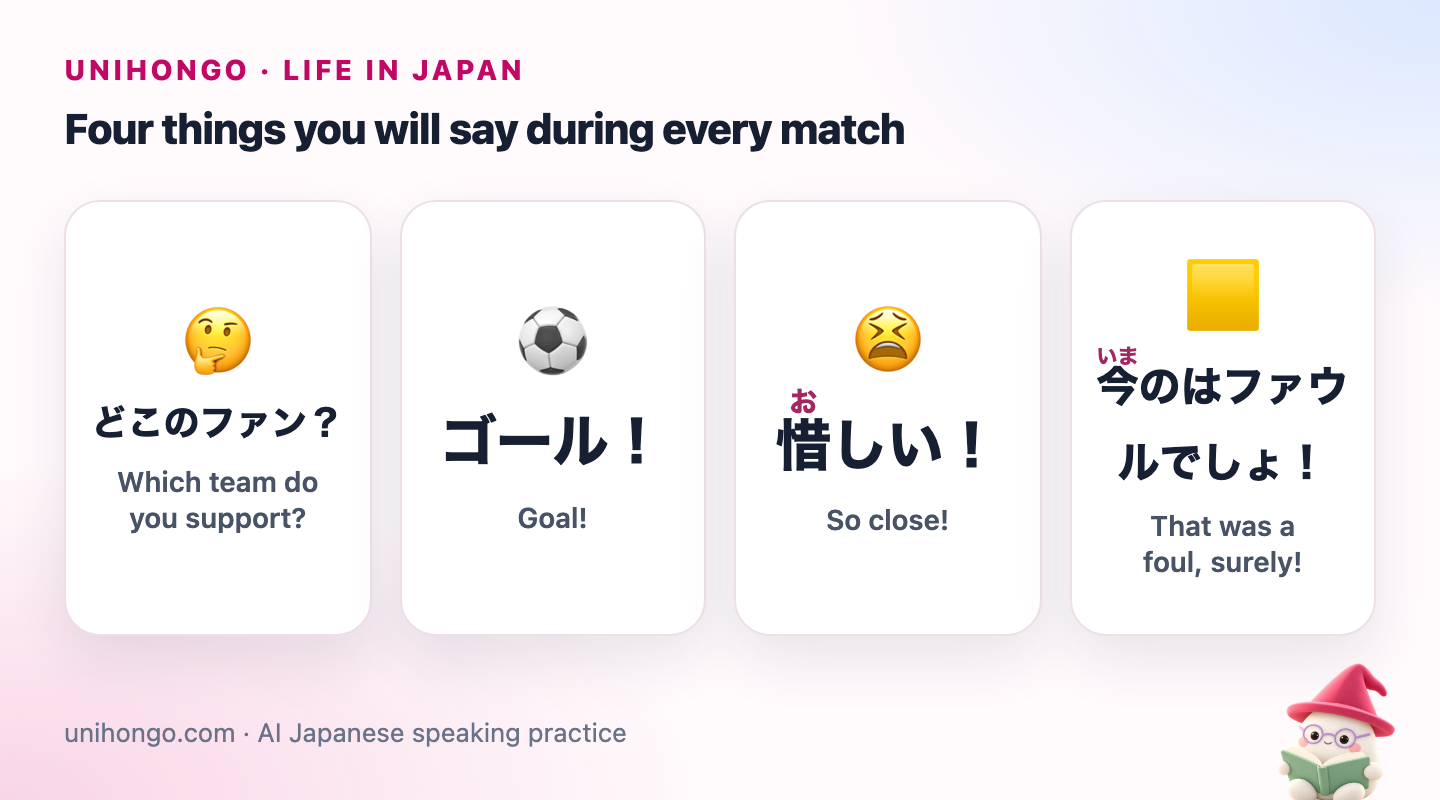
| Japanese | Romaji | Meaning |
|---|---|---|
| どこのファン? | Doko no fan? | Which team do you support? |
| ゴール! | Gōru! | Goal! |
| 惜しい! | Oshii! | So close! |
| 今のはファウルでしょ! | Ima no wa fauru desho! | That was a foul, surely! |
Doko no fan? is casual, literally a fan of where? With a new coworker, make it polite: dono chīmu no fan desu ka. Desho at the end of the foul line asks for agreement in a strong way, like surely or right?, and is very common when watching sport.
Football words: English in a Japanese accent
Most football terms come from English, so the challenge is pronunciation rather than vocabulary. Japanese adds vowels and changes sounds: shoot becomes shūto, pass becomes pasu, free kick becomes furī kikku. Say them the Japanese way, or people may not recognise them. A few key words are Japanese, though, and they come up in every match.
| Japanese | Meaning | Note |
|---|---|---|
| 試合 shiai | Match | Kyō no shiai: today's match |
| 前半 zenhan / 後半 kōhan | First half / second half | Hāfu taimu is half-time |
| 日本代表 Nihon daihyō | Japan national team | Daihyō alone is often enough |
| シュート shūto | Shot | Shūto o utsu: to take a shot |
| キーパー kīpā | Goalkeeper | Nai sēbu: great save |
| オフサイド ofusaido | Offside | Often argued about |
| 延長戦 enchōsen | Extra time | Then a penalty shoot-out |
Before kick-off: teams, players and predictions
The minutes before a match are for small talk. People ask who you support, who will win and who the dangerous players are. If you support a club from your home country, say so; it is a good conversation opener. Predicting the score is yosō (予想), and people enjoy making bold ones.
J-League clubs are tied to their home towns, and many people support the local club even if they rarely go to matches. Asking about it is a natural way to learn about someone's home region: if a coworker is from a city with a club, ask whether they support it. Club supporters often wear the team shirt, called a yunifōmu, to matches and to bars on match days, so a shirt is also an easy conversation starter.
| Japanese | Romaji | Meaning |
|---|---|---|
| どこのチームを応援してる? | Doko no chīmu o ōen shiteru? | Which team are you cheering for? |
| 地元のチームを応援してます。 | Jimoto no chīmu o ōen shitemasu. | I support my local team. |
| 今日はどっちが勝つと思う? | Kyō wa dotchi ga katsu to omou? | Who do you think will win today? |
| 二対一で日本が勝つと思う。 | Ni tai ichi de Nihon ga katsu to omou. | I think Japan will win two-one. |
| あの選手、すごく速いよね。 | Ano senshu, sugoku hayai yo ne. | That player is really fast, isn't he? |
Scores are read with tai (対), versus: ni tai ichi is two-one, and zero zero is often said rei tai rei or simply zero tai zero. Ōen suru (応援する), to cheer for or support, is the most useful verb of the evening.
Live reactions: from ike! to uso desho!
When the ball is moving, keep it short. These reactions are casual but used by everyone, including adults with coworkers in a bar, because nobody speaks in full polite sentences during a counter-attack. Yosshā! is an energetic yes!, and although it sounds a bit rough, both men and women use it when celebrating.
| Japanese | Romaji | Meaning |
|---|---|---|
| 行け! | Ike! | Go on! |
| 打て! | Ute! | Shoot! |
| よっしゃー! | Yosshā! | Yes! |
| ナイスセーブ! | Naisu sēbu! | Great save! |
| うそでしょ! | Uso desho! | No way! |
| 危なかった…。 | Abunakatta... | That was close... (a narrow escape) |
| 頑張れ、日本! | Ganbare, Nippon! | Come on, Japan! |
Mini dialogue: a Japan match at a sports bar
You are at a crowded bar with two Japanese friends, wearing blue. Japan is one goal down in the second half. Notice how the conversation jumps between reactions, short opinions and practical things like ordering.
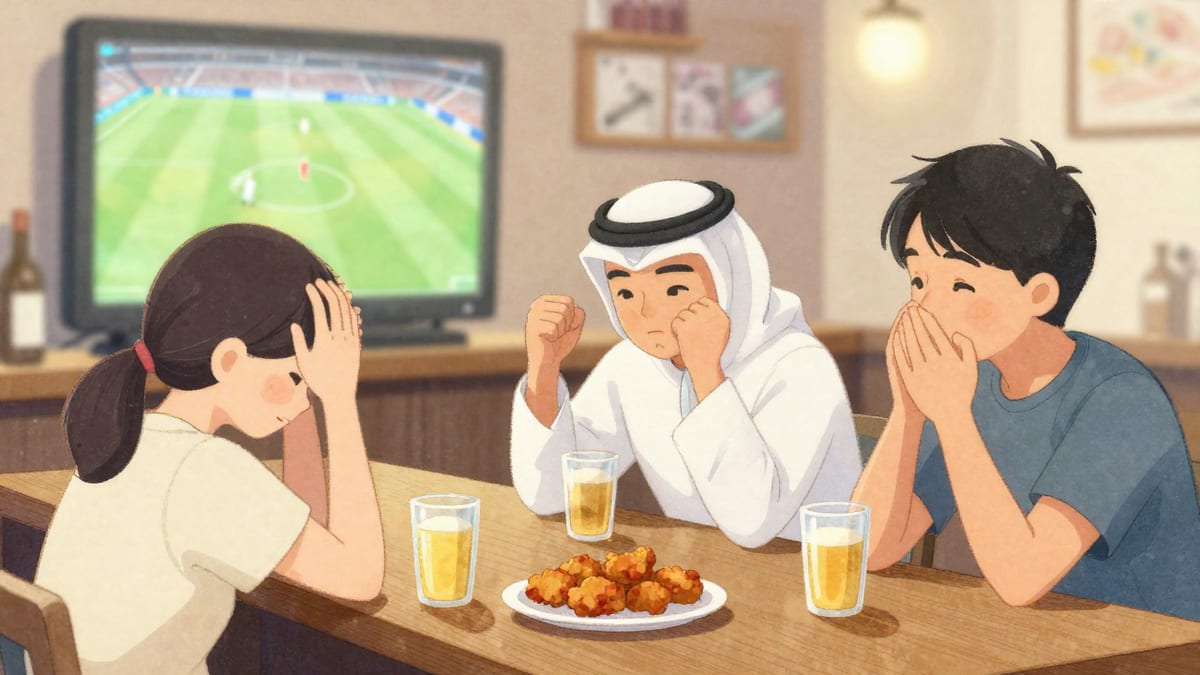
| Japanese | Romaji | Meaning |
|---|---|---|
| あー、惜しい!ポストだ! | Ā, oshii! Posuto da! | Friend: Argh, so close! Off the post! |
| 今のは入ったと思った! | Ima no wa haitta to omotta! | You: I thought that was in! |
| まだ時間あるよ。大丈夫。 | Mada jikan aru yo. Daijōbu. | Friend: There's still time. It's fine. |
| 今のはファウルでしょ!イエローだよ! | Ima no wa fauru desho! Ierō da yo! | You: That was a foul! That's a yellow! |
| あ、行ける行ける! | A, ikeru ikeru! | Friend: Oh, he can make it, he can make it! |
| ゴール!やったー! | Gōru! Yattā! | Everyone: Goal! Yes! |
| 乾杯しよう! | Kanpai shiyō! | Friend: Let's drink to that! |
Ikeru ikeru, repeated, means this could work. It is what people shout as a player breaks clear. Haitta, it went in, is the natural verb for a goal: the ball entered the net.
After the final whistle
After the match, people talk it over: the best player, the turning point, the referee, the next fixture. If your team lost, Japanese has a perfect word, kuyashii (悔しい), the frustrated feeling of having nearly done it. It is stronger and more personal than zannen, which is just a pity.
| Japanese | Romaji | Meaning |
|---|---|---|
| いい試合だったね。 | Ii shiai datta ne. | That was a good match. |
| 今日一番良かったのは誰だと思う? | Kyō ichiban yokatta no wa dare da to omou? | Who do you think played best today? |
| 悔しい! | Kuyashii! | So frustrating! |
| 次の試合はいつ? | Tsugi no shiai wa itsu? | When's the next match? |
| 今度、スタジアムに行こうよ。 | Kondo, sutajiamu ni ikō yo. | Let's go to the stadium sometime. |
That last line is how one evening in a bar turns into a friendship. If someone invites you to a J-League match, say yes: watching from the supporters' end, singing with people you have just met, is an experience in itself.
Watching with coworkers or your boss
Big tournaments often mean watching with people from work, in an office break room, a bar after hours or a colleague's home. The reactions stay the same: nobody says gōru desu! when the ball goes in. What changes is everything around them. Questions, opinions and invitations switch to desu and masu, and you speak about the team rather than teasing the person who supports the other side.
Japanese fans are generally supportive of their own team even after a defeat, and loud criticism of a player can make people uncomfortable, especially in mixed company. Saying the team did its best, yoku ganbatta, is a gentler way to end a bad night than listing everything that went wrong. Among close friends, of course, the post-match arguments can be as heated as anywhere.
| Japanese | Romaji | Meaning |
|---|---|---|
| 部長はどのチームのファンですか。 | Buchō wa dono chīmu no fan desu ka. | Which team do you support? (to your manager) |
| 後半は良くなりましたね。 | Kōhan wa yoku narimashita ne. | It got better in the second half. |
| よく頑張りましたね。 | Yoku ganbarimashita ne. | They did really well, didn't they? |
| 次の試合も一緒に見ませんか。 | Tsugi no shiai mo issho ni mimasen ka. | Shall we watch the next match together too? |
Common learner mistakes
- Saying futtobōru for football. It is understood, but in Japan the normal word is sakkā.
- Pronouncing English words the English way. Shūto, pasu and gōru are what people recognise.
- Using kuyashii for disappointing food or weather. It is about losing or failing, not things that are just bad.
- Shouting the casual reactions at a quiet public screening. Match the volume of the room, and keep strong language out of it.