
Names that tell you a generation
Japanese people talk about names in terms of era: a Showa-ish name, shōwa ppoi namae, or a name like a grandmother's. These are not insults when said between friends about names in general, but they show how strongly names are tied to a time. The words below describe the style; the next sections give you the names themselves.
| Japanese | Romaji | Meaning |
|---|---|---|
| 古風な名前 | kofū na namae | a classic, old-style name |
| 昭和っぽい名前 | shōwa ppoi namae | a name that feels Showa-era (casual) |
| レトロな名前 | retoro na namae | a retro name |
| おばあちゃん世代の名前 | obāchan sedai no namae | a name of grandma's generation |
Kofū na namae is the kindest of these. It suggests classic and elegant rather than dated, and you can say it about a name you like. The Japanese eras matter here: Meiji (1868-1912), Taishō (1912-1926), Showa (1926-1989), Heisei (1989-2019) and Reiwa (from 2019). People often place a name in one of them.
Four classic endings in four names
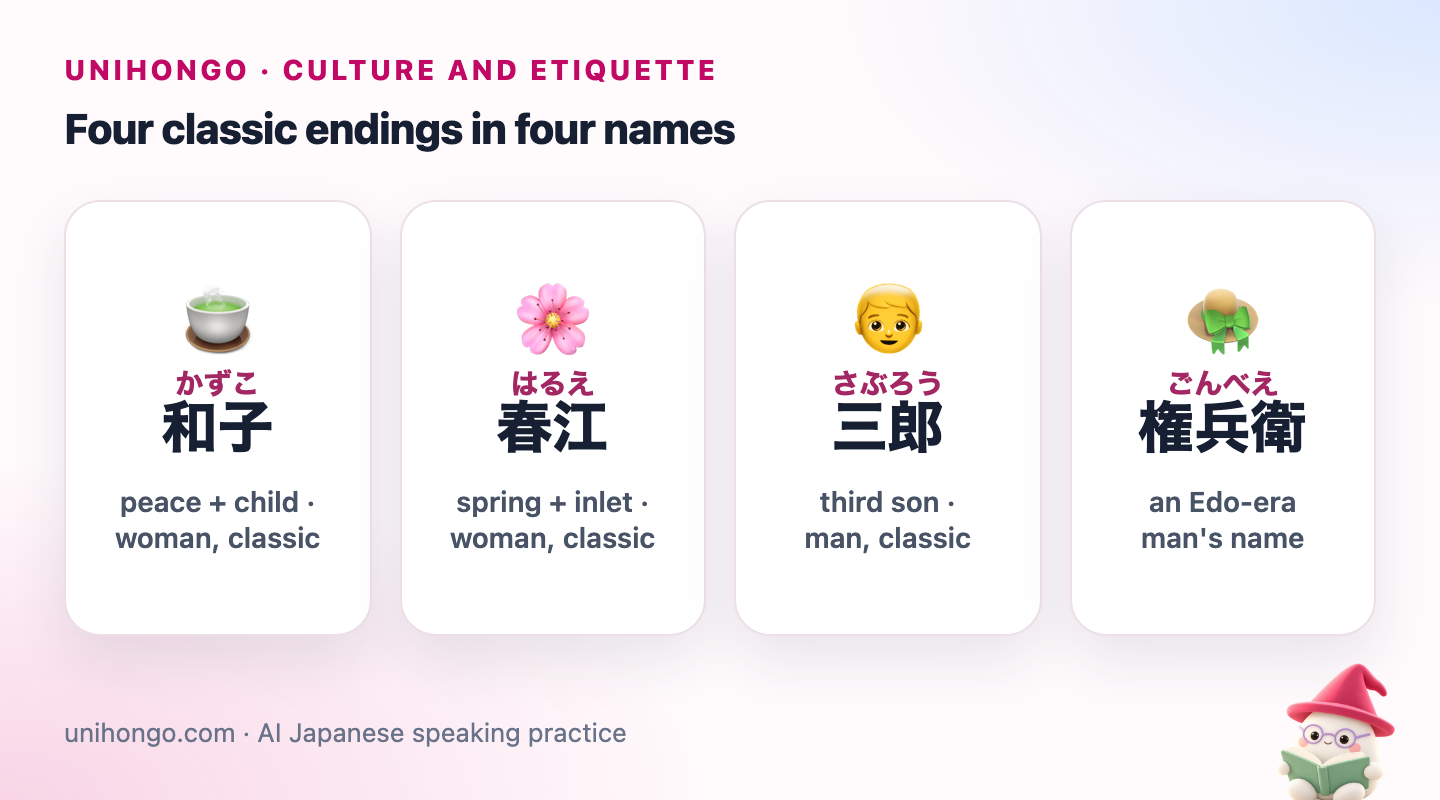
Each of these names shows one old ending. Kazuko and Harue are women's names a Japanese person would expect for someone born in the middle of the twentieth century. Saburō is a classic third son. Gonbē is so old that it now appears mostly in sayings and period dramas.
| Japanese | Romaji | Meaning |
|---|---|---|
| 和子 | Kazuko | peace + child · woman, classic |
| 春江 | Harue | spring + inlet · woman, classic |
| 三郎 | Saburō | third son · man, classic |
| 権兵衛 | Gonbē | an Edo-era man's name |
Notice the endings: 子 (child), 江 (inlet, bay), 郎 (son) and 兵衛. The ending alone is often enough for a Japanese person to picture the era and gender of the name's owner.
Women's names: -ko, -e, -yo and kana names
In the Meiji and Taishō eras many ordinary women were registered with short names of two syllables, often written in katakana or hiragana: Hana, Ume, Tome, Kiyo, Tsuru. The -ko ending, often said to have been associated with noble families at first, spread widely in the early twentieth century and became the standard girls' ending for decades. Other common endings were -e, written 江, 枝 or 恵, and -yo, written 代 or 世, which suggests generations.
| Japanese | Romaji | Meaning |
|---|---|---|
| ウメ | Ume | plum · woman, Meiji-era style |
| ハナ | Hana | flower · woman, Meiji-era style |
| 千代 | Chiyo | a thousand generations · woman |
| 幸子 | Sachiko | happiness + child · woman |
| 節子 | Setsuko | moderation, season + child · woman |
| 洋子 | Yōko | ocean + child · woman |
| 幸枝 | Sachie | happiness + branch · woman |
| 初江 | Hatsue | first + inlet · woman |
Tome (トメ) is a name often explained as meaning stop, given when a family hoped that this child would be the last. You will read this explanation in many places, but individual families had their own reasons, so treat it as a popular story rather than a fact about any one person.
Men's names: numbered sons, merchants and samurai
Older men's names come in a few clear families. Birth order was often written into the name with 郎 (son): 一郎, 次郎, 三郎, 四郎. Merchant and farming families liked endings such as 吉 (luck), 蔵 or 造 (storehouse, making) and 助 (help). The oldest-sounding endings, 兵衛 and 右衛門 or 左衛門, come from old official titles and were common in the Edo period.
| Japanese | Romaji | Meaning |
|---|---|---|
| 寅吉 | Torakichi | tiger + luck · man, very old |
| 源蔵 | Genzō | origin + storehouse · man, old |
| 十兵衛 | Jūbē | Edo-era man's name |
| 名無しの権兵衛 | nanashi no Gonbē | a nobody, like John Doe |
| Ending | Reading | Original sense | Example | Feel today |
|---|---|---|---|---|
| 郎 | rō | son, young man | 三郎 Saburō | Classic, still used in compounds |
| 吉 | kichi | good luck | 寅吉 Torakichi | Very old, merchant-era |
| 蔵 / 造 | zō | storehouse / making | 源蔵 Genzō | Old, rural or craftsman |
| 兵衛 | bē | from an old guard title | 十兵衛 Jūbē | Historical, period drama |
| 右衛門 | emon | from an old guard title | 五右衛門 Goemon | Historical, comic or heroic |
Today -rō survives in compounds such as Kentarō or Shintarō, while -kichi, -zō, -bē and -emon are heard mostly in historical dramas, folk tales and comedy. A child called Genzō today would surprise people, though perhaps in a charming way.
Showa one-kanji names for men
In the Showa era, many boys received short one-kanji names with a strong, simple meaning. They sound reliable and a little old-fashioned now: the names of grandfathers and veteran colleagues.
Most of them come straight from a native word, which is why they are easy to read once you know it: kiyoshi is the classical form of kiyoi (pure), and shigeru (to grow thick), isamu (to be in high spirits, brave), minoru (to ripen) and susumu (to go forward) are verbs. That pattern, a whole verb as a name, is rarer in names given today.
| Japanese | Romaji | Meaning |
|---|---|---|
| 清 | Kiyoshi | pure · man, Showa-era |
| 茂 | Shigeru | to grow thick · man, Showa-era |
| 勇 | Isamu | brave · man, Showa-era |
| 実 | Minoru | to bear fruit · man, Showa-era |
| 進 | Susumu | to advance · man, Showa-era |
Retro names that are coming back
Fashion turns in circles. Alongside modern names, some young parents now choose names with an old-style feel, and online you may see the joking word shiwashiwa nēmu, wrinkly names, as the opposite of kirakira names. You may meet little boys with the samurai-sounding ending -nosuke and little girls with short, classic names that would not have surprised a Taishō grandmother.
Nobody has an exact count, so think of this as a style you will notice in nurseries and parks rather than a trend with numbers. Often the retro name gets a fresh kanji: an old sound, a new look.
| Japanese | Romaji | Meaning |
|---|---|---|
| 龍之介 | Ryūnosuke | dragon + helper · boy, retro feel |
| 慎之介 | Shinnosuke | careful + helper · boy, retro feel |
| 小春 | Koharu | little spring · girl, classic |
| すず | Suzu | bell · girl, soft and classic |
| シワシワネーム | shiwashiwa nēmu | 'wrinkly names', retro names (joke) |
Mini dialogue: a neighbour's name
You meet your elderly neighbour, Kazuko, and she mentions her name. The polite reactions here work with anyone older than you.
| Japanese | Romaji | Meaning |
|---|---|---|
| 和子さんのお名前、素敵ですね。 | Kazuko san no onamae, suteki desu ne. | You: Kazuko, what a lovely name. |
| あら、ありがとう。昔はクラスに和子が三人もいたのよ。 | Ara, arigatō. Mukashi wa kurasu ni Kazuko ga sannin mo ita no yo. | Neighbour: Oh, thank you. There were three Kazukos in my class. |
| 三人もですか。どうやって呼び分けていたんですか。 | Sannin mo desu ka. Dō yatte yobiwakete ita n desu ka. | You: Three! How did people tell you apart? |
| 苗字で呼ばれていたわね。 | Myōji de yobarete ita wa ne. | Neighbour: They called us by our surnames. |
| へえ、面白いですね。 | Hē, omoshiroi desu ne. | You: Oh, that's interesting. |
An era quiz with Mocchi, then tea with Yamada-sensei
Ask Mocchi, "Give me ten Japanese names and let me guess the era each one feels like, then explain the ending." Mocchi runs it as a /quiz, explains the endings you mixed up, and notes them, so -e and -yo names come back next time.
Then open AI Sensei and choose Yamada-sensei. Ask him to play your grandfather-in-law, born in the Showa era, telling you about his classmates' names. Practise reacting, asking follow-up questions and repeating the names back.
Mistakes to avoid with old names
- Calling someone's name furukusai (古臭い), old and musty. It is rude. If you must comment, say kofū na, classic.
- Guessing someone's age from their name out loud. Names hint at an era, but it is personal; keep the guess to yourself.
- Assuming every -ko name belongs to an older woman. Plenty of young women and girls carry -ko names.
- Reading 兵衛 as hyōe in every name. Bē is the usual reading in names like Gonbē, though hyōe exists in some old names too.
- Treating Tome's 'stop' story as certain for a real person. Ask, or simply do not mention it.