
Hatsumōde in four words
Hatsumōde is written 初詣: 初 means first and 詣 means a visit to a holy place. You will hear the word everywhere in late December and early January, on the news, on train posters and in casual chat, usually as a plan: hatsumōde doko iku, where are you going for hatsumōde?
Four words carry most of the visit. The invitation itself, the coin offering, the bow-and-clap sequence at a shrine, and the paper fortune that many people draw on the way out.
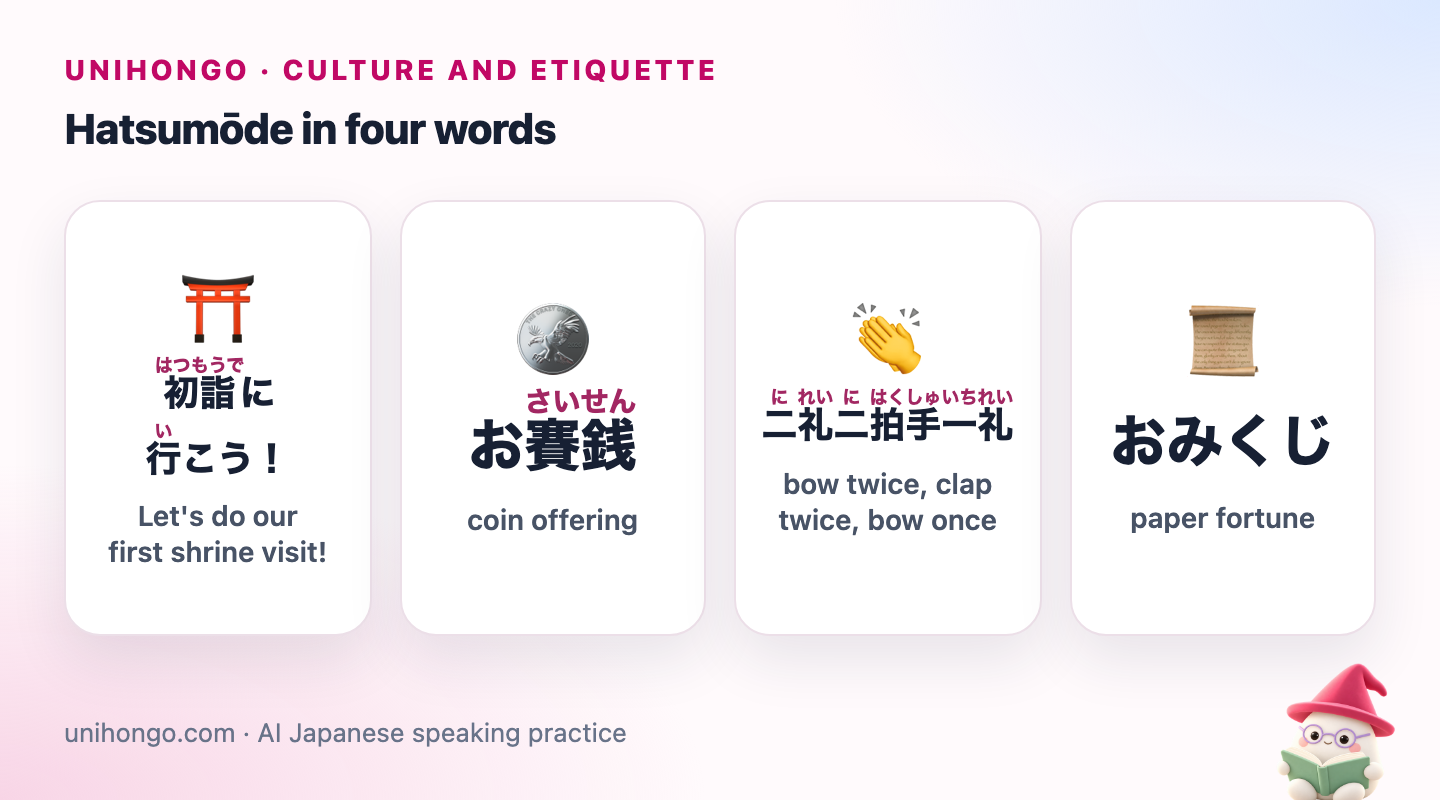
| Japanese | Romaji | Meaning |
|---|---|---|
| 初詣に行こう! | Hatsumōde ni ikō! | Let's do our first shrine visit! |
| お賽銭 | osaisen | coin offering |
| 二礼二拍手一礼 | nirei nihakushu ichirei | bow twice, clap twice, bow once |
| おみくじ | omikuji | paper fortune |
| 三が日 | sanganichi | the first three days of January |
| 参拝 | sanpai | visiting to worship (formal word) |
Sanpai is the formal word you will see on shrine notices and hear from staff. Among friends people say omairi, a visit to pray, or simply use hatsumōde as a verb with suru or iku.
When people go, and where
There is no single right time. Some people love the atmosphere of a midnight visit, with fires burning and stalls open late; others prefer a calm morning. Big, famous shrines can mean queues of an hour or more in the first days, while a small neighbourhood shrine may take five minutes. Many families visit their local shrine, the one that traditionally protects their area, and some also travel to a well-known shrine or temple linked to a particular wish, such as passing exams.
| Japanese | Romaji | Meaning |
|---|---|---|
| いつ初詣に行く? | Itsu hatsumōde ni iku? | When are you going for hatsumōde? (casual) |
| 元日の朝に行きます。 | Ganjitsu no asa ni ikimasu. | I'm going on the morning of New Year's Day. |
| 近所の神社でいいよ。 | Kinjo no jinja de ii yo. | The local shrine is fine with me. |
| 年が明けたらすぐ行こう。 | Toshi ga aketara sugu ikō. | Let's go right after midnight. |
| 今年もよろしくお願いします。 | Kotoshi mo yoroshiku onegai shimasu. | I look forward to another year with you. |
| When | What it is like | Good for |
|---|---|---|
| Just after midnight, 1 January | Crowded, lively, cold; fires and food stalls | Friends who stayed up for the countdown |
| Morning of 1 January | Busy with families in their best clothes | Starting the year with the whole family |
| 2 and 3 January | Still busy at famous shrines, calmer locally | A relaxed visit within sanganichi |
| Until about 7 January, or later | Quiet, often no queue; customs vary by area | Workers and anyone who missed the rush |
Step by step at the shrine
Every shrine has its own small customs, and many post a picture guide near the water basin. The common pattern below works almost everywhere, and if you are unsure, simply copy the person in front of you.
| Japanese | Romaji | Meaning |
|---|---|---|
| 鳥居の前で一礼します。 | Torii no mae de ichirei shimasu. | You bow once in front of the gate. |
| 手と口を清めます。 | Te to kuchi o kiyomemasu. | You purify your hands and mouth. |
| お賽銭を入れます。 | Osaisen o iremasu. | You put in your coin offering. |
| 鈴を鳴らします。 | Suzu o narashimasu. | You ring the bell. |
| お寺では手をたたきません。 | Otera de wa te o tatakimasen. | At a temple, you don't clap. |
- Bow lightly once at the torii gate before you enter. Many people walk to the side of the path, because the centre is often said to be for the god.
- At the water basin, the temizuya or chōzuya, rinse your left hand, then your right, then pour a little water into your cupped left hand to rinse your mouth. Do not drink from the ladle.
- At the main hall, drop your coin gently into the offering box and ring the bell if there is one.
- At most shrines: bow deeply twice, clap twice, pray silently with your palms together, then bow once more. Some shrines use a different count and say so on a notice.
- Step aside so the next person can come forward, especially when there is a queue.
At a Buddhist temple the steps are similar but quieter: offer your coin, put your palms together, pray, and bow. Some temples have an incense burner, and people waft the smoke towards themselves for good health.
How to phrase a wish in Japanese
The prayer is silent, so nobody will hear your Japanese. Still, thinking it in Japanese is a lovely practice, and the same grammar appears on wooden ema plaques and New Year cards. Many people start by thanking the god for the past year, and some also say their name and address in their head first so the god knows who is asking. Then comes the wish, usually with ~ masu yō ni: the polite verb stem plus masu, then yō ni, meaning may it turn out that.
Use the potential form when the wish is about your own ability, such as sugosemasu, being able to spend the year, or gōkaku dekimasu, being able to pass. Use a plain ~ masu verb for things that simply happen, such as jōzu ni narimasu, getting better.
| Japanese | Romaji | Meaning |
|---|---|---|
| 昨年はありがとうございました。 | Sakunen wa arigatō gozaimashita. | Thank you for last year. |
| 今年も健康で過ごせますように。 | Kotoshi mo kenkō de sugosemasu yō ni. | May I stay healthy this year too. |
| 試験に合格できますように。 | Shiken ni gōkaku dekimasu yō ni. | May I pass my exam. |
| 家族みんなが元気でいられますように。 | Kazoku minna ga genki de iraremasu yō ni. | May my whole family stay well. |
| 日本語が上手になりますように。 | Nihongo ga jōzu ni narimasu yō ni. | May my Japanese get better. |
| 願い事は人に言わないほうがいいって。 | Negaigoto wa hito ni iwanai hō ga ii tte. | They say it's better not to tell your wish. |
Charms, fortunes and last year's charm
After praying, many people go to the shrine office or the stalls run by the shrine. Omamori are small cloth charms for health, safe driving, study, love and more. Hamaya are decorative arrows said to break bad luck, popular at New Year. Ofuda are paper or wooden talismans for the home altar or a high shelf.
Many people bring last year's charms back to the shrine to be burned, and buy new ones. Look for a box or counter often called kosatsu osamejo (古札納所), a place for old talismans. Shrines usually prefer that you return items from that shrine, but customs vary, so ask. Omikuji fortunes run from daikichi, great luck, to kyō, bad luck. Many people tie a bad fortune to the rope or rack provided, and keep a good one.
| Japanese | Romaji | Meaning |
|---|---|---|
| お守りを一つください。 | Omamori o hitotsu kudasai. | One charm, please. |
| 交通安全のお守りはありますか。 | Kōtsū anzen no omamori wa arimasu ka. | Do you have a charm for safe driving? |
| 古いお守りはどこに納めればいいですか。 | Furui omamori wa doko ni osamereba ii desu ka. | Where should I return my old charm? |
| 大吉だった! | Daikichi datta! | I got great luck! |
| 凶だったから、結んで帰ろう。 | Kyō datta kara, musunde kaerō. | It was bad luck, so let's tie it up and go. |
Shrine staff will say kashikomarimashita, certainly, and often name the price. Hand over the money politely. Shrines often avoid the word for selling and say they offer charms to visitors, but you can ask in plain polite Japanese.
The queue, the stalls and the cold
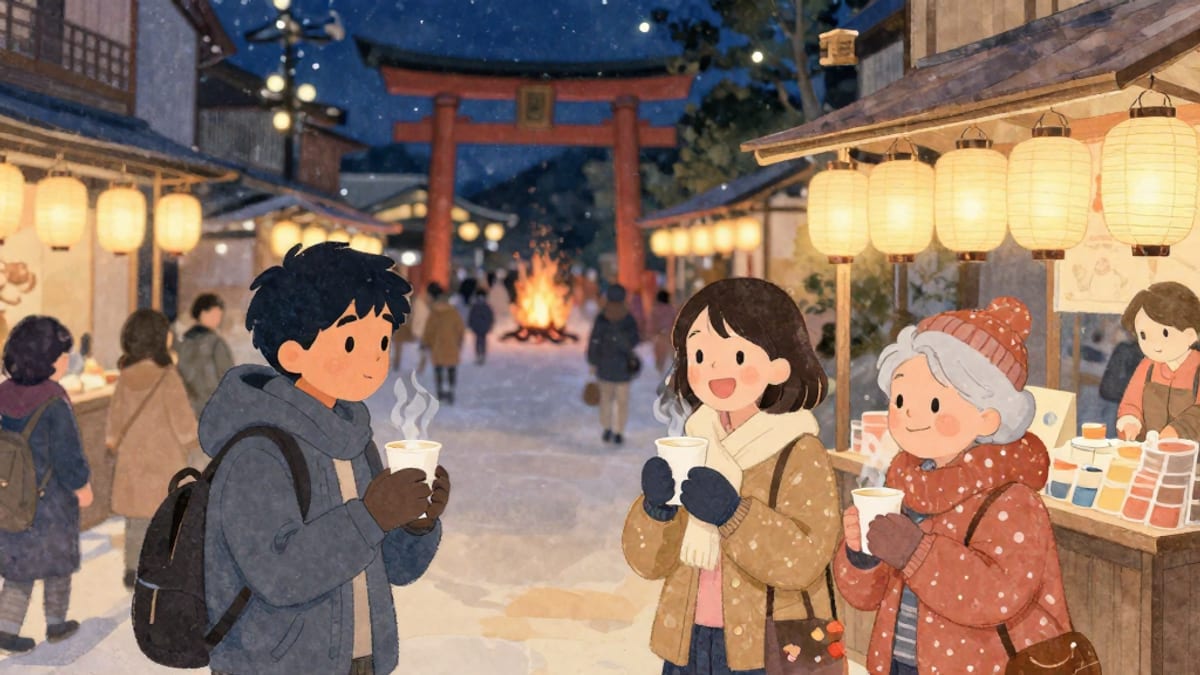
At a popular shrine on the first days, the experience is mostly waiting: a slow, patient crowd moving towards the main hall, staff with megaphones guiding the line, and food stalls along the approach. People warm up with amazake, a sweet, thick rice drink. Families keep track of children, and friends agree on a meeting point in case they get separated.
| Japanese | Romaji | Meaning |
|---|---|---|
| 最後尾はこちらです。 | Saikōbi wa kochira desu. | Staff: The end of the line is here. |
| 押さないでください。 | Osanaide kudasai. | Staff: Please don't push. |
| 甘酒、飲む? | Amazake, nomu? | Want some sweet rice drink? (casual) |
| はぐれないようにね。 | Hagurenai yō ni ne. | Let's not get separated, OK? |
| 鳥居の前で待ち合わせしよう。 | Torii no mae de machiawase shiyō. | Let's meet in front of the gate. |
Mini dialogue: after praying with a friend
| Japanese | Romaji | Meaning |
|---|---|---|
| やっとお参りできたね。 | Yatto omairi dekita ne. | Friend: We finally got to pray. |
| うん。一時間も並んだね。 | Un. Ichijikan mo naranda ne. | You: Yeah. We queued for a whole hour. |
| 何をお願いしたの? | Nani o onegai shita no? | Friend: What did you wish for? |
| 日本語が上手になりますように、って。 | Nihongo ga jōzu ni narimasu yō ni, tte. | You: That my Japanese gets better. |
| きっとなるよ。おみくじ引こうか。 | Kitto naru yo. Omikuji hikō ka. | Friend: I'm sure it will. Shall we draw a fortune? |
| いいね。その後、甘酒も飲もう。 | Ii ne. Sono ato, amazake mo nomō. | You: Sure. Then let's have some amazake too. |
Talk around a shrine is ordinary casual Japanese, just a little quieter near the main hall. Ichijikan mo, a whole hour, uses mo to stress that the number felt large.
Rehearse the visit with Mocchi and Sakura-sensei
Type /explain 家族みんなが元気でいられますように to Mocchi and you get the wish broken into pieces: which particle marks what, why the verb is in the potential form, and what yō ni adds. Then ask for three more wishes of your own and have Mocchi correct them. Mocchi keeps a note of the forms you mixed up, so the next quiz brings them back.
When the words feel comfortable, open AI Sensei, choose Sakura-sensei and ask her to play the shrine office staff. Buy a charm, ask where old charms go and ask about the omikuji, then read the corrections in your session report.
Common learner mistakes
- Clapping at a Buddhist temple. Clapping belongs to shrines; at a temple, put your palms together quietly.
- Throwing the coin hard into the box. Drop it in gently; the offering is a gesture of respect, not a game.
- Photographing people while they pray, or the inside of the main hall. Many shrines forbid it; take photos of the grounds instead.
- Tying a fortune to any tree. Use the rope, rack or stand the shrine provides, because tying paper to living branches can damage them.
- Thinking you missed hatsumōde if you could not go on 1 January. A visit later in the first week, or even later in the month, is perfectly normal.