
Engineering terms with their Japanese readings
Most of the field's vocabulary is katakana borrowed from English, which is good news for reading and bad news for listening. Server becomes sābā with two long vowels and no r sound, data becomes dēta, release becomes rirīsu, and merge becomes māji. If you say them with English sounds, colleagues may not catch them at meeting speed, and you may not recognise them coming back. Learn each one as a Japanese word with its own length and rhythm.
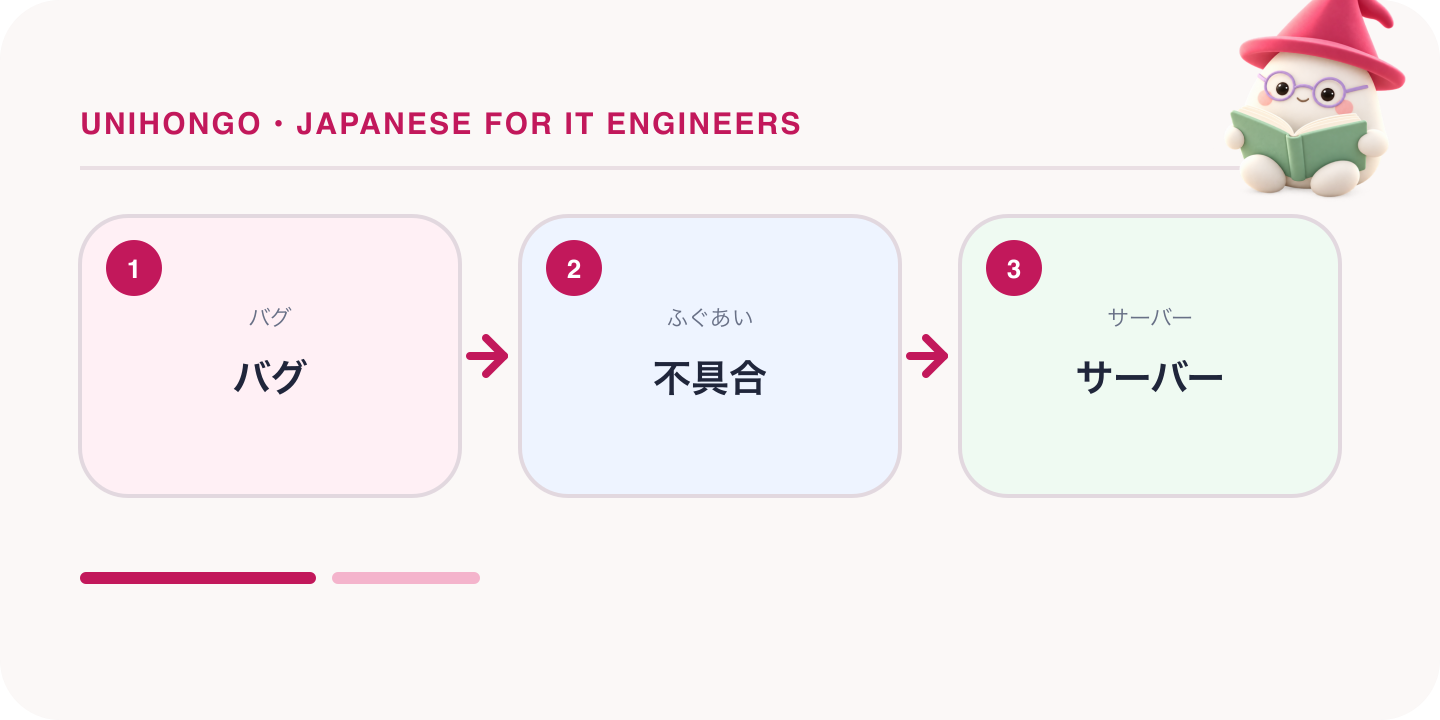
Beside every loanword there is usually a kanji word that appears in tickets, specifications and formal reports. Bagu is the chat word; fuguai is what goes in the ticket title. Tesuto is what you do; kenshō is what the report says you did. Older documents also drop the final long vowel from some loanwords, so you will meet sābā written as サーバ and yūzā written as ユーザ. They are the same words.
| Term | Romaji | Meaning |
|---|---|---|
| バグ | bagu | bug (everyday word) |
| 不具合 | fuguai | defect, the formal word for a bug |
| サーバー | sābā | server |
| データ | dēta | data |
| テスト | tesuto | test |
| リリース | rirīsu | release |
| デプロイ | depuroi | deploy |
| マージ | māji | merge |
| プルリク | puru-riku | pull request (short form) |
| レビュー | rebyū | review |
| ログ | rogu | log |
| エラー | erā | error |
| 仕様 | shiyō | specification |
| 仕様書 | shiyōsho | specification document |
| 要件 | yōken | requirement |
| 設計 | sekkei | design |
| 実装 | jissō | implementation |
| 改善 | kaizen | improvement |
| 修正 | shūsei | fix, correction |
| 再現 | saigen | reproduction of a bug |
| 検証 | kenshō | verification, testing a fix |
| 本番 | honban | production environment |
| 開発環境 | kaihatsu kankyō | development environment |
| 障害 | shōgai | incident, outage |
| 影響範囲 | eikyō han'i | scope of impact |
| 納期 | nōki | delivery deadline |
| 工数 | kōsū | effort, person-hours |
| 見積もり | mitsumori | estimate |
| 進捗 | shinchoku | progress |
| 対応 | taiō | handling, dealing with |
| 運用 | un'yō | operations |
| 保守 | hoshu | maintenance |
| デグレ | degure | regression, from degrade |
| リスケ | risuke | reschedule |
| エビデンス | ebidensu | evidence, usually a screenshot showing a test passed |
The daily stand-up in three parts
The morning meeting, often called asakai or the daily, follows the same three questions everywhere: what you did yesterday, what you will do today, and whether anything is blocking you. Prepare three sentences, not a story. Kinō wa for yesterday, kyō wa for today, and either burokkā wa toku ni arimasen or a specific place where you are stuck. Saying gambarimasu instead of a concrete status is the common mistake; the lead wants a task name and a state.
Progress words matter. Yotei dōri means on schedule, sukoshi okurete imasu means slightly behind, and kyō-jū ni owaru mikomi desu means you expect to finish today. If you are behind, say so in the stand-up rather than in a message the night before the deadline; a Japanese team forgives a delay it heard about early.
| Japanese | Romaji | Meaning |
|---|---|---|
| 昨日はログイン機能の実装を進めました。 | Kinō wa roguin kinō no jissō o susumemashita. | Yesterday I made progress on implementing the login feature. |
| 今日はテストを書いて、プルリクを出す予定です。 | Kyō wa tesuto o kaite, puru-riku o dasu yotei desu. | Today I plan to write tests and open a pull request. |
| ブロッカーは特にありません。 | Burokkā wa toku ni arimasen. | No blockers in particular. |
| APIの仕様が決まっていないので、そこで止まっています。 | API no shiyō ga kimatte inai node, soko de tomatte imasu. | The API spec is not settled yet, so I am stuck there. |
| 進捗は予定どおりです。 | Shinchoku wa yotei dōri desu. | Progress is on schedule. |
| 少し遅れています。 | Sukoshi okurete imasu. | I am a little behind. |
| 今日中に終わる見込みです。 | Kyō-jū ni owaru mikomi desu. | I expect to finish by the end of today. |
| 田中さんに確認したいことがあります。 | Tanaka-san ni kakunin shitai koto ga arimasu. | I have something I want to check with Tanaka. |
A lead may reply with a short follow-up such as itsu-goro owarisō desu ka, asking roughly when it will finish, or dare ka tetsudaimashō ka, offering help. Answer with a day and a task, and take the help if the blocker is outside your control.
Asking about a spec and confirming your understanding
Specification conversations in Japan run on the pattern to iu rikai de atte imasu ka, meaning is my understanding correct that. You restate what you think the spec says, in your own words, and let the other person confirm or correct. This is not a sign of weakness; the phrase ninshiki awase, aligning understanding, is something senior engineers ask for constantly. The mistake is saying wakarimashita early to end the discussion and then building the wrong thing.
Ask where a rule is written with shiyōsho no doko ni kaite arimasu ka. If it is not written anywhere, the answer will often be a shrug, and that is your cue to propose the behaviour yourself and ask for agreement, which also gets it written down.
| Japanese | Romaji | Meaning |
|---|---|---|
| この仕様について確認させてください。 | Kono shiyō ni tsuite kakunin sasete kudasai. | Let me confirm something about this spec. |
| エラーの場合は、画面にメッセージを出すという理解で合っていますか? | Erā no baai wa, gamen ni messēji o dasu to iu rikai de atte imasu ka? | Am I right that on error we show a message on the screen? |
| この場合はどう動くべきですか? | Kono baai wa dō ugoku beki desu ka? | How should it behave in this case? |
| 仕様書のどこに書いてありますか? | Shiyōsho no doko ni kaite arimasu ka? | Where is that written in the spec document? |
| 認識合わせをさせてください。 | Ninshiki awase o sasete kudasai. | Let me make sure we are on the same page. |
| 要件を整理してもいいですか? | Yōken o seiri shite mo ii desu ka? | May I summarise the requirements? |
| はい、その理解で合っています。 | Hai, sono rikai de atte imasu. | Yes, that understanding is correct. |
| いえ、そこは少し違います。 | Ie, soko wa sukoshi chigaimasu. | No, that part is a bit different. |
| では、その内容でチケットに書いておきます。 | Dewa, sono naiyō de chiketto ni kaite okimasu. | Then I will write that in the ticket. |
Code review comments that are direct but polite
A good Japanese review comment names the problem plainly and softens only the instruction. Koko wa null ni naru kanōsei ga arimasu states the risk without hedging. The fix then arrives as a suggestion: shita hō ga ii kamo shiremasen, meaning it might be better to, or wakeraresō desu, meaning this looks like it could be split. Small style points are marked with komakai desu ga, minor but, and a bare shite kudasai from a junior reviewer reads as an order, so save it for a lead's tone or a clear bug.
As the author, thank the reviewer with go-shiteki arigatō gozaimasu and say what you will do. If the code is intentional, say so with itoteki ni and give the reason; a Japanese reviewer expects a reason, not a defence. The exchange below shows both sides of one pull request.
| Japanese | Romaji | Meaning |
|---|---|---|
| お手すきの時にレビューをお願いします。 | O-tesuki no toki ni rebyū o onegai shimasu. | Please review this when you have a moment. |
| ここはnullになる可能性があります。 | Koko wa null ni naru kanōsei ga arimasu. | This could become null here. |
| 変数名をもう少し具体的にしたほうがいいかもしれません。 | Hensū-mei o mō sukoshi gutaiteki ni shita hō ga ii kamo shiremasen. | It might be better to make the variable name a bit more specific. |
| この処理は別の関数に分けられそうです。 | Kono shori wa betsu no kansū ni wakeraresō desu. | This logic looks like it could be split into a separate function. |
| 念のため、テストを追加してもらえますか? | Nen no tame, tesuto o tsuika shite moraemasu ka? | Just to be safe, could you add a test? |
| 細かいですが、ここはタイポだと思います。 | Komakai desu ga, koko wa taipo da to omoimasu. | Minor, but I think this is a typo. |
| ご指摘ありがとうございます。修正します。 | Go-shiteki arigatō gozaimasu. Shūsei shimasu. | Thank you for pointing that out. I will fix it. |
| ここは意図的にこうしています。理由は速度です。 | Koko wa itoteki ni kō shite imasu. Riyū wa sokudo desu. | This is intentional. The reason is speed. |
| 確認しました。問題ありません。 | Kakunin shimashita. Mondai arimasen. | I checked. No problem. |
Approval usually arrives as LGTM desu or shōnin shimashita, and a merged pull request often gets a one-line māji shimashita in the thread. Reply with arigatō gozaimasu even when the review was rough; the thread is read by the whole team.
Reporting a bug and an incident
A bug report in Japanese has the same skeleton as anywhere else: what happened, how to reproduce it, what you expected, and what you got. The words are saigen tejun for reproduction steps, kitai suru dōsa for expected behaviour, and jissai no dōsa for actual behaviour. Say rōkaru de wa saigen shimasen when it only appears in one environment; that sentence saves a reviewer an hour.
An incident, shōgai, has a stricter order. The first report, daiippō, goes out fast and says only what is broken and who is affected. Cause comes later, after chōsa, investigation, and the closing report adds saihatsu bōshi, prevention of recurrence. Japanese teams judge you on the speed of the first message far more than on its completeness, so send it before you understand the cause.
| Japanese | Romaji | Meaning |
|---|---|---|
| 不具合を見つけました。 | Fuguai o mitsukemashita. | I found a defect. |
| 本番でエラーが出ています。 | Honban de erā ga dete imasu. | Errors are occurring in production. |
| 影響範囲はログイン画面だけです。 | Eikyō han'i wa roguin gamen dake desu. | The impact is limited to the login screen. |
| 再現手順は次のとおりです。 | Saigen tejun wa tsugi no tōri desu. | The steps to reproduce are as follows. |
| ローカルでは再現しません。 | Rōkaru de wa saigen shimasen. | It does not reproduce locally. |
| 原因を調査中です。 | Gen'in o chōsa-chū desu. | I am investigating the cause. |
| 一旦ロールバックしてもいいですか? | Ittan rōrubakku shite mo ii desu ka? | May I roll back for now? |
| 復旧しました。 | Fukkyū shimashita. | It has been restored. |
| 原因は設定ミスでした。再発防止策を考えます。 | Gen'in wa settei misu deshita. Saihatsu bōshi-saku o kangaemasu. | The cause was a configuration mistake. I will work out how to prevent a recurrence. |
Estimating and pushing back on a deadline softly
Estimates are given in days or in person-days, nin-nichi, and softened with hodo or kurai, meaning about. Mikka hodo desu is a normal answer; a bare number without a softener sounds like a promise, and promises are remembered. When the requested date is not realistic, the standard word is kibishii, tight, followed immediately by an alternative. The alternative is what makes the pushback acceptable: a later date, a smaller scope, or a question about priorities that lets the lead choose.
If you need time to think, ichido mochikaette kakunin shimasu, let me take it away and check, is a respected sentence. It signals that you take the estimate seriously rather than guessing on the spot, and it buys you a day.
| Japanese | Romaji | Meaning |
|---|---|---|
| 見積もりは三日ほどです。 | Mitsumori wa mikka hodo desu. | The estimate is about three days. |
| 工数は二人日くらいかかりそうです。 | Kōsū wa ni-nin-nichi kurai kakarisō desu. | It will probably take about two person-days. |
| 金曜日までは少し厳しいかもしれません。 | Kin'yōbi made wa sukoshi kibishii kamo shiremasen. | Friday might be a little tight. |
| 来週の月曜日なら間に合います。 | Raishū no getsuyōbi nara ma ni aimasu. | If it is next Monday, I can make it. |
| この機能を後回しにすれば、納期に間に合います。 | Kono kinō o atomawashi ni sureba, nōki ni ma ni aimasu. | If we postpone this feature, we can meet the deadline. |
| 優先順位を教えていただけますか? | Yūsen jun'i o oshiete itadakemasu ka? | Could you tell me the priority order? |
| 一度持ち帰って確認します。 | Ichido mochikaette kakunin shimasu. | Let me take that away and check. |
A lead may answer with jā, getsuyōbi de onegai shimasu, accepting Monday, or with nantoka narimasen ka, asking whether anything can be done. To the second, repeat the scope trade rather than caving: kono kinō o hazuseba, kin'yōbi ni dekimasu, if we drop this feature, Friday is possible.
Reading a Japanese ticket
Tickets are where the kanji vocabulary lives. The field labels repeat across every tracker, so learning twenty of them turns an unreadable wall into a form you can scan. Status values are the ones you will say aloud in the stand-up, so read them with their pronunciation, not only their meaning.
| Ticket field | Romaji | Meaning |
|---|---|---|
| 件名 | kenmei | title |
| 概要 | gaiyō | summary |
| 再現手順 | saigen tejun | steps to reproduce |
| 期待する動作 | kitai suru dōsa | expected behaviour |
| 実際の動作 | jissai no dōsa | actual behaviour |
| 優先度 | yūsendo | priority |
| 担当者 | tantōsha | assignee |
| 期限 | kigen | due date |
| ステータス | sutētasu | status |
| 未着手 | michakushu | not started |
| 対応中 | taiō-chū | in progress |
| レビュー待ち | rebyū-machi | awaiting review |
| 保留 | horyū | on hold |
| 要確認 | yō-kakunin | needs checking |
| 対応済み | taiō-zumi | handled |
| 完了 | kanryō | done |
A ticket written by a Japanese colleague often ends with yoroshiku onegai shimasu even when it is only a bug report, and your comment can end the same way. When you close a ticket, a one-line taiō shimashita, handled, with a link to the pull request is the expected sign-off.
Chat-tool etiquette
Team chat in Japan is more formal than most engineers expect. A direct message usually opens with otsukaresama desu, the all-purpose workplace greeting, and a request to a busy person adds o-tesuki no toki ni, when you have a moment. Mark urgency honestly: isogi de wa arimasen tells the reader they can leave it until after lunch, and shikyū means drop everything, so use it rarely. An emoji reaction counts as an acknowledgement on most teams, but a request from someone senior deserves a typed shōchi shimashita.
Presence messages are normal in Japanese chat culture. Riseki shimasu when you step away, modorimashita when you return, and honjitsu wa agarimasu when you sign off for the day. They look fussy at first and become automatic within a week.
| Japanese | Romaji | Meaning |
|---|---|---|
| お疲れ様です。 | Otsukaresama desu. | Hello (the standard chat opener between colleagues). |
| お手すきの時に見ていただけますか? | O-tesuki no toki ni mite itadakemasu ka? | Could you take a look when you have a moment? |
| 急ぎではありません。 | Isogi de wa arimasen. | It is not urgent. |
| 至急確認をお願いします。 | Shikyū kakunin o onegai shimasu. | Please check this urgently. |
| 承知しました。 | Shōchi shimashita. | Understood. |
| 確認して、後ほど返信します。 | Kakunin shite, nochihodo henshin shimasu. | I will check and reply later. |
| 取り急ぎご報告まで。 | Toriisogi go-hōkoku made. | Just a quick report for now. |
| 離席します。 | Riseki shimasu. | Stepping away from my desk. |
| 戻りました。 | Modorimashita. | I am back. |
| 本日は上がります。お疲れ様でした。 | Honjitsu wa agarimasu. Otsukaresama deshita. | Signing off for today. Thank you for your work. |
A weekly routine for engineering Japanese
- Say your stand-up aloud before the meeting, every day, using the real ticket names; three sentences take under a minute.
- Write one review comment in Japanese per day, even on a colleague's pull request you would otherwise approve silently, and use one softening form each time.
- Read one closed ticket end to end each week and speak its status history: michakushu, taiō-chū, rebyū-machi, kanryō.
- Rehearse an incident first report for a system you own, so the words come out in order when the real alert fires.
- Practise one deadline conversation a week in which you offer a scope trade instead of a yes.
- Keep a list of loanwords you mispronounced in meetings and drill their long vowels aloud.