
One English phrase, five Japanese answers
Before learning the phrases, learn the sort. Ask what the other person is actually facing. Are they ill, are they leaving, are they exhausted, do they need permission to rest, or do you simply want to wish them a recovery? Each answer selects a different Japanese phrase, and Japanese speakers switch between them without thinking. Learners who memorise one translation end up using it everywhere, which is how odaiji ni gets said to a healthy guest at the door.
| Situation | Say this | Register note |
|---|---|---|
| Someone is ill or injured | お大事に Odaiji ni | Add nasatte kudasai for seniors |
| Someone is leaving or travelling | 気をつけて Ki o tsukete | Oki o tsukete is politer |
| Someone is working too hard | 無理しないで Muri shinaide | Muri nasaranaide kudasai at work |
| Someone needs to rest | ゆっくり休んでください Yukkuri yasunde kudasai | Softens a request to go home |
| You want to wish recovery | 早く良くなってください Hayaku yoku natte kudasai | Warm, slightly personal |
| A long parting | お元気で Ogenki de | For months or years apart |
| Written, formal | ご自愛ください Gojiai kudasai | Letters and email, not speech |
Odaiji ni for someone who is unwell
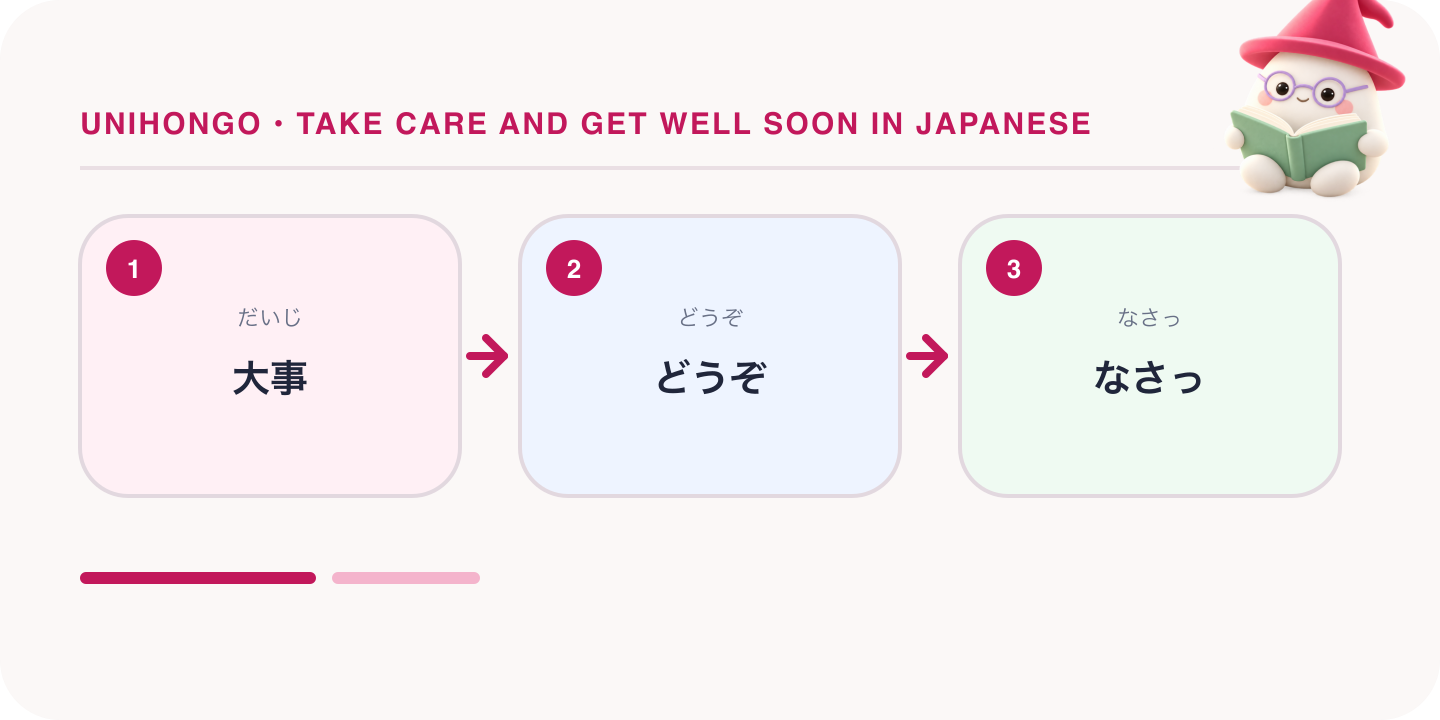
Odaiji ni comes from daiji, meaning important or precious, with the honorific o. You are asking the other person to treat themselves as something to look after. It is the standard closing line at a clinic reception, at a pharmacy counter, and from a colleague who has just heard you are going home sick. It is said at the end of the exchange, as a farewell, not as an opener.
The plain odaiji ni is fine between colleagues of similar rank and to anyone younger. To a manager, a client or an older neighbour, extend it: odaiji ni nasatte kudasai uses the honorific nasaru and sounds considerably warmer. Dōzo odaiji ni is a middle option that costs one word and buys noticeable politeness.
| Japanese | Romaji | Meaning |
|---|---|---|
| お大事に。 | Odaiji ni. | Take care of yourself. (to someone unwell) |
| どうぞお大事に。 | Dōzo odaiji ni. | Please take care of yourself. |
| お大事になさってください。 | Odaiji ni nasatte kudasai. | Please take good care of yourself. (polite) |
| お大事にしてくださいね。 | Odaiji ni shite kudasai ne. | Do look after yourself, now. |
| お加減はいかがですか。 | Okagen wa ikaga desu ka? | How are you feeling? (polite) |
| 体調はどう? | Taichō wa dō? | How are you feeling? (casual) |
| 熱はありますか。 | Netsu wa arimasu ka? | Do you have a fever? |
| 病院に行きましたか。 | Byōin ni ikimashita ka? | Have you been to the doctor? |
Notice that the health question comes first and odaiji ni closes the exchange. Saying odaiji ni immediately, before asking anything, reads as a formula rather than concern. One question, one sympathetic reaction, then the phrase.
Ki o tsukete for someone leaving or travelling
Ki o tsukete literally attaches your attention to something, so it means be careful or watch out as much as it means take care. It is what you say at the door, at the station, at the end of a night out and before a trip. Because it is about a hazard, you can name the hazard: the rain, the ice, the step, the late hour. Adding the reason makes the phrase sound like real care rather than a habit.
The polite form puts the honorific o on ki: oki o tsukete. Combined with a verb it becomes oki o tsukete okaeri kudasai, please get home safely, which is what hotel and restaurant staff say and what you say to a guest older than you. Between friends, ki o tsukete ne is the everyday version.
| Japanese | Romaji | Meaning |
|---|---|---|
| 気をつけて。 | Ki o tsukete. | Take care. (casual, on parting) |
| 気をつけてね。 | Ki o tsukete ne. | Take care, now. |
| 気をつけてください。 | Ki o tsukete kudasai. | Please take care. |
| お気をつけて。 | Oki o tsukete. | Do take care. (polite) |
| お気をつけてお帰りください。 | Oki o tsukete okaeri kudasai. | Please get home safely. |
| 道中お気をつけて。 | Dōchū oki o tsukete. | Take care on the journey. |
| 足元に気をつけてください。 | Ashimoto ni ki o tsukete kudasai. | Please watch your step. |
| 雪なので、気をつけて帰ってね。 | Yuki na node, ki o tsukete kaette ne. | It is snowing, so get home safely. |
| 台風が来ているので、お気をつけください。 | Taifū ga kite iru node, oki o tsuke kudasai. | A typhoon is coming, so please take care. |
| 行ってらっしゃい。気をつけて。 | Itterasshai. Ki o tsukete. | Off you go. Take care. |
Muri shinaide for someone pushing too hard
Muri means an unreasonable amount, so muri shinaide asks the other person not to force it. This is the phrase for the colleague still at their desk at nine in the evening, the friend training through an injury, and the classmate revising all night. English take care rarely carries this meaning, so learners miss it entirely, yet in Japanese it is one of the kindest things you can say.
The forms scale cleanly. Muri shinaide is casual, muri shinaide kudasai is polite, and muri nasaranaide kudasai uses the honorific nasaru for a superior or a client. Muri sezu ni is a compact written variant that often opens a longer sentence, as in muri sezu ni yasunde kudasai.
| Japanese | Romaji | Meaning |
|---|---|---|
| 無理しないで。 | Muri shinaide. | Do not overdo it. (casual) |
| 無理しないでね。 | Muri shinaide ne. | Please do not push yourself. |
| 無理しないでください。 | Muri shinaide kudasai. | Please do not overdo it. (polite) |
| ご無理なさらないでください。 | Gomuri nasaranaide kudasai. | Please do not strain yourself. (respectful) |
| 無理せずに休んでください。 | Muri sezu ni yasunde kudasai. | Please rest instead of pushing on. |
| 顔色が悪いですよ。 | Kaoiro ga warui desu yo. | You look pale. |
| 少し休んだほうがいいですよ。 | Sukoshi yasunda hō ga ii desu yo. | You had better rest a little. |
| 今日は早めに帰ってください。 | Kyō wa hayame ni kaette kudasai. | Please go home early today. |
Rest and recovery: yasunde and yoku natte
Yukkuri yasunde kudasai means rest slowly and thoroughly, and it does a job the English take care does not: it gives permission. A Japanese colleague who is ill often worries about the work they are leaving behind, so the sentence that actually helps is the one that removes that worry. Pair the rest phrase with a reassurance about the work and the message becomes complete.
Hayaku yoku natte kudasai is the direct get well soon. It is warm and slightly personal, so it fits friends, close colleagues and family better than a first-time client. To a client or a senior manager, odaiji ni nasatte kudasai stays safer. Hayaku yoku natte ne is the casual version for a friend or a child.
| Japanese | Romaji | Meaning |
|---|---|---|
| ゆっくり休んでください。 | Yukkuri yasunde kudasai. | Please get plenty of rest. |
| ゆっくり休んでね。 | Yukkuri yasunde ne. | Get some rest, now. (casual) |
| 今日はゆっくり休んでください。 | Kyō wa yukkuri yasunde kudasai. | Please rest properly today. |
| 早く良くなってください。 | Hayaku yoku natte kudasai. | Please get well soon. |
| 早く良くなってね。 | Hayaku yoku natte ne. | Get well soon. (casual) |
| お体を大切にしてください。 | Okarada o taisetsu ni shite kudasai. | Please look after your health. |
| 仕事のことは心配しないでください。 | Shigoto no koto wa shinpai shinaide kudasai. | Please do not worry about work. |
| こちらは大丈夫ですので、安心してください。 | Kochira wa daijōbu desu node, anshin shite kudasai. | Things are fine here, so please rest easy. |
Why ganbatte is the wrong word for an ill person
Ganbatte asks for effort and endurance. It is right before an exam, a match or a presentation, when effort is exactly what the situation needs. Said to someone with a fever, it asks them to try harder at being ill, which is why it can land as pressure rather than comfort. The same applies to someone already exhausted by overwork: ganbatte tells them to keep going when what they need is permission to stop.
The safe substitutions are simple. Where you would say ganbatte to an ill person, say odaiji ni or yukkuri yasunde kudasai. Where you would say it to an overworked person, say muri shinaide. The dedicated guide on the meanings of ganbatte covers the situations where the word genuinely fits.
| Japanese | Romaji | Meaning |
|---|---|---|
| 頑張ってください。 | Ganbatte kudasai. | Do your best. (right before an exam, wrong for illness) |
| 無理しないで、ゆっくり休んでね。 | Muri shinaide, yukkuri yasunde ne. | Do not push yourself, just rest. |
| 治すことに集中してください。 | Naosu koto ni shūchū shite kudasai. | Please concentrate on getting better. |
| 今は休むのが仕事ですよ。 | Ima wa yasumu no ga shigoto desu yo. | Right now, resting is your job. |
The message you send a sick colleague or friend
A written message follows a predictable shape: acknowledge that you heard, ask nothing that demands a long reply, remove the work worry, and close with odaiji ni. Keep it short. Someone with a fever should not have to compose a paragraph back. Note that a colleague reporting sick to a manager uses a different set of lines, which the guide on calling in sick in Japanese covers.
| Japanese | Romaji | Meaning |
|---|---|---|
| 体調を崩されたと聞きました。 | Taichō o kuzusareta to kikimashita. | I heard you are unwell. (polite, message opener) |
| お休みのところ、失礼します。 | Oyasumi no tokoro, shitsurei shimasu. | Sorry to write while you are off. |
| 返信は大丈夫ですので、休んでください。 | Henshin wa daijōbu desu node, yasunde kudasai. | No need to reply, just rest. |
| こちらの件は私が対応しておきます。 | Kochira no ken wa watashi ga taiō shite okimasu. | I will handle this matter here. |
| 何かあれば言ってください。 | Nani ka areba itte kudasai. | Let me know if you need anything. |
| どうぞお大事になさってください。 | Dōzo odaiji ni nasatte kudasai. | Please take good care of yourself. |
| 風邪、大丈夫? | Kaze, daijōbu? | Is your cold all right? (casual) |
| 何か買っていこうか? | Nani ka katte ikō ka? | Shall I buy you anything on the way? |
What to say when they come back
The return is its own small ritual, and it runs in both directions. The person coming back apologises for the trouble and thanks whoever covered; the people who stayed check that the recovery is real and warn against doing too much on day one. Learners often skip this exchange because no English script prompts it, and the silence reads as indifference.
| Japanese | Romaji | Meaning |
|---|---|---|
| おかえりなさい。もう大丈夫ですか。 | Okaerinasai. Mō daijōbu desu ka? | Welcome back. Are you all right now? |
| 体調はもう良くなりましたか。 | Taichō wa mō yoku narimashita ka? | Have you recovered now? |
| おかげさまで良くなりました。 | Okagesama de yoku narimashita. | I am better now, thank you. |
| ご心配をおかけしました。 | Goshinpai o okake shimashita. | Sorry to have worried you. |
| ご迷惑をおかけして申し訳ありませんでした。 | Gomeiwaku o okake shite mōshiwake arimasen deshita. | I am sorry for the trouble I caused. |
| フォローしていただき、ありがとうございました。 | Forō shite itadaki, arigatō gozaimashita. | Thank you for covering for me. |
| まだ本調子ではありません。 | Mada honchōshi de wa arimasen. | I am not quite back to normal yet. |
| 今日は無理しないでくださいね。 | Kyō wa muri shinaide kudasai ne. | Do not push yourself today. |
Take care inside the family
Family speech drops the polite endings and keeps the same core verbs. To parents and grandparents, karada ni ki o tsukete ne is the standard line at the end of a phone call, and muri shinaide ne is what you say to a parent still working long hours. The particle ne matters here: it turns an instruction into a shared feeling, which is exactly the tone you want with people close to you.
| Japanese | Romaji | Meaning |
|---|---|---|
| 体に気をつけてね。 | Karada ni ki o tsukete ne. | Look after yourself. (to family) |
| おばあちゃん、無理しないでね。 | Obāchan, muri shinaide ne. | Grandma, do not overdo it. |
| ちゃんと食べてる? | Chanto tabeteru? | Are you eating properly? |
| 寒いから風邪ひかないでね。 | Samui kara kaze hikanaide ne. | It is cold, so do not catch a cold. |
| また電話するね。 | Mata denwa suru ne. | I will call again. |
| お父さんにもよろしく伝えてね。 | Otōsan ni mo yoroshiku tsutaete ne. | Say hello to Dad for me. |
How to answer when someone says it to you
Most learners freeze here, because thanks alone feels thin and a long speech feels wrong. The pattern is short: thank them, add one clause about what you will actually do, and hand the care back. That third move, otagai ni ki o tsukemashō or sochira mo odaiji ni, is what makes the exchange feel mutual instead of one-sided.
| Japanese | Romaji | Meaning |
|---|---|---|
| ありがとうございます。 | Arigatō gozaimasu. | Thank you. |
| お心遣いありがとうございます。 | Okokorozukai arigatō gozaimasu. | Thank you for your kindness. |
| はい、そうします。 | Hai, sō shimasu. | Yes, I will do that. |
| ゆっくり休みます。 | Yukkuri yasumimasu. | I will get some rest. |
| そちらもお大事に。 | Sochira mo odaiji ni. | You take care too. (if they are also unwell) |
| お互いに気をつけましょう。 | Otagai ni ki o tsukemashō. | Let us both be careful. |
| はい、気をつけて帰ります。 | Hai, ki o tsukete kaerimasu. | Yes, I will get home safely. |
| ありがとう。またね。 | Arigatō. Mata ne. | Thanks. See you. (casual) |
Register check before you speak
- To a client or a senior manager: odaiji ni nasatte kudasai, gomuri nasaranaide kudasai, oki o tsukete okaeri kudasai.
- To a colleague at your level: odaiji ni, muri shinaide kudasai, yukkuri yasunde kudasai.
- To a close friend: odaiji ni ne, muri shinaide ne, hayaku yoku natte ne.
- In a letter or formal email: gojiai kudasai, which is written and sounds stiff if spoken aloud.
- Never to an ill person: ganbatte kudasai, and avoid asking for a detailed update they have to type out.