
Which Japanese these processes really ask for
People approaching permanent residency or naturalization often imagine an exam. It is closer to a long, formal conversation with a bureaucracy: counters, forms, letters that arrive by post, and in the case of naturalization, sit-down interviews. The Japanese that gets you through is the Japanese of your own life. Can you say when you came and why, where you have worked and lived, who your family are, how you pay your taxes and pension, and why you want to stay? Can you understand a clerk telling you which document is missing? Can you read your own application?
That is a reachable target, and most long-term residents are closer to it than they fear. The first line below is the sentence that sits under both applications.
| Japanese | Romaji | Meaning |
|---|---|---|
| 日本で暮らし続けたい。 | Nihon de kurashi tsuzuketai. | I want to keep living in Japan. |
| 永住許可を申請したいです。 | Eijū kyoka o shinsei shitai desu. | I would like to apply for permanent residency. |
| 帰化について相談したいです。 | Kika ni tsuite sōdan shitai desu. | I would like a consultation about naturalization. |
The four words, and the rest of the vocabulary
Four words organise everything. Eijūken, permanent residency, the right to stay indefinitely; strictly, the status is eijū and the permission is eijū kyoka, but everyone says eijūken. Kika, naturalization. Hōmukyoku, the Legal Affairs Bureau, which handles naturalization and family registers. Zairyū kādo, the residence card every mid- to long-term foreign resident carries, which a permanent resident keeps and a naturalized citizen returns.
The documents have their own names, and you will hear them at every counter. Learn them as a set; they are the same words on your application checklist, the letter from the bureau and the clerk's lips.
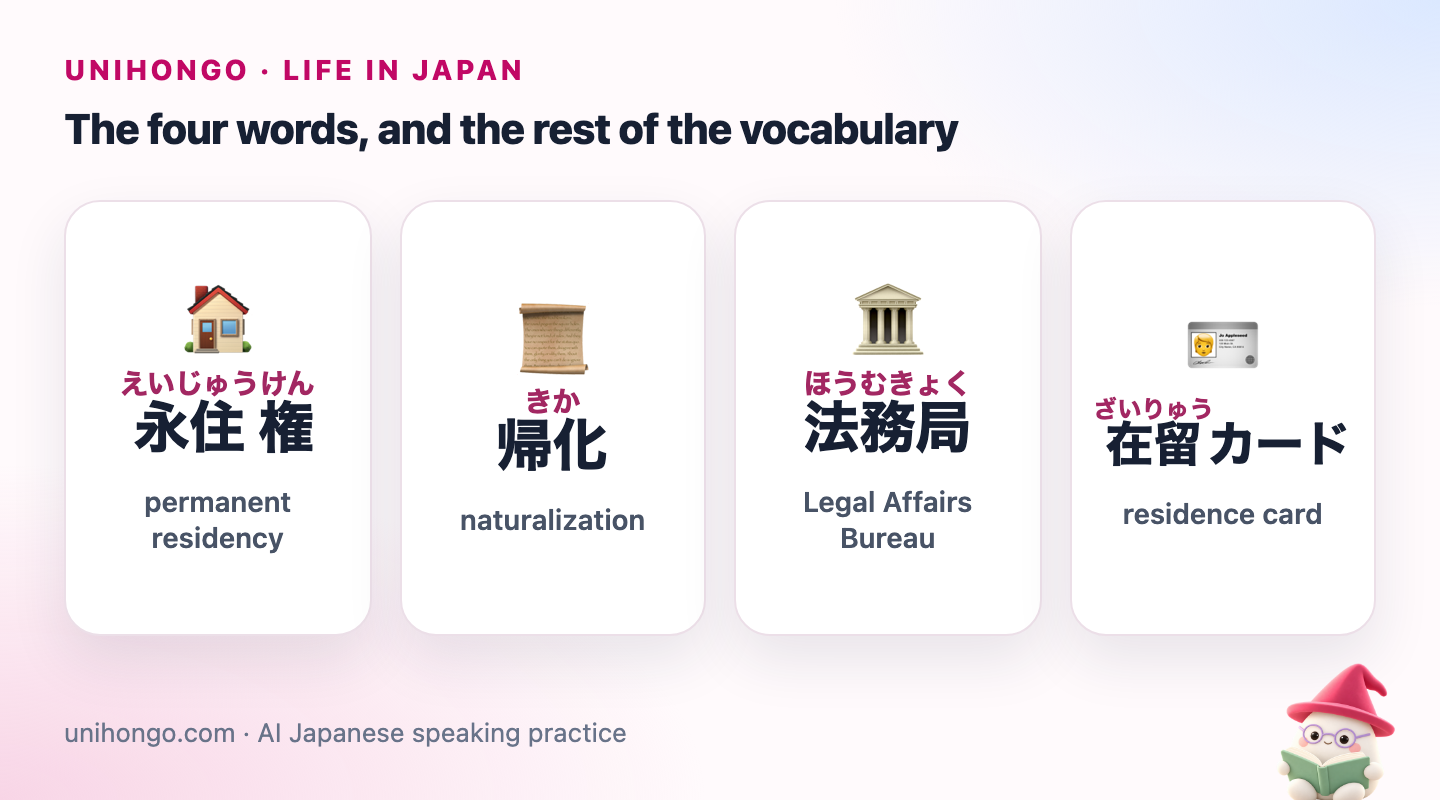
| Japanese | Romaji | Meaning |
|---|---|---|
| 永住権 | eijūken | permanent residency |
| 帰化 | kika | naturalization |
| 法務局 | hōmukyoku | Legal Affairs Bureau |
| 在留カード | zairyū kādo | residence card |
| 出入国在留管理局 | Shutsunyūkoku Zairyū Kanrikyoku | regional immigration bureau |
| 身元保証人 | mimoto hoshōnin | guarantor |
| 理由書 | riyūsho | statement of reasons |
| 住民票 | jūminhyō | certificate of residence |
| 納税証明書 | nōzei shōmeisho | tax payment certificate |
| 課税証明書 | kazei shōmeisho | taxation certificate |
| 年金 | nenkin | pension |
| 戸籍 | koseki | family register |
| 国籍 | kokuseki | nationality |
| 行政書士 | gyōsei shoshi | administrative scrivener |
Permanent residency and naturalization side by side
The table summarises the two paths as they are commonly described. Every row is subject to exceptions, points systems and changes in guidance, so use it to orient yourself and confirm the current rules on the official websites of the Immigration Services Agency and the Ministry of Justice, or at a free consultation.
| Point | Permanent residency (eijū) | Naturalization (kika) |
|---|---|---|
| Authority | Regional immigration bureau | Legal Affairs Bureau (hōmukyoku) |
| Residence commonly required | Often around ten years, shorter for spouses of Japanese nationals and some skilled categories | Commonly around five years of continuous residence, with exceptions |
| Nationality | You keep your nationality and passport | You become Japanese; previous nationality is in principle given up |
| Language | No formal test in the standard application | Everyday Japanese; a short reading and writing check at the officer's discretion |
| Interview | Usually documents only | Several visits and interviews about your life and reasons |
| Typical documents | Residence card, tax and pension records, income proof, guarantor, reason statement | Everything above plus family documents from your home country, and a detailed personal history |
The numbers of years are the figures most often quoted in guidance and by practitioners; your own case may differ, and only the authorities can say.
At the counter: asking, confirming, slowing down
Both processes begin with consultations at a counter, and continue with visits to submit and correct documents. The clerks are used to applicants whose Japanese is a second language and are, in most people's experience, patient; what helps is a few formal, clear requests and the habit of confirming what you heard. Use desu and masu throughout, and itadakemasu ka for requests.
| Japanese | Romaji | Meaning |
|---|---|---|
| 永住許可の申請について相談したいのですが。 | Eijū kyoka no shinsei ni tsuite sōdan shitai no desu ga. | You: I'd like to ask about applying for permanent residency. |
| 必要な書類を教えていただけますか。 | Hitsuyō na shorui o oshiete itadakemasu ka. | You: Could you tell me which documents I need? |
| こちらの一覧をご確認ください。 | Kochira no ichiran o gokakunin kudasai. | Clerk: Please check this list. |
| この書類はこれで大丈夫ですか。 | Kono shorui wa kore de daijōbu desu ka. | You: Is this document all right as it is? |
| 納税証明書が一年分足りません。 | Nōzei shōmeisho ga ichinen bun tarimasen. | Clerk: One year of the tax payment certificates is missing. |
| すみません、もう一度ゆっくりお願いします。 | Sumimasen, mō ichido yukkuri onegai shimasu. | You: Sorry, once more slowly, please. |
| 確認します。来週また来ます。 | Kakunin shimasu. Raishū mata kimasu. | You: I'll check. I'll come again next week. |
Bun after a period, as in ichinen bun, means the amount covering that period: one year's worth. You will meet it constantly in document requests, such as sannen bun, three years' worth.
The naturalization interview: what it is like
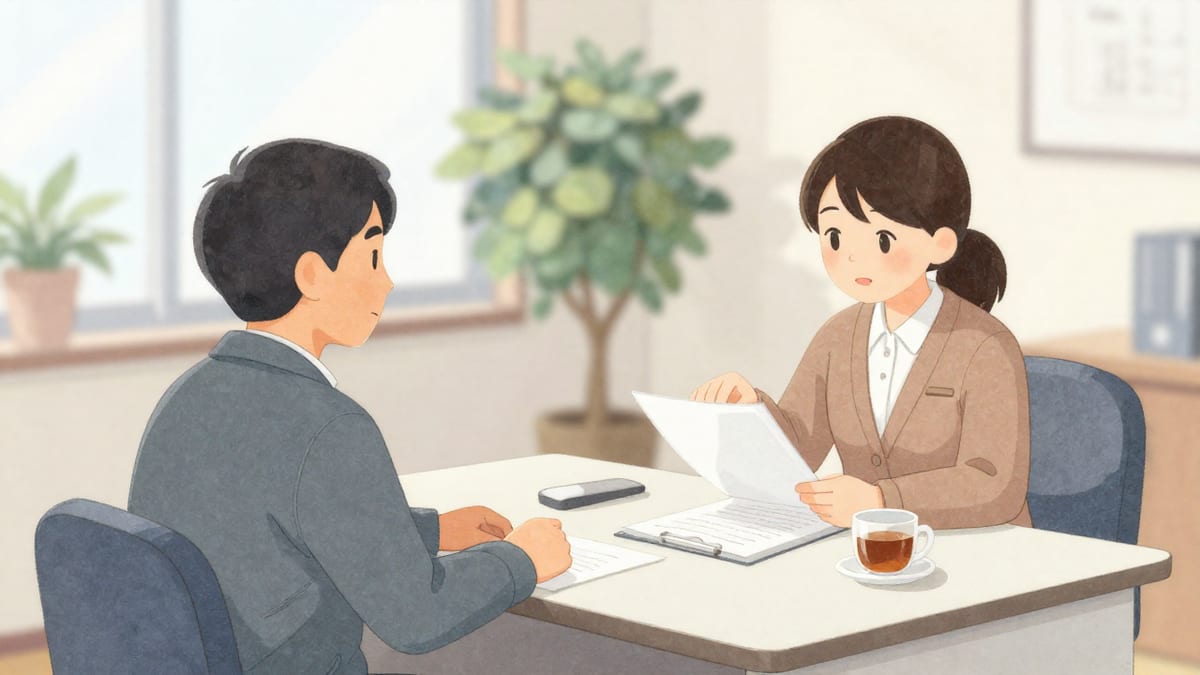
Naturalization interviews at the Legal Affairs Bureau are conversations with an officer, in Japanese, about the life you have described in your documents. People who have been through them commonly describe questions about how long you have lived in Japan, your work and income, your family and household, your relations with neighbours, your reasons for wanting to become Japanese, and your plans. A spouse may be interviewed as well. At the officer's discretion you may be asked to read a short text aloud or write a few sentences, at roughly primary-school level. The tone is formal but not hostile; the officer is checking that the person matches the paperwork.
Here is the shape of such a conversation, with the applicant answering in plain polite Japanese. Short, true, complete answers are the goal, not eloquence.
| Japanese | Romaji | Meaning |
|---|---|---|
| 日本に来てどのくらいになりますか。 | Nihon ni kite dono kurai ni narimasu ka. | Officer: How long have you been in Japan? |
| 十二年になります。二千十四年に来ました。 | Jūninen ni narimasu. Nisen jūyonen ni kimashita. | Applicant: Twelve years. I came in 2014. |
| お仕事は何をされていますか。 | Oshigoto wa nani o sarete imasu ka. | Officer: What work do you do? |
| 大阪の会社でエンジニアとして働いています。 | Ōsaka no kaisha de enjinia toshite hataraite imasu. | Applicant: I work as an engineer at a company in Osaka. |
| なぜ帰化を希望されるのですか。 | Naze kika o kibō sareru no desu ka. | Officer: Why do you wish to naturalize? |
| 家族と日本でずっと暮らしていきたいからです。 | Kazoku to Nihon de zutto kurashite ikitai kara desu. | Applicant: Because I want to live in Japan with my family for good. |
| ご近所の方との付き合いはありますか。 | Gokinjo no kata to no tsukiai wa arimasu ka. | Officer: Do you have contact with your neighbours? |
| はい、町内会の掃除に参加しています。 | Hai, chōnaikai no sōji ni sanka shite imasu. | Applicant: Yes, I take part in the neighbourhood association's clean-ups. |
Sarete imasu and kibō sareru are honorific passives, the officer being polite to you. You answer with plain polite forms; there is no need to match the honorifics.
Preparing without fear
The anxiety around these processes is mostly about the unknown, and the cure is to make the known part very solid. Write your reason statement in your own simple Japanese first, even if a scrivener polishes it later, so that every sentence in it is one you can say aloud. Practise the two-minute version of your life in Japan with years and dates, because dates in Japanese, including the era names on official documents, trip up fluent speakers. Read your own documents: your residence certificate, your tax certificates, the application form. Learn the kanji on them, not the two thousand general-use kanji. And book a consultation early; the bureau's own checklist is the only one that counts.
| Japanese | Romaji | Meaning |
|---|---|---|
| 平成二十六年に日本に来ました。 | Heisei nijūrokunen ni Nihon ni kimashita. | I came to Japan in Heisei 26 (2014). |
| 税金と年金はきちんと納めています。 | Zeikin to nenkin wa kichinto osamete imasu. | I pay my taxes and pension properly. |
| 公式サイトで確認します。 | Kōshiki saito de kakunin shimasu. | I'll check on the official website. |
- Say your reasons aloud daily for a month, until they are a story and not a text.
- Rehearse dates: the year you arrived, moved, married, changed jobs, both in Western years and in era years as they appear on forms.
- Read your own paperwork in Japanese; ask a friend or tutor to quiz you on what each document is for.
- Practise the recovery lines: once more slowly, could you explain that, I will check and come back.
- Use the official websites and a free consultation for every legal detail; blogs, including this one, go out of date.
- Consider an administrative scrivener if your documents cross several countries or your case is unusual.
Mistakes applicants make with the Japanese side
- Memorising a scripted reason statement word for word. Officers ask follow-up questions; know the content, not the text.
- Over-formal keigo that you cannot sustain. Plain polite desu and masu, used consistently, are exactly right.
- Guessing at a document name. Ask kore wa dono shorui desu ka, which document is this, rather than nodding.
- Confusing eijū and kika in conversation. They are different applications at different offices; using the wrong word confuses the consultation.
- Studying general kanji instead of your own documents. The characters you need are on your tax certificates and the forms in front of you.
- Relying on second-hand rules. Residence years, fees and document lists change; the bureau and official websites are the source.