
Why yes is the expensive answer
Learners accept work they cannot do for understandable reasons: the refusal vocabulary is missing, the hierarchy feels unforgiving, and yes is the easier sound to make. The cost arrives later, and it arrives as a missed deadline, which in a Japanese workplace is a considerably bigger problem than a decline would have been.
The convention that governs this is the same one behind hōkoku and sōdan: bad news early is treated as protecting the team. A capacity problem raised on Monday can be reallocated. The same problem discovered on Friday is a failure that involves other people. Declining early is therefore not the opposite of being cooperative; it is a form of it.
The three-part decline
A workable refusal has three parts and they must come in order. Acknowledge the request, so it is clear you took it seriously. Name the constraint, which is a fact rather than a preference. Offer an alternative, which is what keeps the conversation collaborative.
Skipping the third part is what makes a decline feel like a wall. With an alternative, you have not refused to help; you have proposed different help. That distinction is most of the social work.
| Part | Job | Wording |
|---|---|---|
| 1. Acknowledge | Show you took it seriously | ご相談ありがとうございます |
| 2. Constraint | State a fact, not a feeling | 今、A と B を抱えておりまして |
| 3. Alternative | Keep it collaborative | 来週でしたら対応できます |
| 4. Hand back | Let them decide | いかがいたしましょうか |
Ikaga itashimashō ka, what would you like me to do, is the safest possible ending. It refuses nothing explicitly and hands the decision to the person who owns it.
Declining a task
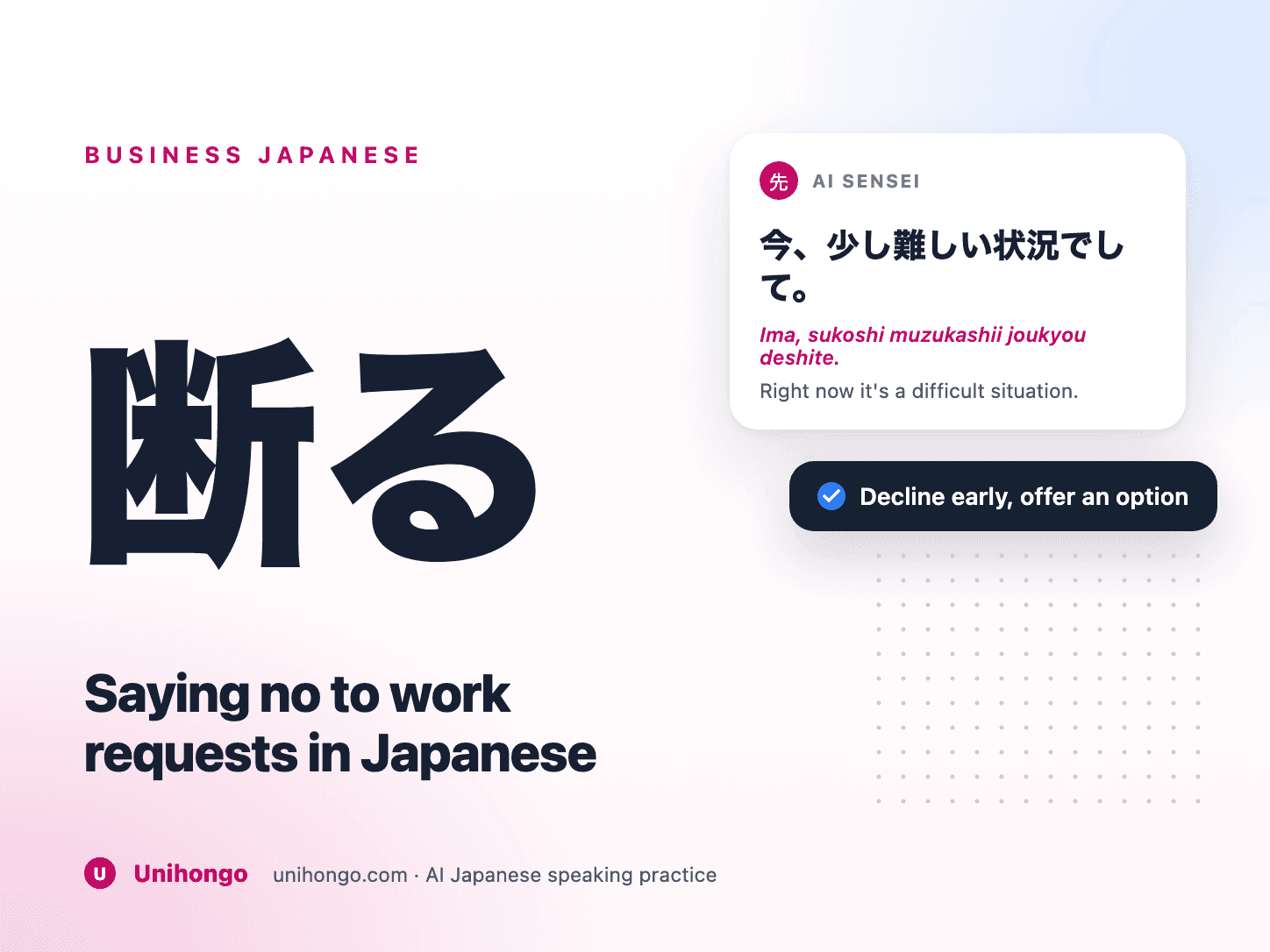
The wording avoids the words no and cannot. It names a situation, which is harder to argue with and does not read as unwillingness. Muzukashii jōkyō desu, it is a difficult situation, is the workhorse phrase and appears constantly in Japanese offices.
Where you can, quantify. A refusal supported by two deadlines is a scheduling statement; the same refusal without them is an opinion about your own workload, which invites a discussion you do not want.
| Japanese | Romaji | Meaning |
|---|---|---|
| ご相談ありがとうございます。 | Gosōdan arigatō gozaimasu. | Thank you for consulting me about it. |
| 今、少し難しい状況でして。 | Ima, sukoshi muzukashii jōkyō deshite. | Right now it is a somewhat difficult situation. |
| 今週は二件抱えていて、金曜が締め切りです。 | Konshū wa ni-ken kakaete ite, kin-yō ga shimekiri desu. | I am holding two items this week, both due Friday. |
| 来週でしたら対応できます。 | Raishū deshitara taiō dekimasu. | If it were next week, I could handle it. |
| 一部だけでしたらお手伝いできます。 | Ichibu dake deshitara otetsudai dekimasu. | I could help with part of it. |
| いかがいたしましょうか。 | Ikaga itashimashō ka. | How would you like to proceed? |
Pushing back on a deadline
Deadlines are more negotiable than they appear, provided the conversation happens early and comes with a proposal. The move that works is to offer a partial delivery on the original date, because it converts a delay into a revised plan.
Naming a specific new date is essential. A request for more time without a date leaves the other person holding uncertainty, and uncertainty is exactly what they are trying to remove by setting a deadline.
| Japanese | Romaji | Meaning |
|---|---|---|
| 納期について、ご相談させてください。 | Nōki ni tsuite, gosōdan sasete kudasai. | Let me consult you about the deadline. |
| 三日ほど延ばしていただくことは可能でしょうか。 | Mikka hodo nobashite itadaku koto wa kanō deshō ka. | Would it be possible to extend by about three days? |
| 金曜には前半だけお出しできます。 | Kin-yō ni wa zenhan dake odashi dekimasu. | I can deliver the first half by Friday. |
| 品質を優先するなら、来週水曜が現実的です。 | Hinshitsu o yūsen suru nara, raishū suiyō ga genjitsuteki desu. | If quality comes first, next Wednesday is realistic. |
| 早めにお伝えしておきます。 | Hayame ni otsutae shite okimasu. | I am letting you know early. |
When you are already at capacity
The most professional version of a refusal is not a refusal at all: it is a priority question. If you are full and the new work is genuinely needed, the decision about what slips belongs to your manager, and asking them to make it is both correct and safe.
This reframing is particularly useful because it is impossible to argue with. You have not said no. You have said that two things cannot both be first, which is a fact about time rather than about your willingness.
| Japanese | Romaji | Meaning |
|---|---|---|
| 優先順位を確認させてください。 | Yūsen jun'i o kakunin sasete kudasai. | Let me check the priorities. |
| どちらを先に進めましょうか。 | Dochira o saki ni susumemashō ka. | Which should I move forward with first? |
| 新しい件を優先すると、こちらが遅れます。 | Atarashii ken o yūsen suru to, kochira ga okuremasu. | If I prioritise the new matter, this one will be delayed. |
| どちらを後に回しましょうか。 | Dochira o ato ni mawashimashō ka. | Which should I push back? |
| ほかの方にお願いすることは可能でしょうか。 | Hoka no kata ni onegai suru koto wa kanō deshō ka. | Would it be possible to ask someone else? |
Asking whether someone else could take it is not passing the buck. In a team with shared load it is the ordinary next question and is usually welcomed.
Declining invitations from colleagues
Social invitations follow different conventions from work requests. The refusal is vaguer, the reason is not expected to be detailed, and the important part is the forward-looking line that keeps the relationship intact.
You do not need to attend everything. Declining a nomikai occasionally is entirely normal, and a warm decline with a clear next time is received better than reluctant attendance.
| Japanese | Romaji | Meaning |
|---|---|---|
| せっかくのお誘いなんですが、その日はちょっと… | Sekkaku no osasoi na n desu ga, sono hi wa chotto... | Thank you for the invitation, but that day is a little... |
| あいにく先約がありまして。 | Ainiku sen'yaku ga arimashite. | Unfortunately I have a prior engagement. |
| ぜひ次回はご一緒させてください。 | Zehi jikai wa goissho sasete kudasai. | Please do let me join next time. |
| 今日は失礼しますが、楽しんでください。 | Kyō wa shitsurei shimasu ga, tanoshinde kudasai. | I will excuse myself today, but enjoy yourselves. |
| また誘ってください。 | Mata sasotte kudasai. | Please invite me again. |
When the answer really is no
Occasionally there is no alternative to offer and the request is genuinely outside what you can or should do. Here the wording gets more formal rather than more forceful, and the reason becomes more important, because you are asking the other person to accept a firm boundary.
State it once, clearly, and do not soften it into ambiguity. A refusal so indirect that the listener misses it is worse than a clear one, because it produces the same failure as a yes.
| Japanese | Romaji | Meaning |
|---|---|---|
| 申し訳ございませんが、こちらはお引き受けできかねます。 | Mōshiwake gozaimasen ga, kochira wa ohikiuke dekikanemasu. | I am very sorry, but I am unable to take this on. |
| 私の権限では判断できかねます。 | Watashi no kengen de wa handan dekikanemasu. | This is beyond what I have authority to decide. |
| 規定上、対応が難しい状況です。 | Kitei-jō, taiō ga muzukashii jōkyō desu. | Under the rules, it is difficult for us to accommodate. |
| 担当の者におつなぎします。 | Tantō no mono ni otsunagi shimasu. | I will connect you with the person responsible. |
| ご期待に添えず、申し訳ありません。 | Gokitai ni soezu, mōshiwake arimasen. | I am sorry not to be able to meet your expectations. |
Dekikanemasu is the standard formal refusal and is unambiguous to a Japanese listener despite its indirect shape. It is the phrase to use when the answer must not be misread.