
What role language is doing
A Japanese sentence carries more identity information than an English one. The pronoun you choose, the copula you end with and the final particle you attach all say something about age, gender, formality and attitude before the content arrives. Fiction exploits this. A writer who wants a reader to recognise an old scholar in one line does not describe him; the character simply says washi ja and the reader knows.
Because the signal is so efficient, it has hardened into a small set of recognisable costumes. Linguists call these yakuwarigo, role language. The important point for a learner is that the costume is a convention shared between writer and reader, not a description of how people in that category actually talk. A real professor in her sixties speaks more or less like everyone else around her, adjusted for region, generation and how well she knows you.
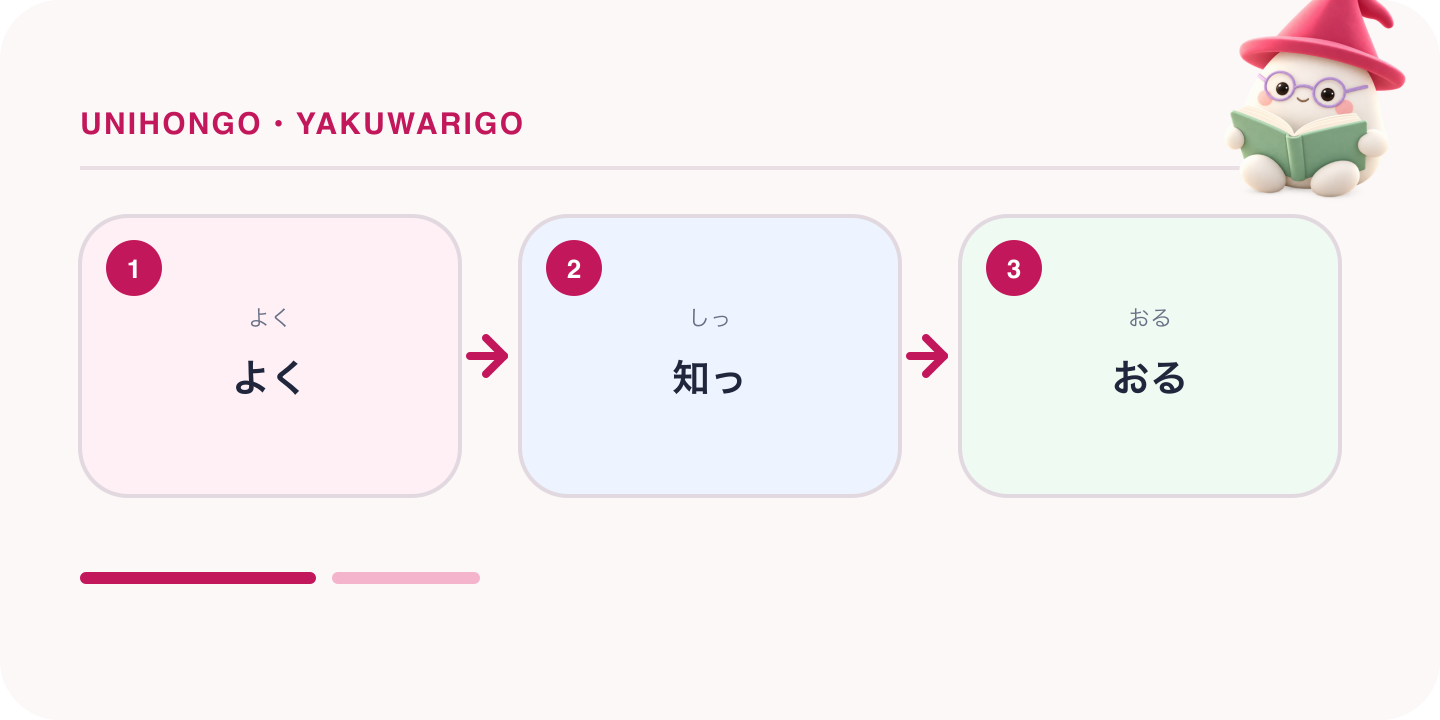
The main styles at a glance
| Style | Typical markers | What it signals to a reader |
|---|---|---|
| Elderly scholar | washi, ja, oru, no ja, nō | Age, authority, a little distance |
| Rough hero | ore, da ze, da yo, omae, -nē endings | Toughness, confidence, informality |
| Refined lady | watakushi, wa, desu no, koto | Wealth, sheltered upbringing, politeness |
| Country speaker | ora, da be, ja, -zura in older writing | Rural origin, plainness, comic warmth |
| Foreign speaker in older fiction | katakana speech, aru yo, missing particles | A dated stereotype, now widely criticised |
| Child | boku or own name, da mon, mite mite | Youth, honesty, emotional directness |
| Neutral modern adult | watashi, desu and -masu | Almost invisible, which is the point |
Read the last row carefully. Ordinary polite speech is the style with no costume at all, which is why fiction uses it for characters whose personality is meant to come from what they say rather than how they say it. That is also the register you want as your own default.
The elderly scholar style
This costume replaces the copula da with ja, the verb iru with oru, and the pronoun with washi. It often adds a drawn-out nō at the end where standard speech would use ne. Historically these forms belong to western regional speech, and some older speakers in some areas do still use them, though this varies by city, generation and speaker. In fiction the association has drifted away from region and toward age and wisdom.
| Japanese | Romaji | Meaning |
|---|---|---|
| わしがよく知っておる。 | Washi ga yoku shitte oru. | I know that well. (fictional elderly style) |
| そうじゃ、その通りじゃ。 | Sō ja, sono tōri ja. | That is so, exactly so. (fictional elderly style) |
| わしの若い頃はのう。 | Washi no wakai koro wa nō. | Back when I was young... (fictional elderly style) |
| 心配せんでもよい。 | Shinpai sen demo yoi. | There is no need to worry. (fictional elderly style) |
| 私はよく知っています。 | Watashi wa yoku shitte imasu. | I know that well. (everyday polite) |
| はい、その通りです。 | Hai, sono tōri desu. | Yes, exactly so. (everyday polite) |
| 若い頃はよく歩きました。 | Wakai koro wa yoku arukimashita. | I used to walk a lot when I was young. (everyday polite) |
| 心配しなくても大丈夫ですよ。 | Shinpai shinakute mo daijōbu desu yo. | You do not need to worry. (everyday polite) |
The rough hero style
This is the costume learners absorb fastest, because action scenes are memorable and the lines are short. It uses ore for I, omae for you, da ze or da yo for emphasis, and flattens the -ai ending of negatives and adjectives into a long -ē sound. Some men genuinely speak in a lighter version of this among close friends. The full version, aimed at strangers, sounds aggressive rather than cool.
| Japanese | Romaji | Meaning |
|---|---|---|
| おれがやるぜ。 | Ore ga yaru ze. | I will do it. (fictional rough style) |
| おまえ、大丈夫か。 | Omae, daijōbu ka. | You all right? (fictional rough style) |
| そんなの知らねえよ。 | Sonna no shiranē yo. | I do not know anything about that. (fictional rough style) |
| おれには関係ねえ。 | Ore ni wa kankē nē. | It has nothing to do with me. (fictional rough style) |
| 私がやります。 | Watashi ga yarimasu. | I will do it. (everyday polite) |
| 大丈夫ですか。 | Daijōbu desu ka. | Are you all right? (everyday polite) |
| すみません、分かりません。 | Sumimasen, wakarimasen. | Sorry, I do not know. (everyday polite) |
| 私は関係ないと思います。 | Watashi wa kankei nai to omoimasu. | I do not think it involves me. (everyday polite) |
Omae is the single riskiest word in this set. Aimed at a stranger, a colleague or anyone senior it reads as a challenge. The safe habit is to use the person's name plus san and drop the pronoun altogether, which is what most adults do anyway.
The refined lady style
The refined-lady costume uses watakushi, keeps polite -masu and desu forms, and then adds ornaments that ordinary polite speech does not: a sentence-final wa with rising intonation, desu no in place of desu, and koto as an exclamation. Some older women in some communities do use a soft final wa, and this varies by generation and region, but desu no and koto are essentially literary.
| Japanese | Romaji | Meaning |
|---|---|---|
| わたくし、存じませんわ。 | Watakushi, zonjimasen wa. | I am afraid I do not know. (fictional refined style) |
| まあ、素敵ですこと。 | Mā, suteki desu koto. | My, how lovely. (fictional refined style) |
| そうですの。 | Sō desu no. | Is that so. (fictional refined style) |
| 明日うかがいますわ。 | Ashita ukagaimasu wa. | I shall visit tomorrow. (fictional refined style) |
| すみません、分かりかねます。 | Sumimasen, wakarikanemasu. | I am afraid I cannot say. (everyday polite) |
| わあ、素敵ですね。 | Wā, suteki desu ne. | That is lovely, isn't it. (everyday polite) |
| そうなんですね。 | Sō nan desu ne. | I see. (everyday polite) |
| 明日うかがいます。 | Ashita ukagaimasu. | I will visit tomorrow. (everyday polite) |
Country speech and the fictional foreigner voice
Fiction also has a generic rural costume, built from ora, da be, ja and, in older writing, endings such as zura. It is not a real dialect; it is a blend that signals plainness and distance from the city. Actual regional speech is far more specific, and features vary by city, generation and speaker, so a real speaker from the north sounds nothing like this composite.
Older fiction and translation used a further device for foreign characters: sentences written in katakana, dropped particles, and endings such as aru yo. This convention is widely criticised now because it flattens real speakers into a stereotype, and modern writing largely avoids it. Recognise it when you meet it in older material, and do not reproduce it.
| Japanese | Romaji | Meaning |
|---|---|---|
| おら、東京さ行くだ。 | Ora, Tōkyō sa iku da. | I am going to Tokyo. (fictional country style) |
| そうだべ。 | Sō da be. | That's right. (fictional country style) |
| わたし、日本語わかるアルヨ。 | Watashi, nihongo wakaru aru yo. | I understand Japanese. (dated stereotype, avoid) |
| 私は東京に行きます。 | Watashi wa Tōkyō ni ikimasu. | I am going to Tokyo. (everyday polite) |
| はい、そうですね。 | Hai, sō desu ne. | Yes, that's right. (everyday polite) |
| 日本語が少し分かります。 | Nihongo ga sukoshi wakarimasu. | I understand a little Japanese. (everyday polite) |
How children are written
Child characters get their own set: a young boy usually says boku, a young girl often refers to herself by her own name, and both use da mon to justify themselves, repeat verbs for emphasis, and end sentences with plain forms plus yo or no. Real children do speak somewhat like this, so the costume is less artificial than the others, but an adult using it sounds either theatrical or deliberately babyish.
| Japanese | Romaji | Meaning |
|---|---|---|
| ぼく、行きたい。 | Boku, ikitai. | I want to go. (child style) |
| だって、こわいんだもん。 | Datte, kowai n da mon. | But it's scary. (child style) |
| ママ、見て見て。 | Mama, mite mite. | Mum, look, look. (child style) |
| やだ、やらない。 | Yada, yaranai. | No, I won't. (child style) |
| 私も行きたいです。 | Watashi mo ikitai desu. | I would like to go too. (everyday polite) |
| ちょっと怖いんです。 | Chotto kowai n desu. | It is a little frightening. (everyday polite) |
| すみません、見ていただけますか。 | Sumimasen, mite itadakemasu ka. | Excuse me, could you take a look? (everyday polite) |
| 申し訳ありませんが、遠慮します。 | Mōshiwake arimasen ga, enryo shimasu. | I am sorry, but I will pass. (everyday polite) |
Converting a fictional line in three steps
The conversion is mechanical once you know where to look. First, replace the pronoun with watashi or delete it, since Japanese drops subjects freely. Second, restore the standard copula and verb: ja becomes desu, oru becomes imasu, the flattened -ē goes back to -ai. Third, strip the identity particles at the end: ze, wa, no, koto, be, mon all come off, and you add ne or yo only if you genuinely want that softening.
| Fictional line | Costume marker | Say this instead |
|---|---|---|
| おれ、腹減った。 | ore plus plain form | お腹が空きました。 |
| わしは反対じゃ。 | washi plus ja | 私は反対です。 |
| わたくし、まいりますわ。 | watakushi plus wa | 行きます。 |
| おまえ、どこ行くんだ。 | omae plus da | どちらへ行かれますか。 |
| 知らねえって言ってるだろ。 | flattened -ē plus daro | 分からないんです。 |
| やめとくだべ。 | da be | やめておきます。 |
| 行きたくないんだもん。 | da mon | あまり行きたくないです。 |
Notice that every conversion gets shorter and flatter. That is not a loss. In real conversation the personality comes from what you choose to talk about, how you respond to the other person and your timing, not from a decorative ending. Learners who chase colour in the grammar usually lose it in the content.
Why copying fiction backfires
The trouble is not that role language is rude. It is that it is loud. A costume worn by someone who does not fit the role reads as a joke, and listeners then spend their attention on your speech style instead of your meaning. Learners report being laughed at gently, corrected in front of others, or simply not taken seriously in a work setting after one stray da ze.
- Mixing costumes in one sentence, such as watakushi with a rough ending, which no character or person would say
- Using omae or temee with anyone, including friends, before the relationship supports it
- Adding ze or na to polite -masu forms, which combines two registers that never meet
- Copying a line whose emotional charge you did not notice, such as a threat delivered calmly
- Assuming a line is neutral because it was short and easy to remember
Listening for register instead of vocabulary
Turn the problem into a skill. When you watch or read, run a quick check on each line: which pronoun, which sentence ending, and does the ending carry identity or just softening. After a few hours of doing this you will hear a character's social position before you understand the sentence, which is a genuinely useful listening skill and also the exact skill that protects you from copying.
- Write down the pronoun each main character uses and see whether it ever changes with the listener
- Mark every sentence ending as neutral, emphatic or identity-carrying before you translate the line
- Keep a two-column notebook: the line as heard, and your polite conversion beside it
- Say both versions aloud so your mouth learns the difference, not just your eyes
- Check any line you plan to reuse against a scene where a stranger is being addressed
A weekly drill that keeps you neutral
Choose one scene of about two minutes. Watch it once for meaning, once for register, and once with the sound off while you say your converted versions over the top. Then take the three most useful ideas from the scene and rebuild them as sentences you could say at work or in a shop. The aim is to keep the vocabulary and throw away the costume, which is exactly what a native adult listener would expect from you.
| Japanese | Romaji | Meaning |
|---|---|---|
| 今のセリフ、普通の言い方だと何ですか。 | Ima no serifu, futsū no iikata da to nan desu ka. | How would that line be said normally? |
| この言い方は男の人っぽいですか。 | Kono iikata wa otoko no hito ppoi desu ka. | Does this way of speaking sound masculine? |
| 初対面の人にも使えますか。 | Shotaimen no hito ni mo tsukaemasu ka. | Can I use this with someone I have just met? |
| 丁寧に言うとどうなりますか。 | Teinei ni iu to dō narimasu ka. | How does that sound if I say it politely? |
| フィクションでしか使わない言葉ですか。 | Fikushon de shika tsukawanai kotoba desu ka. | Is this a word used only in fiction? |
| すみません、言い方を直してください。 | Sumimasen, iikata o naoshite kudasai. | Sorry, please correct the way I said that. |