
From tipsy to hungover in four words
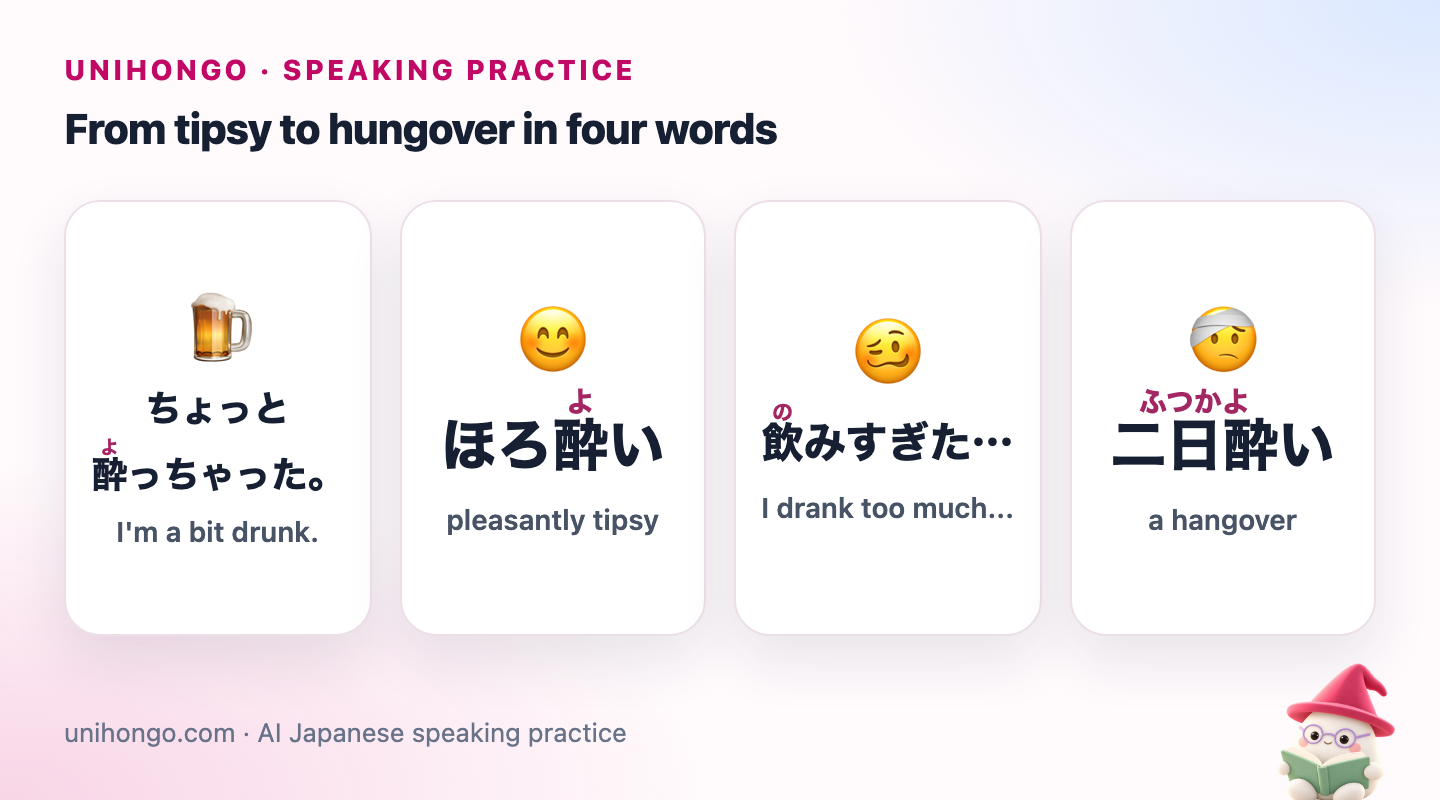
The verb is you (酔う), to get drunk. Because it describes a change of state, Japanese uses the past form when English says I'm drunk. Yotta means I've got drunk, so I'm drunk. Yotchatta adds a soft, slightly sheepish oops. Around that verb sit three words you will hear on any night out.
| Japanese | Romaji | Meaning |
|---|---|---|
| ちょっと酔っちゃった。 | Chotto yotchatta. | I'm a bit drunk. |
| ほろ酔い | horoyoi | pleasantly tipsy |
| 飲みすぎた… | Nomisugita... | I drank too much... |
| 二日酔い | futsukayoi | a hangover |
You will also hear yopparatta, from yopparau, which means properly drunk rather than tipsy. Roughly, the longer the word, the drunker the speaker: chotto yotta, yotta, yopparatta, and finally berobero.
The grammar trap: yotta, not yoimasu
English describes the state: I am drunk. Japanese describes the event that caused it: I have got drunk. So yotta and yotte iru both mean I'm drunk, while yoimasu means I get drunk or I will get drunk. The same logic applies to onaka ga suita, I'm hungry, and tsukareta, I'm tired.
| Japanese | Romaji | Meaning |
|---|---|---|
| 酔った。 | Yotta. | I'm drunk. |
| 酔ってる? | Yotteru? | Are you drunk? |
| 酔ってないよ! | Yotte nai yo! | I'm not drunk! (famous last words) |
| 少し酔ってしまいました。 | Sukoshi yotte shimaimashita. | I've got a little drunk. (polite) |
| 顔が赤いよ。 | Kao ga akai yo. | Your face is red. |
When a friend asks yotteru?, answer with a degree word: chotto yotteru kamo, I might be a bit drunk, or mada daijōbu, I'm still fine. A clear answer helps the people topping up your glass.
The drunk scale
Japanese has a lively set of words for how drunk someone is. The onomatopoeia are casual and often affectionate; yopparai, a drunk, is a little negative and is used for strangers on the last train more than for friends.
| Japanese | Romaji | Meaning |
|---|---|---|
| まだしらふだよ。 | Mada shirafu da yo. | I'm still sober. |
| ほろ酔いで気持ちいい。 | Horoyoi de kimochi ii. | I'm tipsy and feeling good. |
| あの人、もうべろべろだね。 | Ano hito, mō berobero da ne. | That guy is already really drunk. |
| Word | Meaning | Tone |
|---|---|---|
| Shirafu | Sober | Neutral, casual |
| Horoyoi | Pleasantly tipsy | Positive |
| Yotta / yotchatta | Drunk | Neutral; yotchatta is softer |
| Yopparatta | Properly drunk | Casual, a bit stronger |
| Berobero | Very drunk, slurring | Casual, often teasing |
| Yopparai | A drunk person | Slightly negative |
Shirafu also appears in shirafu ja ienai, I couldn't say it sober, which people use with a laugh before confessing something at a party.
Stopping politely
At many gatherings people top up each other's glasses, and in some groups a glass left full is a quiet signal that you do not want more. Customs differ, so if someone keeps pouring, say something kind and clear. Japanese refusals work best with a reason or a soft alternative rather than a flat no.
Osake ni yowai, weak with alcohol, is a face-saving reason everyone accepts. Switching to oolong tea or water lets you keep toasting.
| Japanese | Romaji | Meaning |
|---|---|---|
| もう十分いただきました。 | Mō jūbun itadakimashita. | I've had plenty, thank you. |
| もう飲めないです。 | Mō nomenai desu. | I can't drink any more. |
| お酒に弱いんです。 | Osake ni yowai n desu. | I can't hold my drink. |
| ウーロン茶にします。 | Ūroncha ni shimasu. | I'll switch to oolong tea. |
| お水をもらえますか。 | Omizu o moraemasu ka. | Could I have some water? |
If you are driving, say so: kuruma na node, I came by car. Japan's drink-driving rules are very strict, and people will usually stop offering at once. Some groups also call for ikki, downing a drink in one go; it is widely discouraged today because it is dangerous, and muri muri, no way, I can't, with a laugh is a fine answer.
The morning after
Futsukayoi is the hangover. At work the next day, people often thank the organiser and apologise lightly if they were loud, with kinō wa gochisōsama deshita or kinō wa shitsurei shimashita. Nobody expects a confession; a smile and a short line are enough. Kimochi warui, I feel sick, and atama ga itai, my head hurts, describe the symptoms.
| Japanese | Romaji | Meaning |
|---|---|---|
| 二日酔いで頭が痛い。 | Futsukayoi de atama ga itai. | I'm hungover and my head hurts. |
| ちょっと気持ち悪い。 | Chotto kimochi warui. | I feel a bit sick. |
| 昨日の記憶があまりない。 | Kinō no kioku ga amari nai. | I don't remember much of last night. |
| 昨日は失礼しました。 | Kinō wa shitsurei shimashita. | Sorry about last night. (polite) |
Shijimi miso soup, made with tiny freshwater clams, is a popular hangover remedy in Japan, and convenience stores sell drinks marketed for before and after a night out. Whether they work is another matter, but they make good small talk.
A spoken exchange: the nomikai and the next morning
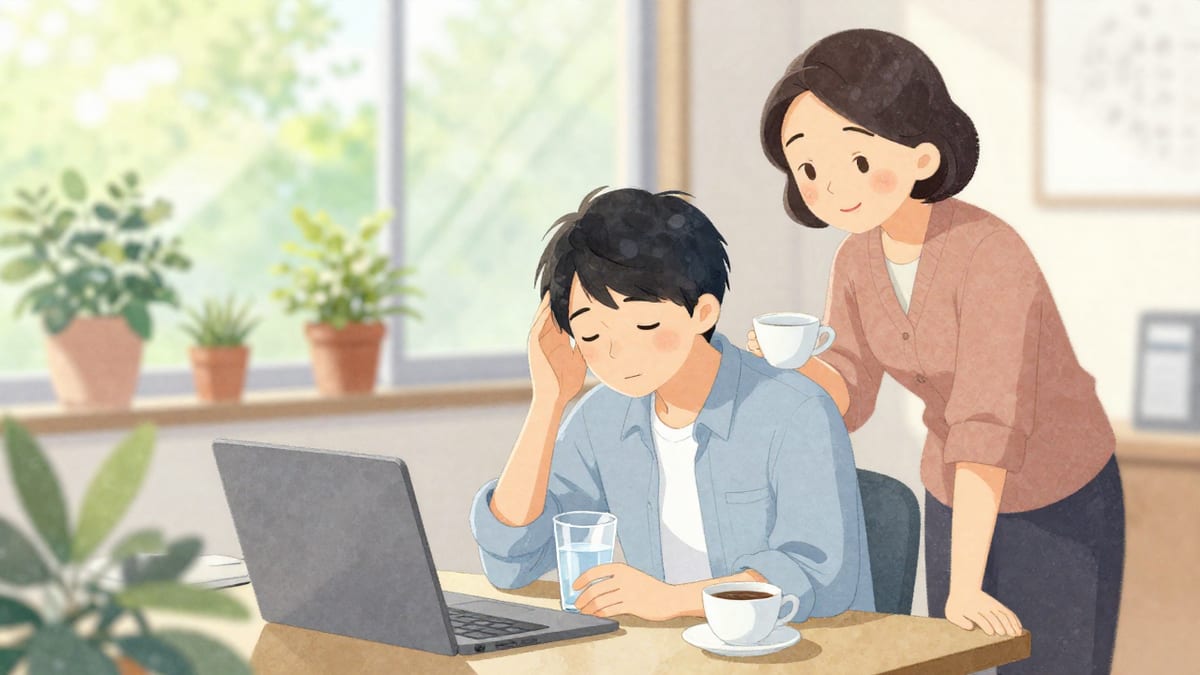
You are at a team dinner. After two beers you switch to tea, and the next morning a coworker checks on you by the coffee machine.
| Japanese | Romaji | Meaning |
|---|---|---|
| もう一杯どう? | Mō ippai dō? | Coworker: How about another? |
| ありがとうございます。でも、少し酔ってきたので、ウーロン茶にします。 | Arigatō gozaimasu. Demo, sukoshi yotte kita node, ūroncha ni shimasu. | You: Thanks. I'm getting tipsy, so I'll have oolong tea. |
| 了解!無理しないでね。 | Ryōkai! Muri shinaide ne. | Coworker: Got it! Don't push yourself. |
| 昨日は大丈夫だった? | Kinō wa daijōbu datta? | Coworker (next day): Were you OK yesterday? |
| 実は、ちょっと二日酔いです。 | Jitsu wa, chotto futsukayoi desu. | You: Actually, I'm a little hungover. |
| 水をたくさん飲んでね。 | Mizu o takusan nonde ne. | Coworker: Drink lots of water. |
Muri shinaide ne, don't push yourself, is the kind reply many people give when someone stops drinking. If you hear it, you have declined successfully and nobody is offended.
Strong or weak: talking about your limits
Before the drinking starts, people often ask osake wa tsuyoi desu ka, are you strong with alcohol? Tsuyoi means you can drink a lot without getting drunk, and yowai means a little goes a long way. Zenzen nomenai, I can't drink at all, is a perfectly acceptable answer.
Answering honestly at the start of the night saves trouble later, because your neighbours will know whether to keep topping you up. If you do not drink for health, religion or simple preference, you do not need to give details. Kyō wa nomanai n desu, I'm not drinking today, is enough, and kanpai dake, just for the toast, lets you raise a glass with everyone.
| Japanese | Romaji | Meaning |
|---|---|---|
| お酒は強いですか。 | Osake wa tsuyoi desu ka. | Can you hold your drink? |
| あまり強くないです。 | Amari tsuyoku nai desu. | I'm not much of a drinker. |
| 全然飲めないんです。 | Zenzen nomenai n desu. | I can't drink at all. |
| 今日は飲まないんです。 | Kyō wa nomanai n desu. | I'm not drinking today. |
| 乾杯だけ付き合います。 | Kanpai dake tsukiaimasu. | I'll join in just for the toast. |
Common mistakes
- Saying yoimasu for I'm drunk. Use yotta, yotchatta or yotte imasu.
- Calling a friend a yopparai to their face. Say yotteru ne or berobero da ne with a laugh instead.
- Refusing with a flat iranai. Give a soft reason: mō jūbun desu or osake ni yowai n desu.
- Overdoing the apology the next day. One kinō wa shitsurei shimashita is enough unless something really went wrong.
Above all, nobody should feel they must drink. A clear, friendly line at the start and a soft drink in your hand keep you part of the party.