
Surname first, given name second
A Japanese name has two parts: the surname, myōji, which comes first, and the given name, shita no namae, the lower name, which comes second. There are no middle names for most Japanese people. In Japanese text the full name is written surname first without a space or with a small space: 田中和子 or 田中 和子.
Inside your story, think about which part of the name each character will use. Narrators often use the surname for adults and the given name for children and close friends, and that choice tells the reader a lot about the relationship.
| Japanese | Romaji | Meaning |
|---|---|---|
| 登場人物の名前 | tōjō jinbutsu no namae | the characters' names |
| 名字 | myōji | surname |
| 下の名前 | shita no namae | given name (lit. lower name) |
| フルネーム | furunēmu | full name |
Myōji is written both 名字 and 苗字, and both are correct. On formal documents the full name is shimei (氏名).
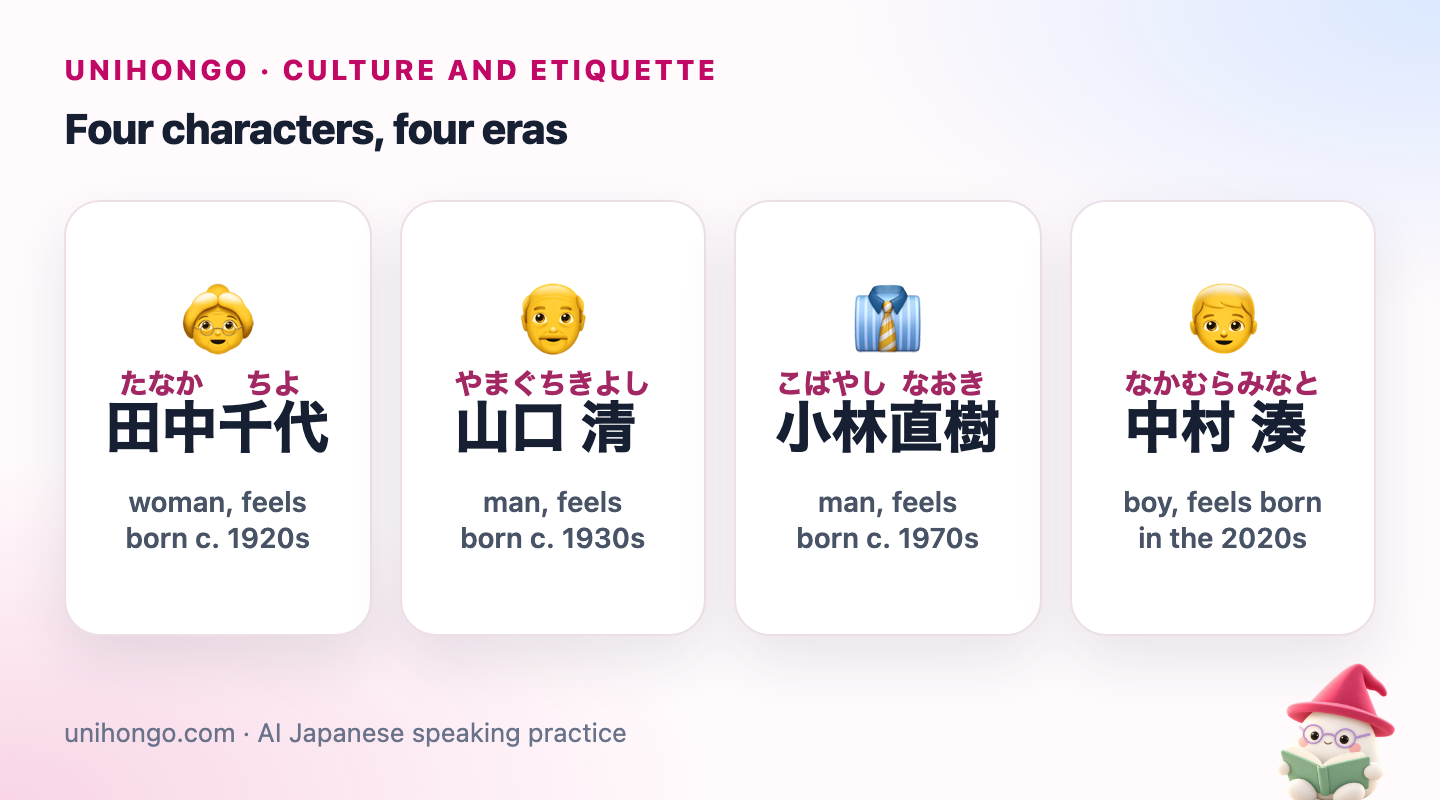
Four characters, four eras
The fastest way to make a character feel real is to match the given name to the birth year. These four imaginary people show the shift over about a century. A Japanese reader would place each one in an era at a glance.
| Japanese | Romaji | Meaning |
|---|---|---|
| 田中千代 | Tanaka Chiyo | woman, feels born c. 1920s |
| 山口清 | Yamaguchi Kiyoshi | man, feels born c. 1930s |
| 小林直樹 | Kobayashi Naoki | man, feels born c. 1970s |
| 中村湊 | Nakamura Minato | boy, feels born in the 2020s |
| Born | Women | Men |
|---|---|---|
| Before 1945 | Two-syllable kana names (Hana, Kiyo); -ko; -e; -yo | -rō, -kichi; one-kanji names like Kiyoshi, Isamu |
| 1945-1975 | -ko dominates: Kazuko, Yōko, Keiko | Hiroshi, Makoto, Takashi; -o names like Kazuo |
| 1975-1995 | -ko declines; -mi, -ka, -e: Ayaka, Naomi, Rie | -ya, -ki, -suke: Takuya, Naoki, Daisuke |
| 1995-2015 | -na, -ka, -ri; two-kanji modern names: Haruna, Misaki | -to, -ta, -ma: Shōta, Yūto, Takuma |
| 2015 onwards | Short, soft names: Himari, Mei, Tsumugi | Haruto, Ren, Minato; nature kanji |
Treat the table as a feel, not a rule: every era has exceptions, and families with strong traditions keep old names. But if your 1950s housewife is called Himari, a Japanese reader will notice.
Surnames: common, regional and rare
Most Japanese surnames are built from landscape words, field, mountain, river, tree, village, which is why so many contain 田, 山, 川, 木 or 村. A handful of surnames are extremely common nationwide, and using them makes a character feel ordinary in a good way. For a minor character, an ordinary surname is almost always the right choice.
Some surnames suggest a region. Okinawa is the clearest case: surnames such as Higa, Kinjō and Ōshiro are especially common there, and a character with one of them will read as having Okinawan roots. Other regions have their typical surnames too, but the patterns are subtler; if regional realism matters, look up which surnames are common in your setting.
| Japanese | Romaji | Meaning |
|---|---|---|
| 比嘉 | Higa | surname, typical of Okinawa |
| 金城 | Kinjō | surname, common in Okinawa |
| 大城 | Ōshiro | surname, common in Okinawa |
| 一ノ瀬 | Ichinose | surname with a stylish, fictional feel |
| 神崎 | Kanzaki | surname that sounds cool in fiction |
Notice the last two. Surnames like Ichinose and Kanzaki are real, but they appear so often for heroes and rivals in manga and games that some Japanese readers find them a little dramatic. Rare surnames can be fun for a main character; a whole cast of them feels like a fantasy.
The checks Japanese parents make, and you should too
Your character's parents would have checked a few things before choosing the name, and checking the same things yourself makes the name believable. Say the full name aloud, surname plus given name, and listen to the rhythm. Avoid accidental words: some sound combinations make a joke or an unfortunate word together with the surname. Check the name is not a well-known real person, especially a celebrity or a historical figure, unless you mean it.
Think about what the parents wished for. A name expresses a wish, and a character who knows their name's meaning has something to say about it. Japanese has two lovely expressions for the relationship between a name and a person.
| Japanese | Romaji | Meaning |
|---|---|---|
| 名は体を表す | Na wa tai o arawasu | a name reflects the person (saying) |
| 名前負け | namaemake | when a name is too grand for its owner |
| 声に出して読んでみる | koe ni dashite yonde miru | read it out loud |
| 名前の意味を知っていますか。 | Namae no imi o shitte imasu ka. | Do you know what your name means? |
Namaemake is a gentle, often joking word. A boy called Tsuyoshi (strong) who is scared of dogs is a classic case, and a character can tease another with it, or worry about it themselves. Na wa tai o arawasu is the opposite idea: the name fits the person perfectly.
How characters call each other
In Japanese stories, forms of address carry the relationship. Coworkers who are not close use the surname with -san. Childhood friends may use the given name bare, or a nickname. Girls are often called -chan by friends and family, boys -kun, though both are used flexibly. Nicknames are usually built from the first two syllables of the name plus -chan, or a doubled sound, as in Takkun for Takuya.
| Japanese | Romaji | Meaning |
|---|---|---|
| 田中さん | Tanaka san | Ms or Mr Tanaka (colleagues, neighbours) |
| ゆうちゃん | Yū chan | nickname for Yūko, Yūta and others |
| たっくん | Takkun | nickname for Takuya, Takumi |
| 湊! | Minato! | given name, bare: close friends, family |
| 先輩 | senpai | a senior at school or work |
| お姉ちゃん | onēchan | big sister (used instead of her name) |
The moment one character starts using another's given name is a classic turning point in Japanese stories. Shita no namae de yonde mo ii?, can I call you by your first name?, is a line readers recognise.
Mini dialogue: a new transfer student
A short scene that shows how names and address work together. A transfer student introduces herself; a classmate tries a nickname.
| Japanese | Romaji | Meaning |
|---|---|---|
| 今日から転校してきた、中村莉子です。 | Kyō kara tenkō shite kita, Nakamura Riko desu. | Riko: I'm Nakamura Riko, I transferred here today. |
| 中村さん、よろしくね。 | Nakamura san, yoroshiku ne. | Classmate: Nice to meet you, Nakamura-san. |
| 莉子でいいよ。 | Riko de ii yo. | Riko: Just Riko is fine. |
| じゃあ、りこちゃんって呼ぶね。 | Jā, Riko chan tte yobu ne. | Classmate: Then I'll call you Riko-chan. |
| うん。前の学校では「りっちゃん」だった。 | Un. Mae no gakkō de wa "Ricchan" datta. | Riko: OK. At my old school I was Ricchan. |
Foreign and mixed-heritage characters
A character with a non-Japanese parent may have a Japanese surname and a given name that works in two languages, such as Emma or Ken, written in katakana or with kanji chosen for the sound. A foreign character living in Japan writes their name in katakana, and Japanese characters will usually call them by surname with -san at work and by given name among friends, often because the surname is harder to say.
| Japanese | Romaji | Meaning |
|---|---|---|
| 佐藤エマ | Satō Ema | Japanese surname + katakana given name |
| 健 | Ken | healthy · a name that works in two languages |
| ジョン・スミス | Jon Sumisu | John Smith in katakana, given name first |
| 名前はカタカナで書きます。 | Namae wa katakana de kakimasu. | I write my name in katakana. |
Foreign names in katakana are usually kept in their own order, given name first, with a middle dot between the parts. That small detail shows care for realism.
Workshop your cast with Mocchi
Tell Mocchi about your story: "I'm writing a novel set in 1960s Osaka. Suggest names for a shopkeeper born in 1915, his daughter born in 1940 and her son born in 1962, and explain each choice." Mocchi suggests names with kanji and readings, explains why each fits, and remembers your story, so next time you can pick up the same cast.
Then send a few lines of dialogue with /correct to check that forms of address sound natural. To hear them, ask Sakura-sensei in AI Sensei to play one of your characters while you play another.
Mistakes that break a Japanese name's realism
- Mixing name orders in the same text. Choose surname-first or given-name-first and keep it.
- Giving an older character a name from today. A grandmother called Himari or a 1950s salaryman called Haruto will jar Japanese readers.
- Filling the cast with rare or dramatic surnames. Most people around your hero should be ordinary Tanakas, Satōs and Suzukis.
- Writing -san in the narration for everyone. Narrators usually drop honorifics; characters use them in dialogue.
- Using a famous real person's full name by accident. Search the name before you commit to it.
- Choosing kanji for meaning alone and never checking the reading. If you are unsure how a name is read, the reader will be too.