

What yōkoso means and where it comes from
Yōkoso is written in hiragana, ようこそ, and is a greeting rather than a verb. Historically it comes from yoku koso, roughly you have come well, which is why it always carries the sense of someone arriving. You say it to a person who has reached a place you are connected with: your country, your town, your house, your company, your festival. It does not mean you are welcome in the sense of the reply to thank you; that is dō itashimashite.
The word can stand alone, but it usually attaches to the place. Two orders are possible. Place plus e plus yōkoso, as in Kyōto e yōkoso, is the most natural in speech. Yōkoso plus place plus e, as in yōkoso Kyōto e, is the order you see on banners and hear in announcements, because putting yōkoso first gives it emphasis. Learners can use either.
Adding a polite verb makes it warmer. Yōkoso irasshaimashita, literally welcome, you have come, is the standard host's line for a guest who has just arrived, and yōkoso o-koshi kudasaimashita is the more formal version used by hotels and event staff.
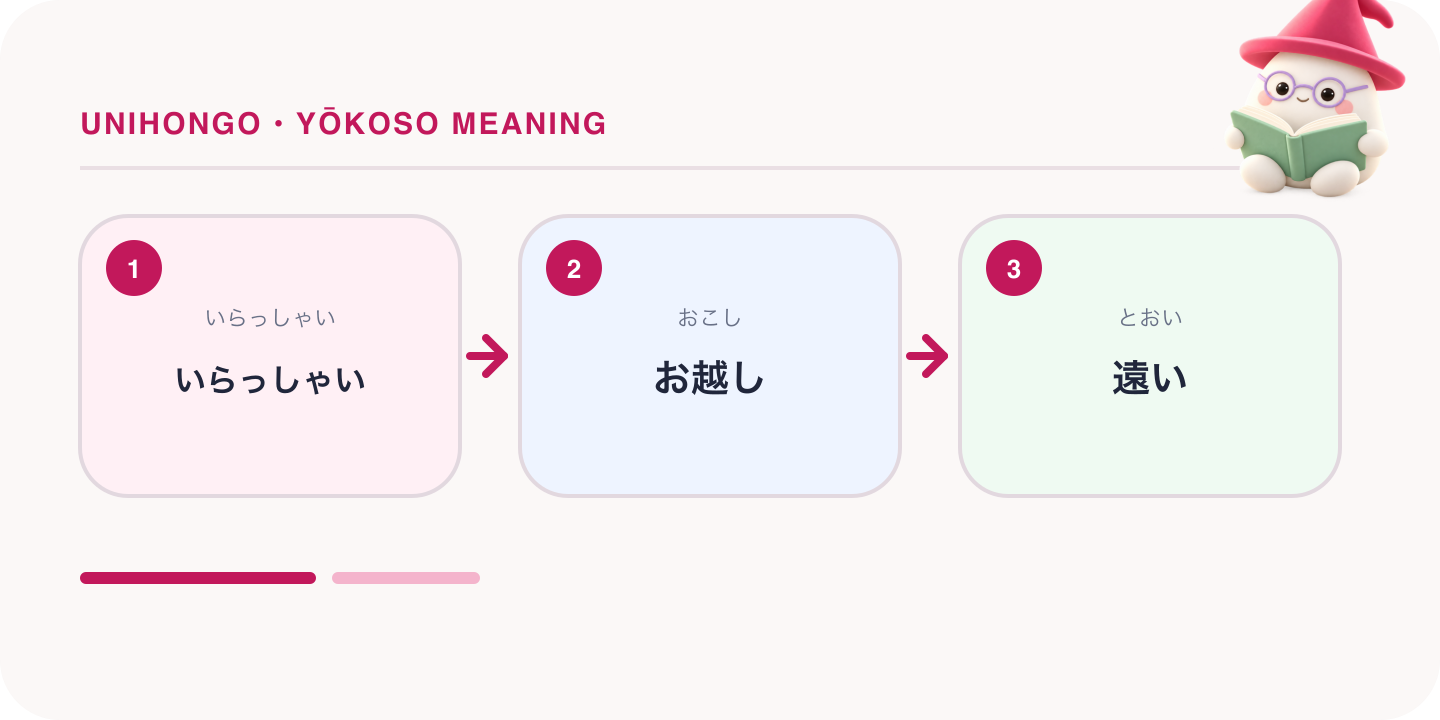
| Japanese | Romaji | Meaning |
|---|---|---|
| ようこそ、日本へ。 | Yōkoso, Nihon e. | Welcome to Japan. |
| 東京へようこそ。 | Tōkyō e yōkoso. | Welcome to Tokyo. |
| ようこそいらっしゃいました。 | Yōkoso irasshaimashita. | Welcome, thank you for coming. |
| ようこそお越しくださいました。 | Yōkoso o-koshi kudasaimashita. | Welcome, we are honoured you came (formal). |
| 遠いところをようこそ。 | Tōi tokoro o yōkoso. | Welcome, and thank you for coming such a long way. |
Irasshaimase, yōkoso, kangei shimasu and dōzo compared
The four words that get translated as welcome belong to four different situations. Irasshaimase is the polite imperative of irassharu, to come, and is the call staff give when a customer enters. It is one directional: staff say it, customers do not answer, and nobody says it at home. Yōkoso is personal and place based. Kangei shimasu is the verb to welcome, which you need when welcome is the main verb of a sentence: we welcome new members, I welcome your opinion. Dōzo means please go ahead and is what you say as you physically invite someone through a door or to a seat.
In real life these combine. A host at the door might say yōkoso, dōzo dōzo, welcome, come in, come in. A company welcoming a visitor will have a receptionist say irasshaimase, and a manager who then says yōkoso o-koshi kudasaimashita. The table below sets out who says what to whom.
| Expression | Reading | Who says it, to whom, and when |
|---|---|---|
| ようこそ | yōkoso | Anyone, to a visitor arriving at a place; warm and neutral |
| いらっしゃいませ | irasshaimase | Staff to customers entering a shop, restaurant or hotel; no reply expected |
| いらっしゃい | irasshai | Casual host to family or friends at the door; also market stall calls |
| 歓迎します | kangei shimasu | We welcome (you); speeches, emails, joining a group |
| 心より歓迎いたします | kokoro yori kangei itashimasu | We sincerely welcome you; formal letters and ceremonies |
| どうぞ | dōzo | Please, go ahead; said while ushering someone in or offering a seat |
| どうぞお上がりください | dōzo o-agari kudasai | Please come in (step up into the house); at a home entrance |
| お待ちしておりました | o-machi shite orimashita | We have been expecting you; hotels, offices, hosts |
| よく来たね | yoku kita ne | Good to see you, you made it; casual, to friends or children |
| お帰りなさい | o-kaerinasai | Welcome home; to someone returning, never to a first-time visitor |
Two traps stand out. Do not say irasshaimase to a friend unless you are joking, and do not say o-kaerinasai to a visitor, because it means welcome back to a home they live in. The safe all-purpose choice is yōkoso, followed by dōzo as you show the person in.
Welcoming someone to your home
At a Japanese home the welcome happens at the genkan, the entrance area where shoes come off. The host opens the door, says irasshai or yōkoso, and then the crucial phrase: dōzo o-agari kudasai, please come up. Agaru, to go up, refers to stepping from the entrance floor onto the raised floor of the house, so this phrase is the real welcome in. If it is a close friend, a simple agatte, come up, is enough.
The guest replies o-jama shimasu, I am intruding, which is the standard and expected line, and takes off their shoes. The host may offer slippers with surippa o dōzo. Once inside, kutsuroide kudasai, please make yourself comfortable, or o-cha demo ikaga desu ka, how about some tea, keeps the welcome going.
| Japanese | Romaji | Meaning |
|---|---|---|
| いらっしゃい。どうぞ上がってください。 | Irasshai. Dōzo agatte kudasai. | Come in. Please step up inside. |
| お邪魔します。 | O-jama shimasu. | Excuse me for intruding (said when entering). |
| スリッパをどうぞ。 | Surippa o dōzo. | Here are some slippers. |
| 狭いところですが、どうぞ。 | Semai tokoro desu ga, dōzo. | It's a small place, but please come in. |
| どうぞくつろいでください。 | Dōzo kutsuroide kudasai. | Please make yourself at home. |
| お茶でもいかがですか。 | O-cha demo ikaga desu ka. | Would you like some tea or something? |
Welcoming a visitor to the office or a new colleague
At work, the welcome is more scripted. A receptionist greets a visitor with irasshaimase or o-machi shite orimashita, we have been expecting you, and asks for a name and appointment. The person hosting the meeting comes out and says yōkoso o-koshi kudasaimashita or the simpler tōku kara arigatō gozaimasu if the visitor has travelled. The visitor replies with o-sewa ni natte orimasu, the standard business greeting meaning thank you for your continued support, even on a first visit.
A new colleague gets a different welcome. Here kangei shimasu comes into its own: the team leader says yōkoso, watashitachi no chīmu e, and adds kangei shimasu or a warm yoroshiku onegai shimasu. A welcome party, kangeikai, is often organised in the first weeks, and the word kangei appears on the invitation.
| Japanese | Romaji | Meaning |
|---|---|---|
| お待ちしておりました。こちらへどうぞ。 | O-machi shite orimashita. Kochira e dōzo. | We have been expecting you. This way, please. |
| 遠くからお越しいただき、ありがとうございます。 | Tōku kara o-koshi itadaki, arigatō gozaimasu. | Thank you for coming all this way. |
| いつもお世話になっております。 | Itsumo o-sewa ni natte orimasu. | Thank you for your continued support (business greeting). |
| チームへようこそ。歓迎します。 | Chīmu e yōkoso. Kangei shimasu. | Welcome to the team. We are glad to have you. |
| 来週、歓迎会を開きます。 | Raishū, kangeikai o hirakimasu. | We're holding a welcome party next week. |
| これからよろしくお願いします。 | Kore kara yoroshiku onegai shimasu. | I look forward to working with you. |
Welcoming people to an event or a group
At the start of a party, a class or a conference, the host says a version of yōkoso from the front of the room. The set opening is honjitsu wa o-koshi itadaki arigatō gozaimasu, thank you for coming today, followed by yōkoso and the event name. For a school or club, minasan, yōkoso, everyone, welcome, is friendly and enough. Online, the same phrase works at the start of a video call.
When you are welcoming a group of foreign visitors, Japanese hosts often switch to yōkoso Nihon e and then continue in simple Japanese or English. If you are the learner doing the welcoming, keep it short: a clear yōkoso, a bow and dōzo o-suwari kudasai, please sit down, is a complete welcome.
| Japanese | Romaji | Meaning |
|---|---|---|
| 本日はお越しいただき、ありがとうございます。 | Honjitsu wa o-koshi itadaki, arigatō gozaimasu. | Thank you for coming today. |
| 皆さん、ようこそ。 | Minasan, yōkoso. | Everyone, welcome. |
| 日本語教室へようこそ。 | Nihongo kyōshitsu e yōkoso. | Welcome to the Japanese class. |
| どうぞお座りください。 | Dōzo o-suwari kudasai. | Please take a seat. |
| 新しいメンバーを歓迎しましょう。 | Atarashii menbā o kangei shimashō. | Let's welcome the new members. |
Replying when you are the one being welcomed
Being welcomed is the situation learners actually face most, and the reply depends on where you are. At a home, o-jama shimasu on entering and o-jama shimashita on leaving are fixed. At a workplace on your first day, o-sewa ni narimasu, I will be in your care, is the correct response to a welcome, and kyō kara yoroshiku onegai shimasu adds a forward-looking note. At a hotel or a shop, a nod or a light arigatō gozaimasu is all irasshaimase needs.
If someone has gone to trouble, thank them for the invitation: o-maneki itadaki arigatō gozaimasu. And if the welcome is warm and personal, ureshii desu, I am happy, is a natural, human reply that hosts like to hear.
| Japanese | Romaji | Meaning |
|---|---|---|
| お招きいただき、ありがとうございます。 | O-maneki itadaki, arigatō gozaimasu. | Thank you for inviting me. |
| 今日からお世話になります。 | Kyō kara o-sewa ni narimasu. | From today I will be in your care. |
| 温かく迎えていただいて、うれしいです。 | Atatakaku mukaete itadaite, ureshii desu. | I'm happy to be welcomed so warmly. |
| お邪魔しました。 | O-jama shimashita. | Thank you for having me (said when leaving). |
| こちらこそ、よろしくお願いします。 | Kochira koso, yoroshiku onegai shimasu. | Likewise, I look forward to it. |
Welcome signs at airports and stations
The written form of yōkoso is everywhere in arrival halls. The commonest banner reads ようこそ日本へ, welcome to Japan, sometimes with the more formal ようこそお越しくださいました beneath it. Regional stations and towns add the place name: ようこそ金沢へ, welcome to Kanazawa. You will also see the kanji 歓迎, kangei, on banners for tour groups, often with the group's name written above, and お帰りなさい, welcome home, at domestic arrivals aimed at returning residents.
Reading these signs is a good habit: they teach you the place name in kanji before you need it for a ticket machine, and they show you which form of welcome each institution considers appropriate.
- ようこそ日本へ: welcome to Japan; the standard arrival banner
- ようこそ〇〇へ: welcome to (place); on station and town signs
- 歓迎 〇〇御一行様: welcoming the (name) party; group tour banners
- お帰りなさい: welcome home; for returning residents, not tourists
- いらっしゃいませ: at shop entrances and on some hotel doors
- またお越しください: please come again; on the way out
The last item is the farewell partner of yōkoso. Mata o-koshi kudasai, please come again, closes the visit the same way yōkoso opened it.
Common mistakes with welcome words
The classic learner error is answering irasshaimase, either with irasshaimase back or with an anxious konnichiwa. Neither is needed; the staff greeting is a signal, not a question. The second error is using irasshaimase as a host, which makes friends laugh and confuses business guests. The third is o-kaerinasai to a first-time visitor.
A subtler mistake is skipping the reply entirely. Japanese hosts expect o-jama shimasu at the door and will notice its absence, even if they never mention it. If you forget and only remember once you are inside, it is fine to say it late with a small laugh.
| Japanese | Romaji | Meaning |
|---|---|---|
| いらっしゃいませって言っちゃった。ごめん、ようこそ。 | Irasshaimase tte itchatta. Gomen, yōkoso. | I said irasshaimase by mistake. Sorry, welcome! |
| あ、お邪魔します。言い忘れました。 | A, o-jama shimasu. Iiwasuremashita. | Oh, o-jama shimasu. I forgot to say it. |
| ようこそ、と言えばいいですか。 | Yōkoso, to ieba ii desu ka. | Is it right to say yōkoso here? |
| ここでは何と言えばいいですか。 | Koko de wa nan to ieba ii desu ka. | What should I say here? |