

O-kaikei onegaishimasu and its variations
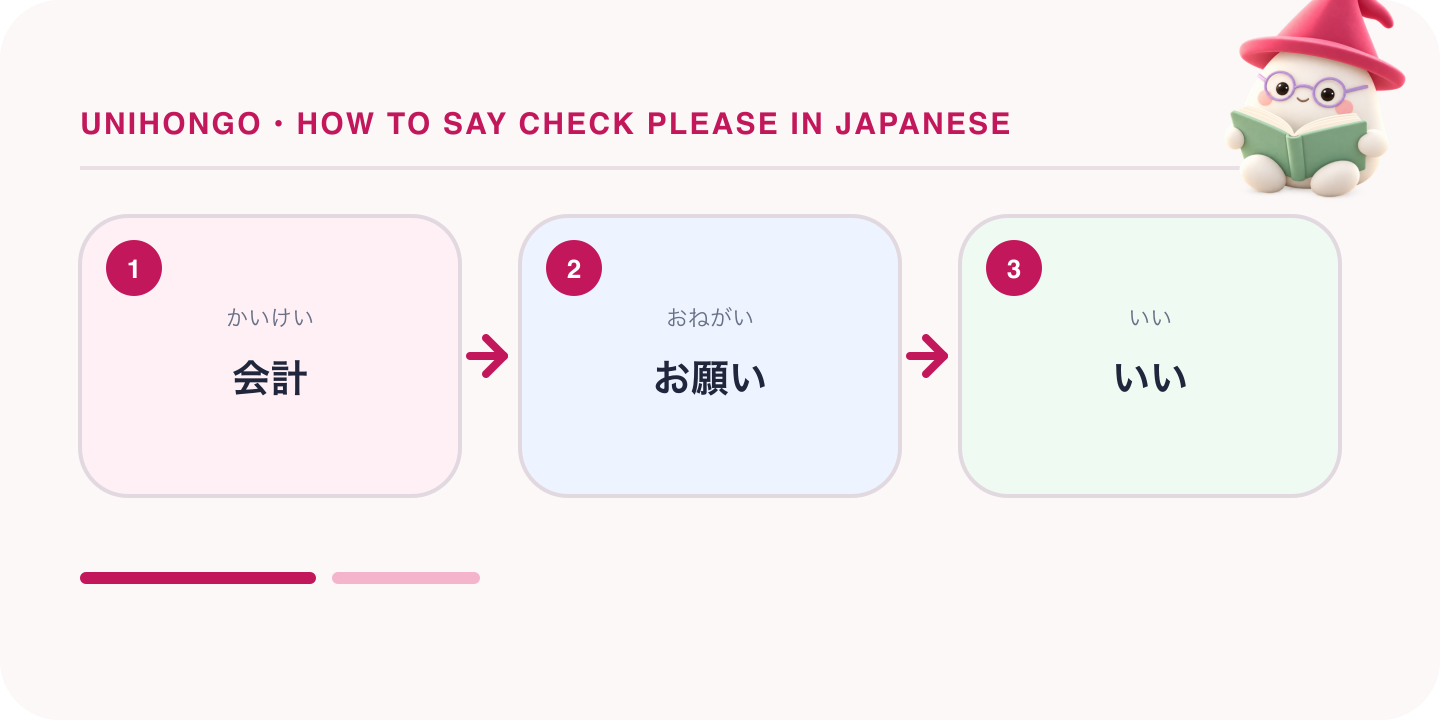
Kaikei is the accounting word for settling a bill, and with the polite prefix it becomes o-kaikei, the phrase you will see on signs and hear from staff. O-kaikei onegaishimasu, the bill please, is polite enough for any restaurant and short enough for a shout across a counter. Start with sumimasen to catch attention, and if the server is already looking at you, o-kaikei with a small bow of the head is understood on its own.
Two softer variations are worth having. O-kaikei ii desu ka, is it all right to settle up, is what many Japanese customers say in cafés and family restaurants. O-kaikei o onegai dekimasu ka, could I ask for the bill, is a touch more formal and suits a hotel restaurant. In a group, whoever is nearest the aisle usually asks, and the others gather their things.
Staff may pre-empt you. As plates are cleared they might ask o-kaikei wa go-issho de yoroshii desu ka, is the bill together, or place the slip face down with go-yukkuri dōzo, take your time. When you see the slip, denpyō, arrive, the restaurant is telling you to pay at the register when you are ready.
| Japanese | Romaji | Meaning |
|---|---|---|
| すみません、お会計お願いします。 | Sumimasen, o-kaikei onegaishimasu. | Excuse me, the bill please. |
| お会計いいですか。 | O-kaikei ii desu ka. | Can I settle up? |
| お会計をお願いできますか。 | O-kaikei o onegai dekimasu ka. | Could I ask for the bill? |
| お会計はご一緒でよろしいですか。 | O-kaikei wa go-issho de yoroshii desu ka. | Is the bill together? (what staff ask) |
| はい、一緒でお願いします。 | Hai, issho de onegaishimasu. | Yes, together please. |
| 伝票はこちらです。 | Denpyō wa kochira desu. | Here is your slip. (what staff say) |
O-aiso and the X gesture
O-aiso, sometimes o-aisō, is the word many older guidebooks give for the bill. It began as sushi shop slang: aiso means courtesy or hospitality, and the shop would say o-aiso ga nakute, sorry for the poor hospitality, as it presented the bill. Customers borrowed the word, and you will still hear men of a certain age call o-aiso across a sushi counter. Because it was originally the shop's line, some purists think a customer saying it is slightly off, and many younger Japanese people never use it. O-kaikei is the safe default; recognise o-aiso and leave it to the regulars.
The X gesture is the wordless option. Hold your two index fingers crossed at chest height while making eye contact with a server, and they will bring or prepare the bill. It stands for shime, closing the account, or for the batsu mark, the cross that means finished. It is common in izakaya, where the noise makes shouting pointless, and in any busy place where the server is far away. It is casual, so pair it with a nod or a sumimasen, and skip it in a formal restaurant or when a manager is standing beside you.
| Japanese | Romaji | Meaning |
|---|---|---|
| お愛想お願いします。 | O-aiso onegaishimasu. | The bill please. (old-fashioned, sushi bars) |
| 締めてください。 | Shimete kudasai. | Please close the account. (casual) |
| そろそろお会計をお願いします。 | Sorosoro o-kaikei o onegaishimasu. | We're about ready for the bill. |
| お先に失礼します。お会計を。 | O-saki ni shitsurei shimasu. O-kaikei o. | I need to head off first. The bill, please. |
| すみません、こちらお願いします。 | Sumimasen, kochira onegaishimasu. | Excuse me, over here please. (holding up the slip) |
Register or table: reading the system
Most everyday restaurants in Japan use a register near the door. The server leaves a slip, denpyō, on the table, often in a small holder, and when you finish you carry it to the reji and pay there. Nobody comes to collect payment at the table, and waiting for them to do so is the most common reason foreign visitors sit for a long time after finishing. If you see a slip on your table and a register by the exit, that is your cue.
Izakaya, formal restaurants, many hotel dining rooms and some ramen counters settle at the table or the counter. There, saying o-kaikei onegaishimasu brings the bill on a small tray, kaikei tore, you put cash or a card on the tray, and the server takes it away and returns with the change and receipt. Ticket-machine restaurants, kenbaiki, are the third system: you paid before you ate, so you simply leave with gochisō-sama deshita.
When you cannot tell, ask. Reji de desu ka, at the register, or o-kaikei wa doko de, where do I pay, both get a clear answer. At the register, hand over the slip first, then wait for the total; the cashier will read it aloud.
| Japanese | Romaji | Meaning |
|---|---|---|
| お会計はレジでお願いします。 | O-kaikei wa reji de onegaishimasu. | Please pay at the register. (what staff say) |
| レジでですか。 | Reji de desu ka. | Do I pay at the register? |
| お会計はどこでしますか。 | O-kaikei wa doko de shimasu ka. | Where do I pay? |
| 伝票をお預かりします。 | Denpyō o o-azukari shimasu. | I'll take your slip. (what staff say) |
| お席でお会計いたします。 | O-seki de o-kaikei itashimasu. | We'll settle the bill at your table. (what staff say) |
| ごちそうさまでした。 | Gochisō-sama deshita. | Thank you for the meal. (said as you leave) |
Paying: card, cash and phone
Once the total is read, say how you will pay. Kādo de onegaishimasu, by card please; genkin de, in cash; and for phone payments the name of the service followed by de. Staff will often ask o-shiharai wa, or o-shiharai hōhō wa, how will you pay. Cash on a tray is still normal, and the cashier counts the change back to you aloud; you are not expected to check it but can.
Card acceptance varies by restaurant, and small independent places may be cash only, so ask kādo wa tsukaemasu ka before you order if it matters. Many cards, tap and phone payments are common in chains and cities, less so in small towns. Tipping is not practised, and leaving coins on the table will usually cause a server to chase you with them.
For a card, you may be asked ikkatsu de yoroshii desu ka, in one payment, and the answer is hai. You may also be asked to insert or tap; the staff will say sashikonde kudasai or kazashite kudasai. A PIN, anshō bangō, is sometimes required.
| Japanese | Romaji | Meaning |
|---|---|---|
| お支払いはどうなさいますか。 | O-shiharai wa dō nasaimasu ka. | How would you like to pay? (what staff ask) |
| カードでお願いします。 | Kādo de onegaishimasu. | By card, please. |
| 現金で。 | Genkin de. | Cash. |
| カードは使えますか。 | Kādo wa tsukaemasu ka. | Can I use a card? |
| 一括でよろしいですか。 | Ikkatsu de yoroshii desu ka. | In a single payment? (what staff ask) |
| 暗証番号をお願いします。 | Anshō bangō o onegaishimasu. | Your PIN, please. (what staff say) |
Reading the bill
Bills and till receipts share a small vocabulary. The words below appear on almost every slip, and knowing them lets you check the total in a few seconds. Tax is normally included in the printed menu prices at restaurants, and the receipt shows it separately for information.
| Word | Reading | Meaning |
|---|---|---|
| 会計 | kaikei | bill, settlement |
| 伝票 | denpyō | the order slip |
| 小計 | shōkei | subtotal |
| 合計 | gōkei | total |
| 税込 | zeikomi | tax included |
| 消費税 | shōhizei | consumption tax |
| お通し | otōshi | izakaya cover charge appetiser |
| サービス料 | sābisu-ryō | service charge |
| お預かり | o-azukari | amount received |
| お釣り | o-tsuri | change |
| レシート | reshīto | till receipt |
| 領収書 | ryōshūsho | formal receipt |
Service charges appear mainly in hotels and some upmarket restaurants and are printed on the menu, so their presence and rate vary; the bill will list it as sābisu-ryō if it applies. Otōshi is charged per person at most izakaya whether or not you eat it.
Receipts: reshīto and ryōshūsho
The till prints a reshīto automatically, and staff may ask reshīto wa go-riyō desu ka, do you need the receipt, to which hai or kekkō desu answers. For work expenses you need a ryōshūsho, a formal receipt with the payee's name written or stamped on it. Ask with ryōshūsho o onegaishimasu, ideally before you pay, since some registers print it as part of the transaction.
Staff will then ask atena wa, or o-namae wa, meaning what name to write. Give the company name slowly, or say ue de, which asks for the name line to be left as ue, a conventional placeholder that many companies accept. Whether your employer accepts ue or requires the full company name is a matter of internal policy, so check before you rely on it. If you are asked tadashi-gaki wa, that is the description line, and inshokudai, food and drink, is the usual answer.
- Ryōshūsho o onegaishimasu: a formal receipt, please
- Atena wa kabushiki-gaisha Yamada de: make it out to Yamada Co., Ltd.
- Ue de onegaishimasu: leave the name line as ue
- Tadashi-gaki wa inshokudai de: description as food and drink
- Reshīto wa kekkō desu: I don't need the till receipt
Both receipts can be issued for the same bill, and asking for a ryōshūsho does not look unusual; business customers do it every day.
Splitting the bill in brief
If the group wants separate bills, say betsubetsu de onegaishimasu, separately please, when you ask for the bill or at the register, and the staff will divide it by what each person ordered. Some restaurants cannot do this at busy times and will say betsubetsu wa dekikanemasu, in which case one person pays and the group settles up outside. Warikan, splitting the total equally, is arranged among friends rather than with the restaurant. The separate guide on splitting the bill and paying goes through warikan, ogoru and who pays for whom in detail.
| Japanese | Romaji | Meaning |
|---|---|---|
| 別々でお願いします。 | Betsubetsu de onegaishimasu. | Separately, please. |
| 別々はできかねます。 | Betsubetsu wa dekikanemasu. | We can't do separate bills. (what staff say) |
| じゃあ、まとめて払うね。 | Jā, matomete harau ne. | Then I'll pay it all together. (casual) |
Common mistakes
The biggest mistake is not a phrase but a habit: waiting at the table for a bill that is never coming. If there is a slip on the table, take it to the register. The second is leaving money on the table and walking out, which staff will read as a mistake and may run after you to correct. The third is saying o-aiso in a formal restaurant, where it sounds out of place.
Learners also sometimes say kaikei without the o-, which is understandable but sounds abrupt from a customer; the o- costs nothing. And when the cashier reads the total quickly, ask mō ichido onegaishimasu or point at the display, which every register has. Numbers in the thousands, such as sanzen happyaku-en, come fast, and looking at the screen is what Japanese customers do too.
| Japanese | Romaji | Meaning |
|---|---|---|
| 伝票を持ってレジに行きます。 | Denpyō o motte reji ni ikimasu. | I'll take the slip to the register. |
| すみません、もう一度お願いします。 | Sumimasen, mō ichido onegaishimasu. | Sorry, once more please. |
| これは何の料金ですか。 | Kore wa nan no ryōkin desu ka. | What is this charge for? |
| お通し代ですね。わかりました。 | Otōshi-dai desu ne. Wakarimashita. | The appetiser charge, I see. Understood. |
| レシートはいりません。 | Reshīto wa irimasen. | I don't need the receipt. |