
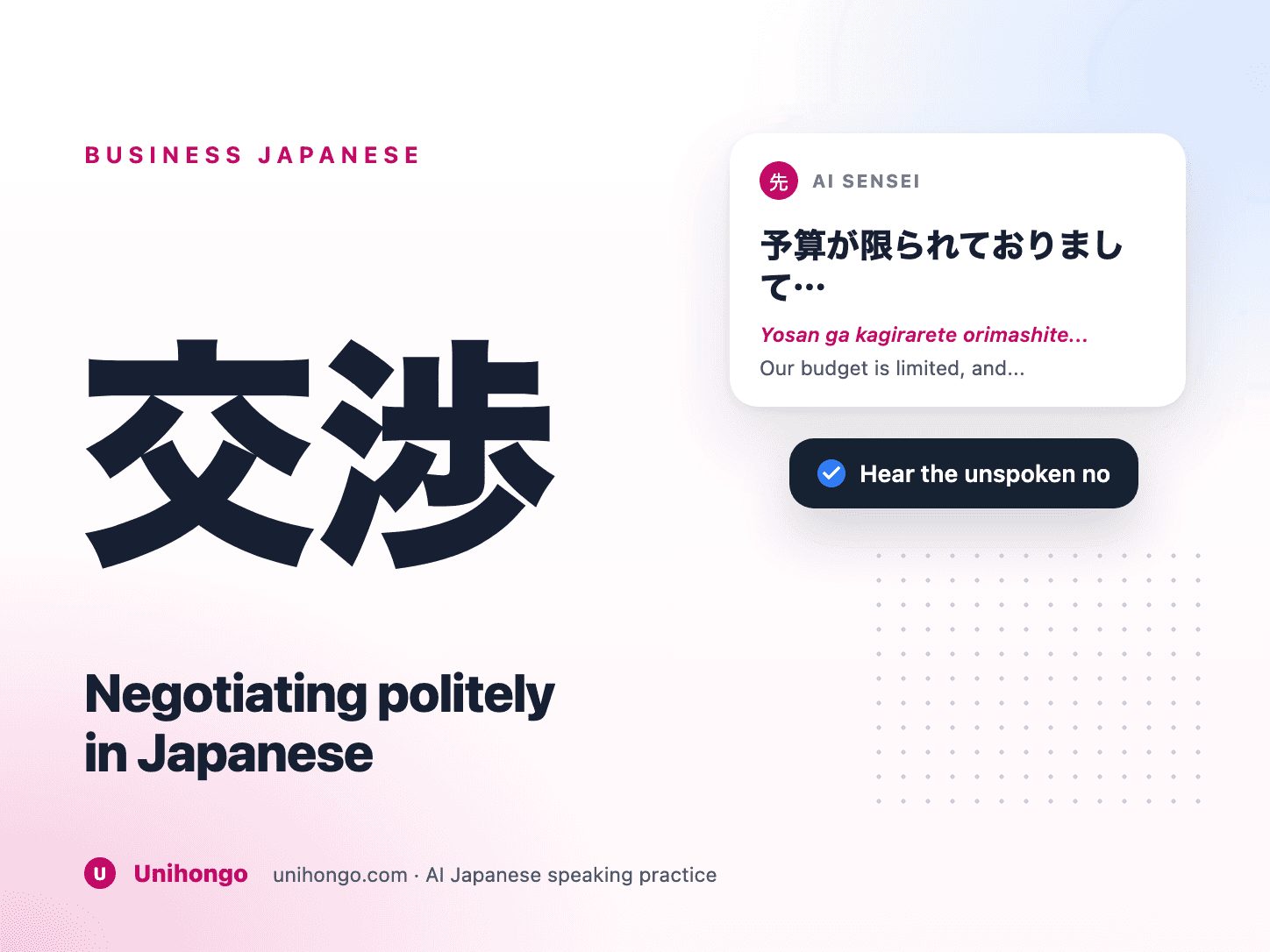
The frame: your difficulty, not their failure
The structural difference from many negotiating cultures is where the problem is located. A direct style says your price is too high. The Japanese convention says our budget is constrained. Both communicate the same thing, but the second does not require the other side to have done anything wrong, which means they can move without losing face.
This is why so many negotiating phrases look like apologies. Osoreirimasu ga, otesū o okake shimasu ga and kokorogurushii no desu ga are not weakness signals; they are the standard opening of a request, and their absence is what reads as aggressive.
| Japanese | Romaji | Meaning |
|---|---|---|
| 予算が限られておりまして… | Yosan ga kagirarete orimashite... | Our budget is limited, and... |
| 社内の事情で恐縮なのですが、 | Shanai no jijō de kyōshuku na no desu ga, | I am sorry, this is due to internal circumstances, but |
| こちらの都合で申し訳ないのですが、 | Kochira no tsugō de mōshiwake nai no desu ga, | I apologise, this is a matter on our side, but |
| ご相談させていただきたいことがございます。 | Gosōdan sasete itadakitai koto ga gozaimasu. | There is something I would like to consult you about. |
| 少し難しい状況になっておりまして。 | Sukoshi muzukashii jōkyō ni natte orimashite. | We find ourselves in a slightly difficult situation. |
Asking about price
Price conversations follow a reliable order: acknowledge the value, state the constraint, name the figure, and offer something in exchange. Naming a specific number is important. A vague request to lower the price gives the other side nothing to work with and often produces a polite refusal simply because there is no proposal to accept.
Offering something in return is what turns a discount request into a negotiation rather than a favour. Longer contract, larger volume, faster payment and a public reference are all standard currency.
| Japanese | Romaji | Meaning |
|---|---|---|
| お見積もりありがとうございます。 | Omitsumori arigatō gozaimasu. | Thank you for the quotation. |
| 大変魅力的なご提案なのですが、 | Taihen miryokuteki na goteian na no desu ga, | It is a very attractive proposal, but |
| 予算が三百万円までとなっております。 | Yosan ga sanbyaku-man-en made to natte orimasu. | Our budget goes up to three million yen. |
| 一割ほどお願いすることは可能でしょうか。 | Ichi-wari hodo onegai suru koto wa kanō deshō ka. | Would around ten percent be possible? |
| 期間を長くする代わりに、単価を見直していただけませんか。 | Kikan o nagaku suru kawari ni, tanka o minaoshite itadakemasen ka. | In exchange for a longer term, could you review the unit price? |
| 社内で通しやすい形にできればと思っております。 | Shanai de tōshiyasui katachi ni dekireba to omotte orimasu. | I hope we can shape it so it passes internally. |
Framing it as needing to pass internal approval is extremely common and effective, because it makes the constraint external to both of you.
Moving a deadline
Deadline requests are the most common negotiation a foreign employee actually has, and the rules are strict: as early as possible, with a reason, a new date, and a statement of what you will do to limit the impact. Asking on the day is a much bigger problem than the delay itself.
Offer a partial delivery if you can. Handing over part of the work on the original date changes the conversation from a missed deadline to a revised plan, and it is the single most effective thing you can propose.
| Japanese | Romaji | Meaning |
|---|---|---|
| 納期についてご相談がございます。 | Nōki ni tsuite gosōdan ga gozaimasu. | I would like to consult you about the delivery date. |
| 確認に想定より時間がかかっておりまして。 | Kakunin ni sōtei yori jikan ga kakatte orimashite. | Verification is taking longer than expected. |
| 三日ほど延ばしていただくことは可能でしょうか。 | Mikka hodo nobashite itadaku koto wa kanō deshō ka. | Would it be possible to extend it by about three days? |
| 一部だけ先にお出しすることもできます。 | Ichibu dake saki ni odashi suru koto mo dekimasu. | We could also deliver part of it first. |
| ご迷惑をおかけして申し訳ございません。 | Gomeiwaku o okake shite mōshiwake gozaimasen. | I am very sorry for the inconvenience. |
| 今後は早めにご連絡いたします。 | Kongo wa hayame ni gorenraku itashimasu. | I will get in touch sooner in future. |
Changing scope
Scope conversations turn difficult when they arrive as accusations about what was agreed. The productive approach separates the facts from the request: restate what was agreed, describe what has changed, then ask. Doing that in that order keeps the discussion about the work rather than about who is at fault.
It also helps to explicitly name what you are willing to give up. Offering a trade shows you understand the other side has constraints too, and it usually produces a faster answer than a request that assumes everything can grow.
| Japanese | Romaji | Meaning |
|---|---|---|
| 当初のお話では、A と B が対象だったかと存じます。 | Tōsho no ohanashi de wa, A to B ga taishō datta ka to zonjimasu. | I believe the original discussion covered A and B. |
| 状況が変わりまして、C も必要になりました。 | Jōkyō ga kawarimashite, C mo hitsuyō ni narimashita. | The situation has changed and C has become necessary too. |
| その分、B を後回しにしても構いません。 | Sono bun, B o atomawashi ni shite mo kamaimasen. | In exchange, we do not mind postponing B. |
| 追加の費用が発生しますでしょうか。 | Tsuika no hiyō ga hassei shimasu deshō ka. | Would additional costs arise? |
| 範囲を一度整理させていただけますか。 | Han'i o ichido seiri sasete itadakemasu ka. | May I organise the scope once more? |
Reading a refusal that was never spoken
This is the skill that decides whether you negotiate well in Japanese. Direct refusals are rare, and a learner who waits for iie will conclude that everything is still open. The refusal signals are lexical and they are consistent, which makes them learnable.
Muzukashii, difficult, is the clearest one. Applied to a proposal, it almost never means challenging but doable; it means no. Kentō shimasu, kangaete okimasu and a long inhale followed by chotto are all in the same family. The tell is what does not follow: no questions, no timeline, no request for details.
| What you hear | Literal | Usually means |
|---|---|---|
| ちょっと難しいですね Chotto muzukashii desu ne | That is a little difficult | No |
| 検討します Kentō shimasu | We will consider it | No, or a long delay |
| 考えておきます Kangaete okimasu | I will think about it | No |
| 持ち帰ります Mochikaerimasu | I will take it back to the office | Genuinely undecided, needs internal approval |
| 前向きに検討します Maemuki ni kentō shimasu | We will consider it positively | Possible, but not a commitment |
| 確認して折り返します Kakunin shite orikaeshimasu | I will check and get back to you | Usually genuine, expect a real answer |
The two rows at the bottom are the ones with real movement in them. If you hear the top three, plan for a no while remaining pleasant.
Refusing without closing the door
When you are the one refusing, the same conventions apply in reverse. A bare dekimasen is unnecessarily final. The standard move names the difficulty, gives a reason if you have one, and immediately offers an alternative, which keeps the conversation open and signals that you want the relationship.
The alternative matters more than the refusal. A no with a counter-proposal is a negotiating move; a no on its own is an ending. Even a small counter, such as a different date or a reduced quantity, keeps things alive.
| Japanese | Romaji | Meaning |
|---|---|---|
| 申し訳ございませんが、その条件は難しい状況です。 | Mōshiwake gozaimasen ga, sono jōken wa muzukashii jōkyō desu. | I am sorry, but those terms are difficult for us. |
| 代わりに、こちらのご提案はいかがでしょうか。 | Kawari ni, kochira no goteian wa ikaga deshō ka. | Instead, how would this proposal be? |
| 数量を増やしていただければ、検討可能です。 | Sūryō o fuyashite itadakereba, kentō kanō desu. | If you could increase the quantity, we could consider it. |
| 今回は見送らせていただきます。 | Konkai wa miokurasete itadakimasu. | We will pass on this occasion. |
| また機会がございましたら、ぜひお願いいたします。 | Mata kikai ga gozaimashitara, zehi onegaiitashimasu. | If there is another opportunity, we would very much like to work together. |
Closing and confirming
Japanese business practice puts a high value on written confirmation after a spoken agreement, and offering to send it yourself is both helpful and protective. It also surfaces misunderstandings while they are still cheap, which matters more when the negotiation ran on indirect language.
Close by restating the terms in your own words and inviting correction. If the other side hesitates at that point, something was not agreed, and finding that out in the room is far better than discovering it in a month.
| Japanese | Romaji | Meaning |
|---|---|---|
| では、この内容で進めさせていただきます。 | Dewa, kono naiyō de susumesasete itadakimasu. | Then we will proceed with these terms. |
| 確認のため、後ほどメールでお送りします。 | Kakunin no tame, nochihodo mēru de ookuri shimasu. | I will send it by email afterwards for confirmation. |
| 私の理解では、納期は月末、金額は据え置きということでよろしいでしょうか。 | Watashi no rikai de wa, nōki wa getsumatsu, kingaku wa sueoki to iu koto de yoroshii deshō ka. | My understanding is end of month for delivery and the price unchanged. Is that correct? |
| 認識に相違がありましたら、お知らせください。 | Ninshiki ni sōi ga arimashitara, oshirase kudasai. | Please let me know if our understanding differs. |
| 本日はありがとうございました。引き続きよろしくお願いいたします。 | Honjitsu wa arigatō gozaimashita. Hikitsuzuki yoroshiku onegaiitashimasu. | Thank you for today. I look forward to continuing to work with you. |