

O-daiji ni: the phrase that fits everyone
O-daiji ni is the get well soon of daily life. You hear it from the doctor as you leave the consulting room, from the pharmacist as they hand over your medicine, from a colleague when you say you are going home with a cold, and from friends by text. It wishes the person a careful recovery without any claim about how bad the illness is, which is exactly why it fits so many situations.
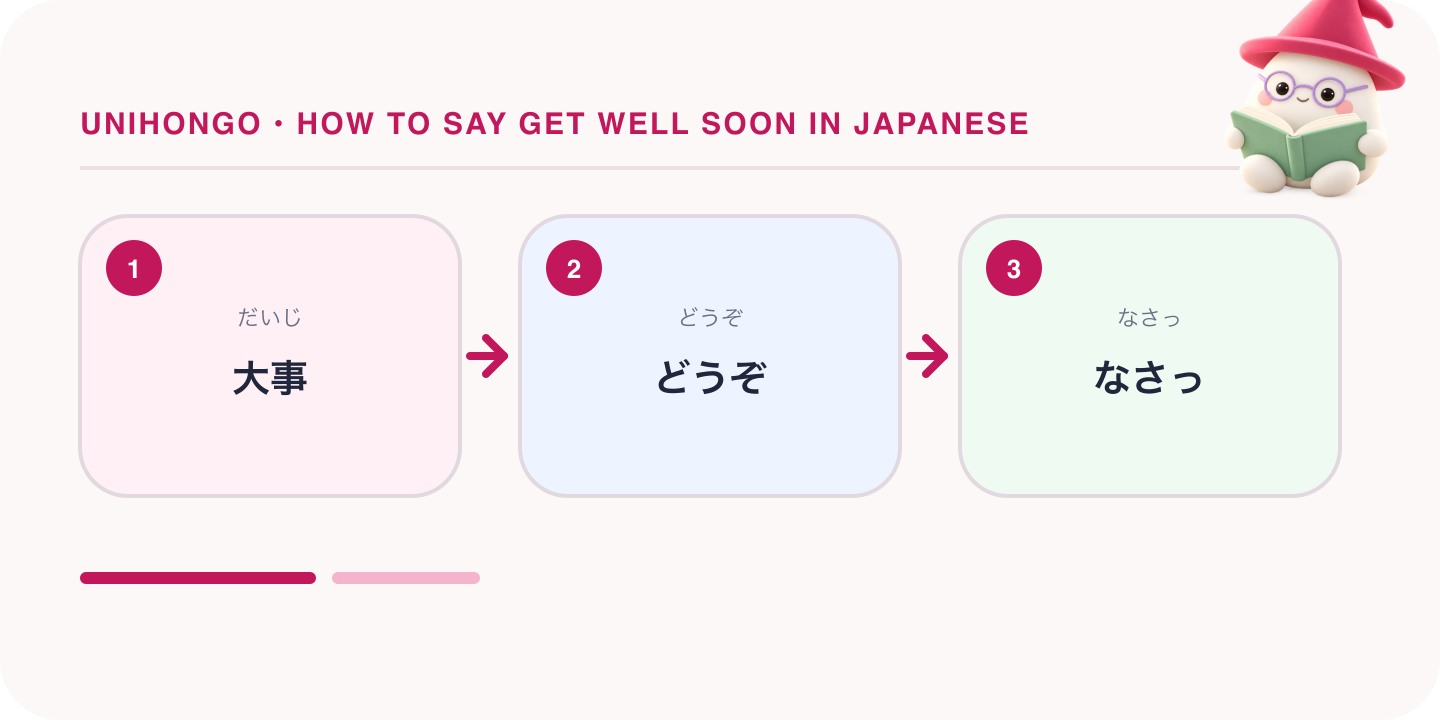
It is a shortened form. The full expressions are o-daiji ni shite kudasai and, more respectfully, o-daiji ni nasatte kudasai, please take good care of yourself. The short o-daiji ni is polite on its own because of the o prefix, and adding dōzo in front, dōzo o-daiji ni, makes it a touch warmer and more formal at the same time. That three-word version is what most adults say to acquaintances and colleagues.
Timing matters. O-daiji ni is a parting phrase, said as the person leaves, as you hang up, or at the end of a message, so hold it for the goodbye.
| Japanese | Romaji | Meaning |
|---|---|---|
| お大事に。 | O-daiji ni. | Take care of yourself. Get well soon. |
| どうぞお大事に。 | Dōzo o-daiji ni. | Please take good care of yourself. |
| お大事になさってください。 | O-daiji ni nasatte kudasai. | Please take good care of yourself. (respectful) |
| 風邪ですか。お大事に。 | Kaze desu ka. O-daiji ni. | A cold? Take care. |
| それでは、お大事に。 | Sore de wa, o-daiji ni. | Well then, get well soon. |
Warmer phrases for friends and family
With people close to you, o-daiji ni can feel a little distant, and Japanese speakers reach for sentences that show they are thinking about the person. Hayaku yoku naru to ii ne, literally it would be good if you got better soon, is the classic. The to ii ne ending expresses a hope rather than a command, which keeps it gentle. Hayaku naoru to ii ne, using naoru, to be cured, means the same.
Yukkuri yasunde ne, rest properly, and muri shinaide ne, do not push yourself, are the practical companions. They tell the person what to do rather than how to feel, and in Japanese that often reads as more caring. For someone in real pain, tsurai ne, that must be rough, acknowledges the situation before any wish.
Among close friends and family, plain forms without ne are fine: hayaku genki ni natte, get well quickly. Offers are natural here too: nani ka motte ikō ka, shall I bring you something.
| Japanese | Romaji | Meaning |
|---|---|---|
| 早くよくなるといいね。 | Hayaku yoku naru to ii ne. | I hope you get better soon. |
| 早く治るといいね。 | Hayaku naoru to ii ne. | I hope you recover soon. |
| ゆっくり休んでね。 | Yukkuri yasunde ne. | Rest well. |
| 無理しないでね。 | Muri shinaide ne. | Don't push yourself. |
| 早く元気になって。 | Hayaku genki ni natte. | Get well quickly. (casual) |
| 何か持っていこうか。 | Nani ka motte ikō ka. | Shall I bring you something? |
Polite and formal phrases for colleagues and clients
At work, get well soon moves into polite and humble forms. O-karada ni o-ki o tsukete kudasai, please take care of your health, is the everyday polite version and works both for someone who is ill and for someone who is simply working hard. O-karada o o-daiji ni nasatte kudasai combines karada, body, with the respectful nasatte and is a standard close for a message to a manager, a client or an older person.
For written notes and formal emails, the language becomes more set. Ichinichi mo hayai go-kaifuku o o-inori shite orimasu, I pray for your recovery at the earliest possible day, is the standard sentence in get-well cards and business messages. Go-kaifuku means recovery, and o-inori shite orimasu is the humble form of to pray or hope. Go-jiai kudasai, please take care of yourself, is another formal close, common in letters.
| Japanese | Romaji | Meaning |
|---|---|---|
| お体にお気をつけください。 | O-karada ni o-ki o tsukete kudasai. | Please take care of your health. |
| お体をお大事になさってください。 | O-karada o o-daiji ni nasatte kudasai. | Please take good care of yourself. (formal) |
| 一日も早いご回復をお祈りしております。 | Ichinichi mo hayai go-kaifuku o o-inori shite orimasu. | I wish you the speediest possible recovery. |
| どうぞご自愛ください。 | Dōzo go-jiai kudasai. | Please look after yourself. (letters) |
| お仕事のことはご心配なく。 | O-shigoto no koto wa go-shinpai naku. | Please don't worry about work. |
The register ladder at a glance
Here are the main phrases arranged from most casual to most formal, so you can pick the rung that matches the person. Most learners need the middle three rungs daily and the top two only for writing.
| Phrase | Reading | Register and use |
|---|---|---|
| 早く元気になって。 | Hayaku genki ni natte. | Casual; close friends and family |
| 早くよくなるといいね。 | Hayaku yoku naru to ii ne. | Casual and warm; friends |
| ゆっくり休んでね。 | Yukkuri yasunde ne. | Casual; friends, family |
| お大事に。 | O-daiji ni. | Neutral; anyone, spoken |
| どうぞお大事に。 | Dōzo o-daiji ni. | Polite; colleagues, acquaintances |
| お大事になさってください。 | O-daiji ni nasatte kudasai. | Respectful; seniors, customers |
| お体にお気をつけください。 | O-karada ni o-ki o tsukete kudasai. | Polite; messages and email |
| お体をお大事になさってください。 | O-karada o o-daiji ni nasatte kudasai. | Formal; managers, clients |
| 一日も早いご回復をお祈りしております。 | Ichinichi mo hayai go-kaifuku o o-inori shite orimasu. | Formal written; cards, business |
| ご自愛ください。 | Go-jiai kudasai. | Formal letter close; general health |
Go-jiai kudasai is a general wish for someone's health rather than a response to illness, so it fits the end of a seasonal letter but not a message to someone in hospital.
Writing get well soon in a message
Most get-well wishes today are typed, and the shape of a Japanese message is fairly fixed: a short ask about how they are, a reassurance about whatever they are missing, and a closing wish. Asking taichō wa ikaga desu ka, how is your condition, is polite and does not demand details. To a friend, chōshi dō?, how are you doing, is enough.
The reassurance is important in a work message, because the sick person is often worrying about the team. Shigoto no koto wa ki ni sezu, or more politely o-shigoto no koto wa go-shinpai naku, tells them not to worry. Kochira wa daijōbu desu, we are fine here, adds concrete comfort.
Then close. To a colleague: yukkuri yasunde kudasai, dōzo o-daiji ni. To a manager: o-karada o o-daiji ni nasatte kudasai. To a friend: hayaku yoku naru to ii ne, followed by muri shinaide ne. Keep the whole message short; a long note can feel like something the sick person has to answer.
- Taichō wa ikaga desu ka: how are you feeling (polite)
- Chōshi dō?: how are you doing (casual)
- O-shigoto no koto wa go-shinpai naku: do not worry about work
- Kochira wa daijōbu desu: everything is fine on our side
- Henshin wa fuyō desu: no need to reply
- Yukkuri yasunde kudasai: please rest well
Henshin wa fuyō desu, no reply needed, is a considerate line to add for a colleague who is really unwell. It frees them from the sense of owing you an answer.
Replying when someone says it to you
When a pharmacist, colleague or friend says o-daiji ni to you, the reply is thanks, not an echo. Arigatō gozaimasu with a small nod is complete. The common learner mistake is to answer o-daiji ni with o-daiji ni, which wishes the healthy person a recovery and sounds odd.
If you want to add something, a brief status works: daibu yoku narimashita, I am much better; mō daijōbu desu, I am fine now; or ato sukoshi de naoru to omoimasu, I think I will be over it soon. To a colleague who covered for you, go-meiwaku o o-kake shimashita, sorry for the trouble I caused, is expected on your first day back, and o-kage-sama de, thanks to you, is the gracious way to acknowledge concern.
| Japanese | Romaji | Meaning |
|---|---|---|
| ありがとうございます。 | Arigatō gozaimasu. | Thank you. (the normal reply) |
| おかげさまで、だいぶよくなりました。 | O-kage-sama de, daibu yoku narimashita. | Thanks to you, I'm much better. |
| もう大丈夫です。 | Mō daijōbu desu. | I'm fine now. |
| ご迷惑をおかけしました。 | Go-meiwaku o o-kake shimashita. | Sorry for the trouble I caused. |
| 心配してくれてありがとう。 | Shinpai shite kurete arigatō. | Thanks for worrying about me. (casual) |
Speaking to the family of the person who is ill
Sometimes the person you meet is not the patient but a spouse, a parent or a child who is caring for them. The phrases change target. Go-yōsu wa ikaga desu ka, how is their condition, asks after the patient politely. Then the wish: dōzo o-daiji ni nasatte kudasai to osshatte kudasai, please tell them to take care, passes your message through. And a wish for the carer themselves: go-kazoku no kata mo, dōzo o-daiji ni, you take care too.
For serious illness, the formal expression o-mimai mōshiagemasu, I offer my sympathy, is used in speech and writing, and it is what appears in cards sent to a hospital. Offers of practical help are welcome but should be concrete: kaimono nado, nani ka dekiru koto ga areba, if there is anything I can do, shopping or the like.
| Japanese | Romaji | Meaning |
|---|---|---|
| ご様子はいかがですか。 | Go-yōsu wa ikaga desu ka. | How are they doing? |
| お大事にとお伝えください。 | O-daiji ni to o-tsutae kudasai. | Please tell them to take care. |
| ご家族の方もどうぞお大事に。 | Go-kazoku no kata mo dōzo o-daiji ni. | Please look after yourself too. |
| お見舞い申し上げます。 | O-mimai mōshiagemasu. | I offer my sympathy. (formal) |
| 何かできることがあればおっしゃってください。 | Nani ka dekiru koto ga areba osshatte kudasai. | Please tell me if there's anything I can do. |
Mistakes to avoid
The first mistake is the echo reply described above. The second is using genki dashite, cheer up, for illness; it suggests the person could feel better if they tried, which is not how a fever works. The third is asking what the illness is. Nan no byōki desu ka, what illness is it, is intrusive in Japanese unless the person has already volunteered the information; taichō wa ikaga desu ka is the polite alternative.
Be careful with gifts as well. Potted plants are avoided for hospital patients because roots suggest a long stay, and some hospitals do not allow flowers at all, so ask first or send a message instead. Finally, when in doubt about register, go one rung more polite than you think you need. Dōzo o-daiji ni has never offended anyone, and it is the phrase you will end up using most.
| Japanese | Romaji | Meaning |
|---|---|---|
| 体調はいかがですか。 | Taichō wa ikaga desu ka. | How are you feeling? |
| お花は大丈夫ですか。 | O-hana wa daijōbu desu ka. | Are flowers all right? (asking a hospital or family) |
| 無理せず、ゆっくり治してください。 | Muri sezu, yukkuri naoshite kudasai. | Take your time getting better. |