
What varies and what does not
Funeral practice in Japan varies by religion, by region, by generation and by family. Many services follow Buddhist forms, but Shinto, Christian and non-religious ceremonies are all held, and small family-only services have become ordinary. The scale, the order of events and even whether guests are invited at all differ from one household to the next.
What barely varies is the language. The same handful of condolence phrases is used across almost all of these settings, said quietly, once, with a bow. That is why this guide teaches the sentences in detail and describes the surrounding customs only in general terms. If the family sends instructions about dress, timing, offerings or attendance, those instructions replace everything written here.
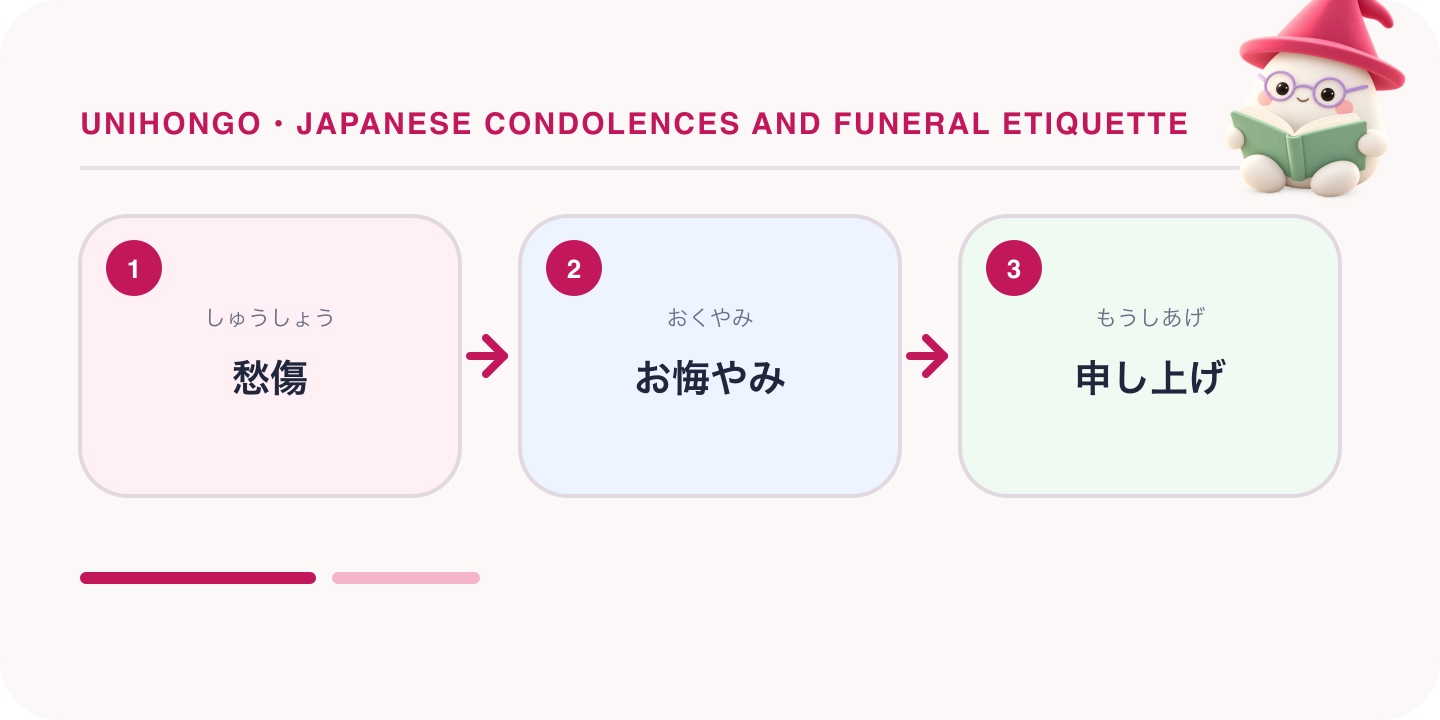
The first thing you say when you hear the news
Hearing the news in conversation calls for a shorter response than you might expect. One condolence line, a pause, and then silence or a practical offer is the whole shape. Do not ask how the person died, do not ask for details of the illness, and do not say that you understand how they feel. If you were close to the person who died, a single sentence about them is welcome, but keep it to one.
Kono tabi wa is a fixed opener meaning on this occasion, and it softens whatever follows. Goshūshō-sama desu is spoken rather than written. Okuyami mōshiagemasu works in both speech and writing and is the phrase to reach for when you are not sure what kind of service the family holds.
| Japanese | Romaji | Meaning |
|---|---|---|
| この度はご愁傷様です。 | Kono tabi wa goshūshō-sama desu. | Please accept my condolences. |
| この度はご愁傷様でございます。 | Kono tabi wa goshūshō-sama de gozaimasu. | Please accept my condolences. (more formal) |
| お悔やみ申し上げます。 | Okuyami mōshiagemasu. | I offer my condolences. |
| 心よりお悔やみ申し上げます。 | Kokoro yori okuyami mōshiagemasu. | My sincere condolences. |
| ご訃報に接し、驚いております。 | Gofuhō ni sesshi, odoroite orimasu. | I was shocked to hear the news. |
| 突然のことで、言葉もありません。 | Totsuzen no koto de, kotoba mo arimasen. | It is so sudden that I am lost for words. |
| 何と申し上げてよいか分かりません。 | Nan to mōshiagete yoi ka wakarimasen. | I do not know what to say. |
| 心中お察しいたします。 | Shinchū o sasshi itashimasu. | I can only imagine what you are going through. |
The expected reply from the family is equally short, usually osoreirimasu or arigatō gozaimasu. Nobody continues the conversation from there. If you feel a silence forming, let it sit rather than filling it.
Words that are usually avoided
Two groups of words are commonly avoided. The first is repetition: doubled words such as kasanegasane, and words meaning again or continuing, because they suggest the loss recurring. The second is bluntness about death itself, which is softened with nakunaru or goseikyo. These conventions are widely observed at services and in written messages, and less strictly in casual conversation between close friends.
| Avoid | Why it is avoided | Say instead |
|---|---|---|
| 重ね重ね kasanegasane | A doubled word suggesting repetition | 心から kokoro kara |
| たびたび tabitabi | Doubled word, suggests recurrence | よく yoku |
| 再び futatabi | Means again | Leave it out |
| 続く tsuzuku | Suggests something continuing | Rephrase the sentence |
| ますます masumasu | Doubled word | さらに sara ni |
| 死ぬ shinu | Too blunt for the setting | 亡くなる nakunaru |
| 死亡 shibō | Clinical, used on forms not to family | ご逝去 goseikyo |
| 生きていた頃 ikite ita koro | Blunt reference to being alive | ご生前 goseizen |
| 頑張って ganbatte | Asks a grieving person to try harder | ご無理なさらないでください |
Numbers pronounced shi and ku are also often avoided in this context because of their association with death and suffering, so people say yon and kyū instead. Beyond the word list, avoid asking about the cause of death, about money, and about what the family will do next.
The condolence envelope
Guests commonly bring a condolence offering in a special envelope, called kōden, handed in at the reception desk. The envelope is plain, usually white with black or black-and-silver cord, and it is bought ready-made. What is written on the front depends on the ceremony, so the safest approach is to buy the envelope after you know what kind of service it is, or to ask the shop staff.
Amounts, and whether an offering is expected at all, vary so much by relationship, region and family that no general figure is useful. Many families now state in the notice that they are declining offerings, and if they do, that instruction stands. Carry the envelope in a small cloth wrap rather than loose in a bag, and take it out at the desk.
| Japanese | Romaji | Meaning |
|---|---|---|
| 心ばかりですが、お供えください。 | Kokoro bakari desu ga, osonae kudasai. | It is only a small thing, but please accept it as an offering. |
| ご霊前にお供えください。 | Goreizen ni osonae kudasai. | Please place this before the altar. |
| この度はご愁傷様でございます。お参りさせていただきます。 | Kono tabi wa goshūshō-sama de gozaimasu. Omairi sasete itadakimasu. | My condolences. I would like to pay my respects. |
- The front label differs by ceremony: goreizen and gokōden are common at Buddhist services, ohanaryō at Christian ones.
- Names are traditionally written in pale ink, and ready-made pens for this are sold with the envelopes.
- Write your full name clearly below the cord, since the family will read it later when acknowledging guests.
- Very new, crisp notes are usually avoided, as they would suggest the death was expected.
- If the notice says offerings are declined, bring nothing and say nothing about it.
Dress and behaviour in general terms
Guests generally wear plain black: a dark suit with a white shirt and a black tie, or a plain black dress or suit with covered shoulders and low shoes. Accessories are kept minimal and non-shiny, bags and shoes are plain, and strong scent is avoided. Some families ask guests to come in ordinary clothes, especially at a small service, and that request should be taken at face value.
Behaviour follows the same logic as the language: quiet, brief, unshowy. Phones stay silent and out of sight, photographs are not taken, and conversation in the room stays low. Arrive a little early rather than late, and if you must leave during the service, do it between stages rather than in the middle of one.
| Japanese | Romaji | Meaning |
|---|---|---|
| 服装は平服でよろしいでしょうか。 | Fukusō wa heifuku de yoroshii deshō ka. | Would ordinary clothes be all right? |
| 何時に伺えばよろしいでしょうか。 | Nanji ni ukagaeba yoroshii deshō ka. | What time should I arrive? |
| 受付はこちらでしょうか。 | Uketsuke wa kochira deshō ka. | Is the reception desk this way? |
| 先に失礼させていただきます。 | Saki ni shitsurei sasete itadakimasu. | Please excuse me for leaving early. |
The order a guest usually follows
A wake in the evening and a service the following day are the common pattern, and many guests attend only one of the two. Whichever you attend, the sequence for a guest is short and largely silent, with just two or three moments where you speak at all. Knowing where those moments fall is most of what stops the day feeling unmanageable.
| Moment | What you usually say | Notes |
|---|---|---|
| Arriving at the desk | この度はご愁傷様でございます (Kono tabi wa goshūshō-sama de gozaimasu) | Said quietly with a bow, then hand over the envelope |
| Signing the register | お願いいたします (Onegai itashimasu) | Staff will point to the book and pen |
| Taking your seat | 失礼します (Shitsurei shimasu) | Sit where you are shown and wait in silence |
| Offering incense or flowers | No words | Follow the person in front of you exactly |
| Bowing to the family | No words, or a silent bow | A bow is enough and is often preferred |
| Passing the family on the way out | お悔やみ申し上げます (Okuyami mōshiagemasu) | One line only, then keep moving |
| Being invited to stay | お言葉に甘えます (Okotoba ni amaemasu) | Accepting a family invitation to eat is polite |
| Leaving | 本日は失礼いたします (Honjitsu wa shitsurei itashimasu) | No long goodbye |
The offering itself differs by ceremony: incense at many Buddhist services, a flower placed on the altar at Christian and non-religious ones, and a branch offering at Shinto ones. In every case the reliable method is to copy the guest ahead of you and to move at their pace. Nobody expects a visitor to know the form, and hesitating quietly is not a mistake.
A short exchange at the reception desk
This is the exchange that most guests worry about, and it lasts under twenty seconds. The staff lines are fixed, so once you recognise them you can answer with single phrases. Note that the desk is often staffed by colleagues or neighbours of the family rather than the family themselves.
| Japanese | Romaji | Meaning |
|---|---|---|
| この度はご愁傷様でございます。 | Kono tabi wa goshūshō-sama de gozaimasu. | You: Please accept my condolences. |
| 恐れ入ります。お預かりいたします。 | Osoreirimasu. Oazukari itashimasu. | Staff: Thank you. I will take that. |
| こちらにご記帳をお願いいたします。 | Kochira ni gokichō o onegai itashimasu. | Staff: Please sign the register here. |
| はい、お願いいたします。 | Hai, onegai itashimasu. | You: Yes, of course. |
| 会場は二階でございます。 | Kaijō wa ni-kai de gozaimasu. | Staff: The hall is on the first floor up. |
| ありがとうございます。失礼します。 | Arigatō gozaimasu. Shitsurei shimasu. | You: Thank you. Excuse me. |
Offering condolences to a colleague
At work the register goes up slightly and the offer of help becomes concrete. Say the condolence line once when you first see the person, then move to practical support: covering their work, taking a handover, or simply telling them not to worry about the office. Bereavement leave is normal in Japanese companies and is arranged through the manager, so do not make the colleague explain themselves.
Do not raise the subject again every day. One line at the start, one offer of help, and then treating the person normally is what most people prefer. If you are the manager, tell them directly that the work is covered rather than asking them what they want to do about it.
| Japanese | Romaji | Meaning |
|---|---|---|
| この度はご愁傷様です。 | Kono tabi wa goshūshō-sama desu. | Please accept my condolences. |
| お力落としのないようにしてください。 | Ochikara-otoshi no nai yō ni shite kudasai. | Please try not to be too downhearted. |
| 仕事のことは気になさらないでください。 | Shigoto no koto wa ki ni nasaranaide kudasai. | Please do not worry about work. |
| こちらは大丈夫ですので、ご心配なく。 | Kochira wa daijōbu desu node, goshinpai naku. | We have things covered here, so please do not worry. |
| 何かお手伝いできることがあれば、おっしゃってください。 | Nanika otetsudai dekiru koto ga areba, osshatte kudasai. | If there is anything I can help with, please tell me. |
| 引き継ぎは私がやっておきます。 | Hikitsugi wa watashi ga yatte okimasu. | I will take care of the handover. |
| どうかご無理なさらないでください。 | Dōka gomuri nasaranaide kudasai. | Please do not push yourself. |
Condolences by message
A written message follows the same rules but adds one more: say that no reply is needed. A grieving person may receive dozens of messages during the busiest days of their life, and henshin wa fuyō desu removes an obligation rather than adding one. Keep the message to two or three sentences and do not use stickers, emoji or decorative punctuation.
If you cannot attend, say so plainly in one clause, without a long explanation, and offer to visit later. That later visit is a real and common thing rather than a polite formula, so only offer it if you mean it.
| Japanese | Romaji | Meaning |
|---|---|---|
| ご連絡ありがとうございます。心よりお悔やみ申し上げます。 | Gorenraku arigatō gozaimasu. Kokoro yori okuyami mōshiagemasu. | Thank you for letting me know. My sincere condolences. |
| 返信は不要です。 | Henshin wa fuyō desu. | There is no need to reply. |
| お体を大切になさってください。 | Okarada o taisetsu ni nasatte kudasai. | Please take care of yourself. |
| 遠方のため参列できず、申し訳ございません。 | Enpō no tame sanretsu dekizu, mōshiwake gozaimasen. | I am sorry that I cannot attend, as I am far away. |
| 後日、改めてお参りさせていただきます。 | Gojitsu, aratamete omairi sasete itadakimasu. | I would like to pay my respects at a later date. |
| 謹んでお悔やみ申し上げます。 | Tsutsushinde okuyami mōshiagemasu. | I respectfully offer my condolences. (written) |
Gomeifuku o oinori itashimasu, wishing peace for the departed, appears in many written messages, but the wording is Buddhist in origin and does not suit a Christian or Shinto service. When you do not know, use okuyami mōshiagemasu, which fits everywhere.
Replying when condolences are offered to you
If you are the one who has been bereaved, your side of the exchange is even shorter. One word of thanks per person is complete, and repeating it a hundred times in an evening is normal and expected. Osoreirimasu carries both thanks and apology for the trouble, which is exactly the tone the situation wants.
Learners often over-explain here, describing the illness or the arrangements because the silence feels rude. It is not rude. A bow and a two-word thanks is the full and correct response, and it protects you from having to talk about it repeatedly.
| Japanese | Romaji | Meaning |
|---|---|---|
| 恐れ入ります。 | Osoreirimasu. | Thank you, you are very kind. |
| ご丁寧にありがとうございます。 | Goteinei ni arigatō gozaimasu. | Thank you for your kind words. |
| お忙しいところ、ありがとうございます。 | Oisogashii tokoro, arigatō gozaimasu. | Thank you for coming when you are busy. |
| ご会葬いただき、ありがとうございます。 | Gokaisō itadaki, arigatō gozaimasu. | Thank you for attending the service. |
| 生前はお世話になりました。 | Seizen wa osewa ni narimashita. | Thank you for all your kindness to them during their life. |
| お心遣いに感謝いたします。 | Okokoro-zukai ni kansha itashimasu. | I am grateful for your thoughtfulness. |
Going back to work and following up later
The return to work has its own small script. On the first morning, go to your manager and the colleagues who covered for you, thank them for the time off and for the cover, and say that you are back to your normal duties. It is short, it is said standing up, and it is done once. Nobody expects details about the funeral, and you do not need to give any.
Later contact matters more than people expect. Japanese families hold memorial gatherings at intervals after a death, and a message near one of those dates, or simply a call some weeks later when the immediate rush is over, lands well. If you receive a return gift acknowledging your offering, many people take the view that no thank-you message is needed, since it would restart the exchange; a short note when you next speak is enough.
| Japanese | Romaji | Meaning |
|---|---|---|
| お休みをいただき、ご迷惑をおかけしました。 | Oyasumi o itadaki, gomeiwaku o okake shimashita. | I am sorry for the trouble my leave caused. |
| ご配慮いただき、ありがとうございました。 | Gohairyo itadaki, arigatō gozaimashita. | Thank you for your consideration. |
| おかげさまで、無事に葬儀を終えることができました。 | Okagesama de, buji ni sōgi o oeru koto ga dekimashita. | Thanks to you, we were able to complete the funeral without trouble. |
| 本日から通常どおり勤務いたします。 | Honjitsu kara tsūjō dōri kinmu itashimasu. | I will be back to my normal duties from today. |
| 落ち着かれた頃に、また連絡します。 | Ochitsukareta koro ni, mata renraku shimasu. | I will get in touch again once things have settled. |
| ご家族の皆様にもよろしくお伝えください。 | Gokazoku no minasama ni mo yoroshiku otsutae kudasai. | Please give my regards to your family. |
| 一周忌に伺ってもよろしいでしょうか。 | Isshūki ni ukagatte mo yoroshii deshō ka. | May I visit at the first anniversary? |