
Four words from start to finish
These four lines follow a race from beginning to end: the cheer that carries you along the course, the water station where you grab a cup, the proud sentence at the finish, and the cramp you hope you will not need to mention.
Kansō shimashita is the key phrase. Kansō means completing the full distance, and many Japanese runners care more about it than about the time, especially in a first marathon.
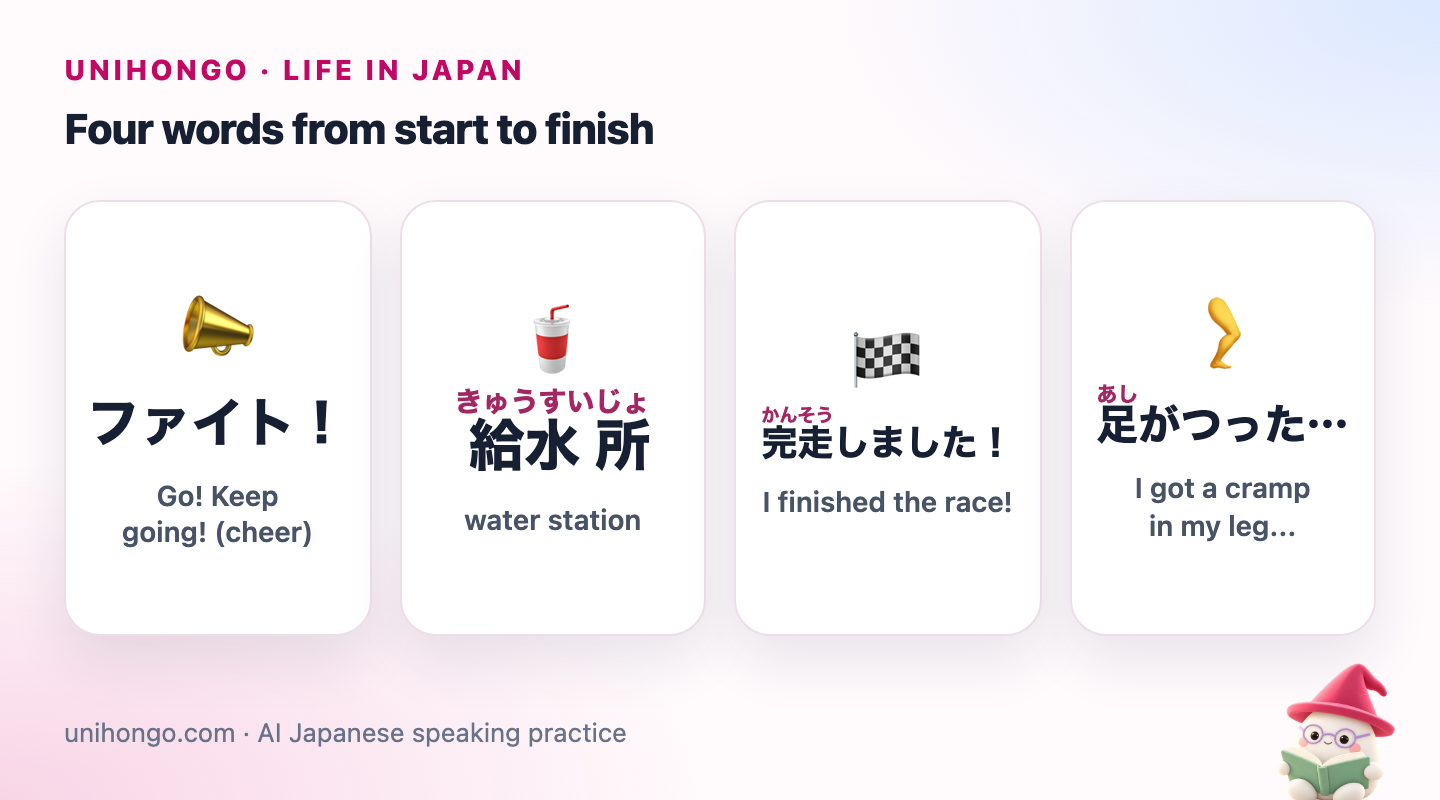
| Japanese | Romaji | Meaning |
|---|---|---|
| ファイト! | Faito! | Go! Keep going! (cheer) |
| 給水所 | kyūsuijo | water station |
| 完走しました! | Kansō shimashita! | I finished the race! |
| 足がつった… | Ashi ga tsutta... | I got a cramp in my leg... |
| がんばれ! | Ganbare! | Go for it! (cheer) |
Entering and preparing: the words before race day
Most races open entry, entorī, online months ahead. Popular big-city marathons are oversubscribed and use a lottery, chūsen, and you will see results announced as tōsen (won a place) or rakusen (did not win). Before the race you receive or collect your zekken and race guide. Many big races also hold an expo where you pick up your number.
| Japanese | Romaji | Meaning |
|---|---|---|
| マラソンにエントリーしました。 | Marason ni entorī shimashita. | I entered a marathon. |
| 抽選に当たりました! | Chūsen ni atarimashita! | I won a place in the lottery! |
| 今回は落選でした。 | Konkai wa rakusen deshita. | I didn't get a place this time. |
| ゼッケンの受け取りはどこですか。 | Zekken no uketori wa doko desu ka. | Where do I collect my bib? |
| 荷物預かりはどこですか。 | Nimotsu azukari wa doko desu ka. | Where is the bag drop? |
Race-day vocabulary on the course
On the day, these words appear in the race guide, on announcements and in the mouths of volunteers. Kanmon (関門) are cutoff points: if you do not pass them before the set time, you may be stopped. Kyūshoku, normally school lunch, is used at races for food stations, and some runners still find that funny.
| Word in romaji | Meaning | Note |
|---|---|---|
| sutāto burokku | Start corral | Assigned by expected finish time |
| gōhō | Starting gun | Literally signal gun |
| kyūsuijo | Water station | Volunteers hand out water and sports drinks |
| kyūshoku | Food station | Bananas, sweets and local food at some races |
| kanmon | Cutoff point | Pass before the time limit or stop |
| seigen jikan | Time limit | Check it before entering |
| gōru | Finish line | From English goal |
Spectators sometimes set up their own small aid stations with sweets or drinks, called shisetsu eido (private aid). Whether you take from them is up to you; a thank you, arigatō gozaimasu, is always welcome.
The crowd: cheers and how to respond
Japanese roadside support is famous among runners: people line the course with clappers, bells and home-made banners, and call out to strangers. They may shout your name if it is on your bib, or read your country from your shirt. You do not have to answer every cheer. A smile, a nod, a wave or a quick arigatō is perfect.
| Japanese | Romaji | Meaning |
|---|---|---|
| ファイト、いっぱーつ! | Faito, ippātsu! | Come on, one more push! |
| あと少し! | Ato sukoshi! | Almost there! |
| ナイスラン! | Naisu ran! | Nice run! |
| いいペース! | Ii pēsu! | Good pace! |
| ありがとう! | Arigatō! | Thanks! |
Faito, ippatsu is a well-known catchphrase from a long-running energy drink advert. The crowd uses it with a smile; it adds a little humour to the cheer.
Small talk at the start line
Standing in the start corral for twenty minutes is the easiest time to chat. Runners around you are nervous and friendly, and the obvious topics are goals, training and whether this is your first race. Japanese runners often talk about times using sabu (sub): sabu fō is under four hours, sabu surī under three.
| Japanese | Romaji | Meaning |
|---|---|---|
| 今日は何回目ですか。 | Kyō wa nankaime desu ka. | How many times have you run this? |
| フルマラソンは初めてです。 | Furu marason wa hajimete desu. | This is my first full marathon. |
| 目標タイムはありますか。 | Mokuhyō taimu wa arimasu ka. | Do you have a target time? |
| サブフォーが目標です。 | Sabu fō ga mokuhyō desu. | My goal is under four hours. |
| 暑くなりそうですね。 | Atsuku narisō desu ne. | Looks like it'll get hot. |
| お互いがんばりましょう! | Otagai ganbarimashō! | Good luck to us both! |
Scenario: after the finish line
You have just crossed the line. Volunteers hang a medal around your neck and hand you a towel. In the recovery area you meet the runner you chatted with at the start. Both of you are exhausted and happy, and the conversation that follows is pure small talk: times, the hard part, and food.

| Japanese | Romaji | Meaning |
|---|---|---|
| ランナー:お疲れさまでした!タイムはどうでしたか。 | Rannā: Otsukaresama deshita! Taimu wa dō deshita ka. | Runner: Well done! How was your time? |
| あなた:4時間10分でした。 | Anata: Yo-jikan juppun deshita. | You: Four hours ten minutes. |
| あなた:30キロから足がつって、少し歩きました。 | Anata: Sanjikkiro kara ashi ga tsutte, sukoshi arukimashita. | You: I cramped from 30 km and walked a bit. |
| ランナー:でも完走、すごいですよ! | Rannā: Demo kansō, sugoi desu yo! | Runner: But you finished, that's great! |
| あなた:沿道の応援に助けられました。 | Anata: Endō no ōen ni tasukeraremashita. | You: The roadside cheering really helped me. |
| ランナー:自己ベストでした! | Rannā: Jiko besuto deshita! | Runner: It was my personal best! |
Endō no ōen, the support along the road, is something almost every runner in Japan mentions. Ōen ni tasukeraremashita, I was helped by the cheering, uses the passive and sounds natural and grateful.
Training, running clubs and everyday running talk
Between races, running is a natural topic with coworkers and neighbours. Many Japanese runners keep track of their monthly distance, gessō (月走), and will ask how much you run. Running clubs, ranningu kurabu, and informal groups meet in parks and along rivers, and many welcome newcomers. In Tokyo, the loop around the Imperial Palace is famous among runners, and in other cities riverside paths play the same role.
Weather is a big part of running talk. Summers are hot and humid, so many people run early in the morning or at night, and races are mostly held in the cooler months. Talking about the heat, the rain or the wind is an easy way to begin a conversation with another runner you meet on the path.
| Japanese | Romaji | Meaning |
|---|---|---|
| 毎朝、川沿いを走っています。 | Maiasa, kawazoi o hashitte imasu. | I run along the river every morning. |
| 月にどのくらい走りますか。 | Tsuki ni dono kurai hashirimasu ka. | How much do you run a month? |
| 月に百キロくらいです。 | Tsuki ni hyakkiro kurai desu. | About a hundred kilometres a month. |
| ランニングクラブに入りたいです。 | Ranningu kurabu ni hairitai desu. | I'd like to join a running club. |
| 今度、一緒に走りませんか。 | Kondo, issho ni hashirimasen ka. | Would you like to run together sometime? |
| 夏は暑くて、夜に走っています。 | Natsu wa atsukute, yoru ni hashitte imasu. | Summer is hot, so I run at night. |
Runners also talk about the wall. Sanjikkiro no kabe, the 30-kilometre wall, is the well-known point in a marathon where many runners slow down sharply, and saying you hit it, kabe ni butsukatta, will get knowing nods from anyone who has run a full marathon.
Common mistakes
- Saying owarimashita for finishing a race. It means it ended; kansō shimashita means you completed the distance.
- Using ganbatte kudasai to a runner going past. It is not wrong, but it is long; ganbare or faito fits the moment.
- Reading times digit by digit. Say yo-jikan juppun, not four ten.
- Saying kiromētoru in full. In everyday talk runners just say kiro: sanjikkiro, thirty kilometres.