
Peace and kindness in four names
These names show the two halves of the theme: peace and harmony with others, and the gentle character that makes it possible. Two are girls' names and two are boys' names.
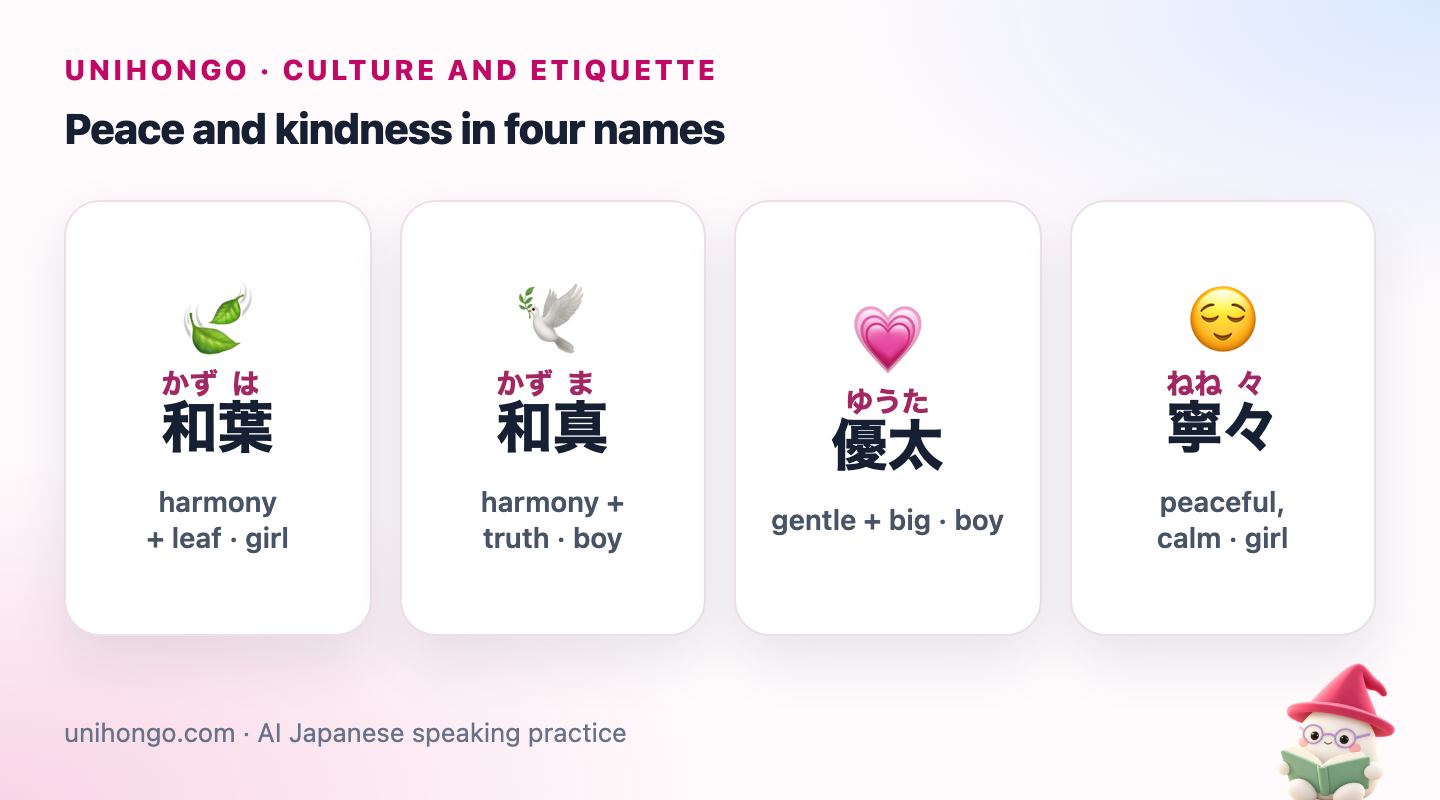
| Japanese | Romaji | Meaning |
|---|---|---|
| 和葉 | Kazuha | harmony + leaf · girl |
| 和真 | Kazuma | harmony + truth · boy |
| 優太 | Yūta | gentle + big · boy |
| 寧々 | Nene | peaceful, calm · girl |
寧 means peaceful and settled, as in 丁寧 (polite, careful) and 安寧 (peace and order). The mark 々 repeats the kanji before it, so 寧々 is read ne-ne. Yūta written 優太 sounds exactly like 勇太, brave plus big: the sound is the same, but one name wishes for gentleness and the other for courage.
和: peace, harmony and a very old idea
和 is one of the most loved kanji in Japanese names. In everyday words it means peace and harmony, as in 平和 (heiwa, peace) and 調和 (chōwa, balance), and it also means Japanese, as in 和食 and 和服. In names it is read kazu, wa, and sometimes nodoka or yawara, and it combines easily with almost any second kanji.
Harmony has a long history as an ideal in Japan. A famous line from the Seventeen-Article Constitution, traditionally attributed to Prince Shōtoku in the seventh century, begins with it, and many Japanese people learn it at school. The current era name, 令和 (Reiwa), also contains 和; the government explained it in English as beautiful harmony.
| Japanese | Romaji | Meaning |
|---|---|---|
| 和を以て貴しと為す。 | Wa o motte tōtoshi to nasu. | Harmony is to be valued above all. |
| 和奏 | Wakana | harmony + playing music · girl |
| 和人 | Kazuto | harmony + person · boy |
| 和希 | Kazuki | harmony + hope · boy |
和奏 is a lovely example of how kanji work together: 和 is harmony and 奏 is to play music, so the name suggests instruments playing in harmony. Kazuki and Kazuto are also written with 一 (one) or 和 depending on the family, so the same sound may or may not carry the peace meaning.
Calm, quiet, safe and steady
Besides 和, several kanji describe peace from a slightly different angle. They are worth telling apart if you are choosing a name, because the image changes.
| Japanese | Romaji | Meaning |
|---|---|---|
| 静香 | Shizuka | quiet + fragrance · girl |
| 安奈 | Anna | safe, at ease + a soft ending · girl |
| 泰生 | Taisei | steady, calm + life · boy |
| 康平 | Kōhei | healthy + peaceful · boy |
| Kanji | Image | Everyday word | Name example |
|---|---|---|---|
| 寧 | Settled, peaceful | 安寧 annei, peace and order | 寧々 Nene |
| 静 | Quiet, still | 静か shizuka, quiet | 静香 Shizuka |
| 安 | Safe, at ease | 安心 anshin, relief | 安奈 Anna |
| 泰 | Steady, calm, large | 泰然 taizen, composed | 泰生 Taisei |
| 平 | Flat, level, peaceful | 平和 heiwa, peace | 康平 Kōhei |
Anna shows a trend in recent naming: names that work in Japanese and also sound familiar in other languages. 康平 joins 康 (health, as in 健康) and 平 (peace), two very traditional wishes. 泰 describes calm that cannot be shaken, so 泰生 suggests a steady, unhurried life.
Gentle, generous, warm: the kindness kanji
Kindness in Japanese names comes mainly from three kanji. 優 is the most common, but it has a second meaning that surprises learners: as well as gentle, as in 優しい (yasashii), it means excellent, as in 優勝 (yūshō, winning a championship) and 優秀 (yūshū, outstanding). A name with 優 can therefore wish for a child who is both kind and capable.
寛 means generous and tolerant, someone with a wide heart; 寛大 (kandai) is the everyday word. 篤 means warm-hearted, sincere and devoted, as in 篤実 (tokujitsu), sincere and honest.
| Japanese | Romaji | Meaning |
|---|---|---|
| 優奈 | Yūna | gentle + a soft ending · girl |
| 寛 | Hiroshi | generous, open-hearted · boy |
| 篤 | Atsushi | warm-hearted, sincere · boy |
| 寛太 | Kanta | generous + big · boy |
Hiroshi and Atsushi as single-kanji names were very common for boys of earlier generations, and they now sound classic. Many other spellings exist: Hiroshi is often 博 or 浩, and only 寛 carries the meaning of generosity.
Words for a kind, peaceful person
When people talk about why they chose a name like these, or describe someone who matches it, these words come up. They are useful in everyday conversation, from describing a colleague to recommending a teacher.
| Japanese | Romaji | Meaning |
|---|---|---|
| 優しい | yasashii | kind, gentle |
| 穏やか | odayaka | calm, mild-mannered |
| 思いやりがある | omoiyari ga aru | considerate, thinks of others |
| 面倒見がいい | mendōmi ga ii | good at looking after people |
| 人当たりがいい | hitoatari ga ii | pleasant to deal with |
| お人好し | ohitoyoshi | too nice, easily taken advantage of |
Be careful with ohitoyoshi. It sounds like a good person, but it usually means someone so kind that others take advantage, and it often carries a little pity or teasing. If you want to praise someone, omoiyari ga aru or yasashii is safer.
Mini dialogue: a new baby's name in the park
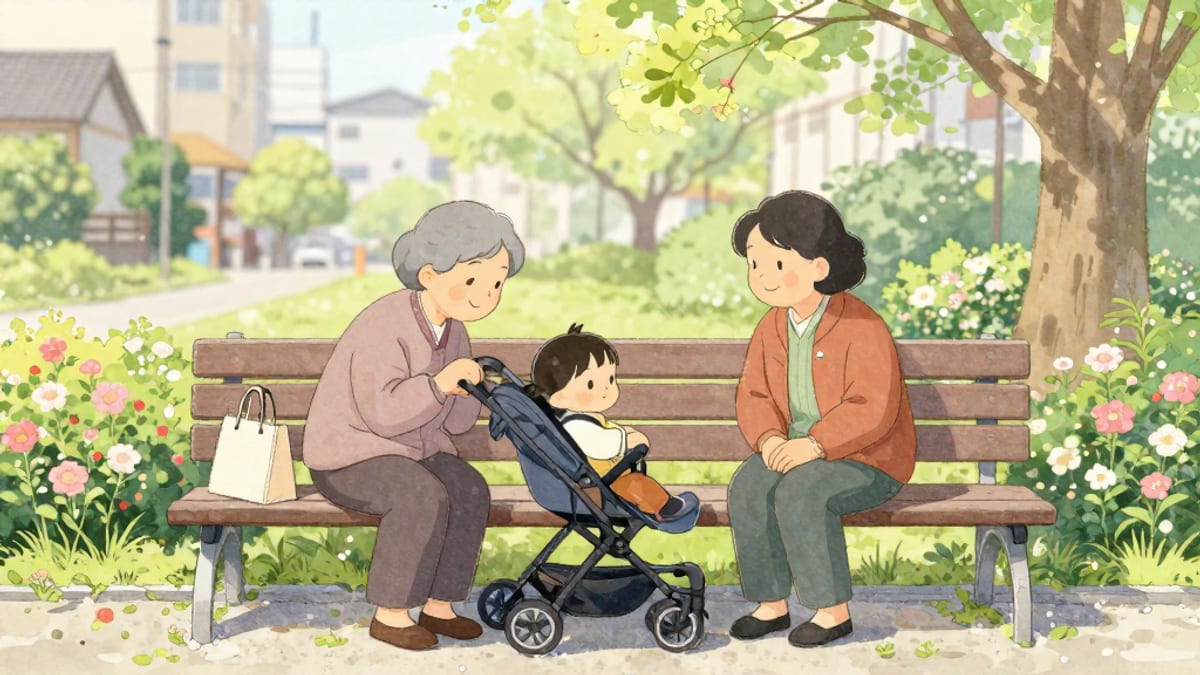
Your elderly neighbour is in the park with her new granddaughter in a pram. You have spoken a few times before, so you use polite Japanese, and she answers warmly.
| Japanese | Romaji | Meaning |
|---|---|---|
| かわいいですね。お名前は? | Kawaii desu ne. Onamae wa? | You: She's adorable. What's her name? |
| 和葉です。平和の和に、葉っぱの葉。 | Kazuha desu. Heiwa no wa ni, happa no ha. | Neighbour: Kazuha. Wa as in peace, ha as in leaf. |
| 素敵ですね。どんな意味ですか。 | Suteki desu ne. Donna imi desu ka. | You: Lovely. What does it mean? |
| みんなと仲良くできる子に、って。 | Minna to nakayoku dekiru ko ni, tte. | Neighbour: So she'll get along with everyone, they said. |
| 優しい子になりそうですね。 | Yasashii ko ni narisō desu ne. | You: She looks like she'll be a gentle child. |
The tte at the end of the neighbour's line reports what the parents said: the grandmother is passing on their wish. Adding sō to narimasu, as in narisō desu, means looks likely to become, a soft, natural way to say something kind about a baby's future.
Choosing a gentle name for a child or a character
Families who choose a peace or kindness name usually think about three things at once: the meaning of each kanji, the sound of the whole name with the surname, and how the kanji look written together. A name like 和葉 is easy to read and easy to explain, which many parents value, while a rarer reading may need explaining at every new school or job. Some families also check the stroke counts of the full name, a custom of name fortune-telling that matters a great deal to some people and not at all to others.
For a story character, a gentle name sends a clear signal. A calm, kind helper called Nene or Kōhei feels believable at once, and a villain with a peaceful name can create a nice contrast, as long as you choose it on purpose.
| Japanese | Romaji | Meaning |
|---|---|---|
| 呼びやすい名前がいいね。 | Yobiyasui namae ga ii ne. | A name that's easy to call out would be nice. |
| 苗字との響きも大事です。 | Myōji to no hibiki mo daiji desu. | How it sounds with the surname matters too. |
| 画数も調べました。 | Kakusū mo shirabemashita. | We checked the stroke count too. |
Put these names into your plan with Mocchi
- Tell Mocchi what you want: /adjust-plan add a week of family conversations, starting with talking about names. Mocchi folds small tasks into your existing plan and ticks them off as you finish them.
- Ask Mocchi to explain the difference between 優しい, 穏やか and お人好し with one example each, and to quiz you on them a few days later. It remembers which word you used wrongly.
- For the speaking step, choose Hana-sensei in AI Sensei and ask the Sensei to play a grandmother showing you her new grandchild. Ask about the name, the kanji and the wish behind it, then read the session report.
What learners often get wrong
- Thinking 優 only means gentle. It also means excellent, so names with 優 can wish for kindness and ability at the same time.
- Assuming every Kazuki, Kazuto or Kazuha is a peace name. Kazu is also written 一 (one), 千 (thousand) or 数, so ask about the kanji.
- Calling someone ohitoyoshi as a compliment. It suggests they are easy to take advantage of.
- Translating 和 in a name as Japan. Parents mean harmony; the Japanese flavour is a bonus.
- Making a pun with a name that is also an adjective, like Shizuka. People with these names have heard every joke already.